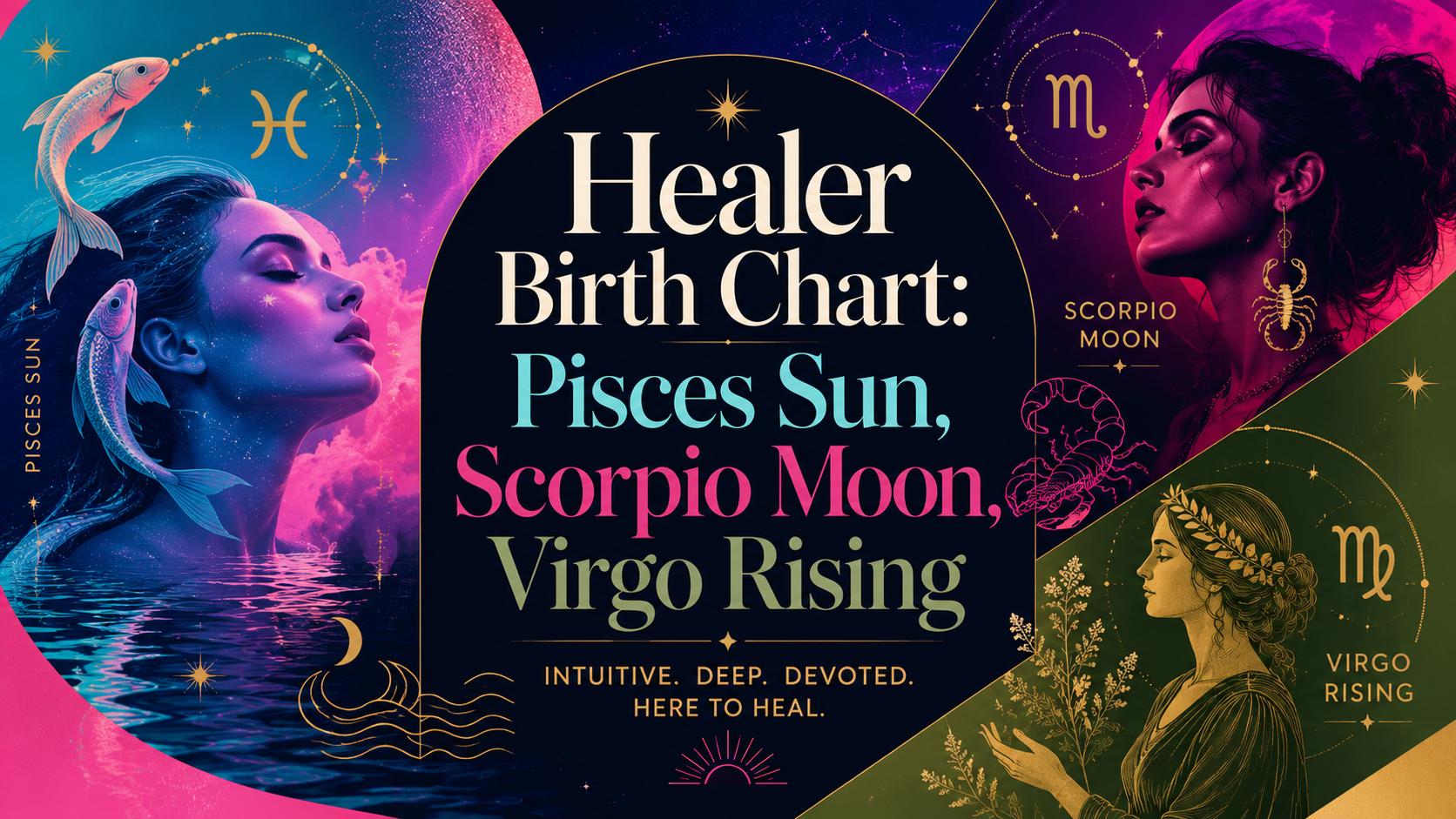
Written in the Stars: The Healer — Pisces Sun, Scorpio Moon, Virgo Rising
Every reading in this series so far came with an asterisk — a noon chart, no houses, no rising sign. This time the asterisk comes off. An anonymous reader shared her exact birth time, and the sky repaid her: a Moon fused to Pluto at twelve minutes of arc, a Pluto sextile the Ascendant exact to a single minute, both angles ruled by one intuitive Mercury, and a chart that names its purpose in every house it owns. This is what a full reading looks like.
Every reading in this series so far has come with an asterisk. Meghan Markle, Tyler Henry, Travis Kelce — all of them read from noon charts, with the houses and rising sign politely set aside, and each post ending with the same honest confession: a verified birth time would sharpen everything. Today the asterisk comes off. The chart below belongs not to a celebrity but to a reader — a woman who shared her data for publication, identifying details withheld — and her birth time is exact: 6:15 in the evening, on the twelfth of March, 1993, in a South Jersey town about fifteen minutes from Philadelphia. Since anonymous charts can't be named for their owners, we'll name each one in this new strand of the series for its archetype — the figure the sky itself keeps drawing. By the end of this reading, you'll see why this one could only be called The Healer. For the first time in this series, we have the whole sky: every house, both angles, the entire architecture. This is what the asterisk was hiding.
And the timing of that birth turns out to be the first interpretation. At 6:15 PM on that date, at that latitude, the Sun had slipped below the western horizon minutes earlier — she was born at sundown, with the Sun sitting almost exactly on the Descendant, the setting-point of the chart. In traditional astrology, a birth after sunset makes this a night chart, and in a night chart the Sun hands its lantern to the Moon: the Moon becomes the luminary in charge, the light the whole life reads by. Hold that thought, because this chart's Moon is not a gentle lamp. It is fused to Pluto — the underworld itself, at home in its own sign of Scorpio — at 0°12′ of orb, essentially exact. And the two tightest aspects in the entire chart, tighter than anything we've seen in this series, are that Moon and that Pluto sextiling the Ascendant at 0°11′ and 0°01′ — one single minute of arc. The deepest point in the chart is wired directly into the face it shows the world, to a precision that borders on unsettling.
One more piece of scene-setting, because the sky insists on it: within a day of her first breath, the Storm of the Century— the great March 1993 superstorm — came roaring up the Eastern Seaboard and buried her home state in snow. She was born, quite literally, on the eve of the storm. Given what the chart says about depth, pressure, and weathering things, it is hard not to smile at the timing.
A note on method, inverted this time: because the birth time is exact, we are using everything — signs, degrees, aspects, and the twelve houses (Placidus), which answer the question the noon charts never could: where in life each planet does its work. If signs are the how and planets the what, houses are the where — career or home, love or health, the public stage or the private room. Structurally, three things leap out before we touch a single placement: five of eleven placements sit in water — the chart is more than half feeling; the Moon and Mars sit in traditional mutual reception, each in the other's sign, trading keys the way this series' charts keep doing; and both angles — the Virgo Ascendant andthe Gemini Midheaven — are ruled by the same planet, Mercury, making this a rare double-Mercury chart: the persona and the career both report to one planet. We'll meet that planet shortly, and it is not where you'd expect.
Let's begin — for once — not with the Sun, but where an exact birth time lets us begin: at the Ascendant.
The Virgo Ascendant and the Double-Mercury Chart
The Ascendant — the sign rising on the eastern horizon at the moment of birth — is the chart's front door: the instinctive persona, the first impression, the way life is met. Hers rises at 25°26′ of Virgo: precise, observant, helpful, self-contained. Virgo rising people tend to present as composed and useful — the one who notices what's needed and quietly handles it, the friend with the plan and the well-stocked bag, the colleague whose competence is so consistent it becomes invisible. There is a modesty built into this Ascendant, sometimes to a fault: Virgo rising would rather be correct than be seen, and often deflects attention toward the work.
But the Ascendant is only the door; the chart ruler tells you who answers it. Virgo is ruled by Mercury — and here the chart makes its first structural statement, because the Midheaven, the career-point at the top of the chart, sits at 24°46′ of Gemini, also ruled by Mercury. Both angles of this chart — the self-point and the world-point, the mask and the mission — funnel through a single planet. Whatever Mercury is doing in this chart, the whole outer life is doing.
So find Mercury: it sits at 14°54′ of Pisces, retrograde, in the Sixth House — and every word of that sentence matters. Pisces is the sign of Mercury's classical detriment and fall, which textbooks read as weakness and lived charts read as difference: this is not the linear, list-making mind Virgo rising advertises on the door. It is an intuitive, associative, porous mind — one that absorbs rather than sorts, that knows things before it can show its work, that thinks in images and undercurrents. Retrograde turns that mind inward: the deep processor, the one who replays conversations, who drafts and redrafts, whose best thinking happens after the meeting, in the quiet. And the Sixth House placement — the house of work, service, health, and daily craft — aims all of it at being useful: this is a mind built for care work, for reading what a person or a body or a room actually needs beneath what it says.
Put the architecture together and you get the chart's first portrait: a Virgo mask of order and competence, run from behind the scenes by a Pisces intuition that operates on feel. She likely presents as the organized one and operates as the psychic one — the practical exterior over the intuitive engine. And because both angles answer to this Mercury, the implication runs deep: the life's outer work, whatever form it takes, will always come back to perception, communication, and care — the noticing mind, in service.
One more resident of the First House deserves mention: Jupiter, retrograde in Libra, sits just inside the Ascendant. Jupiter rising is one of astrology's kindest placements — grace, buoyancy, a benefic standing at the front door, inclining others to trust and like her on sight. In Libra it reads as fairness and charm; retrograde, the luck works from the inside: resilience, a self-righting quality, protection that shows up as inner buoyancy rather than outer showiness. It softens everything the heavier parts of this chart are about to say.
The Sun in Pisces in the Sixth, Setting on the Descendant
The Sun — identity, vitality, the life's central project — sits at 22°23′ of Pisces in the Sixth House, freshly set, three degrees from the Descendant. Three statements in one placement.
First, the sign. A Pisces Sun is the empath's Sun: permeable, imaginative, compassionate to the point of self-forgetting, tuned to the feelings in a room the way other signs are tuned to the facts in it. Pisces runs on meaning and mercy; it struggles with rigid systems and thrives wherever care, creativity, or spirit are the actual product.
Second, the house — and here the chart repeats itself on purpose. The Sixth is the house of work, health, service, and daily practice, and her Sun and her chart-ruling Mercury both live there. When a chart doubles down like this, the reading writes itself: the identity is realized through service. This is the signature of the helper, the healer, the caretaker, the one whose sense of self is inseparable from being of use — teacher, nurse, therapist, counselor, caregiver, advocate; the specific costume varies, but the Sixth-House Pisces Sun always ends up in some version of the helping professions, formally or informally. The shadow is just as legible: the Sixth-House Sun can over-serve — burning its own vitality as fuel for other people's needs — and Pisces, which struggles with boundaries on a good day, makes that the chart's most important health warning. The medicine is built in next door: the Virgo Ascendant's routines, lists, and limits exist precisely to give this Sun a container.
Third, the angle. The Sun stands in opposition to the Ascendant — which is to say, conjunct the Descendant, the partnership point, within about three degrees. She was born as the Sun touched the western horizon: the self, positioned at the meeting-place with the other. Sun-on-the-Descendant people find themselves through relationship — they see their own light most clearly reflected in a partner, a client, a person across the table — and their lives tend to be built around significant one-to-one bonds. Combined with the Sixth-House service theme, the picture sharpens further: identity found in devoted attention to another person. It is a beautiful placement, and a demanding one: the lifework includes learning that the self exists even when no one is currently being helped.
The Sun's aspects are almost entirely soft — a flowing trine to the Moon and Pluto in Scorpio, supportive sextiles to Uranus and Neptune — which matters enormously in a chart this deep: the identity is on good terms with its own intensity. Whatever pressure this chart carries, the core self and the core feelings are allies. Which brings us to the feelings.
Moon Conjunct Pluto in Scorpio in the Third: The Lamp in the Deep
Here is the center of the chart — the placement everything else orbits. The Moon sits at 25°15′ of Scorpio, conjunct Pluto at 25°28′ — an orb of 0°12′, as close to exact as natal aspects get — with Pluto standing in its own sign, at full domicile strength. And remember the sect: born after sundown, this is a night chart, and the Moon is its ruling luminary. The lamp of this life is a Moon fused to the lord of the underworld, in the underworld's own sign.
Let's be precise about what that means, because Moon-Pluto is one of astrology's most formidable signatures and it deserves better than ominous hand-waving. The Moon is the emotional body — needs, instincts, safety, memory. Pluto is depth, extremity, death-and-rebirth, the truth beneath the floorboards. Fused, they produce a person who feels at maximum depth or not at all: no casual emotions, no surface attachments, no "fine, thanks." Moon-Pluto natives read undercurrents the way others read faces — they register the tension in a room before the door finishes opening, they know when someone is lying, they form bonds of totalizing loyalty and expect (silently, fiercely) the same in return. The emotional life runs on transformation: this Moon periodically burns down its own structures and rebuilds, and its keeper tends to emerge from each life-chapter genuinely changed — the phoenix pattern, run on a domestic scale. Classically the Moon is in "fall" in Scorpio, and here the chart performs its now-familiar rescue: the Moon sits in the sign of its conjunction partner — fused to its own modern dispositor, at home — and holds traditional mutual reception with Mars (Moon in Mars's sign of Scorpio, Mars in the Moon's sign of Cancer). The feelings and the drive have traded keys. Emotional courage is native here: this is someone who can act on what she feels, and whose actions are always, underneath, about protecting what she loves.
Now the detail an exact birth time makes possible — the houses and the angles — and it changes everything. This conjunction sits in the Third House: the house of communication, language, siblings, early schooling, and the local, everyday world. A Third-House Moon needs to talk to feel safe; a Third-House Pluto gives words surgical power. Together: the voice as the site of depth. This is someone whose speech, writing, or daily conversation carries unusual weight — the friend whose two-sentence text lands like a verdict, the person others confess things to without meaning to. It can also mark the early environment as intense: Third-House Pluto often correlates with a childhood world — siblings, school, the neighborhood — where deep currents ran under ordinary days, and where she learned early to read what wasn't being said. The North Node in Sagittarius sits in this same house: the destiny-point, in the sign of teaching, meaning, and publishing, in the house of the voice. The path of growth in this life runs through communicating what the depths have taught her — turning the underwater perception into language others can use.
And then the aspect that makes this chart genuinely rare. The Moon sextiles the Ascendant at 0°11′; Pluto sextiles it at 0°01′ — one minute of arc, the tightest aspect this series has ever printed. The deepest structure in the chart is soldered directly to the rising degree: the perception, the intensity, the emotional x-ray — all of it flows straight into the persona, harmoniously, whether she intends it or not. People feel it when she enters a room. The Virgo mask says tidy and helpful; the sextile from the deep says and she sees everything. Most Moon-Pluto people learn to hide the depth. Hers is load-bearing in the face itself.
Every centerpiece has its cost, and this one is named Saturn: from 24°37′ of Aquarius, Saturn squares the Moon at 0°39′ and Pluto at 0°51′ — a double square from the planet of restriction to the chart's emotional core, in fixed signs, nearly exact. Moon square Saturn is the signature of feelings met early with conditions — the learned instinct that emotions are safest managed, rationed, earned; that composure is armor. Squaring this Moon, with Pluto attached, it reads as a gatekeeper installed over an ocean: enormous feeling, and an equally strong internal official deciding what may surface, when, and to whom. Saturn-Pluto in square adds the endurance signature — the capacity to withstand sustained pressure that would flatten others, purchased at the price of rarely letting anyone see the strain. In a young life this square usually feels like loneliness; in a maturing one it becomes the very thing that makes the depth usable — the discipline that turns an overwhelming inner sea into a well with a bucket and a rope. The fixed squares are the hard weather of this chart. They are also, unmistakably, its strength training.
Venus Retrograde in Aries in the Eighth: The Heart, Under Renovation
The love storyline in this chart is vivid enough to deserve its own chapter. Venus — love, desire, worth — sits at 19°58′ of Aries, retrograde, at the end of the Seventh House and therefore read in the Eighth: the house of intimacy, merging, shared resources, and transformation through relationship.
Take the layers in order. Venus retrograde is the rarest of the retrogrades — Venus reverses less than any other planet, so only a small fraction of people carry it natally — and it turns the love-function inward: worth and affection are processed privately, felt more than shown, and relationships tend to be re-examined, re-encountered, re-negotiated. Venus-retrograde natives often report a love life with second acts: the returning person, the relationship that must be done twice to be done right, the late-blooming clarity about what the heart actually wants versus what it was taught to want. There is frequently an early chapter of undervaluing herself in love — accepting less, loving unavailable or unfinished people — followed by a genuine revaluation. The retrograde's gift is that the second draft is almost always truer than the first.
The sign adds heat: Venus in Aries loves directly — quick to spark, courageous, allergic to games, wanting the honest flame rather than the slow negotiation (its classical "detriment" simply means love here refuses to be diplomatic). And the Eighth-House placement adds depth and stakes: this is not a Venus for casual dating. The Eighth House merges — emotionally, physically, financially — and its Venus experiences love as transformation: relationships that change her at the root, intimacy as the place where the real self is finally seen. Combined with the Scorpio Moon-Pluto, the romantic signature is coherent and intense: all-in or not at all, with a strong preference for all-in.
The aspects tell the plot. Venus squares the Uranus-Neptune conjunction (1°24′ and 0°43′) — the disruptor and the dissolver, both challenging the heart. Venus-Uranus squares bring the sudden: instant attractions, abrupt endings, love that arrives and departs like weather, and a lifelong tension between closeness and freedom. Venus-Neptune squares bring the veil: idealization, the beloved seen in soft focus, the disappointment when the fantasy develops ordinary human edges — and, at its best, a capacity for genuinely transcendent, compassionate love once the projector is switched off. Early relationships under these squares tend to be educational in the expensive sense. But the chart writes a corrective into the same paragraph: Venus sextile Saturn (4°38′) — the stabilizer. With time, the same Saturn that gates the Moon steadiesthe Venus: love matures, chooses better, builds. This is a heart whose story genuinely improves with age — the retrograde revaluation, the Saturn ballast, the Eighth-House depth finally met by someone who can hold it. The chart practically promises the second act is better than the first.
Mars in Cancer in the Tenth: The Protector at the Top of the Chart
Mars — drive, effort, the fight — sits at 12°16′ of Cancer in the Tenth House, the house of career, reputation, and the public role. Mars in Cancer is the series' returning guest (Meghan Markle carries it too): the tender warrior, the fighter whose battles are always, underneath, about protection — family, the vulnerable, the inner circle. Its anger is tidal rather than explosive; its courage is fiercest on someone else's behalf. Classically in its fall, this Mars is rescued the same way the Moon was: the mutual reception — Mars in the Moon's sign, Moon in Mars's — means the drive and the feelings run each other's households. She fights because she feels; she feels safely because she can fight.
The Tenth-House placement aims all of it at the career: the protector, installed at the very top of the chart, visible to everyone. Mars in the Tenth works — ambitiously, tirelessly, and usually in roles with a defensive or caretaking edge: advocacy, healthcare, teaching, management of people who need managing for their own good, any profession where effort visibly shields someone. Note how the whole vocational architecture now locks together: a Gemini Midheaven ruled by a caring Pisces Mercury in the Sixth; a Sixth-House Sun of service; and a protective Cancer Mars actually standing in the Tenth. Three separate systems, one job description. Whatever her business card says, the work is care, and the chart has been unanimous about it from every angle.
One aspect needs honest handling: Mars square Jupiter, at 0°18′ — the second-tightest planetary aspect in the chart.Mars-Jupiter squares do everything at 120 percent: more effort, more commitments, more causes, the yes said before the calendar is consulted. In a Tenth-House Mars, it reads as professional overextension — the one who takes the extra shift, absorbs the extra case, carries the extra colleague — powered by a genuinely enormous engine and endangered only by its own generosity. Paired with the Sixth-House Sun's over-serving tendency, this is the chart's clearest practical warning, so let it be said plainly: the drive is not the problem; the dosage is. The same square, disciplined, is the signature of prodigious, principled work capacity — the person who simply outlasts every problem in front of her.
The Fourth House: Uranus Conjunct Neptune, and the Roots in Motion
An exact birth time turns generational weather into personal architecture, and nowhere more than here. Uranus and Neptune sit conjunct at 0°41′ of orb in Capricorn — the great, once-in-171-years conjunction that peaked in 1993, the very year of her birth; she carries it at nearly its exact degree — and in her chart it lands in the Fourth House: home, family, roots, the private foundation of the life.
Read plainly and gently: the house of foundations, occupied by the planet of disruption fused to the planet of dissolution, suggests roots that moved — a childhood home life touched by change, instability, unconventionality, or a certain unreality: the family that relocated or restructured, the parent who was present-but-elusive, the sense (common to Fourth-House Neptune especially) that something in the family story was idealized, unspoken, or slightly out of focus. Fourth-House Uranus adds the electric version: sudden changes of household, an early life where the ground could rearrange itself without notice. The IC — the root-point itself — sits in Sagittarius, sign of distance and belief: a family narrative involving big beliefs, big moves, or meaning-making as the household weather.
Here is what the rest of the chart does with it, and it is genuinely redemptive: this conjunction is supported everywhere — sextile the Sun (1°01′, 1°42′), sextile the Moon (3°53′, 4°34′), trine the Ascendant (4°04′, 4°45′). The unstable foundation did not destabilize the person; it trained her. The shifting ground became the source of her adaptability, her radar for undercurrents, her refusal to take safety for granted — the very sensitivities the Sixth-House Sun and Third-House Moon turned into skill. In the mature chapter of this chart, the Fourth-House conjunction usually inverts: the person who grew up on moving ground becomes the one who builds an unconventional, deeply intentional home of her own — chosen family, redefined roots, a foundation designed rather than inherited. The storm she was born before, weathered into architecture.
Saturn in Aquarius in the Fifth: The Late Permission to Play
One placement remains, and it answers a question the fixed squares raised. Saturn — dignified in its own traditional sign of Aquarius — sits in the Fifth House: joy, creativity, romance, play, children, self-expression. Saturn here takes the fun seriously, which usually means an early life where fun felt earned rather than free: the child who was responsible before she was carefree, for whom self-expression carried performance pressure and play had a curfew. Fifth-House Saturn people often report feeling older than their peers young — and younger than their age later, because this is the placement of joy as a discipline: creativity, romance, and delight arriving properly in the second act, built rather than stumbled into, and therefore durable. (Saturn's quincunx to the Ascendant, 0°50′, repeats the theme sideways: the composed persona and the inner official are in permanent, slightly awkward negotiation about how much lightness is allowed to show.) The instruction hidden in this placement is one of the kindest in the chart: schedule the joy. Treat play as seriously as work, and Saturn — who respects nothing but commitment — will build it to last.
The Synthesis: The Well and the Rope
Read together, the chart resolves into a single coherent portrait, and for once the houses let us say where it lives. The water — five placements deep — is the sea itself: a Pisces Sun of compassion, a Scorpio Moon-Pluto of x-ray feeling, a Cancer Mars of protection, all in mutual conversation by trine, reception, and sect. The Virgo Ascendant and its double-Mercury architecture are the wellhead: the practical, precise, service-shaped structure through which the sea is drawn up in usable buckets. The fixed Saturn squares are the rope's tension — the gatekeeping that made the depth survivable and will, matured, make it deliverable. And the Third-House North Node is the destination: the deep water, spoken. Taught. Written. Shared.
If there is a single sentence this chart keeps writing, it is this: the depth is the gift, and the discipline is the delivery system. A person built to feel everything, born at the moment the Sun handed the sky to a Moon fused with the underworld — and equipped, angle by angle and house by house, with exactly the structures needed to turn that inheritance into care for other people. The noon charts in this series could tell us who someone is. An exact birth time tells us what the life is for. This one, by every measure the houses allow, is for the helping.
She was born at sundown, on the eve of the storm of the century. The chart suggests she has been quietly good in storms ever since.
Frequently Asked Questions
What are the "big three" in this chart?
Pisces Sun, Scorpio Moon, Virgo Rising — and for the first time in this series, all three are confirmed, because the birth time is exact. It is a classic healer's triad: Pisces supplies the compassion, Scorpio the depth and perception, Virgo the practical craft that makes the other two usable. Two water lights behind an earth mask: the empath, presenting as the organized one.
What does Moon conjunct Pluto mean in a birth chart?
Moon-Pluto fuses the emotional body to the planet of depth and transformation: feelings run at maximum intensity, bonds are total, and the native reads undercurrents others miss entirely. At 0°12′ of orb, in Pluto's own sign of Scorpio, this chart carries one of the strongest possible versions. In the Third House, the depth flows into the voice — words that land with unusual weight. The challenge is the near-exact Saturn square: learning to let the depth be seen, not just managed.
Is Venus retrograde in a natal chart bad for love?
No — but it is slow, in the best sense. Venus retrograde (which fewer than one in ten people have) turns love inward: worth and desire get re-examined rather than accepted as taught, and the love life tends toward second acts — revaluations, returns, late-blooming clarity. In this chart, Venus retrograde in Aries in the Eighth House squares Uranus and Neptune (early lessons in sudden and idealized love) but sextiles Saturn: the heart's story genuinely improves with age, and what it builds late, it keeps.
What does Mercury retrograde mean in a birth chart?
Natally, Mercury retrograde is nothing to fear — it describes an inward mind: reflective, thorough, at its best in the second draft. Here it carries extra weight because Mercury rules both the Ascendant and the Midheaven — the persona and the career alike answer to it — and it sits in intuitive Pisces in the Sixth House of service. The whole outer life runs through a mind that perceives by feel and thinks in depth. Slower to speak, and worth the wait.
What careers fit this chart?
The chart is unusually unanimous. A Sixth-House Pisces Sun (identity through service and health), the chart ruler in the Sixth, a protective Cancer Mars in the Tenth (career house), and a Gemini Midheaven of communication together point at the helping and healing professions: healthcare, therapy and counseling, teaching, advocacy, care coordination — any role where perceptive attention to people is the actual job. The Third-House North Node adds a writing, teaching, or speaking dimension that grows over the lifetime.
What's the rarest thing in this chart?
Three candidates. Pluto sextile the Ascendant at 0°01′ — one minute of arc, the tightest aspect this series has published. The Moon-Pluto conjunction at 0°12′ with Pluto at home in Scorpio. And the double-Mercury architecture — both angles ruled by one planet — combined with a natal Venus retrograde, which fewer than ten percent of people carry. It is a chart of exact wiring: the important things in it are not approximate.
What does it mean that the Sun is on the Descendant?
She was born minutes after sunset, placing the Sun on the western angle — the partnership point. Sun-on-the-Descendant natives find and refine their identity through significant others: the self is most visible in devoted one-to-one connection. It also makes this a night chart, which hands rulership of the sky to the Moon — so the Scorpio Moon-Pluto conjunction is not merely an aspect here. It is the chart's governing light.
Why does an exact birth time change a reading this much?
Compare this post to the three before it. Without a birth time, we could read who someone is — signs, degrees, aspects. With one, we can read where the life happens: the houses placed this Sun in service, this Moon in the voice, this Mars in the career, this Uranus-Neptune in the childhood home — and gave us the Ascendant, the Midheaven, and aspects exact to the minute of arc. The noon charts were portraits. This is a map.
Whose chart is this?
A reader's — a woman born in March 1993 who generously allowed her data to be published anonymously, with identifying details withheld. Which means one more thing worth saying: the next chart in this series could be yours.
Your Chart Is Waiting
For three posts, this series has ended the same way: imagine what a full reading could reveal. Now you've seen one. Exact angles, real houses, aspects to the minute — the whole architecture of a sky, walked through line by line. Your chart holds the same precision, waiting for a birth time and an hour of attention.
Book your personal chart reading — and find out what was written in your stars.