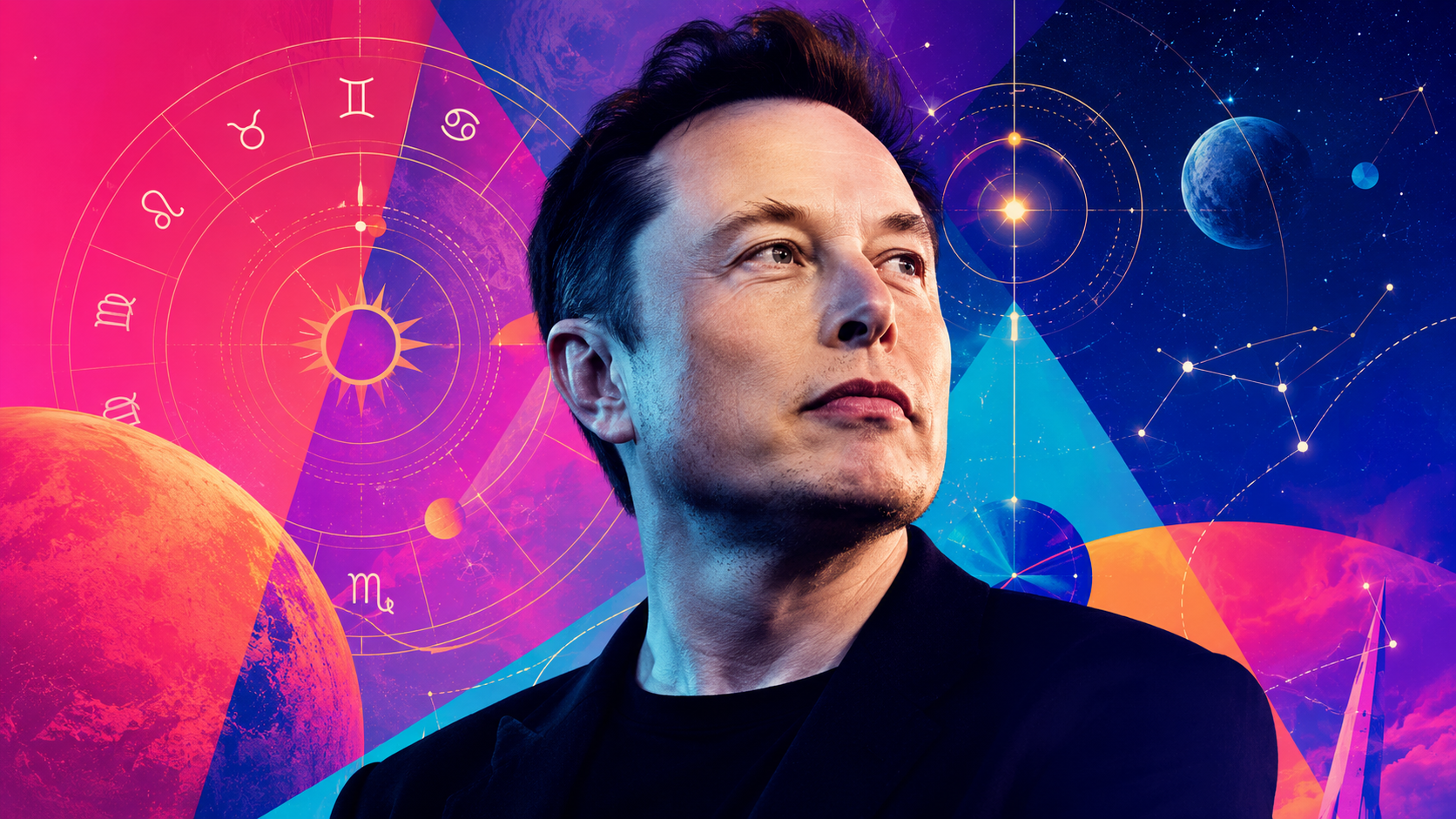
Written in the Stars: The Birth Chart of Elon Musk, the Visionary Engineer
Some birth charts contain a career — Elon Musk's contains an argument, written at twenty minutes of arc: Saturn, the planet of deadlines, locked in near-exact opposition to Neptune, the planet of dreams, which also happens to be the only fire in his entire sky, standing at the zero degree of the frontier sign. Add a Cancer Sun on a species-scale protection mission, a wealth engine running at half a degree from exact, and a chart where every planet reports to the loop between mind and mood, and you get astrology's cleanest diagram of the visionary-engineer. A deep-dive reading of the self-made sky with no thrones, no exiles — and one far-off flame.
Some birth charts contain a career. Elon Musk's contains an argument — the oldest one in engineering, between the dream and the deadline — and it is written into his sky at a precision that borders on theatrical: Saturn opposite Neptune, at 0°20′ of orb. Twenty minutes of arc. The planet of hard limits, schedules, and structural reality, staring directly across the wheel at the planet of visions, illusions, and the impossible — essentially exact, the tightest aspect in the chart. Born on June 28, 1971, in Pretoria, South Africa, the most argued-about industrialist of the modern era carries, as his chart's central feature, a permanent, load-bearing argument — and has spent five decades converting it into rockets, cars, and headlines.
And the chart sharpens the joke further. Run the element count: five placements in air, three in water, two in earth — and exactly one in fire: Neptune itself, retrograde, at the zero degree of Sagittarius, the sign of the far frontier. Sit with that. The only flame in this entire chart — all of its passion, its heat, its burning — is the dream planet, freshly arrived in the sign of long journeys and distant horizons, turned inward, and opposed to the minute by Saturn. The singleton fire of Elon Musk's chart is, literally, a vision of somewhere very far away — and the engineer stands eternally opposite it, demanding it be built. It would be difficult to write a cleaner astrological caption for a man whose stated life's work is making a distant planet reachable, on a schedule, with hardware.
The rest of the sky assembles the machine around the argument. Mars sits conjunct the North Node in Aquarius — the drive, fused to a destiny in the sign of technology, electricity, and the collective future (he runs, note, a company named for the man who electrified the world). Jupiter in Scorpio sextiles Pluto at 0°32′ — near exact, the wealth-through-leverage engine, fortune wired to transformation and colossal stakes. The Moon and Mercury sit in mutual reception— Moon in Mercury's Virgo, Mercury in the Moon's Cancer — and here is the structural stunner: trace every rulership chain in the chart, and every planet drains into that loop. The final government of this entire sky is a closed circuit between the mind and the mood. The most consequential poster alive is ruled, astrologically, by the thing he does at 3 a.m.
And one genuine rarity, worth flagging before we start: this chart contains no classical dignities and no debilities whatsoever. No planet enthroned in its own sign, none exalted, none in detriment or fall. Every previous subject in this series carried inherited crowns or handicaps — Sebastian's sovereign Mars, Timothée's exalted one, Meghan's royal Sun. His sky starts everyone at zero: nothing pre-installed, nothing pre-broken, everything to be built from neutral ground. Astrologers would call it undistinguished. The biography suggests a better word: self-made.
A note on method before we begin: because his recorded birth time is set to noon, we're setting aside the houses and the rising sign, and reading the planets purely by sign, degree, and their conversations with one another. As ever, the chart says plenty without them.
Let's begin where all charts begin — with the Sun. And it is not the Sun anyone expects.
The Sun and Mercury in Cancer: The Protector
Ask a room to guess Elon Musk's Sun sign and the votes come back Aquarius, Aries, maybe Capricorn — the technologist, the warrior, the empire-builder. The actual answer is the series' best plot twist since Snooki's Capricorn Moon: he is a Cancer — Sun at 6°04′, with Mercury alongside at 14°27′, both in the zodiac's most protective, family-rooted, emotionally tidal sign. Cancer's portfolio is home, kin, legacy, and defense: the crab builds armor because what's inside is soft, and its deepest instinct — the one all its ferocity serves — is to protect what it considers its own.
Now re-read the mission statements through that lens, because they are Cancer sentences wearing engineering vocabulary. The entire stated rationale for the space program is not conquest or glory — it is life insurance for the species: making humanity multiplanetary so that consciousness survives catastrophe, a backup drive for the family of man. That is a crab's logic, scaled to civilization: identify the vulnerable thing, build it a second shell, somewhere the asteroid can't reach. The electric-car bet was framed the same way — protecting the habitability of the home planet itself. Strip the technical language from either mission and what remains is the oldest Cancer instinct in the book: the home must survive. His homes simply happen to be planetary.
The personal record cooperates. The famously enormous brood of children — Cancer Suns build dynasties, and his is one of the largest in public life. The lifelong preoccupation with legacy and posterity. Even the origin story is a Cancer story told in the hard mode: the homeland left at seventeen, alone, oceans crossed — because Cancer's relationship to home is the axis of its life whether by embrace or by departure, and a Cancer who leaves home young tends to spend the rest of the decades building new homes at ever-larger scales: companies run like clans, factories he literally sleeps in, and eventually, if the budget allows, a spare planet.
But this Cancer core is squared by lightning. Sun square Uranus (3°25′) is the disruptor's signature — identity in permanent friction with establishments, the constitutional inability to leave an industry the way he found it — and Mercury square Uranus (4°58′) wires the same voltage into the voice: the erratic-genius communication style, the sudden reversal, the 3 a.m. pronouncement that moves markets, thought arriving in bolts rather than paragraphs. And with Sun conjunct Mercury (8°23′) fusing identity to mind, there is no gap between the man and the stream of consciousness: he thinks as himself, out loud, in public, and the Uranus squares guarantee the thinking is never, ever boring. The protector's heart, wired to a tesla coil.
The Moon in Virgo and the Reception: The Mind-Mood Machine
The emotional core sits at 10°29′ of Virgo — the analyst's Moon: regulated by work, soothed by problem-solving, safest when improving something. A Virgo Moon processes feeling through fixing — anxiety converts to checklists, distress to diagnostics — and its native habitat is the production line at 2 a.m. The biography's most Virgo-Moon chapters are famous: the "production hell" years sleeping on the Fremont factory floor, the conviction that the assembly line itself was the product, the micrometer attention to manufacturing detail that executives found punishing and the Moon found calming. Where other billionaires decompress on yachts, this Moon decompresses by walking the line and finding the bottleneck. That is not workaholism, astrologically. That is emotional regulation.
And here the chart plays its structural masterstroke. The Moon sits in Virgo — Mercury's sign — while Mercury sits in Cancer — the Moon's sign: mutual reception, the series' favorite key-exchange, this time between the mind and the mood. Thinking and feeling run each other's households: the emotions are processed as analysis, and the analysis is powered by emotion — the engineer who cries in interviews about rockets, the technical decisions made with tidal conviction, the feelings that arrive as engineering opinions and the engineering opinions that arrive as feelings.
Then trace the chains of command, because this is the chart's deepest architecture: the Sun answers to the Moon; Venus, Saturn, and Pluto answer to Mercury; Mars answers to Saturn answers to Mercury; Jupiter and Neptune route through Mars to the same place — every planet in this sky drains, by every path, into the Moon-Mercury loop. The final government of the entire chart is the closed circuit between mind and mood. Which makes one late-career acquisition look less like a business decision and more like a homecoming: of all the things the world's richest man could have bought, he bought the global conversation — a machine whose entire function is the minute-by-minute coupling of thought and feeling, at planetary scale. The chart's government purchased its own capital city. Moon sextile Mercury (3°58′) and Sun sextile Moon (4°25′) keep the circuit humming smoothly — for better and, as any observer of the feed knows, occasionally otherwise.
Saturn Opposite Neptune at 0°20′: The Dream and the Deadline
Now the thesis. Saturn at 1°09′ of Gemini. Neptune at 0°49′ of Sagittarius. Opposition, 0°20′ of orb — as exact as this series has ever printed for two heavyweight planets, and the cleanest possible diagram of the life it presides over.
Read the two ends. Neptune — the dream, the vision, the impossible — stands at the zero degree of Sagittarius: the far frontier, the long journey, the horizon itself, freshly entered, retrograde (the vision turned inward, consulted privately, held for decades). And it is the chart's singleton fire — the only flame in the sky, meaning all of this chart's passion, its burning, its why, funnels through this one placement: a dream of the very far away. Opposite it, to a third of a degree, stands Saturn in Gemini — reality, limits, and deadlines, in the sign of information, machinery, and moving parts: the engineer's Saturn, the planet of "prove it" wearing the sign of "show me the schematics."
An opposition is a permanent negotiation, and his life is the negotiation industrialized. Every venture is the same aspect wearing different hardware: the Mars dream (Neptune at 0° Sagittarius, almost embarrassingly literal — the frontier vision) versus the launch manifest (Saturn); the vision of a sustainable-energy civilization versus the production ramp; the promise versus the delivery date. The famous phenomenon insiders call "Elon time" — the timeline announced by Neptune and honored, eventually, by Saturn — is this opposition operating as a management style. So is the signature achievement no one thought buildable: rockets that land themselves to be flown again, which is precisely a Neptune image (the impossible, the science fiction) forced through Saturn's door (metallurgy, software, iteration, and a thousand failed landings on drone ships). The dream did not defeat the deadline, nor the reverse. They remain locked at 0°20′, and the tension between them is the product line.
The aspect also explains, honestly and neutrally, the thing every observer notices: no living figure divides belief so cleanly. Saturn-Neptune oppositions polarize by nature — one camp sees the vision, the other sees the vapor, and both are watching the same man — because the chart itself holds both poles at full strength, permanently. The believers and the skeptics are each reading one end of an exact opposition. The chart's position is that he is both ends, and always has been.
Jupiter complicates the axis gorgeously: Jupiter conjunct Neptune (3°11′, across the Scorpio-Sagittarius border)inflates the dream with fortune — belief itself becomes an asset class, which is as good a one-line explanation as astrology offers for companies valued on vision years ahead of the income statements — while Jupiter opposite Saturn (3°31′, out of sign) re-runs the boom-versus-discipline negotiation on the financial ledger. The expansion is always arguing with the structure. The structure keeps, remarkably, winning just often enough.
Mars Conjunct the North Node in Aquarius: Destiny, Electrified
If Saturn-Neptune is the argument, this is the assignment. Mars at 20°56′ of Aquarius, conjunct the North Node at 15°07′ (5°49′) — the planet of drive, fused to the point of destiny, in the sign of technology, electricity, the future, and humanity considered as a whole. A Mars-Node conjunction aims the entire life force down the path of fate: the effort and the destiny are the same vector, and in Aquarius the vector points at exactly what the résumé shows — the collective's technological future, pursued as a personal workload. It is worth repeating the on-the-nose detail: the man's flagship consumer company is named for Nikola Tesla, the patron engineer of Aquarius's own element. The chart put the drive on the electric line; he incorporated it.
The supporting aspects tune the engine. Mars square Jupiter (6°42′) is the overreach circuit — the series has met it in Travis Kelce and the anonymous Healer — everything at 120 percent, five companies where one would exhaust anyone else, the appetite that treats "impossible workload" as a provocation. Uranus trine the Node (5°38′) puts disruption itself in service of the destiny: the rule-breaking is not incidental to the path; it is the vehicle. And Venus trine Mars (1°19′), the chart's third-tightest aspect, wires the charm to the drive across the air signs — which in this particular chart expresses less as romance than as the thing the internet knows best: the play in the work. The memes, the product names that are jokes, the flamethrower sold as a gag, the wit deployed as both marketing department and defense mechanism. Venus in Gemini loves wordplay; Mars in Aquarius loves provocation; the trine between them is, with all astrological seriousness, the shitposting aspect — and it has moved more product than most advertising agencies.
Jupiter in Scorpio Sextile Pluto: The Wealth Engine
Quietly, at 0°32′ of orb — the chart's second-tightest aspect — sits the placement the net-worth trackers should study. Jupiter in Scorpio, retrograde, in the sign of shared resources, other people's money, crisis, and all-or-nothing stakes, in near-exact flowing sextile to Pluto in Virgo — power through systems, transformation through engineering. Jupiter-Pluto contacts are astrology's classic plutocrat signature — fortune that compounds through leverage and metamorphosis rather than salary — and the sextile's ease means the enormous bets keep, improbably, working.
The biography is a Jupiter-in-Scorpio case file: fortune built almost entirely on leverage, equity, and existential wagers — the proceeds of one company perpetually shoved, whole, into the next; the storied 2008 winter when the last dollars were split between a car company and a rocket company that were both weeks from death, the purest all-in Scorpio play in modern business history — and the compounding thereafter into the largest private fortune ever recorded. Jupiter retrograde keeps the luck internal (conviction over consensus; the bet placed against every advisor in the room), and Saturn trine Pluto (4°03′) adds the endurance floor under it all: the capacity to operate for years inside pressure that would flatten institutions, and emerge holding more leverage than before. The wealth was never accumulation. It was transformation, run in a loop, at 0°32′ from exact.
The Self-Made Sky
Step back and count what this chart doesn't have, because the absences are as eloquent as the placements. No planet in domicile. No exaltation. No detriment, no fall. Zero classical dignity anywhere — the only chart in this series with none. Astrology's aristocratic scoring system, which crowned Sebastian's Mars and Timothée's, which humbled Travis's Sun and rescued it by reception, simply has nothing to say here: nobody enthroned, nobody in exile, every planet a commoner. Whatever this chart built, it built without inherited thrones — from neutral ground, in the middle of every sign's ordinary territory, by force of aspect and architecture alone. The receptions, the exact oppositions and sextiles, the nodal fusion — all of it is wiring, not royalty. It is the astrological definition of self-made, and it belongs to the textbook self-made biography: the teenager who landed on another continent with a backpack and a reading list.
The generational placements finish the frame. Pluto in Virgo marks the cohort that transformed the world through systems, precision, and work — the generation that built the digital infrastructure — and his sits at the sign's final degrees, the lesson compressed, sextile his Jupiter into the wealth engine. Uranus in Libra, squaring his Sun and Mercury personally, made the disruption intimate rather than ambient. Neptune sextile Pluto (3°43′) hums beneath as the long generational undercurrent of imagination-as-leverage. And the singleton-fire Neptune, flagged at the top, deserves its closing note: in a chart of five air placements — ideas, information, systems, speech — the only fire is a far-off dream. The passion of this life was never going to be spent on ordinary heat. It was always reserved, all of it, for the horizon.
The Synthesis: The Argument That Builds Rockets
Read together, the chart resolves into the series' most productive contradiction yet. A Cancer core that wants, at species scale, to protect the home. A Virgo Moon that regulates its enormous feelings by fixing machines at 2 a.m. A mind-mood circuit that governs everything and eventually bought itself the global conversation. A drive welded to an electric destiny. A wealth engine that only knows how to bet everything. And over it all, the exact opposition that is the life's actual operating system: the dream at the zero degree of the frontier, and the deadline staring it down, twenty minutes of arc apart, forever.
If there is a single sentence this chart keeps writing, it is this: the argument is the engine. Most people resolve the tension between vision and reality by surrendering one end — the dreamers stay dreamers, the engineers build what's sensible. His chart refuses the surrender at 0°20′ of precision, and the refusal, institutionalized, is the whole portfolio: science fiction with delivery dates, the impossible on an assembly line, a spare planet treated as a logistics problem. The world argues endlessly about whether he is the visionary or the operator, the dream or the machine. The chart filed its answer in 1971: he is the opposition itself — both ends, at full strength, permanently — born under the only fire in his sky, which was already pointed at the far horizon.
Frequently Asked Questions
What is Elon Musk's zodiac sign?
Elon Musk is a Cancer Sun — born June 28, 1971 — and it is the most counterintuitive answer in this series. But read the missions through Cancer's lens of protection, home, and legacy: making humanity multiplanetary as "life insurance" for the species, defending the habitability of the home planet, the enormous brood of children. Cancer protects what it considers its own; his chart simply defines "his own" at species scale. The square from Uranus adds the disruptor's edge to the protector's core.
What is Elon Musk's Moon sign?
His Moon is in Virgo — the analyst's Moon, emotionally regulated by work, soothed by problem-solving, at home on a factory floor at 2 a.m. The "production hell" chapters, sleeping at the Fremont plant, the micrometer manufacturing obsession — that is a Virgo Moon decompressing. It sits in mutual reception with his Cancer Mercury: the mind and the mood running each other's households, with every planet in the chart ultimately reporting to their loop.
What is Elon Musk's rising sign?
From this data alone, we can't say. The chart used here is set to noon rather than an exact birth time, so the rising sign and houses can't be reliably calculated — an Ascendant changes roughly every two hours. This reading sticks to signs, degrees, and aspects, which hold true regardless of the hour. (It's also a perfect illustration of why an exact birth time matters for a personal reading.)
What is his "big three"?
With the noon-chart caveat on the rising sign, his confirmed two-thirds are Cancer Sun and Virgo Moon — the protector and the engineer, water and earth: an emotional mission executed with technical precision. The public sees the five air placements (the ideas, the posts, the systems); the core underneath is a protective heart with an analyst's hands.
What in his birth chart explains the visionary-engineer combination?
One aspect, essentially exact: Saturn opposite Neptune at 0°20′ — the deadline versus the dream, the planet of limits staring directly at the planet of visions. And the dream end is loaded: Neptune is his singleton fire, at the zero degree of Sagittarius, the sign of the far frontier — the only flame in the chart is a vision of somewhere very far away. Reusable rockets, the Mars program, "Elon time" — all of it is this opposition, industrialized: science fiction, forced through engineering's door.
What explains his wealth?
Jupiter in Scorpio sextile Pluto at 0°32′ — near exact, astrology's classic signature of fortune through leverage, transformation, and colossal stakes. Jupiter in Scorpio bets everything, repeatedly — the 2008 winter with the last dollars split between two dying companies is the textbook case — and the Pluto sextile makes the transformations compound. Saturn trine Pluto adds the endurance to survive the pressure the bets create.
Why is he so polarizing?
The chart answers neutrally: a Saturn-Neptune opposition this exact is polarization, internalized. One end is pure vision, the other pure skepticism-inducing reality-check, and both operate at full strength in the same man permanently. Believers are reading his Neptune; skeptics are reading his Saturn; both are describing the same 0°20′ aspect from opposite ends. The chart's position is that he is both — which is precisely why the arguments about him never resolve.
What's the rarest thing in his birth chart?
Four candidates. The 0°20′ Saturn-Neptune opposition — as exact as this series has printed for two heavyweights. The singleton-fire Neptune at 0° Sagittarius — all the chart's passion funneled into one far-off dream. The whole-chart dispositor loop — every planet draining into the Moon-Mercury reception, the mind-mood circuit that governs everything (and eventually bought the global conversation). And the strangest: zero classical dignities or debilities — no planet enthroned, none in exile. The entirely self-made sky, for the textbook self-made biography.
Is this reading based on his exact birth time?
No — and that's worth being transparent about. His circulated data uses a noon placeholder time, so this analysis deliberately excludes houses and the Ascendant and reads only what's certain: planetary signs, degrees, and aspects. Even that partial picture tells a strikingly coherent story. A verified birth time would sharpen everything further — which is exactly why professional readings always begin by asking for yours.
Your Chart Is Waiting
Here's the thing: this entire reading came from a noon chart — no birth time, no houses, no rising sign. A fraction of the picture. Imagine what a full reading of your chart could reveal: your exact angles, your houses, your aspects and degrees, the whole architecture of your sky, walked through line by line. If this reading stirred something, that's usually the invitation.
Book your personal chart reading — and find out what was written in your stars.