Written in the Stars: The Birth Chart of Morgan Wallen, Country Music's Record-Breaking Hitmaker
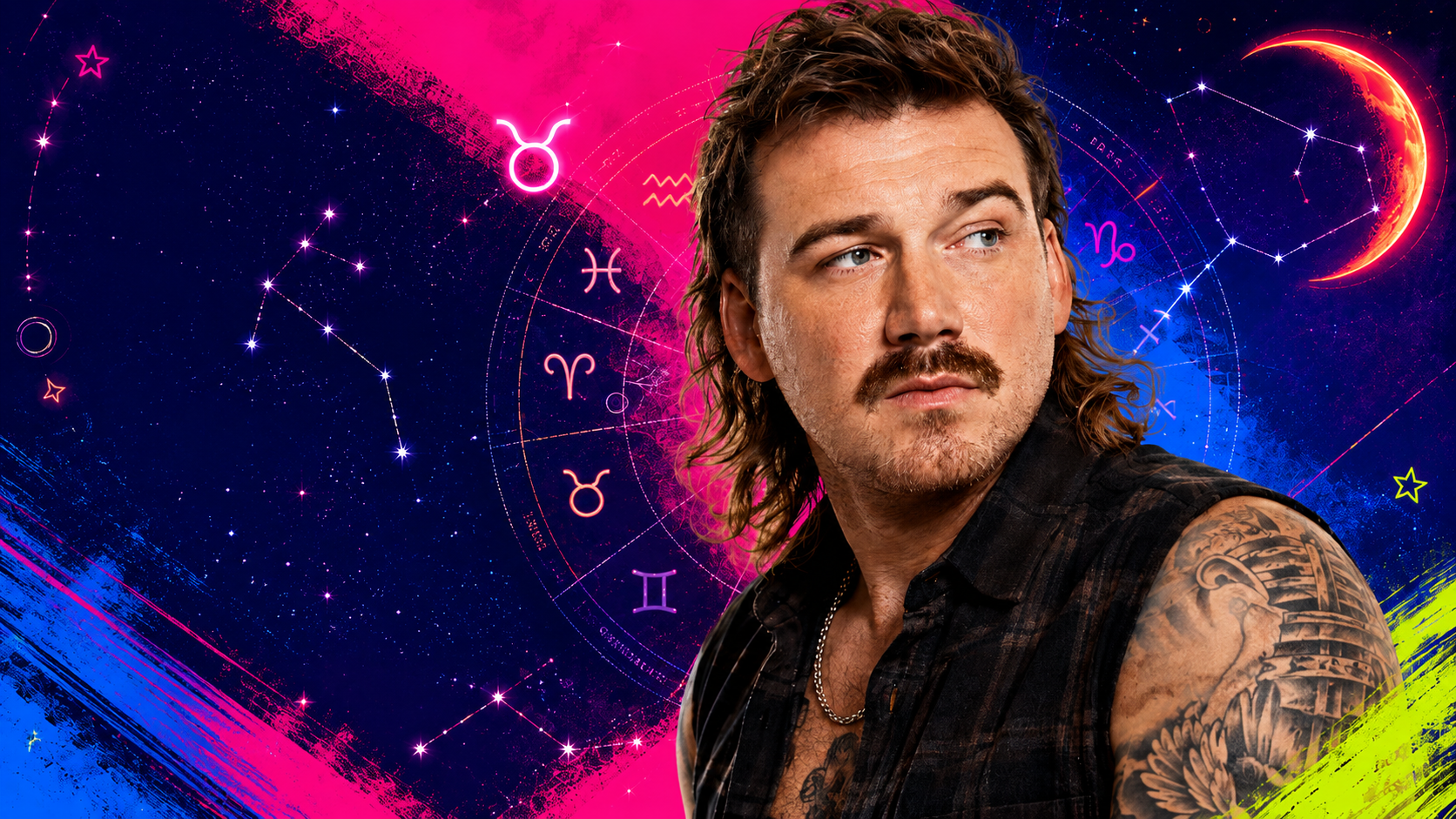
Some charts build their thesis around a single placement. Morgan Wallen's builds a pressure chamber out of an entire modality.
Born May 13, 1993, in Sneedville, Tennessee, the country singer arrived under a sky with six placements in fixed signs and only one in a mutable sign. The Sun and Mercury sit together in Taurus. The noon Moon and Saturn occupy Aquarius. Mars burns in Leo. Pluto stands in Scorpio. Every corner of the fixed cross is occupied, and three of those corners lock into the chart's defining geometry: the Taurus Sun opposes Pluto in Scorpio at 1°17′, while the noon Moon in Aquarius squares Pluto at 0°24′ and the Sun at 1°42′.
That is a fixed T-square — the astrology of pressure that does not dissipate, identity that does not bend easily, emotion that can remain contained until it becomes force, and a life that tends to move through accumulation rather than moderation. It belongs to a man whose commercial career has behaved in the same language: albums that do not simply debut but remain; songs that do not merely chart but occupy; a fan base that has repeatedly proved more durable than the institutions attempting to discipline it. By late 2025, less than a decade after his first Gold certifications, Wallen had become the RIAA's highest-certified country artist, with Dangerous: The Double Album, One Thing at a Time, and I'm the Problem turning streaming-era country into a long-duration event.
But the chart's resistance is only half the story. Its other great structure is an earth-sign production line of startling precision. The Taurus Sun trines Uranus in Capricorn at 0°49′ and Neptune in Capricorn at 1°51′. Mercury trines Neptune at 1°06′ and Uranus at 2°08′. The voice and identity — Taurus, old soil, melody, texture, repetition — are wired directly into the two planets that describe technological disruption and atmospheric production, both operating through Capricorn's commercial discipline. Traditional material, modern machinery. Country storytelling built to survive in playlists, short-form clips, pop radio, hip-hop collaborations, and stadiums without ceasing to sound recognizably rural.
Then comes the chart's hidden engine: the Sun in Taurus is ruled by Venus in Aries; Venus is ruled by Mars in Leo; Mars is ruled by the Sun. Identity, attraction, and performance form a closed three-planet dispositor circuit. The voice feeds the appetite; the appetite feeds the stage; the stage feeds the identity. It is difficult to imagine a cleaner astrological mechanism for a performer whose public mythology, romantic catalogue, physical presence, and commercial persona continually reinforce one another.
And under all of it sits a single reservoir. Of eleven placements, exactly one is in water: Pluto in Scorpio, retrograde, and — by modern rulership — at home in its own sign. The chart's entire water function is concentrated in the planet of compulsion, shame, crisis, survival, and transformation. The feeling is not absent. It is buried under pressure and given one route out: the underworld. That is why the catalogue can sound emotionally direct even when the man giving interviews often does not. The songs go where the public persona will not.
A note on method: Wallen's birth time is not verified, so the noon chart is used as a neutral placeholder. Houses and the Ascendant are excluded completely. The Moon sits at 24°35′ Aquarius at noon and did not enter Pisces until late that evening, making Aquarius the likely — but not guaranteed — Moon sign. The hard lunar contacts to the Sun and Pluto remain operative across the date, but their exact orbs depend on the hour. Everything else in this reading — the signs, the non-lunar aspects, the dispositor pattern, the element balance, and the fixed emphasis — is time-stable.
Let's begin inside the pressure chamber.'
The Fixed T-Square: A Career That Accumulates
The fixed signs preserve. Taurus preserves value and material. Leo preserves identity and pride. Scorpio preserves emotional memory and power. Aquarius preserves conviction, distance, and the system it believes should exist. A chart with six fixed placements is not built for casual revision. It repeats, consolidates, withstands, and sometimes remains in a pattern long after flexibility would have been kinder.
At noon, Wallen's Taurus Sun opposes Pluto in Scorpio, with the Aquarius Moon squaring both. The Sun-Pluto opposition is exact enough to operate as a lifelong confrontation between the stable self and the forces capable of overturning it. Taurus wants continuity: the known voice, the known town, the known values, the familiar chord progression that still works because it is true. Pluto wants exposure, rupture, and rebirth. It forces whatever is hidden to become consequential. In opposition, the life can alternate between extraordinary control and moments when the buried material seizes the wheel.
The biography has moved through precisely that rhythm. The boy who expected baseball to be his route out of East Tennessee tore the ulnar collateral ligament in his pitching arm during high school, losing the college path he had imagined. The fixed chart did not stop; it rerouted. He began writing songs and playing guitar, auditioned for The Voice in 2014, was eliminated before the finals, and returned to Tennessee with enough industry contact to keep moving. Again: not a clean ascent, but pressure converted into another form.
The same pattern repeated at scale. If I Know Me grew slowly after its 2018 release, then produced “Whiskey Glasses” and established the voice. Dangerous arrived in January 2021; after the most damaging public controversy of his career erupted the following month, the album nevertheless remained at No. 1 on the Billboard 200 for ten weeks. One Thing at a Time turned long-form abundance into a streaming strategy, while “Last Night” spent sixteen weeks at No. 1 on the Hot 100. I'm the Problem followed in 2025 with thirty-seven tracks and another extended run atop the album chart. The story is not simply success. It is fixed-sign duration: the refusal of momentum to disperse.
The noon Moon is the T-square's apex, and Aquarius is an instructive place for the pressure to discharge. Aquarius Moons often survive intensity by stepping back from it — observing the feeling, intellectualizing it, turning private weather into a pattern that can be managed. At 24°35′, this Moon squares Pluto by just twenty-four minutes of arc, the tightest aspect in the noon chart. The emotional body and the underworld are in direct conflict: detachment versus compulsion, the calm exterior versus whatever has been stored beneath it.
This is one reason the public record can feel split. The performer can appear almost casual while singing material organized around heartbreak, intoxication, regret, jealousy, hometown longing, and the inability to let go. The fixed T-square does not forget. It converts memory into inventory.
Sun Conjunct Mercury in Taurus: The Voice as Material
The Sun and Mercury sit together in Taurus at 2°58′, making the voice inseparable from the identity. Mercury describes speech, language, phrasing, and the way the mind packages experience. In Taurus, it works through texture, rhythm, physical sound, repetition, and phrases simple enough to live in the body. This is not Mercury trying to impress with verbal complexity. It wants the line that can be remembered after one listen and sung by sixty thousand people on the second chorus.
Wallen's instrument has always been central to the appeal: nasal, rough-edged, elastic, and immediately identifiable. He began singing in the Southern Baptist church where his father was a pastor, learned violin as a child, played piano, and grew up hearing both country and the rock records his father loved. When he appeared on The Voice, the coaches heard a pop-soul roughness before the country industry had fully claimed him. Taurus Mercury eventually did what Taurus does: it found the natural register and stayed there long enough to turn distinctiveness into an asset.
The conjunction also helps explain the extraordinary continuity between persona and product. The drawl, the haircut cycles, the baseball cap, the East Tennessee references, the songs about bars and back roads — whether spontaneous or strategically sharpened — all reinforce one stable signal. Taurus does not want ten identities. It wants one identity valuable enough to compound.
And compound it has. Wallen's albums are unusually long even by streaming-era standards: thirty tracks on Dangerous, thirty-six on One Thing at a Time, thirty-seven on I'm the Problem. The easy critique is excess, and there is truth in it. But the astrological logic is accumulation. Taurus Mercury does not discard a usable song simply because the album already has one. It builds the barn larger.
The conjunction's hard contacts show the cost. Mercury opposes Pluto at 4°15′ and, at noon, squares the Moon at 4°39′. Words can become pressure valves. Silence can become its own form of intensity. The mind may circle the same material until it finds a phrase durable enough to contain it. In music, that creates hooks with emotional weight. In public life, it can also create long gaps between incident and explanation, followed by statements carrying far more consequence than ordinary speech.
The Earth Circuit: Old Country, New Machine
If the fixed T-square explains the staying power, the trines to Uranus and Neptune explain the sound.
Sun trine Uranus at 0°49′ is the closest time-stable aspect in the chart. The identity flows naturally toward disruption, innovation, and the instinct to modernize a familiar form without asking permission from its gatekeepers. Uranus sits in Capricorn, so the rebellion is not anti-commercial. It is commercial innovation: changing the structure because the new structure can reach farther.
Sun trine Neptune at 1°51′ adds image, atmosphere, longing, and the ability to become a projection surface for an audience. Neptune in Capricorn dreams in formats that can be distributed. The fantasy is not left in the bedroom; it is mixed, mastered, marketed, and taken on tour.
Mercury repeats the pattern even more precisely: trine Neptune at 1°06′ and Uranus at 2°08′. The singing voice and songwriting mind are wired to both mood and technology. Wallen's music can move from acoustic confession to programmed drums, trap-influenced percussion, pop structures, rock guitars, and collaborations with artists outside traditional country without sounding like a costume change. The production changes. The Taurus signal remains.
This is the chart's most commercially intelligent architecture. Uranus keeps the sound from becoming museum country. Neptune keeps it emotionally immersive. Capricorn makes both useful. Taurus supplies the recognizable product.
The generational Uranus-Neptune conjunction at 1°02′ was shared by many people born in the early 1990s, but here it is personalized by four exact trines from the Sun and Mercury. Wallen does not merely belong to the generation that watched genre boundaries dissolve under digital distribution. His identity and voice are plugged directly into that dissolution.
This is why his crossover success has not required abandoning country. “Last Night” could dominate an all-genre singles chart. “I Had Some Help,” with Post Malone, could become both a country event and a pop event. The records use the modern machine, but the material remains Taurus: possession, loyalty, loss, drink, home, the body, the thing one can touch and the person one cannot keep.
The Closed Dispositor Circuit: The Voice, the Appetite, the Stage
A dispositor shows where a planet reports. Wallen's chart contains a rare and revealing loop.
The Sun in Taurus reports to Venus in Aries. Venus reports to Mars in Leo. Mars reports back to the Sun. No planet in the chain reaches a final ruler; the three keep feeding one another.
The Sun is the identity and central life force. Venus is attraction, pleasure, style, relationship, and value. Mars is desire, action, libido, conflict, and performance energy. In this chart, the person, the appetite, and the stage are not separate departments. Each continually recharges the others.
Venus in Aries is in detriment — not weak, but impatient with the relational compromises Venus usually prefers. It wants immediacy, conquest, heat, and the uncomplicated proof of desire. Mars in Leo wants visibility, drama, pride, and a stage large enough for the gesture. Taurus Sun wants the result to last and pay.
The aspects make the circuit highly functional. Venus trines Mars at 3°18′, smoothing attraction and action into charisma. This is physical ease, sexual magnetism, and the ability to make performance feel personal. Mars sextiles Jupiter at 2°30′, expanding energy, competitiveness, and the scale of the live show. Venus opposes Jupiter at 5°47′, increasing appetite: more love, more pleasure, more songs, more nights, more of whatever feels good — and, in the shadow, difficulty recognizing the point at which abundance has become excess.
That opposition is one of the chart's clearest biographical cautions. The two benefics can make life generous, popular, and materially rewarding. In hard aspect, they can also overestimate the margin for indulgence. The closed circuit is powerful precisely because it is self-reinforcing. When it is creating, touring, flirting, selling, and performing, it can become a nearly perfect engine. When it is gratifying itself without an external brake, it can keep escalating.
This is not an astrological excuse for behavior. No placement makes a person use a slur, violate a boundary, or endanger others. A chart describes temperament and pressure; choices remain choices. But Venus-Jupiter excess inside a Sun-Venus-Mars loop does describe a life in which appetite requires conscious governance because success keeps enlarging the room in which appetite operates.
Moon Conjunct Saturn: The Feeling Behind the Wall
At noon, the Moon sits in late Aquarius with Saturn at 29°42′, a conjunction of 5°08′. Because the Moon's exact degree depends on the birth hour, this aspect is time-sensitive — but it remains plausible for most of the date, and Saturn's condition is certain.
Saturn is traditionally at home in Aquarius. At the anaretic twenty-ninth degree, it behaves like a final examination in self-command, consequence, belonging, and the relationship between the individual and the crowd. This is not soft Saturn. It is structurally strong, socially aware, and acutely conscious of what happens when a person becomes part of a system larger than himself.
Moon-Saturn people often experience emotion as something to contain until it can be made useful. They may appear reserved, dry, self-sufficient, or difficult to reach, while privately carrying more heaviness than the surface reveals. Wallen has described songwriting and singing as one of the few ways he can express what he does not naturally say. That is Moon-Saturn in one sentence: feeling given a form because unstructured feeling is harder to tolerate.
Aquarius adds the crowd. The emotional life is connected to the audience, the fan community, and the strange distance created by mass recognition. Wallen's career contains one of modern country music's sharpest divides between institutional judgment and audience loyalty. Radio pulled records. Awards bodies restricted eligibility. The fan base continued listening in enormous numbers. Saturn in Aquarius understands systems, but it also understands the counter-system: the community that creates its own authority through scale.
The conjunction can become emotionally isolating if the person confuses endurance with invulnerability. It can also produce remarkable professionalism. Despite vocal injury, public scandal, legal consequences, and relentless scrutiny, the touring and recording machine has repeatedly resumed. Saturn does not promise ease. It promises the ability to keep a structure standing — provided the owner accepts maintenance.
Singleton Water Pluto: The Underworld Gets the Only Key
The chart has four earth placements, three air, three fire, and one water placement. That one is Pluto in Scorpio.
A singleton carries the workload of its element. Water governs feeling, bonding, vulnerability, grief, intuition, and the capacity to be changed by emotional experience. When Pluto alone holds that function, water arrives in concentrated form: obsession rather than sentiment, crisis rather than a passing mood, loyalty and betrayal remembered in the body, private material that gains power when it is hidden.
Pluto is retrograde and, by modern rulership, dignified in Scorpio. It opposes the Sun, opposes Mercury, squares the noon Moon, and squares Saturn. This is not a background planet. It is one of the chart's governing powers.
The catalogue repeatedly returns to Plutonian material in Taurus clothing: the drink that cannot erase the person, the hometown that cannot release the memory, the relationship that is over but not finished, the confession arriving after the damage, the desire to become someone else without fully surrendering the old self. Even the album title I'm the Problembelongs to the Sun-Pluto axis. It is the stable identity forced to name the shadow standing opposite it.
But Pluto is not self-awareness merely because it names darkness. Its work is transformation, which requires more than packaging a flaw into a hook. The public biography has included serious ruptures: the 2021 video in which Wallen used a racial slur, and the 2024 Nashville incident that ended with guilty pleas to two misdemeanor counts of reckless endangerment. Those facts belong to conduct, accountability, and the people affected — not to an aspect.
Astrologically, what can be said is narrower. Sun-Pluto and Saturn-Pluto charts often live under intense cycles of power, exposure, consequence, and attempted reconstruction. The lesson is not that collapse is inevitable. It is that whatever remains unexamined eventually acquires leverage. Pluto's only clean use is conscious descent: telling the truth before the crisis tells it for you.
Saturn Square Pluto: Consequence Is Part of the Architecture
Saturn squares Pluto at 5°32′, linking the planet of limits to the planet of compulsion. The aspect belongs to a generation, but in this chart it is personalized: Saturn is tied to the noon Moon and Pluto directly confronts the Sun and Mercury.
Saturn-Pluto is pressure against pressure. It can create formidable endurance, an instinct for survival, and the ability to operate under conditions that would flatten a less concentrated chart. It can also create long contests with authority, control, shame, punishment, and the belief that strength means never yielding until an outside force makes yielding unavoidable.
The music industry story has repeatedly placed Wallen in exactly this terrain. He has received its biggest honors — including the 2024 CMA Entertainer of the Year award and Grammy nominations for “I Had Some Help” — while also existing in a complicated relationship with its gatekeeping institutions. The commercial public and the professional establishment have not always moved in sync.
Saturn-Pluto does not care whether the pressure comes from enemies, consequences, systems, or the native's own resistance. It asks one question: what structure remains after reality removes the unsustainable parts?
The aspect's highest expression is disciplined transformation. Its lowest is a siege mentality that mistakes survival for vindication. The chart offers the stamina for either. The life determines which one is built.
Venus and Mars to the North Node: The Road Out Runs Through Performance
The North Node sits at 12°21′ Sagittarius, and the personal planets meet it with unusually supportive fire.
Venus trines the Node at 1°18′. Mars trines it at 4°36′. The path of development runs through performance, risk, travel, expansion, storytelling, and the willingness to live beyond the borders of the original environment. Sagittarius does not erase the hometown; it carries the hometown into a larger world.
This is the chart of someone born in a tiny Appalachian town who would eventually take East Tennessee phrasing into global streaming culture and stadiums. The path began indirectly. Baseball was supposed to be the future. Injury closed that door. Music, first practiced in church and later on a television competition, became the road.
Venus on the Node makes appeal part of the path. Mars on the Node makes action and performance part of it. Their trine to one another means the stage is not merely work; it is a developmental engine. The more directly he performs, writes, collaborates, and risks creative expansion, the more the life opens.
The Sagittarius Node also carries the chart's only mutable placement. Everything else wants to preserve or initiate; almost nothing wants to adapt. The soul's homework, in astrological language, is therefore flexibility: wider perspective, honest learning, and the capacity to let experience alter the worldview rather than merely enlarge the platform.
That may be the chart's most important instruction. Success came through fixedness. Growth requires what the chart has least.
The Synthesis: The Fixed Voice and the Modern Machine
Read together, Morgan Wallen's noon chart becomes one of the clearest studies in durability this series has encountered.
A Taurus Sun conjunct Mercury turns identity into voice and voice into material — tactile, repeatable, commercially recognizable. Four exact earth trines wire that traditional signal into Uranus and Neptune in Capricorn, the planets of disruption and atmosphere operating through an industrial framework: old country feeling, modern distribution, songs built to work everywhere without losing the accent that made them specific.
A closed Sun-Venus-Mars dispositor loop keeps the person, appetite, romance, image, and stage circulating through one self-reinforcing engine. Venus trine Mars gives charisma. Mars sextile Jupiter enlarges the show. Venus opposite Jupiter warns that the same appetite that creates abundance can overshoot the boundary.
Then the fixed pressure system: Sun opposite Pluto, the noon Moon squaring both, Saturn at the final degree of Aquarius, and Pluto holding the chart's entire water element alone. The public voice is simple because the private machinery is not. Emotion is contained, intensified, converted into songs, and periodically forced into the open through crisis.
The career record reads like the chart's strongest verb: to remain. Remain on the chart. Remain in the argument. Remain in the playlist. Remain after the institution withdraws approval. Remain long enough for a debut album to become a hit, for a reality-show elimination to become a stadium career, for a regional voice to become one of the most commercially powerful sounds in American music.
But fixedness is not the same as growth. The North Node in Sagittarius — the chart's lone mutable placement — asks for something the rest of the sky does not grant automatically: perspective capable of changing, truth larger than self-protection, and expansion measured not only by the size of the audience but by the breadth of the person addressing it.
The chart gives him extraordinary staying power. Its deeper question is what, exactly, will be allowed to stay.
Frequently Asked Questions
What is Morgan Wallen's zodiac sign?
Morgan Wallen is a Taurus Sun, born May 13, 1993. His Sun sits at 22°53′ Taurus conjunct Mercury, making the voice, identity, and way of telling a story nearly inseparable. Taurus also helps explain the durability of his sound: recognizable, physical, melodic, and built through repetition rather than constant reinvention.
What is Morgan Wallen's Moon sign?
The noon chart places his Moon at 24°35′ Aquarius. The Moon did not enter Pisces until late on his birth date, so Aquarius is likely but not guaranteed without a verified time. At noon, the Moon squares Pluto at 0°24′ and the Sun at 1°42′, completing the fixed T-square; the exact orbs change with the hour.
What is Morgan Wallen's rising sign?
It cannot be determined from the available data. The 12:00 noon time is a placeholder, not a verified birth time, so the Ascendant and houses are excluded from this reading. A rising sign changes roughly every two hours and should not be guessed.
What is Morgan Wallen's “big three”?
His confirmed Sun is Taurus. His noon-chart Moon is Aquarius, though a very late-evening birth could place it in Pisces. His rising sign is unknown. The most responsible version of the big three is therefore Taurus Sun, likely Aquarius Moon, and an undetermined Ascendant.
What in his chart explains his distinctive voice?
Sun conjunct Mercury in Taurus is the foundation: identity fused with a voice that works through tone, texture, repetition, and physical sound. Mercury then trines Neptune at 1°06′ and Uranus at 2°08′, connecting the country instrument to atmosphere, digital-era production, and genre-crossing innovation.
What in his chart shows his staying power?
The chart contains six fixed-sign placements and only one mutable placement. Its defining Sun-Pluto opposition and noon Moon T-square concentrate enormous endurance. Fixed charts accumulate momentum, resist dispersal, and can remain in a public or commercial position far longer than expected — a clear match for his albums' unusually long chart runs.
What is the closed dispositor loop in his chart?
His Taurus Sun is ruled by Venus in Aries; Venus is ruled by Mars in Leo; Mars is ruled by the Sun. Identity, attraction, appetite, performance, and creative drive feed one another continuously. It is a powerful signature for a public persona whose music, romantic themes, physical presence, and stage energy continually reinforce the brand.
What is the rarest structural feature in his chart?
Several compete. The 0°49′ Sun-Uranus trine is the closest time-stable personal aspect. The singleton-water Pluto in Scorpio concentrates the entire emotional element into one powerful planet. The Sun-Venus-Mars dispositor loop is unusually self-contained. And at noon, the 0°24′ Moon-Pluto square creates one of the tightest emotional pressure aspects the series has printed.
Does his chart explain his controversies?
No birth chart excuses conduct or predicts a specific harmful act. The chart can describe intensity, appetite, rigidity, secrecy, and cycles involving exposure and consequence — especially through the Sun-Pluto opposition, Venus-Jupiter opposition, and Saturn-Pluto square. What a person does with those tendencies remains a matter of choice and accountability.
Is this reading based on his exact birth time?
No. It uses a noon chart, excludes the houses and Ascendant, and treats the Moon's exact degree with caution. The non-lunar planetary signs, major aspects, element balance, modality emphasis, retrogrades, dignities, and dispositor structure remain valid regardless of the hour.
Your Chart Is Waiting
A noon chart can reveal an astonishing amount — but it is still only part of the architecture. With an exact birth time, the Ascendant, houses, angles, chart ruler, and timing techniques come into focus, showing not only what the planets are doing but where the story is most likely to unfold.
Book your personal chart reading — and find out what was written in your stars.