Written in the Stars: The Birth Chart of Princess Diana, the Woman Who Made the Monarchy Feel
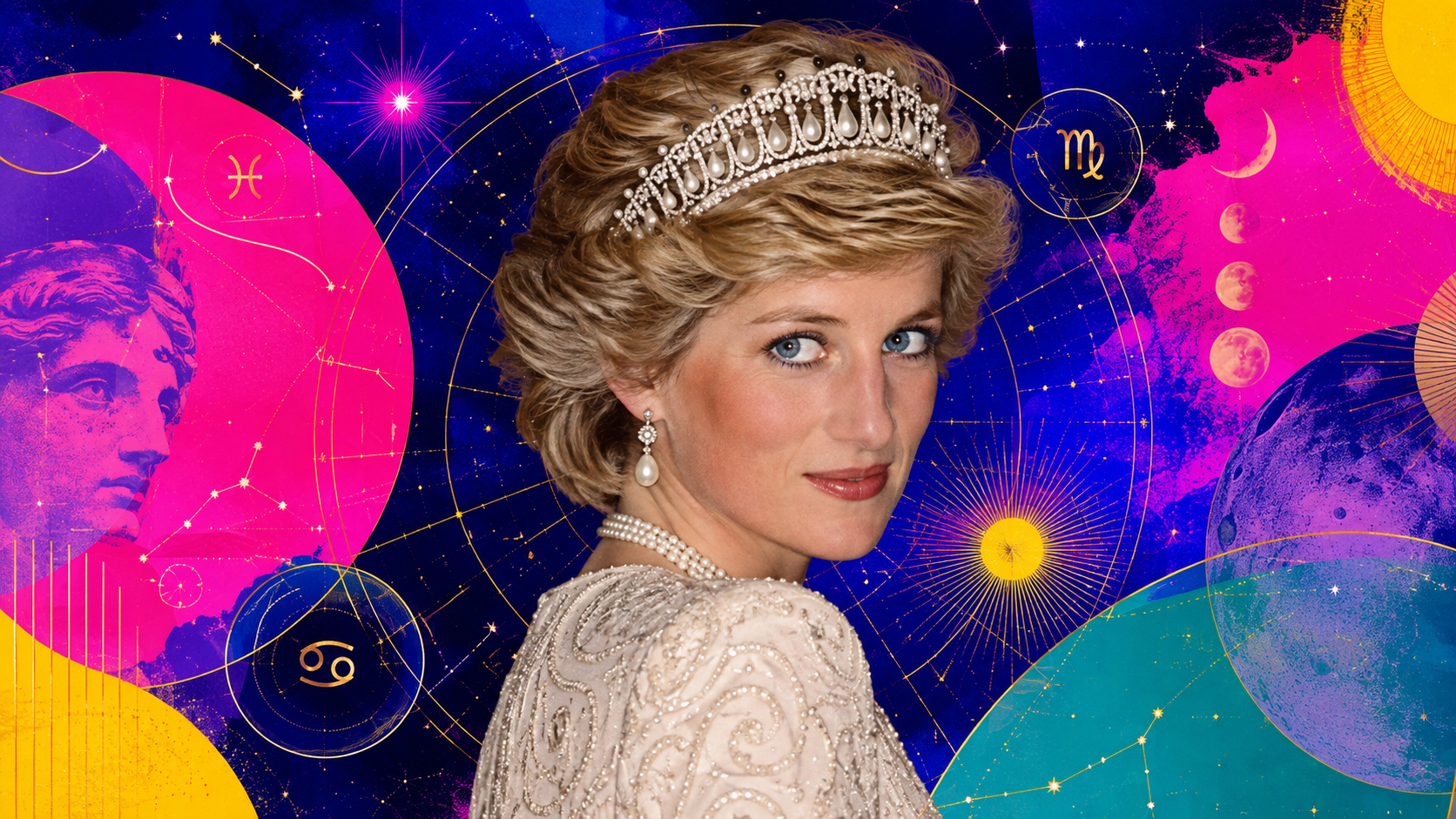
Before Diana became a princess, she worked with children.
Before the gowns, the balconies, the flashbulbs, the interviews, and the global mythology, she was Lady Diana Spencer: a young woman raised near Sandringham, educated in England and Switzerland, employed for a time as a nanny and kindergarten teacher.
Then, at nineteen, she became engaged to the heir to the British throne.
The wedding took place at St Paul’s Cathedral on July 29, 1981. The official Royal Family biography estimates that the ceremony reached a global television and radio audience of roughly one billion people.
The transformation was immediate.
A private person became an international image.
A young woman became a constitutional symbol.
A face became a surface onto which the world projected romance, motherhood, vulnerability, glamour, disappointment, rebellion, compassion, and grief.
Yet Diana’s enduring power did not come only from being photographed.
It came from what she did with the image.
She used touch in places where fear had made touch politically meaningful. She brought cameras into hospital wards, shelters, leprosy programs, and minefields—not merely to keep herself visible, but to redirect visibility toward people the public had learned not to see.
She did not invent royal charity.
She changed its emotional temperature.
Where the institution often represented continuity through distance, Diana created connection through proximity. She sat beside patients. She held hands. She embraced children. She allowed the body of the princess to become part of the message.
The chart explains why this was more than a public-relations instinct.
Diana’s natal structure is built around an extraordinary relationship between duty and beauty.
Under traditional rulership:
Her Cancer Sun and Mercury report to the Moon.
Her Aquarius Moon and Jupiter report to Saturn.
Her Virgo Mars and Pluto report to Mercury, then the Moon, then Saturn.
Her Leo Uranus and North Node report to the Sun, then the Moon, then Saturn.
Her Scorpio Neptune reports to Mars, then Mercury, then the Moon, then Saturn.
Saturn is in its own sign of Capricorn and becomes the terminal ruler of nearly the entire chart.
Venus stands apart in Taurus, also in its own sign.
Venus trines Saturn.
Nearly everything answers to Saturn.
Venus answers to itself.
The whole chart is governed by two sovereign planets: duty and value, structure and touch, institution and beauty.
The relationship between them is harmonious.
This is why Diana could learn the choreography of royalty and still become one of the most recognizable style figures of the twentieth century. It is why elegance and obligation appeared fused in her public image. It is why clothes could become both armor and language. It is why ceremony did not disappear when she became more emotionally direct; ceremony became the container through which emotional directness reached the world.
But the chart does not end with Venus trine Saturn.
Venus also squares Uranus within 0°45′.
The graceful form contains a break.
The woman who could embody the institution’s visual ideal also carried a need to alter the terms of that ideal.
Her Cancer Sun trines Neptune within 0°43′.
Identity and compassion flow together with almost no resistance. The self is porous to suffering, image, longing, fantasy, and collective projection.
Her Mercury in Cancer sextiles Mars and Pluto in Virgo.
Feeling becomes language.
Language becomes precise action.
Her Mars and Pluto are conjunct in Virgo.
Service is not sentimental. It becomes focused, embodied, and difficult to stop once the work has begun.
Her Moon remained in Aquarius throughout the entire birth date.
The emotional system belongs partly to the public, the outsider, the collective, and the future. The Moon can care deeply without processing feeling in a conventional or easily contained way.
This is not the chart of a passive princess.
It is the chart of a woman who entered an ancient structure, mastered its visual grammar, and then made the human body more important than the distance the grammar was designed to preserve.
Princess Diana did not make the monarchy modern simply by dressing differently or speaking publicly. She made it feel.
A Note About the Birth Time
This reading uses the chart data supplied for:
July 1, 1961, at 12:00 noon in Sandringham, England
UT: 11:00
Coordinates: 52°50′N, 0°30′E
The noon time is a placeholder, not a verified birth time.
For that reason, this portrait excludes:
Ascendant and Descendant
Midheaven and Imum Coeli
Houses
House rulerships
Angularity
Claims based on planets occupying particular houses
The supplied chart lists houses, but they are not used in this interpretation.
The Moon remained in Aquarius throughout Diana’s entire local birth date, moving from approximately 12°52′ Aquarius around local midnight to approximately 27°38′ Aquarius by the end of the day.
The Aquarius Moon sign is therefore secure.
The exact noon Moon degree—20°16′ Aquarius—and every lunar aspect orb remain provisional.
All non-lunar planetary positions and aspects discussed below are stable for the date.
The Chart at a Glance
Principal placements
Sun at 9°21′ Cancer
Noon Moon at 20°16′ Aquarius
Mercury at 3°21′ Cancer, retrograde
Venus at 24°04′ Taurus
Mars at 1°27′ Virgo
Jupiter at 5°08′ Aquarius, retrograde
Saturn at 27°50′ Capricorn, retrograde
Uranus at 23°19′ Leo
Neptune at 8°38′ Scorpio, retrograde
Pluto at 6°02′ Virgo
True North Node at 28°11′ Leo, retrograde
Tightest stable aspects
Sun trine Neptune — 0°43′
Venus square Uranus — 0°45′
Mercury sextile Mars — 1°54′
Neptune sextile Pluto — 2°36′
Mercury sextile Pluto — 2°41′
Mars conjunct North Node — 3°17′
Sun sextile Pluto — 3°19′
Jupiter square Neptune — 3°31′
Venus trine Saturn — 3°46′
Venus square North Node — 4°06′
Mars conjunct Pluto — 4°35′
Uranus conjunct North Node — 4°51′
Mercury sextile North Node — 5°11′
Mercury trine Neptune — 5°17′
Sun conjunct Mercury — 6°00′
Noon-based lunar aspects
Moon opposite Uranus — 3°02′
Moon square Venus — 3°47′
The Moon aspects may tighten, widen, or fall outside the working orb with a verified birth time.
The Chart Architecture: Venus and Saturn Hold the Crown
Astrology is often interpreted placement by placement.
Diana’s chart becomes far clearer when read as a rulership system.
Saturn in Capricorn is in domicile.
Venus in Taurus is in domicile.
These are the two planets with the greatest traditional authority in the chart.
Saturn governs structure, endurance, hierarchy, duty, time, consequences, institutions, boundaries, and the burden that must be carried whether or not the carrier feels ready.
Venus governs beauty, affection, value, social grace, relationship, style, pleasure, material culture, and the instinct to bring unlike people into contact.
Every planet except Venus eventually feeds Saturn.
Venus remains self-governing.
Then Venus and Saturn form an earth trine.
The structure is almost architectural.
Saturn builds the palace.
Venus determines whether anyone wants to enter it.
Saturn supplies the rule.
Venus makes the rule visible.
Saturn carries history.
Venus creates recognition.
In Diana’s life, the relationship became literal.
She entered one of the oldest and most symbolically controlled institutions in the world. She learned its schedules, clothing codes, ceremonial gestures, forms of address, public appearances, patronages, and expectations.
The public first encountered her through Venus–Saturn imagery:
The formal engagement portrait
The wedding gown and cathedral
The tiaras and evening dresses
The carefully arranged family photographs
The charity gala
The royal tour
The visual continuity of monarchy expressed through a young woman’s body
But Venus in Taurus is not decorative.
It is dignified.
It possesses its own value system.
Taurus decides what is real through the body, the senses, the material world, and direct contact.
A hand held is real.
A child embraced is real.
A hospital bed is real.
A person harmed by a landmine is real.
The institution can speak through statements.
Venus in Taurus asks what the statement becomes when embodied.
That is where Diana’s chart moves beyond ceremonial beauty.
She did not merely wear the role. She tested whether the role could touch.
Cancer Sun: Identity Through Care
Diana’s Sun is at 9°21′ Cancer.
Cancer is the sign of memory, family, belonging, care, protection, vulnerability, lineage, home, and the emotional conditions that make life feel safe.
The Cancer Sun does not become itself by separating completely from other people.
It becomes itself through attachment.
This creates both strength and exposure.
Diana’s public identity was inseparable from motherhood. The official biography emphasizes the importance of family and her two sons, William and Harry. Even within a constitutional role, the image of Diana as a mother often appeared more immediate than the image of Diana as a future queen.
Cancer understands that institutions are experienced through family.
The monarchy was not only a state structure in her life.
It was a marriage, a household, a set of relatives, a parenting arrangement, a place to live, and a system governing access to the people she loved.
This matters because Cancer does not experience “public” and “private” as cleanly separate.
A change in the institution changes the family.
A change in the family changes the meaning of the institution.
The Cancer Sun gave Diana extraordinary emotional recognizability.
The public did not simply observe her.
Many people felt they knew how she felt.
That perception may not always have been accurate. Public intimacy is still a projection. But her face, posture, voice, and gestures allowed the audience to believe emotion was occurring in real time rather than being completely hidden behind protocol.
Cancer made the royal image personal.
Yet Cancer can also become overidentified with the needs, reactions, or emotional weather of the surrounding family system.
The development of a Cancer Sun requires learning that care is not the same as emotional self-erasure.
Protection must eventually include the self.
Sun Trine Neptune at 0°43′: The Image Becomes Compassion
The closest stable aspect in Diana’s chart is the Sun’s trine to Neptune.
The orb is approximately 0°43′.
This is the signature through which identity, image, empathy, sacrifice, glamour, longing, and collective projection become nearly inseparable.
Neptune dissolves boundaries.
It allows one person to feel what another person is feeling—or to imagine that they do.
It rules the image that becomes larger than the body carrying it.
It governs symbols, ideals, dreams, film, photography, spiritual longing, rescue, sacrifice, and the human tendency to create a perfect figure onto whom hope or sorrow can be projected.
The trine means the flow is easy.
Diana did not have to work to become symbolically legible.
The camera found a story in her face.
The audience found a feeling.
A photograph could appear to confirm whatever the viewer already believed: innocence, loneliness, rebellion, maternal warmth, romantic tragedy, courage, fragility, or sainthood.
This is the gift and danger of Sun–Neptune.
The person becomes permeable to myth.
The real individual may be obscured by the emotional use the public makes of the image.
Diana’s humanitarian work expressed the constructive form of the aspect.
Compassion became visible.
During the AIDS crisis, physical contact carried enormous symbolic force because fear and misinformation had stigmatized people living with HIV. Diana’s willingness to shake hands, sit beside patients, and embrace people challenged the visual language of contamination and distance.
The act was simple.
That was why it mattered.
Neptune had created fear through invisible transmission and collective panic.
The Cancer Sun answered with human contact.
In 1997, the minefield walk in Angola used the same symbolic intelligence at a different scale.
Protective gear, a cleared lane, a princess walking through terrain associated with hidden danger—the image could cross borders faster than a technical policy document.
The HALO Trust continues to describe that visit as a moment that brought international attention to landmine victims and demining. The former minefield area in Huambo later became a community site that includes a school bearing Diana’s name.
The chart’s compassion is not abstract.
Sun–Neptune allows suffering to be translated into an image the collective cannot easily forget.
But the same permeability creates vulnerability.
A person with a strong Sun–Neptune signature can be loved as a symbol while feeling unseen as a person.
The audience’s compassion for the image does not always translate into boundaries for the human being carrying it.
Diana could make the world feel. The world did not always know when to stop taking feeling from her.
Sun Sextile Pluto: Vulnerability With Transformative Force
The Sun also sextiles Pluto by approximately 3°19′.
This aspect adds power to the Neptunian sensitivity.
Without Pluto, Sun–Neptune can remain purely receptive: feeling, imagining, absorbing, and symbolizing.
Pluto gives the identity depth, strategic instinct, survival force, and the ability to change the meaning of a public role.
Diana’s power did not operate primarily through constitutional authority.
It operated through emotional attention.
She could redirect the room.
She could move press interest from the princess to the patient beside her.
She could turn a dress into a statement, a gesture into a challenge, and a charity appearance into a cultural intervention.
Pluto understands that visibility is power.
The sextile suggests an ability to use that power intentionally, especially once she became more conscious of the difference between the public role and the private person.
The official biography notes that after separation and divorce, she reduced and reorganized her public commitments. She retained a smaller group of patronages and intensified work in selected areas, including HIV/AIDS and landmines.
This is a Plutonian refinement of power.
More appearances are not necessarily more influence.
Sometimes influence becomes stronger when concentrated.
Mercury in Cancer Retrograde: The Voice Remembers
Mercury is at 3°21′ Cancer and retrograde.
Mercury describes thought, speech, interpretation, language, information, memory, media, and the story a person tells to make experience coherent.
Cancer Mercury remembers emotionally.
It does not organize events only by chronology.
It remembers atmosphere, tone, exclusion, comfort, loyalty, rupture, and the detail that proves what a relationship felt like from the inside.
Retrograde Mercury turns part of the interpretive process inward.
Thought may be revised repeatedly before it is spoken.
The person may return to earlier conversations, reinterpret events through later knowledge, or struggle to communicate in a language built by people whose emotional assumptions differ from her own.
Diana’s public voice evolved.
Early appearances were often shy, compressed, and tightly constrained by role. Over time, the voice became more authored.
The 1995 television interview discussed her unhappiness and the pressures of public life. Whatever one concludes about the interview’s later-disclosed production ethics, the event remains part of the historical record of a woman attempting to narrate her own experience within a system famous for institutional silence.
Cancer Mercury speaks because memory has become too consequential to remain private.
The strength of this Mercury is not detached objectivity.
It is testimony.
The risk is that emotional memory and public narrative can become inseparable. A remembered feeling is real as feeling, but it may not contain every perspective on the event.
The chart needs the Virgo contacts to sharpen and test the story.
Fortunately, it has them.
Mercury Sextile Mars at 1°54′: Feeling Learns to Act
Mercury sextiles Mars within approximately 1°54′.
Mars gives Mercury courage, speed, direction, and the willingness to say something because silence has become a form of inaction.
Diana’s Mars is in Virgo.
This is not theatrical Mars.
It acts through precision, service, preparation, practical intervention, and attention to the person or problem immediately in front of it.
The sextile connects emotional language with useful action.
Cancer Mercury identifies what hurts.
Virgo Mars asks what can be done.
This is one reason Diana’s compassion became effective in public.
The chart does not stop at “I feel for you.”
It moves toward a visit, a patronage, a fundraising effort, a change in visual representation, or an issue selected for sustained attention.
Mercury–Mars can also produce sharpness when the person feels emotionally cornered.
Cancer protects.
Virgo identifies details.
The voice may become especially forceful when it can point to the exact moment, phrase, or behavior through which safety was lost.
The mature expression uses specificity to create repair.
The shadow uses specificity as a weapon after trust has collapsed.
Mercury Sextile Pluto at 2°41′: The Private Story Gains Power
Mercury sextiles Pluto within approximately 2°41′.
This contact gives the mind an instinct for what is hidden, psychologically charged, socially taboo, or structurally important.
Diana’s public impact repeatedly involved subjects that institutions had difficulty discussing directly:
AIDS and stigma
Mental and emotional distress
Marital unhappiness
Homelessness
Leprosy
Landmine injuries
The human cost hidden beneath official policy
Mercury–Pluto is not satisfied with the ceremonial description.
It wants the underlying truth.
In Cancer and Virgo, the truth is found through personal testimony and concrete detail.
Who was harmed?
Who was excluded?
What did the official story leave out?
What happened to the body?
This aspect helps explain why Diana’s voice could feel dangerous to established structures even when the language remained emotionally framed rather than ideologically abstract.
Pluto gives testimony consequence.
Once the private story is spoken publicly, the institution cannot return completely to the earlier version of reality.
Sun Conjunct Mercury: The Person and the Story Merge
The Sun and Mercury are conjunct by almost exactly 6°.
This is a wider conjunction but still important.
Identity and narrative are linked.
Diana’s sense of self was shaped by the stories told about her—and by the effort to tell her own story in return.
The public name “Diana” became an enormous symbolic object.
The individual behind the name repeatedly attempted to reclaim authorship from the mythology surrounding it.
Sun–Mercury can create eloquence because the voice carries the person’s full presence.
It can also make criticism of the message feel like rejection of the self.
A life lived through headlines intensifies that sensitivity.
When the story is always public, the right to interpret one’s own experience becomes a form of survival.
Aquarius Moon: The Emotional Outsider
The Moon remained in Aquarius throughout Diana’s birth date.
This is one of the most important corrections to the popular image of Diana as purely Cancerian.
Cancer is personal, protective, and emotionally immediate.
Aquarius is collective, future-oriented, socially aware, unconventional, and capable of stepping outside the expected emotional script.
The secure Aquarius Moon helps explain why Diana could feel deeply and still develop an outsider’s relationship with the institution she inhabited.
Aquarius often experiences belonging through difference.
It may care intensely about humanity while feeling less certain about the smaller group that is supposed to provide personal belonging.
The emotional system seeks friendship, social meaning, and the sense that suffering can be connected to a larger cause.
Diana’s humanitarian work was not only Cancerian nurturing.
It was Aquarian redistribution of attention.
She used one of the most visible positions in the world to bring excluded people into the public field.
Aquarius asks who has been left outside the circle.
The Moon brings the body and the public’s emotional response into that question.
This Moon can also protect itself through distance, unpredictability, or sudden changes in social attachment.
When the immediate emotional environment feels controlling, Aquarius looks for another network, another future, or another way to define belonging.
The sign is fixed.
Once an emotional conclusion has been reached, it may be difficult to reverse.
Noon Moon Opposite Uranus at 3°02′
At noon, the Aquarius Moon opposes Uranus in Leo.
Because the exact Moon degree is unverified, the orb is provisional.
The sign-level symbolism is still powerful.
Aquarius Moon and Leo Uranus place collective belonging across from personal visibility and disruption.
The emotional life can become electric under attention.
The person needs freedom from the role through which everyone else recognizes her.
If the opposition is close at the actual birth time, it would intensify sudden shifts in attachment, emotional independence, and the experience of public visibility as both liberating and destabilizing.
Noon Moon Square Venus at 3°47′
At noon, the Moon squares Venus.
Again, the exact aspect is provisional.
The fixed signs are secure: Aquarius and Taurus.
Aquarius Moon seeks freedom, social meaning, and emotional space.
Taurus Venus seeks consistency, physical reassurance, and enduring value.
The square can describe tension between the need to remain socially or psychologically independent and the desire for secure affection.
It can also describe the split between the public’s emotional relationship with Diana and Diana’s private need for reliable love.
The world may offer adoration.
Adoration is not the same as safety.
Venus in Taurus: Beauty as Physical Truth
Venus is at 24°04′ Taurus, its own sign.
This is one of the strongest placements in the chart.
Venus in Taurus understands beauty as material intelligence.
Texture matters.
Color matters.
Fabric matters.
Touch matters.
The arrangement of the room, the body inside the garment, the flowers, the food, the voice, the pace of a gesture—these are not superficial details. They create the conditions through which value is experienced.
Diana’s style legacy cannot be separated from this placement.
The clothing was rarely only clothing.
It communicated role, mood, approachability, confidence, distance, transition, or independence.
Taurus Venus knows that the body is read before the explanation arrives.
In the royal context, that knowledge becomes political.
A silhouette can signal conformity.
A hemline can signal modernization.
The choice to wear British designers can support an industry.
The decision to auction dresses can convert personal iconography into charitable resources.
The official Royal Family biography notes that Diana supported younger British designers and, in 1997, participated in previews for a sale of dresses and suits whose proceeds went to charity.
Venus in Taurus turns the beautiful object into real value.
The dress does not remain trapped in mythology.
It becomes money for work in the world.
This is dignified Venus at its most complete: beauty, embodiment, value, and generosity joined.
Venus Square Uranus at 0°45′: The Princess Changes the Picture
Venus squares Uranus within approximately 0°45′.
This is the chart’s sharpest break from the traditional feminine ideal.
Venus represents relationship, beauty, social acceptance, and the role through which a woman may be valued.
Uranus represents disruption, independence, innovation, unpredictability, liberation, and the refusal to remain inside a category once the category has become too restrictive.
The square creates tension.
Diana could embody the princess image perfectly enough to make it unforgettable.
She could not remain fully contained by it.
The relationship to style changed over time.
The early romantic image gave way to sharper tailoring, stronger silhouettes, cleaner lines, athletic clothing, and a visual identity increasingly distinct from the expectations attached to a young royal bride.
The evolution was not merely fashion history.
It was self-definition through the body.
Venus–Uranus often makes style autobiographical.
A new look marks a new relationship to freedom.
The aspect also affects partnership.
Venus seeks connection.
Uranus requires space.
The person may be drawn toward relationships that alter the expected life path, yet resist arrangements that feel emotionally or socially predetermined.
The square does not mean a person cannot commit.
Diana’s Venus trine Saturn shows enormous capacity for loyalty and endurance.
It means commitment must remain alive rather than purely assigned.
She could honor the form. She could not survive indefinitely as only the form.
Venus Trine Saturn at 3°46′: Grace Carries Duty
Venus trines Saturn within approximately 3°46′.
This is the aspect that made Diana capable of carrying the image for as long as she did.
Venus–Saturn gives style discipline.
It understands timing, formality, restraint, appropriateness, continuity, and the labor required to make grace appear effortless.
The Venus person learns that beauty is constructed.
The Saturn person learns that structure needs warmth if people are going to trust it.
Both planets are dignified in earth signs.
The trine is not weak.
It is durable.
Diana could repeat the public duties, appear at the event, greet the line, remember the name, wear the required symbolism, and sustain the visual coherence of the role.
This aspect is part of why her image remains so carefully preserved decades after her death.
Venus–Saturn produces enduring style because the beauty is attached to form.
It also produces seriousness in love.
Affection is not casual.
It carries obligation, fear of loss, time, endurance, and the desire for a bond strong enough to survive reality.
The shadow is staying loyal to a structure after the structure has ceased to provide emotional safety.
Saturn may treat endurance as proof of worth.
Venus may continue trying to make the relationship beautiful.
Uranus eventually interrupts.
The chart contains both.
Venus Square the North Node: Value Becomes Developmental
Venus squares the Leo North Node by approximately 4°06′.
The North Node describes a developmental direction.
In Leo, the path leads toward visible authorship, creative courage, personal heart, and the right to occupy the center of one’s own life.
Taurus Venus values stability and secure attachment.
The square suggests that growth may require risking some of the security attached to being loved in an established role.
The princess image brought enormous value.
It also threatened to become the only identity the public would permit.
The Leo path asks the person to become more than the role that made her desirable to others.
The developmental task is not to reject Venus.
It is to make value personal.
What does Diana value when the institution is no longer deciding?
What does she wear when the role changes?
Which causes remain after most patronages are relinquished?
Which relationships reflect the person rather than the title?
The post-divorce period concentrated these questions.
Saturn in Capricorn: The Institution Lives Inside the Chart
Saturn is at 27°50′ Capricorn, retrograde, and in domicile.
Saturn is the traditional terminal dispositor of nearly the entire chart.
The institution was not merely imposed from outside.
The chart contained an extraordinary capacity for duty, hierarchy, endurance, public responsibility, and awareness of consequence.
This is important because it complicates the idea that Diana was simply a free spirit trapped by structure.
She understood structure.
She could perform it.
She cared about responsibility.
She remained connected to public service after divorce and continued to be regarded as a member of the Royal Family.
Saturn in Capricorn knows the weight of history.
Retrograde Saturn internalizes authority.
The person may carry rules even when no one is visibly enforcing them.
The inner judge can become harsher than the external institution.
This placement can produce exceptional self-control and exceptional feelings of failure when the role cannot be fulfilled according to the imagined standard.
Late Capricorn Saturn also suggests a life lived near the point at which an old structure is reaching its limit.
The person may become a test case for whether the institution can adapt.
Diana did not abolish royal duty.
She exposed the emotional cost of performing it without sufficient human support.
That distinction is Saturnian.
The question is not whether duty matters.
The question is what makes duty sustainable.
Jupiter in Aquarius Square Neptune: Hope, Scale, and Projection
Jupiter is at 5°08′ Aquarius and retrograde.
It squares Neptune in Scorpio by approximately 3°31′.
Jupiter enlarges belief, meaning, generosity, public reach, education, and social hope.
In Aquarius, Jupiter expands through humanitarian causes, collective change, networks, and the future.
Retrograde motion suggests that the belief system must become internally meaningful rather than merely inherited.
Neptune in Scorpio is sensitive to hidden suffering, fear, death, taboo, trauma, intimacy, and the emotional material society would prefer not to see directly.
The square links collective hope with invisible pain.
This is one of the chart’s humanitarian signatures.
Jupiter wants to make the issue larger.
Neptune identifies the suffering hidden beneath the surface.
The square creates urgency.
It can also create overextension, rescue fantasies, or a public tendency to treat one person as the answer to suffering far beyond any individual’s ability to resolve.
Diana became associated with compassion on a global scale.
That association was meaningful.
It was also impossible for one human being to carry completely.
Jupiter–Neptune can inspire the collective.
It can also turn the compassionate person into a vessel for collective longing.
The retrograde Jupiter asks for a private philosophy strong enough to survive the projection.
Mars and Pluto in Virgo: Compassion Becomes Work
Mars is at 1°27′ Virgo.
Pluto is at 6°02′ Virgo.
They are conjunct by approximately 4°35′.
Mars initiates.
Pluto intensifies.
Virgo serves, analyzes, attends to detail, and focuses on what must be repaired.
This is not a vague humanitarian signature.
It is operational.
The combination can create enormous force around a specific task.
Once Diana chose an issue, she could bring concentrated attention to it.
Virgo asks how the problem appears in actual human life.
What does the patient need?
What does the child encounter?
What happens to the person who steps on the mine?
What practical support exists after the photograph has been taken?
Mars–Pluto can be relentless.
It can also drive the nervous system hard.
The person may struggle to stop, delegate, or accept that some conditions cannot be repaired through personal effort.
The constructive expression is focused advocacy.
The destructive expression is internal pressure that becomes impossible to discharge.
Diana’s later public work became more concentrated, not less powerful.
The smaller portfolio allowed Mars–Pluto to act with greater precision.
Mars Conjunct the North Node: Action Creates the Path
Mars conjuncts the North Node by approximately 3°17′.
The North Node is in Leo.
Growth requires visible courage, personal agency, and action that emerges from the heart rather than only from assigned duty.
Mars in Virgo approaches the Leo path through service.
The person becomes visible by doing something specific.
This is not celebrity for its own sake.
The chart develops when visibility serves action.
The minefield walk is again an almost literal expression.
The body moves through a controlled path.
The action is practical and symbolic at once.
The cameras do not merely record the princess.
They record the issue because the princess is moving through it.
Mars–Node contacts can make action feel consequential.
The person’s choices alter the direction of the life.
They also draw public reaction because the action appears to define who the person is becoming.
Uranus Conjunct the North Node: The Future Cannot Follow the Script
Uranus is at 23°19′ Leo.
The North Node is at 28°11′ Leo.
The conjunction is approximately 4°51′.
Uranus with the North Node places disruption on the developmental path.
The future does not arrive through perfect obedience to precedent.
It arrives through a break in the expected performance.
In Leo, the disruption concerns visibility, personal authorship, charisma, creativity, children, and the right to define the self publicly.
Diana’s life repeatedly altered the expectations attached to royal femininity:
A more emotionally accessible public manner
Highly visible physical affection with her children
Direct engagement with stigmatized patients
A post-separation and post-divorce public identity
A more personal relationship with media
Humanitarian advocacy not fully contained by conventional royal neutrality
Style that became increasingly self-authored
Uranus does not guarantee that every disruption is comfortable or strategically ideal.
It guarantees that the old script cannot remain the only script.
The conjunction also helps explain why Diana’s legacy remained future-facing.
The Diana Award, founded in her memory, continues to organize her name around young people, social action, anti-bullying, mentoring, and change.
The legacy is not only retrospective.
It is attached to the next generation.
Neptune Sextile Pluto: The Image Has Historical Depth
Neptune sextiles Pluto by approximately 2°36′.
This is a generational contact, shared by many people born during the period.
It should not be treated as the personal reason Diana became iconic.
But it forms part of the background through which image, mass media, psychology, and institutional transformation became increasingly intertwined.
In Diana’s chart, the contact is integrated into tighter personal aspects:
The Sun trines Neptune and sextiles Pluto.
Mercury trines Neptune more widely and sextiles Pluto closely.
Mars conjuncts Pluto.
Jupiter squares Neptune.
The generational current becomes personal because the Sun, Mercury, Mars, and Jupiter plug directly into it.
She did not merely live during a transformation in global media.
Her identity became one of its defining images.
Element Balance: Earth Holds the Water
Including the true North Node, Diana’s chart contains:
Earth: 4
Water: 3
Air: 2
Fire: 2
Earth is the strongest element.
This may surprise readers familiar with the emotional public image.
The chart feels deeply, but it is not ungrounded.
Venus in Taurus, Mars and Pluto in Virgo, and Saturn in Capricorn create a complete earth-sign sequence.
Taurus values.
Virgo serves.
Capricorn structures.
The humanitarian and emotional signatures have a material channel.
Compassion becomes clothing, fundraising, touch, scheduling, visits, selected patronages, and physical presence.
Water supplies sensitivity.
Air supplies social perspective.
Fire supplies visibility and courage through Leo Uranus and the North Node.
But earth carries the work.
Modality Balance: Fixed Power Beneath the Soft Image
Including the true North Node, the modalities are:
Fixed: 6
Cardinal: 3
Mutable: 2
Fixed energy dominates.
The chart is far more stubborn, loyal, enduring, and resistant to control than the early shy public image suggested.
Aquarius Moon and Jupiter, Taurus Venus, Leo Uranus and Node, and Scorpio Neptune create a strong fixed cross of values, emotion, visibility, and depth.
Fixed charts do not change because change has been requested.
They change when the existing condition has become impossible to inhabit.
Once a fixed chart changes, it may not return.
This helps explain the combination of endurance and rupture.
Diana could remain inside difficult structures for a long time.
Venus trine Saturn supports loyalty.
Fixed dominance sustains attachment.
But Venus square Uranus means that when the form becomes incompatible with the self, the break carries enormous force.
The Public Image and the Private Person
Diana’s chart contains three different kinds of visibility.
Cancer visibility
The audience recognizes emotion.
Taurus visibility
The audience recognizes the body, clothing, beauty, and physical gesture.
Leo visibility
The audience recognizes the individual as a singular public figure.
These are connected to Neptune, Uranus, and the nodes.
The result is an image that feels intimate, material, dramatic, and larger than life.
The danger is that every layer of the person becomes public property.
Cancer’s family story becomes national narrative.
Taurus’s body becomes fashion archive.
Leo’s personal development becomes global spectacle.
Neptune turns pain into myth.
Pluto turns myth into power.
Saturn turns power into history.
The chart’s central work is maintaining a private self inside an image that millions of people experience as emotionally meaningful.
Diana’s 1993 statement about seeking “a meaningful public role with a more private life” expresses this conflict with remarkable clarity.
She did not ask for no public role.
The Cancer Sun, Aquarius Moon, Saturn rulership, and Leo Node all belong to public life.
She asked for a form of public life that left room for a human life.
What the Chart Does Exceptionally Well
It makes compassion visible
Sun trine Neptune gives emotional permeability and symbolic power. Cancer translates the invisible feeling into personal recognition.
It turns beauty into value
Dignified Venus in Taurus makes style material, memorable, and capable of becoming charitable or cultural currency.
It carries duty with grace
Venus trine dignified Saturn joins presentation with endurance and allows formal responsibility to appear human.
It acts precisely
Mercury sextile Mars and Pluto, with Mars conjunct Pluto in Virgo, gives compassion a practical channel.
It changes the category from within
Venus square Uranus and Uranus conjunct the North Node disrupt the expected image without requiring the person to begin outside the institution.
It understands the excluded
Aquarius Moon and Jupiter recognize the collective and the outsider, while Neptune in Scorpio is sensitive to suffering hidden by fear or taboo.
It creates a legacy larger than the title
The Diana Award and continuing humanitarian associations demonstrate that the name remained attached to social action after the constitutional role ended.
What People May Misunderstand
Diana is often reduced to vulnerability.
The chart is not weak.
It contains:
A dominant fixed modality
Dignified Venus
Dignified Saturn
Mars conjunct Pluto
Sun sextile Pluto
Mercury sextile Mars and Pluto
Uranus conjunct the North Node
The sensitivity is real.
So is the force.
She was not powerful despite feeling deeply.
Feeling was part of how the power operated.
The public may also reduce her to rebellion.
The chart is not anti-structure.
Saturn rules nearly everything.
She had enormous respect for duty, continuity, form, and consequence.
The conflict was not between a responsible chart and an irresponsible life.
It was between a deeply responsible person and forms of responsibility that did not always provide enough emotional reciprocity or room for individual development.
Diana may also be reduced to style.
The clothes mattered because Venus was dignified.
But Venus was connected to Saturn, Uranus, the Moon, and the North Node.
Style carried duty, disruption, emotional tension, and developmental change.
The image was never merely decorative.
The Shadow Pattern
The chart’s shadow begins when compassion becomes boundary loss.
Sun–Neptune can absorb the suffering of the room and become dependent on being needed.
Cancer can confuse care with emotional responsibility for everyone nearby.
Virgo Mars–Pluto can turn service into relentless internal pressure.
Saturn can insist that the role must be carried regardless of the cost.
Venus can continue trying to make the structure beautiful.
Fixed signs can remain attached after flexibility has disappeared.
Uranus eventually creates rupture because gradual change was not permitted early enough.
The shadow sequence can look like this:
The person senses distress.
The person responds through care or service.
The response creates public appreciation.
Appreciation increases the expectation of emotional availability.
The person becomes more symbolically useful to others.
Private needs receive less room because the public role appears successful.
The fixed chart endures.
Uranus breaks the arrangement.
The problem is not compassion.
The problem is compassion without a boundary strong enough to protect the compassionate person.
The Growth Path
The Leo North Node asks Diana’s chart to move toward personal authorship.
Cancer begins with family.
Aquarius begins with the collective.
Taurus begins with value.
Capricorn begins with duty.
Leo asks: What does the individual heart choose?
This does not mean abandoning responsibility.
It means allowing responsibility to become personally authored rather than entirely assigned.
The growth path requires:
Choosing causes rather than carrying every expectation
Defining the public role instead of only inheriting it
Using visibility deliberately
Allowing style to express identity rather than only protocol
Protecting privacy without disappearing
Distinguishing compassion from rescue
Letting the body signal when duty has exceeded capacity
Creating forms of loyalty that include the self
The post-divorce concentration of patronages moved in this direction.
The chart became more Leonine.
Fewer roles.
More personal association between Diana and the cause.
The title became less constitutionally powerful.
The individual image became more globally influential.
The Final Portrait
Princess Diana’s chart is not the chart of a fairy-tale princess who accidentally became a humanitarian icon.
It is a coherent system.
Nearly every placement flows toward Saturn in Capricorn.
The life is structured by duty, consequence, hierarchy, and the weight of institution.
Venus stands sovereign in Taurus.
Beauty, affection, touch, style, and value possess equal authority.
Venus trines Saturn.
The princess image works because grace and duty understand each other.
Then Venus squares Uranus.
The image cannot remain static.
The woman inside it must change the picture.
The Cancer Sun trines Neptune within 0°43′.
Identity becomes compassion, symbolism, and collective feeling.
The Sun sextiles Pluto.
The compassion carries transformative force.
Mercury in Cancer sextiles Mars and Pluto in Virgo.
The private story becomes action.
The feeling becomes a visit, a gesture, a selected cause, a public statement, or a body moving through a minefield.
The Moon remains Aquarius all day.
Behind the intimate image is an emotional outsider concerned with humanity, exclusion, and the future.
The fixed chart endures.
The Uranian chart disrupts.
The Saturnian chart carries.
The Venusian chart touches.
That combination made Diana unusually powerful inside an institution whose authority had traditionally depended on distance.
She understood the visual language of monarchy.
She mastered it.
Then she altered what the language could say.
A princess could sit beside a patient.
A royal hand could touch a stigmatized body.
A gown could become charitable funding.
A photograph could force a hidden injury into global attention.
A public role could remain meaningful while becoming more personal.
Her life also showed the cost.
A person who becomes the emotional surface of an institution may be loved by millions and still struggle to find a private structure capable of holding her.
The chart does not turn that struggle into destiny.
It shows the tension she carried:
Nearly everything answered to duty. Beauty answered to itself.
Diana’s legacy emerged from the trine between them.
She made duty beautiful enough to attract attention.
She made beauty useful enough to redirect attention.
And she used the most controlled image in public life to deliver a radical message:
The person in front of you is not untouchable. Neither are the people the world has taught you to avoid.
That is how she made the monarchy feel.
Principal Chart Signatures
Stable chart architecture
Traditional terminal dispositor: Saturn in Capricorn
Independent dignified dispositor: Venus in Taurus
Venus trine Saturn — 3°46′
Sun trine Neptune — 0°43′
Venus square Uranus — 0°45′
Mercury sextile Mars — 1°54′
Mercury sextile Pluto — 2°41′
Mars conjunct Pluto — 4°35′
Uranus conjunct North Node — 4°51′
Mars conjunct North Node — 3°17′
Jupiter square Neptune — 3°31′
Dignities
Venus in Taurus — domicile
Saturn in Capricorn — domicile
Aquarius Moon sign secure throughout the birth date
Cancer Sun ruled by the Aquarius Moon, which traditionally reports to Saturn
Element balance
Earth: 4
Water: 3
Air: 2
Fire: 2
Modality balance
Fixed: 6
Cardinal: 3
Mutable: 2
Counts include the true North Node.
Noon-based lunar contacts
Noon Moon opposite Uranus — 3°02′
Noon Moon square Venus — 3°47′
The Moon sign is secure. The exact lunar degree and aspect orbs are provisional.
Frequently Asked Questions
What was Princess Diana’s Sun sign?
Princess Diana was a Cancer Sun. Cancer is associated with care, family, emotional recognition, memory, protection, and the need to humanize impersonal structures.
What was Princess Diana’s Moon sign?
Her Moon remained in Aquarius throughout July 1, 1961, so the Aquarius Moon sign is secure even without a verified birth time. The exact degree is noon-based.
What does an Aquarius Moon add to a Cancer Sun?
The Cancer Sun creates personal emotional recognition, while the Aquarius Moon connects feeling to the collective, the outsider, social change, and the future. Diana could feel intimate to the public while also using her visibility to bring excluded people into the social field.
What is the strongest aspect in Princess Diana’s chart?
The closest stable aspect is Sun trine Neptune at approximately 0°43′. It links identity with empathy, image, glamour, symbolism, sacrifice, and collective projection.
Why was Princess Diana such a style icon astrologically?
Venus is in Taurus, its own sign, giving strong material, visual, and sensory intelligence. Venus trines Saturn, creating enduring formal style, and squares Uranus, producing reinvention and a need to change the expected image.
What aspect describes her humanitarian work?
Several contacts contribute: Sun trine Neptune, Sun sextile Pluto, Mercury sextile Mars and Pluto, Mars conjunct Pluto in Virgo, and Jupiter in Aquarius square Neptune. Together they connect compassion, public image, focused service, and collective causes.
Was Princess Diana’s chart mainly emotional?
It was emotionally powerful, but earth was the strongest element and fixed signs dominated the modalities. The chart combines sensitivity with endurance, practical action, loyalty, and considerable force.
What does Venus trine Saturn mean in her chart?
It joins beauty and duty. Diana could make formal responsibility appear graceful, use style as a disciplined public language, and sustain a role over time. It also suggests seriousness and endurance in attachment.
What does Venus square Uranus mean?
It describes tension between relationship or social expectation and the need for freedom, reinvention, and personal authenticity. In style, it can produce iconic change. In relationship, it requires enough space for the person to remain alive inside the form.
Can Princess Diana’s houses or rising sign be interpreted from this chart?
No. The chart uses a noon placeholder. Houses, Ascendant, Midheaven, angles, and house-based interpretations are excluded.
Your Chart Is Waiting
A natal chart is more than a list of signs.
It is a system of rulership, dignity, aspect, tension, and development. The strongest interpretation comes from seeing how the whole chart organizes itself—and how that structure becomes visible through a life.
A private Lotus Astrology reading can explore:
Your chart’s governing planets
Dignities and dispositors
Major aspect patterns
Emotional and relationship signatures
Career and creative themes
Developmental nodal themes
Current transits and life timing
Book a private astrology reading by Google Meet or in person.
Contact: https://www.lotusastrology.com/contact
Editorial Source Notes
Biographical facts and public-role chronology were checked against the official Royal Family biography of Diana, Princess of Wales. The official record documents her birth near Sandringham, marriage in 1981, sons, separation in 1992, divorce in 1996, charitable patronages, landmine work in Angola and Bosnia, death in Paris on August 31, 1997, and funeral at Westminster Abbey.
The Royal Family biography also records that Diana served as president or patron of more than 100 charities during her marriage, worked on behalf of homeless and disabled people, children, and people with HIV/AIDS, retained selected patronages after divorce, and participated in the 1997 charitable auction of her clothes.
The Terrence Higgins Trust’s retrospective on Diana’s HIV/AIDS work was consulted for the history of her physical contact with patients and her role in challenging stigma.
The HALO Trust’s account of Diana’s 1997 Huambo visit was consulted for the continuing legacy of her minefield walk and the later transformation of the area into a community site with a school named in her honor.
The Diana Award’s official materials were consulted for the continuing youth, mentoring, anti-bullying, and social-action legacy organized in her memory.
Astrological interpretation is symbolic and editorial. It is not a medical or psychological diagnosis and does not claim private knowledge of Diana’s motives, relationships, mental state, or experiences beyond documented public information.