Written in the Stars: The Birth Chart of Rama Duwaji, the Artist Who Kept Her Own Frame
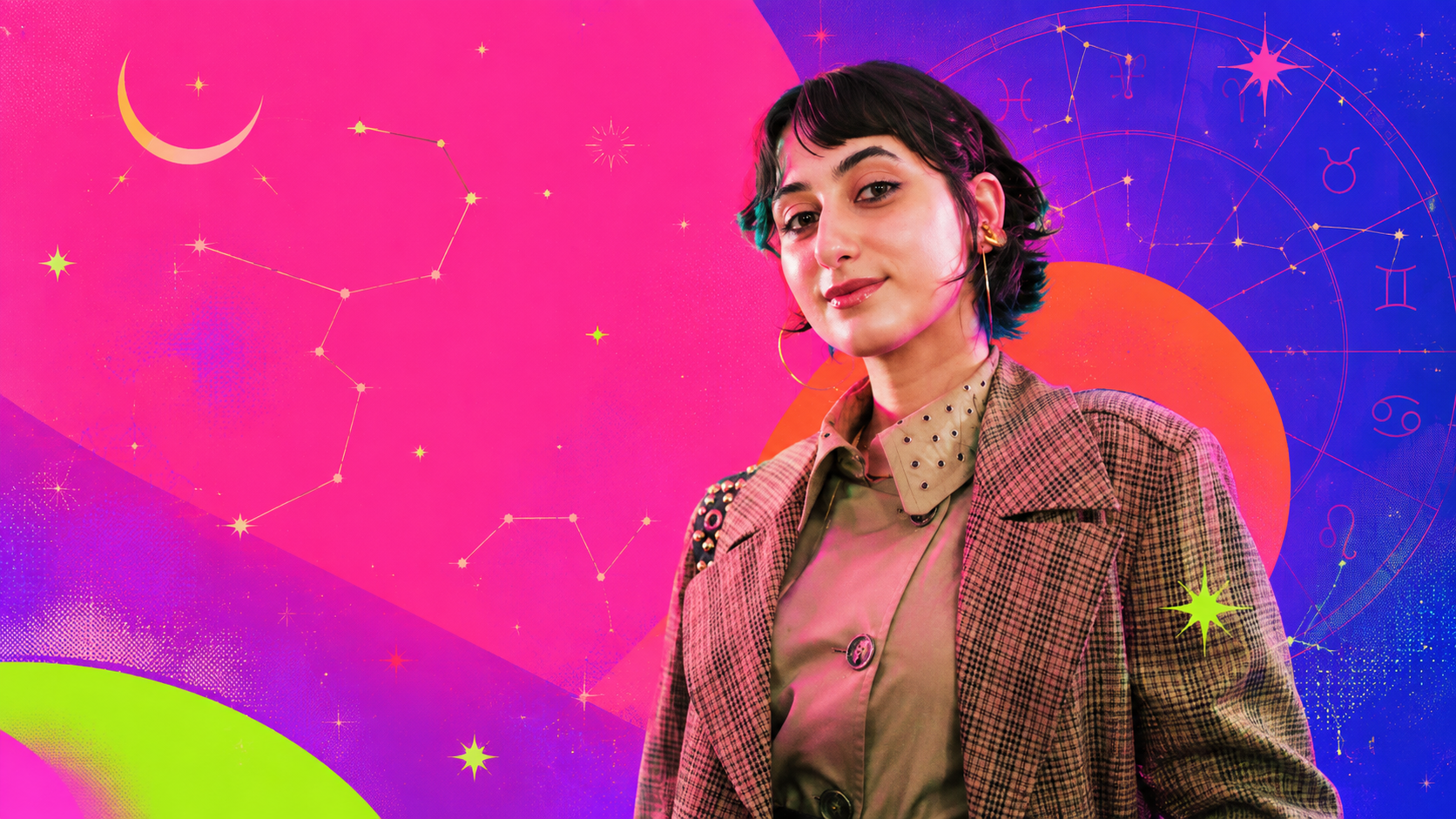
Before Rama Duwaji became New York City’s First Lady, she had already built a visual language of her own.
She was an illustrator, animator, and ceramicist whose work centered Arab identity, sisterhood, communal experience, political attention, and the emotional details of ordinary life. Her drawings appeared in publications and institutions including The New Yorker, The Washington Post, BBC, VICE, and Tate Modern. Her animations gave still images movement. Her ceramics brought illustration into the hand: plates, vessels, and surfaces meant to be held rather than simply viewed.
The public title arrived later.
When her husband, Zohran Mamdani, became mayor of New York City in January 2026, Duwaji entered a role that creates an image before the person has necessarily agreed to its terms. “First Lady” is not only a relationship description. It is a civic archetype, a media category, a set of expectations, and an invitation for strangers to decide what a woman beside power should represent.
Duwaji’s response has been consistent with the artistic identity she established before City Hall.
Her focus remains the work.
In an April 2026 studio interview with Hyperallergic, she described illustration as an accessible practice that could begin in notebook margins or on the subway. She spoke about working within limitations, maintaining a visual language, using art as an archive of the news, protests, friendships, architecture, and daily observations moving through her life. She also made clear that public visibility had not made political honesty less important to her. It had made attentiveness and complexity more necessary.
That distinction matters.
Rama Duwaji did not become visually significant because she entered public life.
She entered public life as someone who already understood that framing is power.
Her birth chart reflects that problem with unusual precision.
Duwaji has a Cancer Sun and Mercury, an exalted Taurus Moon, Venus in Leo, Mars in Libra, retrograde Jupiter and Uranus in Aquarius, Saturn in Aries, retrograde Neptune in Capricorn, retrograde Pluto in Sagittarius, and the true North Node in Virgo.
The chart is organized around three principal structures:
A closed Sun–Moon–Venus dispositor circuit, linking identity, feeling, beauty, memory, craft, and authorship.
A creative cradle built around Venus opposite Uranus, with Mars and Pluto converting tension into form, movement, and durable expression.
A Venus–Neptune opposition that makes aesthetics, projection, symbolism, and the collective image central questions in the life.
This is not a chart asking whether art can become public.
The art was always capable of becoming public.
The deeper question is whether the public image can remain accountable to the artist who created the frame.
A Note About the Birth Time
The chart used for this reading is set to 12:00 noon, not a verified birth time.
The houses, Ascendant, Midheaven, and other angles are therefore excluded.
The Moon is more reliable than it is in many noon charts. It remained in Taurus throughout the entire local birth date, moving from approximately 12°51′ Taurus at the beginning of June 30 to approximately 26°20′ Taurus at the end of the day.
Rama Duwaji is therefore securely a Taurus Moon.
The exact lunar degree and all Moon aspect orbs remain birth-time dependent. The noon chart places the Moon at 19°37′ Taurus, but the sign itself does not change.
The planetary positions from the Sun through the true North Node are stable enough for interpretation.
Cancer Sun: The Private Center Behind the Public Image
Duwaji’s Sun is at 8°55′ Cancer.
Cancer is concerned with memory, belonging, protection, ancestry, home, emotional continuity, and the private material from which identity is built.
The sign is often reduced to softness.
That misses its deeper function.
Cancer protects what it considers alive.
It remembers the details that institutions flatten. It understands that identity is not created in isolation but carried through family stories, food, language, place, friendship, grief, and the ordinary rituals through which people recognize one another.
This is an especially resonant Sun sign for an artist whose work repeatedly returns to communal life and the experience of women within culture.
Duwaji’s own description of her practice emphasizes sisterhood and shared experience. Her 2024 School of Visual Arts thesis, Sahtain!, celebrated the communal preparation and sharing of food through animation, illustration, and objects.
The title is an Arabic expression offered around eating, carrying the wish that nourishment bring health twice over.
The project is profoundly Cancerian without becoming sentimental.
Food becomes memory.
Preparation becomes relationship.
A recipe becomes a social archive.
Cancer understands that the domestic is never merely domestic. Who cooks, who is welcomed, which ingredients survive migration, what is remembered by the hand, and who gathers around the table are all questions of culture and power.
For Duwaji, the private world is not the opposite of political life.
It is where political meaning becomes human.
Sun Conjunct Mercury: The Image and the Story Share a Source
Mercury is at 14°50′ Cancer, conjunct the Sun by 5°55′.
The conjunction is wider than some of the chart’s tighter aspects, but it remains important because it joins identity with language, interpretation, storytelling, and the process of deciding what deserves attention.
Mercury in Cancer thinks through association.
It remembers atmosphere, tone, gesture, and emotional context. It may understand the meaning of a moment through the feeling that remains afterward rather than through a detached inventory of facts.
For a visual artist, this is a powerful narrative intelligence.
The image does not simply illustrate information.
It remembers what the information felt like.
Duwaji has described her work as an archive of what moved her at a particular time: news, protests, conversations, architecture, friendships, and things encountered on the way home. That is an almost literal expression of Mercury in Cancer beside the Sun.
The mind collects lived material and returns it as authored memory.
The conjunction also means that voice is personal.
Criticism of the work may feel close to criticism of the self because the ideas and identity are generated from the same center. The developmental task is not emotional detachment. It is learning how to preserve sensitivity without making every external response the final authority on what the work means.
Sun Square Mars: Protection Becomes Intervention
The Sun squares Mars at 5°13′ Libra with an orb of 3°43′.
This is one of the chart’s central engines.
The Cancer Sun protects emotional truth, culture, memory, and belonging.
Mars in Libra acts through relationship, aesthetics, social judgment, comparison, composition, and the demand that competing positions be brought into view.
The square creates friction between the protected interior and the contested social field.
It does not produce a passive Cancer identity.
It produces a person who may experience action as necessary when something intimate, communal, or human is being misrepresented.
Mars in Libra is often misunderstood because Mars prefers direct movement while Libra sees multiple sides and anticipates response. The result can be delayed action, strategic action, or action expressed through design rather than force.
For an artist, that is significant.
Composition becomes confrontation.
Beauty becomes argument.
The choice of who is centered, what is omitted, which body is drawn, and which story receives visual dignity can function as a form of intervention.
Duwaji has said that everything is political: what is shown, what is omitted, which stories are highlighted, and which remain in the margins.
Sun square Mars describes the urgency beneath that position.
The work is not only an expression of identity.
It is an attempt to act upon the frame.
The Exalted Taurus Moon: Feeling Becomes Material
Duwaji’s Moon remained in Taurus throughout June 30, 1997.
The Moon is exalted in Taurus.
Astrological exaltation describes a placement with unusual capacity to perform its function. The Moon governs emotional regulation, bodily memory, instinct, care, belonging, repetition, and the need for safety. Taurus gives those lunar functions patience, material intelligence, sensory awareness, and continuity.
Feeling wants a form.
It wants a surface, a texture, a meal, an object, a repeated practice, or something the hands can return to.
This Moon is highly coherent with Duwaji’s movement between illustration, animation, and ceramics.
Digital work offers immediacy and circulation.
Ceramics offers weight.
Clay slows the process and makes the image bodily. A plate must be shaped, dried, fired, held, used, and possibly broken. It belongs to the same world as food and gathering.
Duwaji has described ceramics as grounding and as a medium that forces her beyond the two-dimensional logic of illustration. That grounding function belongs naturally to a Taurus Moon.
The placement also supports loyalty to a visual language.
Taurus does not change merely because the audience has moved on. It develops through repetition, refinement, and a growing trust in the body’s recognition of what is worth preserving.
The challenge is that steadiness can become attachment.
A familiar method may remain comfortable after the work is ready to evolve. A stable image may become difficult to release. Public commentary may be endured silently until the accumulated pressure becomes heavier than the original event.
The exalted Moon gives emotional durability.
It also asks that durability remain alive rather than becoming a reason to stay inside a frame that no longer fits.
The Noon Moon Aspects
At noon, the Taurus Moon forms three notable aspects within five degrees:
Moon square Jupiter — 1°39′
Moon trine the true North Node — 3°19′
Moon sextile Mercury — 4°46′
These exact orbs depend on the birth time.
Moon Square Jupiter
At noon, the Moon squares retrograde Jupiter in Aquarius.
Taurus seeks enoughness, continuity, and tangible security. Aquarius expands toward communities, causes, networks, and the future.
The square can create tension between the need to remain grounded in immediate life and the pressure to respond to a much larger collective field.
A person may feel responsible for more than the nervous system can sustainably hold.
The aspect can also enlarge generosity, appetite, hospitality, and emotional conviction. The challenge is distinguishing genuine capacity from the expectation that one must emotionally contain every crisis visible to the public.
Moon Trine the North Node
At noon, the Moon trines the true North Node in Virgo.
The Taurus–Virgo connection supports growth through craft, repetition, material intelligence, and the patient improvement of a skill.
The emotional system stabilizes when the work becomes specific.
A feeling is not required to remain abstract. It can become a line, a sequence, a plate, a workshop, a recipe, or a finished object.
Moon Sextile Mercury
At noon, the Moon sextiles Mercury in Cancer.
This suggests cooperation between bodily feeling and narrative memory. The person may translate emotion into image or language without needing to separate the two completely.
Again, all three lunar aspect orbs are provisional.
The secure statement is the exalted Taurus Moon itself.
The Sun–Moon–Venus Dispositor Circuit: The Chart Returns to Art
The most important technical structure in Duwaji’s chart is not an aspect.
It is rulership.
The Cancer Sun is ruled by the Moon.
The Taurus Moon is ruled by Venus.
Venus in Leo is ruled by the Sun.
This creates a closed circuit:
Sun → Moon → Venus → Sun
Identity leads to feeling.
Feeling leads to value and art.
Art leads back to identity.
The loop is not limited to three planets.
Mercury in Cancer reports to the Moon.
Mars in Libra reports to Venus.
Saturn in Aries reports to Mars and therefore enters the Venus–Sun–Moon circuit.
Jupiter and Uranus in Aquarius traditionally report to Saturn.
Neptune in Capricorn reports to Saturn.
Pluto in Sagittarius reports to Jupiter.
The North Node in Virgo reports to Mercury.
Under traditional sign rulership, the entire chart eventually feeds into the Sun–Moon–Venus loop.
This is a chart-wide dispositor circuit.
Everything returns to the relationship between authorship, emotional truth, material experience, and aesthetic form.
That does not mean every event becomes art immediately.
It means the chart has a natural mechanism for processing life through creation.
Public role, private memory, conflict, travel, friendship, politics, domestic experience, and collective pressure are all drawn toward the same question:
What form can hold this without flattening it?
This helps explain why the distinction between artist and public symbol is so consequential.
Art is not an accessory to the identity.
It is the central circulation system through which the identity remains coherent.
Venus in Leo: The Right to a Visual Signature
Venus is at 2°20′ Leo.
Venus governs art, aesthetics, value, attraction, relationship, pleasure, and the instinct for proportion.
In Leo, Venus wants authorship.
It does not merely want something to be beautiful. It wants the beauty to carry a recognizable signature.
Leo is associated with creative self-expression, visibility, performance, warmth, and the courage to make the personal style legible.
Duwaji’s work is recognizable because it does not disappear behind the assignment.
Even when illustration begins with an external text, the finished image maintains its own world. In her description of the medium, she has emphasized the puzzle of conveying an emotion or story within a frame while still preserving her visual language.
That sentence could serve as the operating principle of Venus in Leo.
The artist accepts the guideline without surrendering authorship.
This placement also becomes central to her public life.
A first lady is often read aesthetically before she is read intellectually. Clothing, posture, setting, and visual association become part of a political narrative whether or not the person intends them to.
Venus in Leo understands the force of presentation.
But because Venus is tied into the chart-wide dispositor circuit, presentation cannot remain empty spectacle. It must return to emotional truth and personal authorship.
The image must still belong to the person inside it.
Venus Trine Pluto: Beauty With Consequence
Venus trines Pluto at 3°18′ Sagittarius with an orb of 0°58′.
This is the chart’s tightest time-stable aspect.
Venus–Pluto aspects give aesthetics intensity.
Beauty is not neutral. Attraction, taste, style, and relationship become ways of approaching power, grief, transformation, desire, memory, and what a culture attempts to hide.
The trine allows these themes to cooperate.
Duwaji can make difficult material visually compelling without erasing its weight. The work may invite the viewer through grace, tenderness, humor, or formal clarity and then reveal a more consequential emotional or political layer.
In Leo and Sagittarius, the aspect also supports conviction.
The artist may trust that beauty can carry a position without becoming propaganda and that emotional directness can coexist with visual sophistication.
The shadow is seduction by intensity itself.
A powerful image can feel true because it is powerful. The aspect becomes strongest when form deepens the subject rather than replacing complexity with impact.
Venus Sextile Mars: The Hand Acts on the Aesthetic Decision
Venus sextiles Mars by 2°52′.
This is a productive relationship between taste and action.
Venus decides what feels coherent.
Mars gives the decision movement.
In Leo and Libra, the aspect is strongly visual and relational. It supports composition, styling, gesture, animation, collaboration, and the translation of an aesthetic instinct into an active choice.
The sextile also gives social warmth to a chart containing considerable pressure around public interpretation.
There is pleasure in making.
Not every image has to carry the full weight of history. Humor, beauty, friendship, motion, and ordinary delight remain part of the practice.
Duwaji has described animation as a place where humor and personality enter objects that are normally quiet or still. That is Venus–Mars in action: form becomes movement without losing charm.
Venus Opposite Uranus: The Artist Refuses the Assigned Category
Venus opposes retrograde Uranus at 7°47′ Aquarius with an orb of 5°27′.
This opposition supplies the main axis of the chart’s cradle configuration.
Venus in Leo wants a personal, authored visual identity.
Uranus in Aquarius disrupts categories, resists ownership, and responds to social systems, networks, technology, and collective change.
The opposition creates tension between the signature and the system.
How does an artist remain recognizable without becoming predictable?
How does a woman occupy a public archetype without allowing the archetype to standardize her?
How does art circulate through digital networks without becoming optimized only for the network’s demands?
Venus–Uranus needs freedom inside relationship and originality inside form.
It may change medium when one medium becomes too limiting. It may resist the separation between commercial illustration and fine art. It may place drawings on cardboard, animate recipes, turn ceramics into narrative surfaces, or use the constraints of an assignment as the beginning of invention.
The opposition can also produce abrupt changes in visibility.
A person may become aesthetically influential before she has decided whether influence is a role she wants. Public attention can arrive through association and then attempt to redefine the work that existed before it.
The task is not to avoid visibility.
It is to remain creatively mobile enough that visibility cannot harden into a cage.
Venus Opposite Neptune: The Person and the Symbol
Venus opposes retrograde Neptune at 29°06′ Capricorn with an orb of 3°14′.
This is one of the most biographically important aspects in the chart.
Neptune governs image, projection, idealization, glamour, longing, symbolism, sacrifice, and the porous boundary between what is seen and what is imagined.
Venus governs aesthetics, relationship, and value.
The opposition makes the visual field emotionally charged.
Other people may encounter an image and supply the rest of the story themselves.
Duwaji’s emergence as a public figure illustrates the aspect clearly. She has been projected upon as a style figure, political emblem, generational representative, Muslim woman, Arab artist, mayoral spouse, activist, and symbol of what a modern first lady should or should not be.
Some of those descriptions may contain truth.
None can contain the complete person.
Venus opposite Neptune can create extraordinary visual sensitivity because the artist understands atmosphere and symbolic resonance. It is capable of tenderness, lyricism, and images that feel larger than their literal content.
It also requires boundaries.
The public may confuse access to the image with access to the person.
The artist may feel pressure to maintain a version of herself that has become meaningful to others.
Aesthetic choices can be interpreted as total political statements even when they emerged from a more layered process.
The aspect does not ask Duwaji to eliminate symbolism.
Symbolism is one of her instruments.
It asks her to retain the right to define the distance between symbol and self.
The Creative Cradle: Tension Becomes a Practice
Duwaji’s chart contains a cradle configuration built around the Venus–Uranus opposition.
The principal aspects are:
Venus opposite Uranus — 5°27′
Venus sextile Mars — 2°52′
Mars trine Uranus — 2°35′
Venus trine Pluto — 0°58′
Pluto sextile Uranus — 4°29′
Mars sextile Pluto — 1°54′
A cradle does not remove the opposition.
It gives the opposition places to go.
The tension between personal authorship and collective disruption can be processed through Mars in Libra and Pluto in Sagittarius.
Mars gives action, design, collaboration, motion, and the willingness to intervene.
Pluto gives depth, conviction, transformation, and the capacity to remain with material that is politically or emotionally consequential.
The Mars–Pluto sextile forms the supportive base.
The chart can convert disruption into work.
This is an important distinction because Venus–Uranus alone can become restless, oppositional, or unable to remain with one form. The cradle gives continuity. Experimentation does not have to mean fragmentation. A change in medium can still belong to the same visual language.
Neptune extends the configuration.
Venus also opposes Neptune, while Neptune sextiles Pluto by 4°12′. The result is a wider creative network in which image, politics, movement, material, experimentation, and transformation continually exchange energy.
This is a chart built for interdisciplinary practice.
Illustration does not have to remain flat.
Animation does not have to remain digital.
Ceramics does not have to remain functional.
Political art does not have to abandon beauty.
The form can change while the authorship remains intact.
Mars in Libra: Action Through Composition
Mars is at 5°13′ Libra.
Mars is traditionally in detriment in Libra.
This does not mean the planet is powerless.
It means action cannot proceed as though relationship, proportion, and consequence do not exist.
Mars in Libra sees the other side before acting. It notices how an intervention will alter the entire composition. It may hesitate when every choice creates a new imbalance, but it can also become highly strategic because it understands that force is not the only form of power.
For Duwaji, Mars belongs naturally to design.
A line directs attention.
A frame creates inclusion and exclusion.
An image can move a viewer without issuing a command.
The placement may prefer persuasion, juxtaposition, visual intelligence, and collaborative action over blunt confrontation.
But the square from the Cancer Sun means the action is not emotionally neutral.
When belonging, culture, memory, or human dignity feels threatened, Libra’s deliberation can become focused advocacy.
The challenge is indecision created by anticipated response.
An artist with Mars in Libra may know too well how every audience will interpret a choice. The work becomes stronger when the need for perfect consensus is released and the aesthetic decision is allowed to stand.
Mars Sextile Pluto: Controlled Force
Mars sextiles Pluto by 1°54′.
This aspect provides concentrated will.
Mars decides where energy goes.
Pluto intensifies the commitment.
The sextile is especially useful for sustained creative labor because it supports effort beyond the initial inspiration. It can remain with a project through revision, repetition, technical frustration, and the emotional difficulty of the subject.
In Libra and Sagittarius, the force has an ethical or ideological dimension. The artist may act because a representation feels unjust, incomplete, or culturally dishonest.
The aspect is strongest when conviction becomes disciplined work rather than permanent combat.
Mars Trine Uranus: Movement Finds the Unexpected Solution
Mars trines Uranus by 2°35′.
This is a signature of inventive action.
The person can respond quickly when a conventional method no longer works. Technology, animation, unexpected materials, and hybrid forms become natural channels for the energy.
The trine supports experimentation without requiring rebellion for its own sake.
Duwaji’s recent interest in drawing on flattened moving boxes, carving scraps of wood, printmaking with discarded container tops, and working with leftover clay reflects the aspect’s ability to find a method inside what is already available.
The solution does not need institutional permission.
It needs enough freedom to begin.
Mercury Square Saturn: The Voice Learns Weight
Mercury squares Saturn at 19°29′ Aries with an orb of 4°39′.
Mercury in Cancer remembers context and speaks from emotional knowledge.
Saturn in Aries demands independence, accountability, and the courage to stand behind a statement without hiding inside the group.
The square can make communication feel consequential.
Words may be revised repeatedly because the person anticipates criticism, misunderstanding, or the possibility that a statement will be removed from its original context.
For a public artist, this is not an abstract concern.
Images and sentences can circulate far beyond the audience for which they were first made. Earlier work can be reread through a later public role. A teenage statement can be excavated and treated as though no development occurred afterward.
Mercury square Saturn can respond by becoming silent, defensive, or excessively controlled.
Its mature expression is disciplined honesty.
The voice does not have to be flawless to be responsible.
It has to be willing to examine consequences, acknowledge harm, and continue developing.
Duwaji’s 2026 response to the resurfacing of harmful teenage posts demonstrated this Saturnian function: she did not use age as a complete excuse and placed the emphasis on care, responsibility, and the work she intends to continue.
Astrology does not prove motive.
But the symbolic structure is coherent with a life in which language, memory, accountability, and public scrutiny are tightly linked.
Saturn in Aries: Authority Must Become Personal
Saturn is at 19°29′ Aries.
Saturn is traditionally in fall in Aries.
Again, this is not a sentence of failure.
Saturn builds through patience, structure, and accumulated authority. Aries begins through instinct, independence, and immediate self-definition.
The placement must learn how to create structure without waiting for an institution to grant permission first.
This is especially significant for someone entering an inherited public role.
There are existing scripts for a first lady: ceremonial visibility, cultural patronage, domestic symbolism, philanthropic focus, fashion scrutiny, and proximity to political power.
Saturn in Aries may experience those scripts as both responsibility and limitation.
Authority cannot be borrowed entirely from the title.
It must be constructed through personal decisions.
The placement asks:
What obligations are real?
Which expectations were never consciously accepted?
What kind of public presence can be sustained without compromising the work?
Where must a boundary be established before resentment establishes it instead?
Saturn in Aries grows by choosing a structure and inhabiting it deliberately.
It does not become mature by obeying every expectation.
It becomes mature by accepting responsibility for the expectations it chooses to carry.
Jupiter Retrograde in Aquarius: The Collective Vision Turns Inward First
Jupiter is at 21°16′ Aquarius and retrograde.
Jupiter governs expansion, belief, meaning, education, publishing, worldview, and the instinct to connect personal experience to a wider social pattern.
Aquarius expands through communities, networks, political ideas, unconventional alliances, and the future imagined beyond the current system.
Retrograde Jupiter internalizes the process.
The person may distrust inherited consensus and require a belief to become personally coherent before presenting it as truth.
This is compatible with an artist whose work addresses collective issues without abandoning the specificity of individual experience.
Aquarius can become abstract.
The rest of Duwaji’s chart prevents that abstraction from floating too far away from the body. The Taurus Moon, Cancer placements, and Venus circuit continually return the social idea to food, friendship, image, memory, and the person inside the system.
Jupiter Sextile Saturn: Vision Can Become Structure
Jupiter sextiles Saturn by 1°46′.
This is one of the chart’s most constructive aspects.
Jupiter imagines scale.
Saturn establishes limits.
Aquarius considers the collective future.
Aries asks what the individual will do now.
The sextile supports the movement from conviction to structure. An idea can become a project. A political concern can become a visual sequence. A community value can become a workshop, an object, or an institutionally legible body of work.
The aspect also helps regulate the chart’s cardinal-fixed balance.
Duwaji has enough cardinal energy to begin and enough fixed energy to sustain. Jupiter–Saturn provides a bridge between expansion and endurance.
Uranus Retrograde in Aquarius: Independence From the Inside
Uranus is at 7°47′ Aquarius and retrograde.
Uranus is especially strong in Aquarius under modern rulership.
The placement belongs to a generation shaped by digital networks, rapidly changing media, global political consciousness, and the collapse of older boundaries between private expression and public circulation.
Retrograde motion turns some of that disruption inward.
The person may appear composed while internally resisting categories that feel imposed from outside.
Uranus opposes Venus and trines Mars, making experimentation a direct part of the aesthetic process.
The visual identity must remain alive.
When the public decides it understands the style completely, the chart is likely to seek another material, scale, or movement that reopens the question.
Neptune Retrograde in Capricorn: The Institution Becomes an Image
Neptune is at 29°06′ Capricorn and retrograde.
The final degree of a sign can intensify its themes.
Capricorn concerns institutions, authority, hierarchy, public role, reputation, and the structures through which society organizes legitimacy.
Neptune dissolves certainty and creates projection.
Together, they describe the dream and mythology surrounding institutions.
A title can appear more solid than it is.
A public role can become a screen for collective fantasies about power, marriage, femininity, culture, and respectability.
Neptune’s opposition to Venus makes this personal.
Duwaji’s appearance, art, clothing, and relational identity can be interpreted through the institution she now stands beside, even when the work has its own origin and purpose.
The retrograde asks for an internal definition of value strong enough to survive the institution’s projections.
Pluto Retrograde in Sagittarius: The Image Carries a Worldview
Pluto is at 3°18′ Sagittarius and retrograde.
Pluto in Sagittarius belongs to a generation transformed by migration, ideology, global media, religion, borders, education, and competing claims about truth.
For Duwaji, these themes are not distant.
She has described living across several places and developing an identity that could not be reduced to a simple national category. Earlier interviews discussed the disorientation of being read as American in the Gulf and then discovering that she did not feel conventionally American in the United States.
Her work became one place where cultural identity could be explored without requiring a single final definition.
Pluto trines Venus, sextiles Mars, and sextiles Uranus.
Worldview becomes visual.
The work can transform how a viewer understands a body, a community, a political event, or a cultural memory because the image carries more than style. It carries an argument about what deserves to be seen.
The True North Node in Virgo: The Work Becomes Specific
The true North Node is at 22°56′ Virgo.
Virgo growth asks for discernment, skill, service, editing, repetition, and respect for the small decision that makes the larger work possible.
This is an important counterweight to public symbolism.
The larger the image around Duwaji becomes, the more the path returns her to the actual practice.
What is the next drawing?
What material is available?
What sequence needs revision?
What detail is inaccurate?
What can be made more useful, more precise, or more honest?
Virgo does not defeat projection by creating a larger projection.
It defeats projection through specificity.
The North Node also reports to Mercury in Cancer, which reports to the Moon, Venus, and Sun. The developmental path therefore reenters the same dispositor circuit.
Craft protects authorship.
Routine protects the artist from becoming only an image of an artist.
The chart grows through returning to the work in front of her.
Element and Modality Balance
Including the true North Node, Duwaji’s chart contains:
Fire: 3
Earth: 3
Air: 3
Water: 2
The elements are unusually balanced.
No single element dominates the entire chart.
Fire supplies creative authorship, conviction, and the willingness to be visible.
Earth supplies material intelligence, patience, craft, and the need to make ideas tangible.
Air supplies design, social awareness, networks, and the ability to understand the image within a wider system.
Water supplies memory, emotional context, and sensitivity to belonging.
The modality balance is more distinctive:
Cardinal: 5
Fixed: 4
Mutable: 2
Cardinal energy begins.
Fixed energy sustains.
Mutable energy adapts.
Duwaji’s chart is built to initiate and continue, with less emphasis on effortless adjustment.
This can be excellent for developing a coherent practice. She can begin from an internal necessity and remain with the work long enough for a signature to emerge.
The challenge is that public life changes the context faster than the chart may want to change the form.
Adaptation must remain conscious.
She does not need to reinvent herself for every audience response, but she does need enough flexibility to prevent a successful identity from becoming a permanent assignment.
The Biography in the Chart
The chart does not predict a career in illustration, an MFA thesis about communal food, a marriage to a mayor, a home at Gracie Mansion, or a particular political position.
It describes an architecture that makes those biographical themes symbolically coherent:
Cancer Sun and Mercury: identity and narrative rooted in memory, culture, belonging, and lived emotional context.
Exalted Taurus Moon: feeling translated into material, sensory, and repeatable form.
Sun–Moon–Venus dispositor circuit: the entire chart returning to authorship, care, beauty, and the need to make experience visible.
Venus in Leo: a recognizable visual signature and the insistence that an assignment still carry the artist’s voice.
Venus opposite Uranus: creative independence, experimentation, and resistance to the category assigned by the collective.
Venus opposite Neptune: beauty, projection, symbolism, and the pressure of becoming a public image.
Venus–Uranus cradle: tension converted into interdisciplinary practice through Mars and Pluto.
Sun square Mars: private values becoming public intervention.
Mercury square Saturn: communication shaped by scrutiny, responsibility, memory, and the consequences of circulation.
Jupiter sextile Saturn: collective vision made tangible through structure.
North Node in Virgo: growth through craft, specificity, useful work, and disciplined return to the actual practice.
The biography begins with an artist developing a language around identity and communal life.
The public story begins when that artist becomes attached to a civic title large enough to threaten the distinction between the work and the role.
The chart’s answer is not withdrawal.
It is authorship.
What People May Misunderstand
Duwaji’s visual restraint can be mistaken for passivity.
The chart is not passive.
The Taurus Moon is steady, but the Sun squares Mars.
Mars trines Uranus and sextiles Pluto.
Venus opposes both Uranus and Neptune.
Mercury squares Saturn.
The composed image contains substantial tension, conviction, and resistance to being defined from outside.
Her privacy can also be mistaken for a lack of public thought.
Cancer and Taurus do not reveal everything merely because an audience asks. They protect what has not yet found a trustworthy container.
The person may be highly aware of the collective field while remaining selective about access to the private center.
The public title can create another misunderstanding.
Because she is the spouse of a mayor, her art may be reread as an extension of his politics rather than as a practice with its own history.
The dispositor circuit argues against that reduction.
The art is not secondary to the role.
The role is one more experience the art must metabolize.
What looks like aesthetic instinct may contain extensive ethical and compositional judgment.
What looks like calm may be the Taurus Moon refusing to react before the response has enough form.
What looks like experimentation may be a disciplined effort to prevent the visual language from becoming institutional property.
The Shadow Pattern
The chart’s shadow emerges when the image becomes easier to manage than the person.
Venus opposite Neptune can encourage projection from the audience and self-projection from the artist. The public symbol may become so aesthetically coherent that it begins to demand maintenance.
Venus opposite Uranus can respond by rejecting the role abruptly, changing direction before a form has fully developed, or confusing freedom with permanent distance.
The Taurus Moon can remain inside a familiar method because the method feels safe.
The Cancer Sun can protect the private world so completely that necessary public boundaries are never stated directly.
Mercury square Saturn can over-edit, anticipate punishment, or treat every imperfect statement as evidence that silence would have been safer.
Sun square Mars can turn protective anger into exhaustion when every external interpretation feels like something that must be corrected.
The shadow is not excessive visibility alone.
It is allowing visibility to determine the terms of creation.
Growth requires several distinctions:
The person is not the title.
The work is not the audience’s projection.
Privacy is not avoidance.
Visibility is not ownership.
A public image can be useful without becoming the complete self.
The chart does not need less beauty, less conviction, or less political attention.
It needs the frame to remain permeable enough that the artist can continue changing inside it.
The Growth Path
The North Node in Virgo provides the clearest direction.
Duwaji grows through specificity.
Not every collective demand deserves an immediate response.
Not every symbolic interpretation requires correction.
Not every public title needs to become a total identity.
Virgo asks what can actually be done.
The chart’s growth path includes:
Returning to the daily practice when public identity becomes abstract.
Choosing the medium that serves the work rather than the medium the audience expects.
Building boundaries before resentment or exhaustion builds them instead.
Allowing accountability without turning self-punishment into proof of seriousness.
Using collaboration without surrendering authorship.
Letting beauty carry complexity rather than forcing every image into a single explanatory message.
Preserving private life as a source of reality, not as material automatically owed to the public.
Developing structures that make experimentation sustainable.
The Jupiter–Saturn sextile supports this path.
Vision can become a practice.
The exalted Moon supports it as well.
The body knows when the pace is unsustainable, when the material is wrong, and when an idea has not yet become tangible enough to share.
The Sun–Moon–Venus circuit ensures that growth does not require abandoning beauty or feeling for technical discipline.
The discipline exists to protect the beauty and feeling from being consumed by the image around them.
The Final Portrait
Rama Duwaji’s birth chart describes an artist whose private center and public image are destined to remain in conversation.
The Cancer Sun remembers.
The Taurus Moon gives memory material form.
Venus in Leo signs the work.
The dispositor circuit returns every major part of the chart to that relationship between identity, feeling, and aesthetic authorship.
The Venus–Uranus cradle gives her the ability to turn creative tension into movement, objects, experiments, and a practice that refuses one permanent category.
Venus opposite Neptune explains why beauty and projection are inseparable from the public story—and why the difference between being seen and being known must remain carefully protected.
Sun square Mars gives the work intervention.
Mercury square Saturn gives the voice consequence.
Jupiter sextile Saturn gives collective vision a structure.
The Virgo North Node returns everything to the next precise act of making.
The public met Rama Duwaji as a first lady after the art world had already met her as an illustrator, animator, and ceramicist.
Her chart suggests that order matters.
The title may enlarge the audience.
It cannot be allowed to become the origin story.
The central work of the chart is not escaping the frame.
It is keeping the frame honest.
Duwaji’s strength lies in knowing that an image can carry culture, tenderness, humor, politics, and memory without surrendering its complexity.
Her growth lies in extending that same principle to herself.
She can be an artist, a Syrian woman, a New Yorker, a spouse, a public figure, a friend, a maker, and a symbol to people who will never know her personally.
None of those frames is the complete portrait.
The artist remains the person who decides what enters the composition—and what is allowed to remain beyond its edges.
Principal Chart Signatures
Venus trine Pluto — 0°58′
Noon Moon square Jupiter — 1°39′, provisional
Jupiter sextile Saturn — 1°46′
Mars sextile Pluto — 1°54′
Mars trine Uranus — 2°35′
Venus sextile Mars — 2°52′
Venus opposite Neptune — 3°14′
Noon Moon trine true North Node — 3°19′, provisional
Sun square Mars — 3°43′
Neptune sextile Pluto — 4°12′
Uranus sextile Pluto — 4°29′
Mercury square Saturn — 4°39′
Noon Moon sextile Mercury — 4°46′, provisional
Venus opposite Uranus — 5°27′
Sun conjunct Mercury — 5°55′
Sun–Moon–Venus closed dispositor circuit
Chart-wide traditional dispositor chain feeding the Sun–Moon–Venus circuit
Venus–Uranus cradle supported by Mars in Libra and Pluto in Sagittarius
Venus–Neptune public-image opposition
Exalted Taurus Moon throughout the entire local birth date
Jupiter, Uranus, Neptune, Pluto, and the true North Node retrograde
Houses and angles excluded because the chart uses a noon placeholder
Frequently Asked Questions
What is Rama Duwaji’s zodiac sign?
Rama Duwaji is a Cancer Sun. Her Sun is conjunct Mercury and square Mars, connecting identity with narrative, memory, visual communication, and the need to act when something personally or culturally important is at stake.
What is Rama Duwaji’s Moon sign?
Her Moon is securely in Taurus. It remained in Taurus throughout June 30, 1997. The exact lunar degree and Moon aspect orbs depend on the unknown birth time.
Is Rama Duwaji’s Moon exalted?
Yes. The Moon is traditionally exalted in Taurus. This can emphasize emotional steadiness, sensory intelligence, material craft, loyalty, and the need to make feeling tangible.
What is Rama Duwaji’s rising sign?
Her rising sign cannot be determined reliably from a noon chart. The listed houses and angles produced by the assumed time are excluded from this reading.
What is the most important structure in Rama Duwaji’s chart?
The chart contains a closed dispositor circuit: the Cancer Sun is ruled by the Taurus Moon, the Taurus Moon is ruled by Venus in Leo, and Venus in Leo is ruled by the Sun. Under traditional rulership, every other placement eventually feeds into this Sun–Moon–Venus loop.
Does Rama Duwaji have a cradle in her birth chart?
Yes. Venus in Leo opposes Uranus in Aquarius, while Mars in Libra and Pluto in Sagittarius create supportive trines and sextiles around the opposition. This forms a creative cradle that helps convert tension into action, experimentation, and durable artistic work.
What is the closest aspect in her chart?
Venus trine Pluto at approximately 0°58′. The aspect gives aesthetics emotional and political depth and supports art capable of holding difficult material without losing visual power.
Why is Venus important in Rama Duwaji’s chart?
Venus rules her exalted Taurus Moon, participates in the chart-wide dispositor circuit, anchors the cradle, opposes both Uranus and Neptune, and trines Pluto. Art, value, authorship, relationship, public image, and creative freedom are therefore central organizing themes.
What does Venus opposite Neptune mean in her chart?
Symbolically, it links aesthetics with projection, idealization, and the collective image. It can support visual sensitivity and symbolic power while making boundaries between the person and the public image especially important.
Is this reading based on an exact birth time?
No. The chart uses a 12:00 noon placeholder. Houses, the Ascendant, the Midheaven, and other angles are excluded. The Taurus Moon sign is secure, but its exact degree and aspects remain provisional.
Your Chart Is Waiting
This portrait was built without a verified birth time, so it excludes the Ascendant, houses, and exact angles.
Even without them, the planetary architecture shows an unusually coherent relationship between identity, material craft, visual authorship, collective vision, and the pressure of public projection.
A verified birth time would establish the exact Moon degree, rising sign, house placements, and complete chart structure.
Book your personal chart reading—and find out what was written in your stars.
Editorial Source Notes
Biographical facts and quotations were checked against Rama Duwaji’s official portfolio, the School of Visual Arts, Hyperallergic, shado, and official New York City material.
Key reference points include:
Duwaji’s official description of herself as a Syrian illustrator and animator based in Brooklyn whose work examines sisterhood and communal experience.
Her professional work with The New Yorker, The Washington Post, BBC, Apple, Spotify, VICE, and Tate Modern.
Her hand-built ceramics and her practice of combining illustration with pottery.
The 2019 shado interview discussing identity, Arab cultural imagery, beauty standards, mental health, misogyny, and the representation of women of color.
Her 2024 MFA thesis at the School of Visual Arts, Sahtain!, a mixed-media project celebrating the communal preparation and sharing of food.
Her public role as First Lady of New York City beginning in January 2026.
The April 2026 Hyperallergic studio interview discussing accessibility, limitation, political art, public visibility, sisterhood, ceramics, and experimentation with found or inexpensive materials.
Mayor Mamdani’s July 2026 statement that Duwaji’s current focus remains her work as an independent artist who deserves to be known in her own right.
Astrological interpretation is symbolic and editorial. It is not a clinical psychological assessment or a factual claim about Rama Duwaji’s private thoughts, motives, or relationships.