Written in the Stars: The Birth Chart of Sebastian Maniscalco, Comedy's Arena Headliner
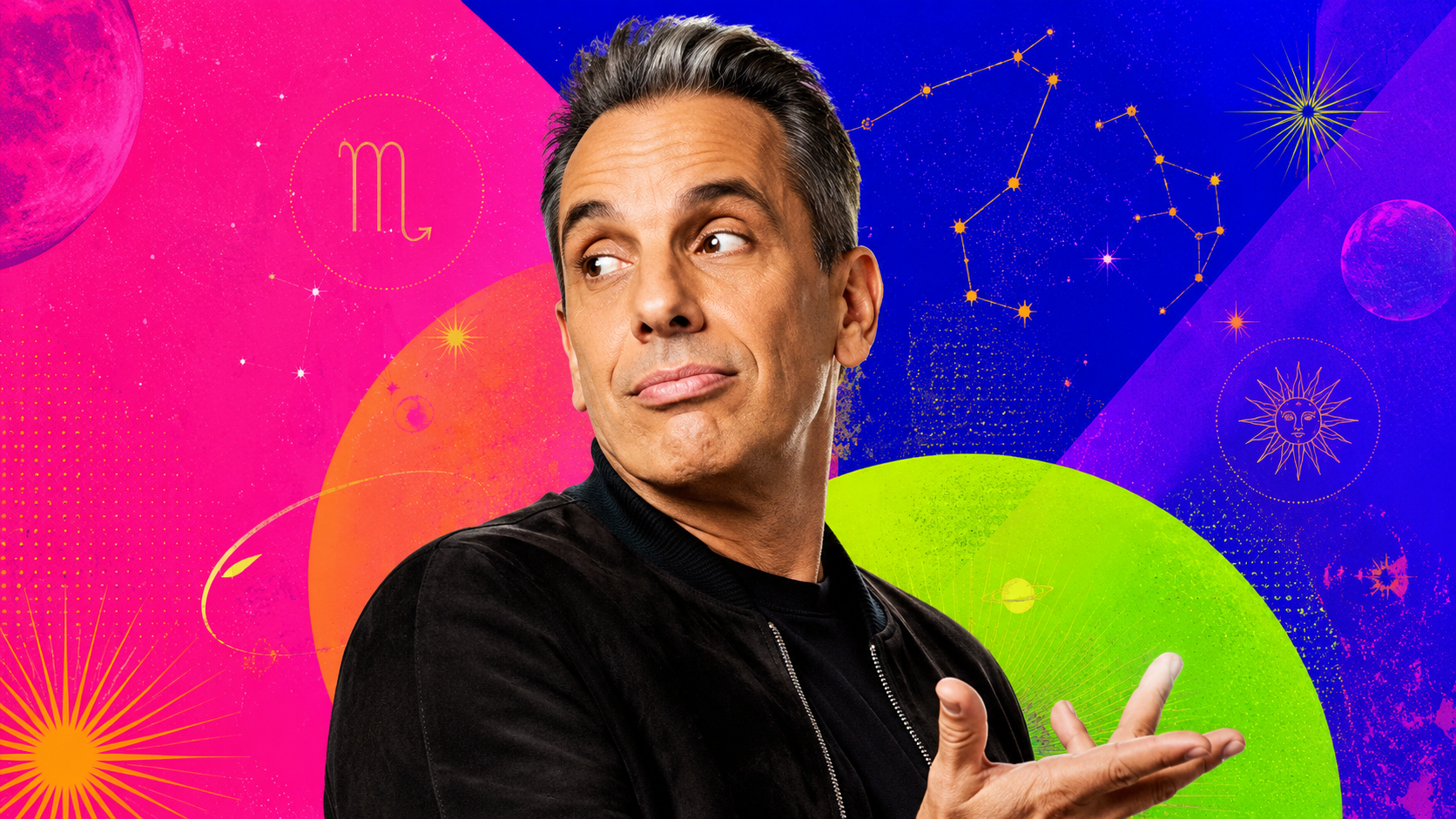
Every birth chart has a point of view. Sebastian Maniscalco's has a complaint. Born on July 8, 1973, in Arlington Heights, Illinois — a northwest Chicago suburb full of the exact well-mannered, hard-working people his comedy would spend decades defending — he carries a chart that reads like a grievance filed with the cosmos and granted in full: the sensitive traditionalist wired directly to a hair-trigger; the observer whose inner monologue was always going to become the act; the body built to perform the aggravation that the mouth was still composing. He is, by the numbers, the biggest live comedian of his era — the man who sold out Madison Square Garden four times in a single weekend — and the astrology's explanation for how a hospitality worker from the suburbs pulled that off is unusually complete.
Strip away the arenas, the Netflix specials, the Scorsese scenes, and what remains is the July sky over Cook County — and that sky was organized, with almost suspicious tidiness, around a single planet. Trace the classical rulership chains in this chart — each planet handing authority to the ruler of its sign — and every one of them, by every path, terminates in the same place: Mars, in Aries, its own sign, dignified and at full strength. Mars is this chart's final dispositor. Enter the psyche through any door — the feelings, the voice, the charm, the ambition — and you end up in the same room: the planet of heat, motion, and irritation, sitting on its own throne. Meghan Markle's chart, earlier in this series, funneled everything into a sovereign Leo Sun; Sebastian's funnels everything into a sovereign Aries Mars. Which is the astrological way of saying: everything in this man eventually becomes physical — the reaction, the opinion, the punchline. All of it exits through the body.
And then the chart hands over the rest of the mechanism, piece by piece. A Cancer Sun — the traditionalist, the family man — locked in a square to that Mars and a second square to Uranus, planet of the modern and the disruptive: the offended classicist, permanently aggravated by contemporary behavior, which is not a description of his comedy so much as its entire premise. A Venus in showbiz Leo standing opposite Jupiter, planet of the crowd, at 0°16′ of orb — essentially exact, the performer and the arena staring at each other across the wheel. And one structural detail so on-the-nose it borders on parody: run the element count, and his singleton earth — the chart's only grounded placement — is the North Node itself, in Capricorn: the point of destiny, standing alone, in the sign of the father, the work ethic, and the old ways. The man's career-summit film is titled About My Father. The chart filed that title in 1973.
A note on method before we begin: because his recorded birth time is set to noon, we're setting aside the houses and the rising sign, and reading the planets purely by sign, degree, and their conversations with one another. What's remarkable, as ever, is how much the chart says without them.
Let's begin where all charts begin — with the Sun.
The Sun in Cancer: The Offended Traditionalist
The Sun in Cancer — Sebastian's sits at 16°22′, midsummer, deep in the sign — is the zodiac's keeper of the hearth: family-first, tradition-minded, nostalgic, protective, and sensitive in the precise sense of registering everything. Cancer Suns are tuned to how things are supposed to feel — the household running right, the guest treated properly, the respect paid where respect is owed — and they experience violations of that order not as trivia but as personal affronts. This is the Sun of the man whose comedy is, at bottom, a defense of manners: the doorbell you don't ring unannounced, the party you bring something to, the handshake done correctly. Cancer doesn't invent values; it inherits them, and guards them.
The inheritance, in his case, has a name and an accent. The son of Salvatore — the Sicilian immigrant hairdresser whose old-world exasperation became the beating heart of the act — Sebastian built a career on the Cancer Sun's home territory: the Italian-American family, the mother's kitchen, the father's rules, the Sunday dinner as sacred institution. Cancer runs on memory and loyalty, and his material runs on both: nearly every classic bit is a piece of domestic archaeology, the old way held up next to the new way, to the new way's enormous disadvantage.
But a warm nostalgic Sun does not fill arenas by itself, and here the chart installs the engine — because this gentle, tradition-keeping Sun is squared from both sides. First, Sun square Mars (5°02′): the sensitive core at a permanent right angle to the planet of irritation — and not just any Mars, but the dignified, full-strength, final-dispositor Mars in Aries. Sun-Mars squares run hot: quick to aggravation, allergic to slowness and stupidity, physically expressive of every annoyance. In most lives this square is a temper to manage. In his, it is the product. The entire Maniscalco persona — the personally offended man, vibrating with disbelief at what he's just witnessed — is a Sun-Mars square doing standup. The aggravation was never incidental to the comedy. The aggravation is the comedy.
And then the second square names the target: Sun square Uranus (2°38′) — the traditionalist at a hard angle to the planet of the modern, the disruptive, the new. Sun-Uranus squares describe a life in permanent friction with contemporary norms, and his act has monetized that friction with almost scientific precision: the bewilderment at how people behave now — at the airport, at the gym, at the party, on the phone — delivered by a man visibly stranded in the wrong decade and proud of it. "Why would you do that?", the title of his breakout special, is a Sun-square-Uranus sentence. The chart's central comedy machine is exactly this triangle: Cancer supplies the standards, Uranus supplies the violations, and Mars supplies the reaction — at full, dignified, unfiltered volume.
Mercury Retrograde in Leo: The Inner Monologue, Externalized
The voice sits at 3°11′ of Leo, retrograde — and for a comedian, this Mercury deserves slow appreciation, because it describes not just that he's funny but the specific architecture of how.
Mercury in Leo is the performer's voice: warm, dramatic, story-shaped, constitutionally incapable of telling an anecdote without acting it out. It doesn't relay information; it stages it. But the retrograde is the masterstroke, because a retrograde Mercury turns the commentary inward — the running internal monologue, the mind that watches, replays, and privately editorializes. Now consider what a Maniscalco bit actually is: it is the inner monologue of a man observing other people's behavior — the silent, appalled commentary everyone has and suppresses — dragged out of the skull and performed at full theatrical scale. Mercury retrograde in Leo is that operation in a single placement: the private reaction, staged. He has effectively spent thirty years doing dramatic readings of his own internal dialogue, which is the retrograde-in-Leo job description verbatim.
The supporting aspects fill out the toolkit with almost suspicious completeness. Mercury trine Neptune (1°52′) is the imagery engine — the planet of the voice in flowing contact with the planet of illusion and mime. This is the act-out aspect: the full-body impressions, the wordless faces, the ability to become the guy at the buffet rather than describe him. Mercury sextile Pluto (1°19′) supplies the scalpel — observation that cuts to the exact absurd detail everyone noticed and nobody named; comedy's version of the surgical strike. Mercury opposite Jupiter (6°41′) licenses the exaggeration — hyperbole as rhetoric, the small offense inflated to operatic scale, which is half of how a bit about hors d'oeuvres becomes ten minutes. And a wide conjunction to Venus in Leo (6°57′) dresses the whole voice in style — because notice that the observations, however scathing, always arrive charming: tailored, polished, delivered in a suit.
One more wire matters enormously, and it's a hard one: Moon square Mercury (1°11′) — the second-tightest aspect in the chart. The visceral emotional reaction (a Scorpio Moon; we're getting there) collides with the speaking voice at a right angle, which in ordinary lives produces the blurt, the tone problem, the thing said before it was considered. In a comedian's chart it produces something priceless: the gap — the beat where the feeling has clearly arrived and the words haven't, the face doing the reacting while the mouth loads. Anyone who has watched him take a long, disgusted pause before the line knows this square by sight. The friction between what he feels and what he says isn't a flaw in the instrument. It's the timing.
The Moon in Scorpio: The Disgust Engine
The emotional core sits at 2°00′ of Scorpio — classically the Moon's fall, and, as this series keeps finding, the classical debilities are where the interesting careers live. A Scorpio Moon feels intensely and viscerally: reactions arrive in the body as full-strength states — contempt, suspicion, loyalty, disgust — with no diluted middle settings. It is a Moon that cannot fake neutrality. Show it something it finds ridiculous and the verdict is instant, total, and visible from the cheap seats.
Which is, of course, the other half of the act. If Mercury retrograde supplies the commentary, the Scorpio Moon supplies the reaction — the genuine, unmanufactured revulsion that makes the commentary land. His comedy is frequently described as "disgust-based," and astrologically that is not a metaphor: this Moon's native emotional register — the curled lip, the narrowed eyes, the full-body recoil from the guy eating over the open buffet — is the raw material the whole enterprise refines. Audiences can tell performed outrage from the real thing, and the reason his reads as real is that it is: a Scorpio Moon does not do bits about things it doesn't actually feel.
The chart then does something crucial: it disciplines the intensity. Moon trine Saturn (4°53′) — an out-of-sign trine, reaching from late Gemini — puts the volcanic feelings under professional management: emotional control, deadpan patience, the ability to hold a reaction for exactly as long as the laugh requires. Moon-Saturn harmony is the timing aspect, the containment that turns eruption into craft. And Moon sextile the North Node (5°38′) ties the feelings to the destiny: the visceral reactions aren't a private liability in this chart — they are, quite literally, the path. The thing he couldn't help feeling became the thing arenas pay to watch him feel.
Venus in Leo Opposite Jupiter: The Showman and the Arena
Now for the chart's tightest aspect, and its most prophetic. Venus — charm, taste, the audience's affection — sits at 10°09′ of Leo, the sign of the stage, the spotlight, and the show. Venus in Leo performs its charm: it dresses well, it holds the room, it understands presentation as a form of respect (his famous stage wardrobe — the suits, the loafers, the groomed — is this Venus's signature on every ticket). And this Venus stands in direct opposition to Jupiter in Aquarius, retrograde, at 0°16′ of orb — essentially exact.
Read the polarity: Leo is the individual performer; Aquarius is the mass audience. Venus is the charm; Jupiter is the multiplier. An exact Venus-Jupiter opposition across this axis is, almost literally, the showman facing the arena — personal magnetism and collective scale locked eye-to-eye, each demanding the other grow. Venus-Jupiter contacts are classically the most fortunate in astrology (charm that attracts abundance, audiences, benefactors), and the opposition is the version that plays at maximum size: not the comedy club's fifty seats but the amphitheater, the stadium tour, the four sold-out Gardens in a weekend, the "highest-grossing comedian" line on the Billboard chart. The aspect's caution is excess — more shows, more cities, more everything — but in a touring comic's life, excess is the business model. The chart got the venue right to within a sixteenth of a degree.
Two flowing trines complete the charm machinery. Venus trine Mars (1°11′) blends the affection with the aggression — and this is the aspect that solves the central puzzle of his appeal: the comedy is genuinely combative (mockery, contempt, aggravation) and yet lands as likable, even affectionate. Venus-Mars harmony lets the attack and the charm operate as one gesture; the audience being roasted is somehow also being embraced. And Venus trine Neptune (5°06′) adds the gloss — glamour, cinema, the aesthetic sheen that made him castable the moment Hollywood looked over: Green Book, then Scorsese's The Irishman, then a movie of his own. Venus in Leo never doubted it would end up on a marquee. The trines simply drew the route.
Mars in Aries: The Body as Punchline
And so to the throne room — the planet the whole chart reports to. Mars sits at 11°20′ of Aries, its own sign, fully dignified: the warrior at home, the engine at full compression. And in this chart, remember, Mars is the final dispositor — the terminus of every rulership chain. The feelings (Moon in Scorpio, Mars's classical sign) answer to it directly; the Sun squares it; everything else routes to it eventually. Whatever this psyche produces — opinion, emotion, observation — its final output format is Martial: kinetic, immediate, physical.
Which is the astrological explanation for the single most distinctive thing about him as a performer: the body is the act.Maniscalco is routinely called the most physical comedian of his generation — the strut, the recoil, the full-torso disbelief, the impressions built from posture before a word is spoken — and a dignified Aries Mars as final dispositor is precisely that wiring: a system in which everything eventually moves. Other comics write jokes and add gestures. His chart suggests the reverse assembly order: the physical reaction is the native language, and the words are the subtitles.
Mars's aspects sharpen the picture. Mars sextile Jupiter (1°28′) pipes the physical energy straight into the arena aspect — stamina at scale, the capacity to do the two-hundred-date tour and perform to the back row of a stadium with his shoulders. Mars square the Sun, as covered, converts the heat into the persona. And Mars square the North Node (3°42′) puts the drive at a hard angle to the destiny — the signature of a path advanced through friction: nothing about the climb was smooth, every stage of it was pushed for, and the impatience that made the twenty-year wait excruciating is the same force that made it end.
Saturn in Gemini: The Twenty-Year Apprenticeship
Here is the placement that explains the part of the biography the arenas obscure. Saturn — discipline, delay, mastery through repetition — sits at 27°07′ of Gemini, the sign of speech, wit, and words. Saturn in Gemini is the craft of language treated as a trade: timing drilled like scales, bits rewritten for years, the conviction that funny is not a gift but a discipline. It is the placement of the comic's comic — the one other comedians describe as technically flawless — and it is earned exactly the way Saturn always insists: slowly.
The receipts are famous precisely because they were unglamorous. He moved to Los Angeles in 1998 and spent the better part of a decade waiting tables at the Four Seasons Beverly Hills — serving the industry by day, doing open mics and bowling-alley gigs by night — a Saturn apprenticeship of nearly Dickensian length before Vince Vaughn's Wild West Comedy Show cracked the door in 2006, and years more grinding after that before the rooms became theaters and the theaters became arenas. Saturn square Pluto (4°45′) — the endurance aspect, the capacity to withstand sustained obscurity without quitting — is all over that stretch: the slow, pressurized decade that either breaks a performer or compresses him into something arena-grade. And the Moon's trine to this Saturn is what the audience now sees on stage every night: intensity, under exquisite control. The pause held one beat past comfortable. The reaction, rationed. Timing is just Saturn in Gemini with twenty years of reps, and his has exactly that.
The Outer Planets and the Node: A Generation's Weather, One Man's Father
The slow outer planets describe generational climates, and his cohort's are quickly told: Uranus in Libra and Pluto in Libra mark the generation that renegotiated partnership and social norms — in his chart, mostly background weather, though Uranus's square to his Sun personalizes it sharply, as we've seen, into the act's central grievance with modernity. Neptune in Sagittarius, retrograde, is the widescreen-dreamer signature — belief, travel, broadcasting — and its flowing contacts to his Mercury and Venus quietly underwrite the storytelling instinct and the screen career: the mime, the glamour, the leap from club stages to Netflix's global platform and movie sets. Jupiter sextile Neptune (4°50′) hums underneath as the dream-at-scale aspect: the suburban waiter's fantasy of arenas, which had the poor judgment to come true.
But the personal headline among the slow points is the one flagged at the top. Run the element count: fire holds four placements, air holds four, water holds his two luminaries — and earth holds exactly one point in the entire chart: the North Node, at 7°38′ of Capricorn. The chart's only ground is the destiny itself. A singleton, as this series keeps demonstrating, is a funnel — and here the funnel means that all of this chart's need for the tangible, the earned, the real, discharges through a single location: the node of fate, wearing the sign of the father, the work ethic, discipline, and the old ways.
It would be difficult to overstate how precisely his life has honored that placement. A Capricorn North Node's mandate is to grow toward earned mastery, traditional structure, and the paternal line — away from the South Node's soft comfort in Cancer's kitchen and toward the mountain. His career is that document: the two-decade climb with no shortcuts taken (Capricorn does not acknowledge shortcuts as a category), the brand built on his father's old-world values, the book and special titled Stay Hungry — a Capricorn commandment if one was ever issued — and, at the summit, the most Capricorn-North-Node artifact imaginable: a major studio film, starring Robert De Niro, titled About My Father. The destiny point stood alone in the sign of the father for fifty years, and then he filmed it. The node's hard squares from Mars and Pluto (3°42′, 5°46′) simply confirm what the biography shows: this destiny was reached by pushing, not by drifting.
The Synthesis: The Complaint as Craft
Read together, the chart resolves into a portrait of productive contradiction — the series' recurring theme, here tuned for laughs. The water luminaries — Cancer Sun, Scorpio Moon — supply the standards and the visceral reactions: the traditionalist who feels every violation of the proper way. The fire bench — Mercury, Venus, Mars, with Neptune's blessing — supplies the stage: the voice that performs, the charm that dresses the attack, the body that delivers it. The air planets — Saturn's craft, Jupiter's crowd, the Libra outer planets' social eye — supply the setting: other people, en masse, behaving badly. And the whole system drains, by every rulership channel, into one dignified Aries Mars: the reaction, made physical, made professional, made enormous.
If there is a single sentence this chart keeps writing, it is this: the aggravation is the gift. A Cancer Sun squared by Mars and Uranus was always going to be offended by the modern world; the rest of the chart determined what happened next — the retrograde Leo Mercury staged the inner monologue, the Scorpio Moon guaranteed the reaction was real, Saturn in Gemini drilled it into timing, and the exact Venus-Jupiter axis booked the arena. Most people's irritation costs them. His chart routed it, disciplined it, dressed it in a tailored suit, and sold it out four nights at the Garden.
That is not a small assignment. It is, however, exactly the kind of assignment written for a man whose every planet answers to Mars, whose only earth is his destiny, and whose destiny is spelled, in the old calendar of the sky, the father's way — earned the long way up.
Frequently Asked Questions
What is Sebastian Maniscalco's zodiac sign?
Sebastian Maniscalco is a Cancer Sun, born July 8, 1973. His Sun sits at 16°22′ of the sign — the traditionalist's placement of family, memory, and inherited values — and it is squared by both Mars (the aggravation) and Uranus (the modern world). That double square is, almost literally, the premise of his comedy: the man of the old ways, permanently offended by the new ones.
What is Sebastian Maniscalco's Moon sign?
His Moon is in Scorpio, at 2° — the sign of visceral, full-strength emotional reactions. It is the disgust engine of the act: the genuine, unfakeable revulsion that powers the faces and the recoils. A near-exact square to his retrograde Mercury creates the famous gap between the reaction and the line, and a trine to Saturn puts the whole thing under professional timing control.
What is Sebastian Maniscalco's rising sign?
From this data alone, we can't say. The chart used here is set to noon rather than an exact birth time, so the rising sign and houses can't be reliably calculated — an Ascendant changes roughly every two hours. This reading sticks to signs, degrees, and aspects, which hold true regardless of the hour. (It's also a perfect illustration of why an exact birth time matters for a personal reading.)
What is his "big three"?
With the noon-chart caveat on the rising sign, his confirmed two-thirds are Cancer Sun and Scorpio Moon — both water, the traditionalist and the visceral reactor. It's a deeply feeling pairing hiding inside a combative act: the standards come from Cancer, the intensity comes from Scorpio, and the fire planets do the performing.
What in his birth chart explains his comedy style?
Four signatures, working as one machine. Sun square Mars and Uranus supplies the persona — the offended traditionalist at war with modern behavior. Mercury retrograde in Leo is the mechanism itself: the inner monologue, staged — with a trine to Neptune for the act-outs and mime, and a sextile to Pluto for the surgical observation. The Scorpio Moon guarantees the disgust is real. And Mars in Aries as the chart's final dispositor makes everything physical: every planet in the chart ultimately answers to the body.
Why is his comedy so physical?
Because the chart is built that way structurally, not stylistically. Mars sits in Aries — its own sign, fully dignified — and serves as the final dispositor: trace any planet's rulership chain and it terminates in Mars. The entire psyche's output routes through the planet of motion and heat. The strut, the recoil, the posture-first impressions — astrologically, the body isn't illustrating the jokes. The body is the native language, and the words are subtitles.
Does his chart show fame?
Emphatically — and it names the venue. Venus in Leo opposite Jupiter in Aquarius at 0°16′ — essentially exact — is the showman facing the mass audience: personal charm and collective scale locked across the wheel. It is the arena aspect, supported by Venus trine Mars (attack that lands as charm) and Venus trine Neptune (the screen career). The chart never predicted a club comic. It predicted Madison Square Garden, four times in a weekend.
What's the rarest thing in his birth chart?
Three features compete. Mars in Aries as final dispositor — the entire chart draining into one dignified planet — is the standout. Close behind: the Venus-Jupiter opposition at 0°16′, essentially exact. And the strangest: his singleton earth is the North Node itself in Capricorn — the chart's only grounded point is the destiny, in the sign of the father and the work ethic. The man spent twenty years earning the climb and then made a film called About My Father. The node was there first.
Is this reading based on his exact birth time?
No — and that's worth being transparent about. His circulated data uses a noon placeholder time, so this analysis deliberately excludes houses and the Ascendant and reads only what's certain: planetary signs, degrees, and aspects. Even that partial picture tells a strikingly coherent story. A verified birth time would sharpen everything further — which is exactly why professional readings always begin by asking for yours.
Your Chart Is Waiting
Here's the thing: this entire reading came from a noon chart — no birth time, no houses, no rising sign. A fraction of the picture. Imagine what a full reading of your chart could reveal: your exact angles, your houses, your aspects and degrees, the whole architecture of your sky, walked through line by line. If this reading stirred something, that's usually the invitation.
Book your personal chart reading — and find out what was written in your stars.