Written in the Stars: The Birth Chart of Bettina Anderson, the Palm Beach Original
Palm Beach's rare native daughter has a sky as unusual as her status: no air at all — five placements in fire, five in water, the steam chart — with a magnetism triangle between Venus, Mars, and Pluto sealed to within a single degree. Every planet answers to a dignified Jupiter in Pisces, the philanthropist's monarchy behind the disaster-relief nonprofit she founded at eighteen, while her Sun travels flanked by Saturn and Uranus — the establishment on one shoulder, the free spirit on the other. And in the rarest touch of all, nothing in this chart moves backward. Not even the node.
Palm Beach is a town of arrivals — everyone there came from somewhere else, and the whole glittering enterprise runs on transplants. Which is what makes Bettina Anderson a genuine rarity in her own habitat: she was born there, on December 9, 1986, raised on the island itself, in a cottage that once belonged to Lilly Pulitzer — the local press has called her an "ambassador of Palm Beach," which is the town's way of saying original stock. Her profile went national in 2026, when she married Donald Trump Jr. in a Palm Beach wedding — but this reading, like every entry in this series, is about one person's sky and no one else's. And hers, it turns out, is one of the strangest and most vivid this series has charted — because for the second entry in a row, the sky handed us a chart with an entire element missing.
Last time, it was New York's mayor with no fire. This time: no air. Run the count on her chart and you find five placements in fire, five in water, a single lonely point in earth — and nothing, anywhere, in Gemini, Libra, or Aquarius. Two consecutive void charts, missing opposite elements, is the kind of joke the zodiac only occasionally tells, and the meaning here is just as instructive: air is analysis, distance, abstraction — the element that steps back and thinks it over. A chart with none doesn't deliberate its way through life. It runs on fire and water in equal, maximum measure — five and five — which is to say: instinct and feeling. Conviction arrives as heat; understanding arrives as emotion; nothing is ever processed at arm's length because there is no arm's length in the chart. Astrologers have a word for what fire and water make together, and it fits the presence everyone describes: steam.
And the chart's machinery matches the metaphor, starting with the most concentrated cluster of tight aspects this series has seen in one signature. Venus sits conjunct Pluto in Scorpio at 0°31′. Mars trines Pluto at 0°28′. Venus trines Mars at 0°59′. Three aspects, every one under a single degree, forming a sealed circuit between the planet of attraction, the planet of drive, and the planet of depth and power — all in water, all flowing, all essentially exact. Call it what it is: the magnetism triangle — the astrological wiring of a person whose presence registers before she says a word, which is, not incidentally, a working description of both modeling and society life.
Then the structure underneath, and the series' happiest recurring discovery — a monarchy. Trace every rulership chain in this chart: the Sagittarius stellium (Sun, Saturn, Uranus) answers to Jupiter; the Scorpio planets route through Mars to Jupiter; the Moon, through Mars, to Jupiter; Neptune, through Saturn, to Jupiter — everything drains to Jupiter, which sits in Pisces, its own traditional sign, answering to no one. A sole, dignified final dispositor — the third monarchy this series has found, after Theresa Caputo's Moon and Timothée Chalamet's Sagittarius Jupiter — and this one is the gentlest of the three: the entire chart, governed by the planet of generosity, enthroned in the sign of compassion. Hold that thought until you hear what her actual life's project is; the fit is almost embarrassing.
Add the rest of the headlines — a Sagittarius Sun flanked on either side by Saturn and Uranus (the establishment on one shoulder, the free spirit on the other), a Moon square Neptune at 1°00′ (the dreamer's moon), an Aries North Node whose assignment we'll spell out, the series' third consecutive Mars-Saturn square, no oppositions anywhere — and one final oddity, the rarest version yet of a series streak: nothing in this chart is retrograde. Not one planet. Not even the node, which spends most of its existence moving backward and, on her birthday, happened to be running direct. The most fully forward-moving sky this series has printed.
A note on method before we begin: because her recorded birth time is set to noon, we're setting aside the houses and the rising sign, and reading the planets purely by sign, degree, and their conversations with one another. As ever, the chart says plenty without them.
Let's begin with the throne.
Jupiter in Pisces: The Philanthropist's Monarchy
Jupiter in its own water sign is classical astrology's picture of the benefactor: abundance expressed as compassion, generosity without ledger, faith in things unseen, and an instinctive pull toward rescue — of people, of creatures, of places. Enthroned in Pisces and ruling every other planet in the sky, this Jupiter isn't one voice in her chart. It is the government — and the biography obeys it with a literalness that should make skeptics nervous.
Because here is what the Palm Beach Original actually built, years before any tabloid learned her name: at eighteen, she co-founded The Paradise Fund with her brothers — a nonprofit providing disaster relief to communities hit by hurricanes and extreme weather, later expanding into Project Paradise, which she founded and runs as executive director, funding Florida filmmakers to make conservation documentaries. Read that résumé as an astrologer reads it: relief for victims of water disasters (Pisces, the ocean's sign, the flood's sign); compassion organized at scale (Jupiter); delivered partly through film — the most Piscean medium there is, Neptune's own art form — in service of wild places. A chart ruled absolutely by Jupiter in Pisces, whose owner's signature project is hurricane relief and conservation cinema, is not a subtle chart. It is a job description with a birthday.
Mars conjunct Jupiter (5°19′), also in Pisces, puts the drive directly in the monarchy's service — energy spent on the mission, effort that flows toward the cause — while Jupiter's trines to Venus and Pluto wire the throne into the magnetism triangle: the charm and the depth, both reporting to the benefactor. And the two squares keep the kingdom honest: Jupiter square Saturn (1°48′) is the boom and the brake — generosity negotiating permanently with old-money restraint, the impulse to give everything checked by the establishment's ledger — and Sun square Jupiter (2°44′) runs the same negotiation through the identity: the self and its own abundance, forever adjusting the pour. In a chart with no air to overthink anything, these two squares are the only quality control the monarchy gets. They appear, by the record, to be sufficient.
The Magnetism Triangle: Venus, Mars, Pluto
Now the circuit itself, aspect by aspect, because three near-exact aspects among the same three planets is the kind of thing an astrologer sees a handful of times in a career.
Venus conjunct Pluto at 0°31′, in Scorpio. The planet of attraction, fused to the planet of depth, intensity, and power — in Pluto's own sign, at half a degree. This is charm with a floor several stories below the lobby: the gaze that holds a beat longer than expected, the presence that reads as consequential rather than merely pretty. Venus-Pluto people do not do casual aesthetics; everything about the presentation carries weight, and the effect on a camera — as any modeling portfolio built on this aspect demonstrates — is that the photograph seems to be about something. Palm Beach's glossies put her on covers and called her the town's ambassador; the aspect explains why the covers worked.
Mars trine Pluto at 0°28′ — the chart's tightest aspect — runs the same depth into the will: quiet, total follow-through, the capacity to want something completely and pursue it without visible strain. And Venus trine Mars at 0°59′ closes the loop, attraction and drive flowing into each other without friction — warmth that acts, action that charms. Sealed together, the three aspects form a closed water circuit with no leaks and no hard edges: magnetism as standing infrastructure. It's worth noting what the circuit is for in this particular chart: all three planets ultimately answer to the Pisces Jupiter — meaning the considerable voltage of this triangle was always, structurally, on loan to the benefactor. The charm raises money. The galas fund the relief. The magnetism, per the chart's own org chart, works for the mission.
One more wire completes the glamour apparatus: Venus sextile Neptune (3°27′) and Mars sextile Neptune (4°26′) — the triangle's two personal planets, both in flowing contact with Neptune, the planet of glamour itself. And here the chart tells its slyest joke: Neptune, in Capricorn, is her singleton earth — the only practical, material placement in the entire sky. Readers of this series will remember Elon Musk's inverse: his only fire was Neptune, a far-off dream. Hers reverses it perfectly — her only earth, her sole point of contact with the material world, is the dream planet in the sign of profession and structure. The one pragmatic thing in this chart is glamour, organized — which is, with respect, a working definition of Palm Beach, and a neat astrological explanation for how a woman made of fire and water built her practical life out of imagery, beauty, and atmosphere: it was the only earth she was issued.
The Sun in Sagittarius, Flanked: The Establishment and the Free Spirit
The Sun sits at 17°20′ of Sagittarius — the adventurer's sign, candid, restless, allergic to small rooms — and it does not sit alone. Look at the arrangement: Saturn at 12°48′ on one side, Uranus at 22°15′ on the other, the Sun held between them — conjunct both (4°31′ and 4°56′), a luminary escorted through the sky by the planet of tradition on one shoulder and the planet of independence on the other. It is the chart's cleanest portrait of a double inheritance: the establishment and the free spirit, both fused to the identity, permanently.
The Saturn side has a name and a résumé. Her father, Harry Loy Anderson Jr., became the youngest bank president in American history at twenty-six — Worth Avenue National Bank, the establishment's establishment — a philanthropist and Red Cross board member, gravity and legacy in human form. A Sun-Saturn conjunction is classically the father's mark on the identity: the standards inherited, the seriousness underneath the shine, the sense of carrying a name. And the chart's timing here turns poignant: he passed away in 2013, when she was twenty-six — the age of the Saturn return, the very transit that turns a father's legacy into a daughter's own weight to carry, and, astrologers note quietly, the same age at which he had made history. The Saturn side of her Sun is not decoration. It is lineage, kept.
The Uranus side is everything the society column doesn't predict: the Columbia degree in art history, the detours through pharmaceutical business development and tech consulting, the decision to build a conservation nonprofit rather than simply chair the expected galas — the streak of independence that keeps the establishment daughter from being only that. Sun conjunct Uranus never fully joins the club it was born into; it attends, charms, and keeps one window open. With Mars square Saturn (3°32′) — the third consecutive chart in this series to carry the aspect, after Sebastian Maniscalco's grind and Zohran Mamdani's two thrones — the friction between drive and decorum runs low and constant: the polite fight, energy negotiating with etiquette, the will to act inside a world with very firm rules about how things are done. Her version resolves the way Palm Beach resolves everything: beautifully, and through committee.
The Moon in Aries and the Dreamer's Fog
The emotional core sits at 3°51′ of Aries — the independent Moon: feelings that arrive fast, first, and undiluted; an emotional life that needs autonomy the way other Moons need reassurance. Aries Moons are the friends who defend you before you finish the sentence, the ones whose warmth has velocity — and in a chart already carrying five fire placements, this Moon supplies the spark-speed under the water signs' depth.
Its single tight aspect is the chart's most delicate: Moon square Neptune at 1°00′ — the feeling body at a hard angle to the planet of dreams, glamour, and dissolving boundaries. This is the dreamer's moon: emotions filtered through idealization, the tendency to see people and situations in their most luminous possible light, an empathy so porous it occasionally floods. In its shadow expression, Moon-Neptune squares are disappointment machines — the gap between the imagined and the actual, felt monthly. In its mature expression — and a chart whose Neptune is also its singleton earth and its professional glamour engine suggests the mature route — the square becomes vision in the emotional life: the instinct for beauty, atmosphere, and story that makes someone a natural in front of cameras and a natural patron of film. The aspect that blurs her boundaries is the same one that lets her art-direct a feeling. In this sky, even the fog is on payroll.
Two grace notes finish the inner life. Moon trine Mercury (4°17′, out of sign) links the quick feelings to the voice — and what a voice placement: Mercury at 29°33′ of Scorpio, the anaretic degree, the final degree of the sign — perception distilled to its last word, the mind of someone who says little and lands all of it. And one biographical charm the Mercury-minded will enjoy: she was born a twin — her sister Kristina arriving the same day — a life begun, fittingly for a chart this relational, in a pair.
The Nodes: From "And Guest" to Her Own Name
The South Node in Libra is the inheritance, and for once the metaphor requires no translation: Libra is the sign of partnership, social grace, the beautifully managed relationship — and she was born directly into its professional habitat: the gala world, the benefit committee, the society page, the realm where names appear joined by ampersands. The Libra South Node arrives already fluent in all of it — the poise, the diplomacy, the seating chart — which is precisely why the chart marks it as the departure point rather than the destination.
Because the North Node sits in Aries — the sign of the self, the first person singular, the own name — and the destiny it assigns is the exact counterweight to the inheritance: become known as yourself. Not the daughter of, not the guest of, not the "and": the founder, the director, the byline. And the chart shows the assignment already well underway, decades before any headline: the nonprofit she co-founded at eighteen and the organization she built and runs today are the Aries node in action — her own name on the letterhead, her own mission in the world. The escorts confirm the path: Sun trine the Node (1°54′) and Uranus trine the Node (3°01′) — the identity and the independent streak, both in flowing service to the destiny of self-authorship. Whatever chapter of public life she is living in any given year, the chart's instruction underneath it never changes, and it was written in 1986: the lifelong work of the Libra-born-and-raised is to be, in the end, unmistakably Bettina — and the sky gave her the fire to do it.
The Synthesis: The Steam and the Sanctuary
Read together, the chart resolves into the series' most atmospheric portrait yet. A sky with no air — nothing held at arm's length, everything felt at full temperature, five parts fire to five parts water: steam, in a town that runs on it. A magnetism triangle sealed to within a degree, generating the presence the cameras kept finding. A single point of earth, and it's glamour, professionalized. A Sun escorted through Sagittarius by the establishment and the free spirit at once — the banker's daughter with the art-history degree and the open window. A dreamer's moon that art-directs its own fog. And underneath all of it, ruling all of it, the gentlest monarchy this series has mapped: Jupiter in Pisces, the benefactor enthroned, quietly redirecting every volt of the chart's considerable charm toward hurricane relief and conservation films.
If there is a single sentence this chart keeps writing, it is this: the magnetism was always meant to fund the mercy. Strip away the addresses and the headlines and the sky describes something simpler than a socialite: a fire-and-water creature of enormous warmth, born into the establishment with one shoulder already out the window, whose deepest structural allegiance — the throne every planet in her chart reports to — is compassion in the sign of the sea. The town made her its ambassador. The chart, characteristically, had appointed her to something bigger first.
Frequently Asked Questions
What is Bettina Anderson's zodiac sign?
Bettina Anderson is a Sagittarius Sun, born December 9, 1986 — the adventurer's sign: candid, warm, restless, and allergic to small rooms. Unusually, her Sun sits flanked — conjunct Saturn on one side and Uranus on the other: the establishment and the free spirit, both fused to her identity. The banker's daughter and the open window, in one luminary.
What is Bettina Anderson's Moon sign?
Her Moon is in Aries — the independent Moon: feelings that arrive fast, first, and undiluted, with warmth that has velocity. Its defining aspect is a 1°00′ square to Neptune — the dreamer's moon: idealizing, porous, deeply empathic, and, in this chart's mature expression, the source of her instinct for beauty, atmosphere, and image.
What is Bettina Anderson's rising sign?
From this data alone, we can't say. The chart used here is set to noon rather than an exact birth time, so the rising sign and houses can't be reliably calculated — an Ascendant changes roughly every two hours. This reading sticks to signs, degrees, and aspects, which hold true regardless of the hour. (It's also a perfect illustration of why an exact birth time matters for a personal reading.)
What is her "big three"?
With the noon-chart caveat on the rising sign, her confirmed two-thirds are Sagittarius Sun and Aries Moon — a double-fire pairing: the adventurer and the independent, all warmth and forward motion, riding on top of five water placements' worth of depth. Fire above, water below: the steam chart.
What does it mean that her chart has no air?
It means nothing in her life is processed at arm's length — air is the element of analysis and detachment, and her sky runs entirely on fire (instinct, conviction) and water (feeling, empathy) in equal five-and-five measure, with a single point of earth. Notably, this is the series' second consecutive void chart — the previous entry had no fire — and the missing elements are opposites.
What in her chart explains the magnetism?
A sealed circuit this series has named the magnetism triangle: Venus conjunct Pluto in Scorpio at 0°31′, Mars trine Pluto at 0°28′, and Venus trine Mars at 0°59′ — attraction, drive, and depth, all connected within a single degree, all in water. It is the wiring of a presence that registers before a word is spoken — and structurally, all three planets report to her chart's ruler, Jupiter in Pisces: the charm, per the chart's own org chart, works for the mission.
What in her chart explains the philanthropy?
The chart's government. Jupiter — the planet of generosity — sits dignified in Pisces, the sign of compassion and the sea, as the sole final dispositor: every planet in her sky ultimately answers to it. Her signature life's work — a nonprofit she co-founded at eighteen providing disaster relief, now funding conservation films — is a Jupiter-in-Pisces résumé line by line: mercy for water disasters, delivered partly through cinema, Neptune's own medium.
What's the rarest thing in her birth chart?
Four candidates. The missing air — the series' second consecutive elementally void chart. The magnetism triangle — three aspects among Venus, Mars, and Pluto, all under one degree. The Jupiter-in-Pisces monarchy — a sole, dignified final dispositor ruling every planet. And the strangest: a chart in which nothing at all is retrograde — not even the North Node, which spends most of its time moving backward and, on her birthday, happened to be running direct. The most fully forward-moving sky this series has printed.
Is this reading based on her exact birth time?
No — and that's worth being transparent about. Her circulated data uses a noon placeholder time, so this analysis deliberately excludes houses and the Ascendant and reads only what's certain: planetary signs, degrees, and aspects. Even that partial picture tells a strikingly coherent story. A verified birth time would sharpen everything further — which is exactly why professional readings always begin by asking for yours.
Your Chart Is Waiting
Here's the thing: this entire reading came from a noon chart — no birth time, no houses, no rising sign. A fraction of the picture. Imagine what a full reading of your chart could reveal: your exact angles, your houses, your aspects and degrees, the whole architecture of your sky, walked through line by line. If this reading stirred something, that's usually the invitation.
Book your personal chart reading — and find out what was written in your stars.
Written in the Stars: The Birth Chart of Zohran Mamdani, Mayor of New York City
New York's mayor is routinely called a firebrand — and his birth chart contains no fire at all, the first elementally void sky in this series. What everyone mistakes for flame is a pressure system: a dignified Scorpio Mars that never releases its objective, an air-sign "we" machine humming at one degree of orb, and five earth placements running the ground game. Add a destiny point in Capricorn — the sign of government — escorted by Neptune and Uranus, two crowned planets locked in a near-exact square between insurgent and institution, and not a single retrograde anywhere, and you get the astrology of the youngest mayor in over a century.
New York's mayor is routinely described, by admirers and critics alike, as a firebrand. His birth chart contains — and this is the first time this series has ever been able to write this sentence — no fire at all. Not a singleton, like the lone far-off flame in Elon Musk's sky. None. Run the count on Zohran Mamdani's chart and you find five placements in earth, three in air, three in water, and an empty column where the fire should be: no planet in Aries, Leo, or Sagittarius, anywhere. Born on October 18, 1991, in Kampala, Uganda, the youngest mayor of America's largest city in generations campaigned with an energy that commentators reached for combustion metaphors to describe — and his sky's quiet correction is that what everyone was watching was never fire. It was focus, and the distinction, as we'll see, explains almost everything about how he actually operates.
Because the chart that lacks fire is loaded nearly everywhere else, starting with the most on-the-nose destiny signature this series has printed. The North Node — the destiny point — sits at 13°34′ of Capricorn, the sign of government, institutions, and civic structure. And it does not sit alone: Neptune, the planet of the dream and the collective imagination, sits conjunct it at 0°33′ — the chart's tightest aspect — and Uranus, the planet of reinvention, sits conjunct it at 3°23′. Read that plainly: the destiny, parked in the sign of the institution, flanked on both sides by the planet that dreams and the planet that rewires. A fate assignment that says, in so many words: bring imagination and reinvention into the machinery of government. The man was born in 1991; New York City handed him the machinery in January 2026. The chart had the job posting drafted first.
Then the engine. Mars square Saturn at 0°44′ — and series readers who remember Sebastian Maniscalco's twenty-year grind under the same square should look closer, because this version has a twist that changes everything: both planets are dignified. Mars sits in Scorpio, its own traditional sign — the relentless strategist's Mars, at full strength. Saturn sits at 0°20′ of Aquarius, its own traditional sign — the architect of collective structures, freshly enthroned, at the very first degree. Two legitimate powers, both crowned, locked at a near-exact right angle: the insurgent and the institution, each arguing from a throne. It is the cleanest astrological diagram imaginable of a career that began as an outsider's challenge to an establishment and ended — or rather, began again — with the outsider holding the establishment's highest office. The square never resolved. It got elected.
And running through it all, a structural signature this series has never seen in this exact configuration: the dignity table, inverted. In the previous entry, Theresa Caputo's chart hobbled both malefics and crowned the Moon — the softest possible architecture. His chart does the precise opposite: Mars, Saturn, and Pluto all sit enthroned in their own signs, while the Sun (in fall in Libra), Venus (in fall in Virgo), and Jupiter (in detriment in Virgo) are all humbled. The hard planets hold every throne; the ego and the luxuries hold none. Whatever one makes of the politics — and this reading, like every entry in this series, is about temperament and mechanism, not platforms — the architecture is unambiguous: this is a chart where power lives in discipline, strategy, and transformation, and where the self, the pleasures, and the excesses were built subordinate from birth. The "we, not me" campaign wasn't a slogan looking for a candidate. It was a dignity table, looking for a microphone.
One more headline before we begin: not a single planet in this chart is retrograde. Every planet, moving full-speed forward — the second all-forward chart in this series, after Timothée Chalamet's, and it carries the same express-train biography: a State Assembly seat at 29, the mayoralty of New York at 34, no detours, no circling back.
A note on method: because his recorded birth time is set to noon, we're setting aside the houses and the rising sign, and reading the planets purely by sign, degree, and their conversations with one another. As ever, the chart says plenty without them.
Let's begin with the absence — because in this chart, the absence is the thesis.
The Missing Fire: The Firebrand Without Fire
In astrology, a missing element is not a missing capacity — it is a different delivery system. Fire is spontaneity, temper, theatrical heat, the flare that burns hot and moves on. A chart with no fire runs its intensity through the other three elements instead, and the result, in high-functioning cases, is something observers routinely mistake for fire because it produces fire-like output — energy, urgency, momentum — through entirely different machinery. Watch how his actually works, element by element.
The drive is water: Mars in Scorpio, dignified — not the sprinter's Mars but the strategist's, the drive that fixes on an objective and simply does not release it, for months, quietly, while everyone else assumes the race is over. The campaign that launched polling in the low single digits and ground forward for a year — the eighty-thousand-door canvassing operation, the walk down the full length of Manhattan, the record volunteer army — is Scorpio Mars in its natural mode: relentless rather than explosive, tidal rather than flammable. The ideas are air: a Libra Sun and Aquarius Moon running the messaging — we'll get there. And the follow-through is earth: five placements, the largest column in the chart, including the entire Capricorn destiny cluster — the door-knocked spreadsheet, the policy detail, the organizer's ground game. Assemble it and you get the corrected metaphor: this was never a wildfire. It is a pressure system — water-driven, air-directed, earth-executed — and pressure systems, unlike fires, don't burn out. They just keep arriving. Anyone who watched the campaign's famously undimmed final months watched a chart with no fire demonstrating why it never needed any.
The Sun in Libra, the Moon in Aquarius: The "We" Machine
The Sun sits at 24°29′ of Libra — in its classical fall — and here, once again, this series' favorite lesson: the debilities are where the interesting careers live. A Sun in fall is an ego that does not run the show — identity subordinated to something beyond the self, which in Libra means the relationship, the coalition, the other side of the table. In most charts this reads as accommodation. In a politician's chart it reads as the specific rhetorical signature every observer of his speeches noticed: the near-total absence of "I." The campaign spoke in "we" with a consistency that media analysts remarked on — and the chart's position is that this was never technique. A Libra Sun in fall constitutionally experiences itself as the representative of a relationship rather than the point of one. The candidate as convener; the mayor as the coalition's instrument.
And the Sun does not merely sit in the coalition sign — it is aligned, nearly exactly, with the people themselves: Sun trine Moon at 1°04′, Libra to Aquarius, air to air. A tight luminaries' trine is inner unanimity — what the identity wants and what the emotional body needs, flowing in the same direction without friction — and the signs make it political: the coalition-self, trine the Aquarius Moon, the Moon of the collective, the crowd, the many. His emotional home is, by placement, the public itself: the rally, the subway car, the comment section. Aquarius Moons feel with groups more comfortably than one-on-one, process emotion through principle, and read as strikingly even-tempered — the famous unbotherable debate demeanor, the smile that never cracked under attack, is an air-trine chart doing what air-trine charts do.
The one hard aspect to the Moon supplies the depth charge: Moon square Pluto (4°09′) — the collective feelings at a hard angle to the planet of entrenched power, dignified in Scorpio. This is the confrontational undertow beneath the even temper: an emotional life organized, at the structural level, around the encounter with concentrated power — challenging it, unseating it, and now, in the chart's great plot twist, wielding it. The square's lifelong homework, for anyone who carries it, is the same in office as in opposition: intensity this deep needs honest outlets, because it does not evaporate.
Mercury Conjunct Mars in Scorpio: The Knife in the Message
Here is the aspect the internet already knows, whether it knows it or not. Mercury at 4°27′ of Scorpio, conjunct the dignified Mars at 1°04′ (3°23′) — the voice, fused to the strategist's blade, in the sign of precision strikes. Mercury-Mars conjunctions speak with edge: the sentence as instrument, the debate line that lands and stays landed, the reply that ends the exchange. In Scorpio, the edge is aimed — no scatter, no bluster, the single sharpest version of the point, delivered calmly, which is more unsettling to opponents than any amount of shouting. The campaign's viral-video machine — the format that turned a longshot into a phenomenon — ran on exactly this signature: short, surgical, direct-to-camera, one idea per blade.
The supporting aspects finish the communications shop. Mercury sextile Jupiter (2°43′) scales the message — the storyteller's reach, the ability to make a city-sized argument feel personal — and Mercury sextile Venus (4°27′) warms the steel: the charm in the delivery, the grin that arrives with the thrust, the reason the sharpest messenger in the race consistently polled as its most likable. And Mercury square Saturn (4°07′) supplies the discipline and the resistance in one aspect: message rigor — the campaign's famous refusal to be knocked off its three or four themes — earned against the constant pushback of institutional gatekeepers, editorial boards, and establishment skepticism. Mercury-Saturn squares are the voice that authority doubts until it can no longer afford to; the arc from dismissed longshot to City Hall is that square, played out on the largest stage in American municipal politics.
Mars Square Saturn at 0°44′: Two Thrones at War
Now the engine room, properly. The series has met the Mars-Saturn square before — in Sebastian Maniscalco it was the twenty-year apprenticeship, drive grinding against limitation until the grind itself became the talent. His version is rarer and stranger: both planets are in their own signs. Mars is not a frustrated upstart; it is dignified — the full-strength strategist. Saturn is not a faceless wall; it is dignified — the legitimate architect of collective structures, in Aquarius, the sign of systems built for the many, at 0°20′: the very first degree, the new order barely across its own threshold. When two enthroned planets square each other, the chart stages not a rebellion but a constitutional crisis: two valid claims to authority, at right angles, permanently — the movement and the institution, each with a crown.
The biography is the square, run in fast-forward. Act one: dignified Mars as the insurgent — the housing counselor turned assemblyman turned longshot, driving against every institutional Saturn the city could field: the party establishment, the donor class, the editorial boards, a former governor with universal name recognition. Act two, the twist no one writes better than a chart: the insurgent won the institution. As of January 2026 he sits on Saturn's side of his own square — the youngest person to run the machinery in over a century, the outsider now responsible for the inside — and the square's permanent tension has become, quite literally, the job description: movement urgency versus institutional process, the promise versus the procurement timeline, every single day. It is worth saying neutrally what the aspect guarantees regardless of anyone's politics: this administration will always be a negotiation between its Mars and its Saturn, and observers on all sides will always be able to point at whichever end they prefer. The believers are reading his Mars. The skeptics are reading his Saturn. The chart, as with another polarizing subject earlier in this series, holds both at full strength — the difference here being that both ends wear crowns.
Venus Conjunct Jupiter in Virgo: The Grocery-Aisle Benefics
For the second consecutive entry — a first for this series — the chart carries the double-benefic conjunction: Venus and Jupiter, fused (1°44′). But where Theresa Caputo's benefic pair blazed in Leo — spectacle, rhinestones, joy visible from the back row — his sits in Virgo, and both planets are debilitated: Venus in fall, Jupiter in detriment. And here the series' recurring lesson about debilities pays its richest dividend yet, because a humbled benefic pair in the sign of service, detail, and daily bread produces a very specific kind of public figure: one whose entire vocabulary of abundance is groceries. Rent. Bus fare. Childcare. The cost of eggs at the corner store. The campaign that made him famous was, at the level of message, one long Virgo-benefic sentence — pleasure and plenty measured not in grandeur but in the line items of an ordinary week — and the pre-political résumé matches: years as a foreclosure-prevention housing counselor in Queens, the benefics doing casework. Even the aesthetic obeys: the suit off the rack, the halal-cart lunch on camera, the studied ordinariness. Leo benefics sparkle so the room believes in joy. Virgo benefics itemize the receipt so the room believes it can afford joy. Both are ministries. The signs just run different departments.
The conjunction's aspects supply the range. Venus trine Uranus (1°17′) is the left-field charm — and the biography's best receipt: before politics, there was the rap career, the "Mr. Cardamom" years, the creative unconventionality that later made the campaign's content feel like nothing else in American politics. Venus trine Neptune (5°13′) is the cinematic inheritance — his mother is the filmmaker Mira Nair, and the trine between the beauty planet and the dream planet is the family business in a single aspect: the visual instinct, the framing, the campaign videos that played like short films because their maker grew up on sets. And Venus trine the North Node (4°40′) puts the charm formally in service of the destiny: the art, the warmth, and the aesthetic were never decoration on the path. Per the geometry, they were vehicles on it.
The Capricorn Convergence: Destiny in the Sign of Government
And so to the chart's crown jewel. The North Node in Capricorn — the destiny in the sign of institutions, structures, and public responsibility — with Neptune conjunct at 0°33′ and Uranus conjunct at 3°23′, the two great planets of change stationed on either side of the fate point like an honor guard. This series has seen loaded nodes before — Timothée's besieged by squares, Elon's fused to Mars — but never one escorted: the dream and the revolution, both riding the destiny, in the sign of government.
Read the three-part instruction. Capricorn says: the path runs through the institution — not around it, not against it from outside, but through its offices, budgets, and org charts. Neptune at 0°33′ says: carry the dream in with you — the destiny is inseparable from collective imagination, from the vision of what the structure could be, and (Neptune's eternal caveat) from the gap between vision and delivery that every idealist in power must manage. Uranus at 3°23′ says: and rewire it — the mandate is not stewardship of the machine as found but its reinvention. Behind it all sits the South Node in Cancer: the inheritance and the departure point — home, origins, the tribe — which reads, in this biography, with unusual poignancy: born in Kampala to an Indian-Ugandan family, moved across the world at seven, naturalized at twenty-seven; the Cancer inheritance of homeland carried and re-carried, released into a Capricorn destiny of building within the civic structure of the adopted city. The immigrant child whose fate point sat in the sign of government, in the town that would eventually hand him its keys.
The generational layer seals it. Uranus conjunct Neptune (3°56′) is the great early-nineties conjunction — the third time this series has met it, after Gigi Hadid and Timothée Chalamet — the cohort born as structures and dreams fused. In the artists' charts it made the imaginal professional. In his, conjunct the node, in Capricorn, it does something the astrology of that generation always promised: it walks the fusion into City Hall. Pluto sextile the Node (5°43′) — dignified power, cooperating with the path — and Jupiter trine Uranus (3°02′) and trine Neptune (6°58′) wire the benefics' service ethos into the same earth-sign grid. The whole chart, in the end, drains toward the same address: the institution, dreamed at and rewired.
The Synthesis: The Organized Flame
Read together, the chart resolves into the series' most paradoxical portrait — and its most internally consistent. No fire, and a reputation for burning: the heat was always focus, water-driven, air-directed, earth-executed, the pressure system that doesn't gutter because it was never a flame. An ego in fall that turned the first person singular into the first person plural. A message-knife in Scorpio, a benefic pair doing casework in the grocery aisle, a luminaries' trine humming "we" at one degree of orb. Two crowned planets locked in the permanent argument between movement and institution — an argument the biography then made literal by electing one end to run the other. And over everything, the destiny in the sign of government, escorted by the dream and the revolution, with every planet in the sky moving forward and not one in retreat.
If there is a single sentence this chart keeps writing, it is this: the assignment was always the institution. Not the burning of it — there is no fire in this sky to burn anything — but the entering of it, carrying a dream on one shoulder and a rewiring kit on the other, at the express-train pace of a chart with no reverse gear. Whether the assignment succeeds is a question for voters, budgets, and time — matters no natal chart decides. What the chart does file, and filed in October 1991 over Kampala, is the shape of the attempt: a firebrand with no fire, a "we" where the "I" should be, and a destiny that was always, from the first degree, headed downtown.
Frequently Asked Questions
What is Zohran Mamdani's zodiac sign?
Zohran Mamdani is a Libra Sun, born October 18, 1991 — and notably, his Sun sits in its classical fall: an ego constitutionally subordinated to the coalition, the relationship, the "we." It is the astrological source of the rhetorical signature every observer of his speeches noticed — the near-total absence of "I" — and it sits in a near-exact trine to his Moon: the identity and the public, aligned at one degree of orb.
What is Zohran Mamdani's Moon sign?
His Moon is in Aquarius — the Moon of the collective: emotionally at home in crowds, causes, and the many rather than the intimate few, processing feeling through principle, and famously even-tempered under fire. Its one hard aspect, a square to dignified Pluto in Scorpio, supplies the undertow: an emotional life structurally organized around the confrontation with concentrated power.
What is Zohran Mamdani's rising sign?
From this data alone, we can't say. The chart used here is set to noon rather than an exact birth time, so the rising sign and houses can't be reliably calculated — an Ascendant changes roughly every two hours. This reading sticks to signs, degrees, and aspects, which hold true regardless of the hour. (It's also a perfect illustration of why an exact birth time matters for a personal reading.)
What is his "big three"?
With the noon-chart caveat on the rising sign, his confirmed two-thirds are Libra Sun and Aquarius Moon — an all-air pairing, trine at 1°04′: the coalition-builder and the collective's Moon, in near-exact harmony. It is the "we" machine in miniature — and it means the famous energy is not fire (his chart has none) but air: ideas, moving at speed.
What does it mean that his chart has no fire?
It is the chart's thesis. A missing element isn't a missing capacity but a different delivery system: his intensity runs through water (the dignified, relentless Scorpio Mars — strategy, not sprinting), air (the Libra-Aquarius messaging engine), and earth (five placements — the ground game, the detail, the door-knocked spreadsheet). What commentators call fire is, astrologically, a pressure system — and pressure systems, unlike fires, don't burn out.
What in his chart explains the viral communication style?
Mercury conjunct a dignified Mars in Scorpio — the voice fused to the strategist's blade: short, surgical, one idea per strike, delivered calmly. Mercury's sextiles to Jupiter (scale) and Venus (the charm in the delivery) built the rest of the communications shop, and the square to Saturn supplied both the message discipline and the institutional resistance it was forged against.
Does his chart show political destiny?
As directly as astrology can. The North Node sits in Capricorn — the sign of government and institutions — conjunct Neptune at 0°33′ and Uranus at 3°23′: the destiny point, escorted by the planet of the dream and the planet of reinvention, in the sign of civic structure. The instruction reads: enter the institution, carry the vision in, and rewire it. What any administration does with such an assignment is a matter for voters and time — the chart describes the shape of the attempt, not its verdict.
What's the rarest thing in his birth chart?
Four candidates. The complete absence of fire — the first elementally void chart in this series. The double node conjunction — Neptune and Uranus both riding the Capricorn destiny point. The inverted dignity table — Mars, Saturn, and Pluto all enthroned while the Sun, Venus, and Jupiter are all debilitated: power in the hard planets, humility in the ego and the luxuries. And the 0°44′ square between two dignified planets — the insurgent and the institution, both crowned, permanently at right angles.
Is this reading based on his exact birth time?
No — and that's worth being transparent about. His circulated data uses a noon placeholder time, so this analysis deliberately excludes houses and the Ascendant and reads only what's certain: planetary signs, degrees, and aspects. Even that partial picture tells a strikingly coherent story. A verified birth time would sharpen everything further — which is exactly why professional readings always begin by asking for yours.
Your Chart Is Waiting
Here's the thing: this entire reading came from a noon chart — no birth time, no houses, no rising sign. A fraction of the picture. Imagine what a full reading of your chart could reveal: your exact angles, your houses, your aspects and degrees, the whole architecture of your sky, walked through line by line. If this reading stirred something, that's usually the invitation.
Book your personal chart reading — and find out what was written in your stars.
Written in the Stars: The Birth Chart of Theresa Caputo, the Long Island Medium
For decades, Theresa Caputo thought her anxiety meant something was wrong with her — until she learned the wiring was an antenna. Her birth chart agrees, in degrees and minutes: a dignified Cancer Moon that rules every planet in her sky, a Moon-Pluto sextile fourteen minutes from exact, and a sealed circuit of soft aspects joining feeling, the veil, and the world of the dead. A deep-dive reading of the Long Island Medium's séance circuit, the double-benefic conjunction behind the hair and the heart, and how her medium's chart differs completely from Tyler Henry's — two doors into the same room.
For the first few decades of her life, Theresa Caputo thought something was wrong with her. The anxiety arrived in childhood — a constant, humming dread she couldn't explain and couldn't turn off — and it stayed for years, through school, through young motherhood, through a perfectly ordinary Long Island life, until a spiritual teacher offered her a different diagnosis entirely: nothing was wrong with the wiring. The wiring was an antenna, and it had been receiving the whole time. Born on June 10, 1967, in Hicksville, New York, the woman who became television's most recognizable medium carries a birth chart that takes an unambiguous side in that story — because the wiring is right there, drawn in degrees and minutes, and so is the antenna. They are, as she eventually learned, the same circuit.
But start with the structure, because this chart has the most elegant government this series has ever mapped. Her Moon sits at 18°14′ of Cancer — its own sign, in full domicile — the receptive luminary, enthroned. Now trace the chains of command: the Gemini Sun answers to Mercury; Mercury, in Cancer, answers to the Moon; Venus and Jupiter in Leo answer to the Sun, which answers up the same chain; Mars answers to Venus, Saturn to Mars, Uranus and Pluto to Mercury, Neptune through its rulers to the same place — every planet in this sky, by every path, drains to the Moon. Sole final dispositor. Dignified. This series has seen shared governments before — Elon Musk's mind-mood loop, Timothée Chalamet's sovereign Jupiter — but never a monarchy: one planet, in its own sign, ruling everything. And consider who the monarch is, and whose chart this is. The entire sky of the woman whose profession is feeling the dead on behalf of families reports to a Moon at home in the sign of family, memory, mothers, and grief. The chart isn't subtle. The chart is a job posting.
Then look at what the Moon is wired to, because here is the mechanism itself. Moon sextile Pluto at 0°14′ of orb — fourteen minutes of arc, essentially exact: the planet of feeling, connected by the smoothest possible line to the planet of death and the underworld. Moon trine Neptune (4°03′) — Cancer to Scorpio, the classic water-trine of clairsentience, feeling that crosses the veil without friction. And Neptune sextile Pluto (4°17′) closes the figure: a sealed triangle of soft aspects joining the Moon, the veil, and the beyond — a private, always-open circuit between her feeling body and the other side. Astrologers would call it a minor grand trine. Given the résumé, we'll call it what it is: the séance circuit. And riding alongside, Uranus conjunct Pluto (2°21′) with the Moon sextile Uranus at 2°07′ — the lightning planet, spliced directly into the same line, supplying the thing her readings are famous for: the sudden download, mid-sentence, mid-manicure, whether anyone asked or not.
Add the rest of the headlines — a Gemini Sun (the talkiest medium in the business), Venus conjunct Jupiter in Leo at 0°55′ (the hair, and everything the hair stands for), both malefics debilitated and locked in opposition with each other, and a South Node in Scorpio that says she arrived already fluent in this — and you have the series' second medium chart, built on completely different architecture than its first. We'll get to that comparison; it's the best part.
A note on method before we begin: because her recorded birth time is set to noon, we're setting aside the houses and the rising sign, and reading the planets purely by sign, degree, and their conversations with one another. As ever, the chart says plenty without them.
Let's begin — for once, not with the Sun. In a monarchy, you start with the queen.
The Moon in Cancer: The Monarchy of Feeling
A dignified Moon is the strongest possible version of the most receptive thing in astrology. The Moon governs feeling, memory, instinct, the body's tidal responses, the bonds of family — and in Cancer it operates at full power and full comfort: nothing needs translating, nothing arrives distorted, the feeling function simply works, at maximum sensitivity, all the time. People with dignified Cancer Moons feel the room before they enter it, carry other people's emotions home by accident, and treat family — given or chosen — as the organizing principle of existence.
Hers, as established, also rules the entire chart — and the career built on it is almost comically faithful to the placement. Consider what the show actually was, for fourteen seasons: not an occult spectacle but a family program — a Long Island mom in ordinary kitchens and living rooms and delis, delivering messages between family members, about family grief, usually from a mother or a father or a child, while her own family life ran warmly in the background. The Moon's entire portfolio — mothers, kitchens, memory, grief, the tie that outlasts death — is the format. Other mediums position themselves as mystics. Her positioning, from episode one, was the neighbor who happens to hear your grandmother. That is a dignified Cancer Moon's version of the gift: domestic, familial, warm as a kitchen — and, because the Moon is conjunct Mercury (5°02′), endlessly verbal. Moon-Mercury conjunctions speak their feelings in real time; hers narrates the messages as they arrive, in the middle of sentences, in that unmistakable accent, because in this chart even the impressions come through chatting.
The Séance Circuit: Moon, Neptune, Pluto — and the Lightning
Now the mechanism, aspect by aspect, because this is the finest medium-wiring this series has documented.
Moon sextile Pluto, 0°14′. Fourteen minutes from exact — the chart's tightest aspect by a wide margin. Pluto governs death, the underworld, and everything buried; the Moon governs feeling; and a sextile is an open, cooperative channel that works without strain. At this precision, the aspect describes a feeling body with a direct line to the depths — grief, the dead, the unsaid — running not as an occasional intrusion but as standing infrastructure. In an ordinary chart, Moon-Pluto contact makes a person emotionally penetrating, drawn to what others avoid. In this chart — sitting inside the rest of the circuit, in the sky of the Moon-monarch — it reads as the profession's foundation cable.
Moon trine Neptune, 4°03′. Cancer to Scorpio, water to water — the textbook clairsentient trine, the aspect astrologers reach for first when a chart belongs to a psychic, an empath, or an artist of the invisible. Neptune is the veil, the dissolving of boundaries between self and other, here and elsewhere; trine the Moon, the veil is permeable by default — feeling flows across it the way water finds level, no effort, no ritual, no door to open because there was never a door. Her lifelong description of the experience matches the aspect exactly: not séances, not trances — just knowing things, sensing presences, the information arriving as feeling first and words second.
Neptune sextile Pluto, 4°17′ seals the triangle — veil to underworld — completing a closed circuit of exclusively soft aspects joining the three most otherworldly points a chart can join: the receptive luminary, the dissolver of boundaries, and the lord of the dead. Nothing in the figure is hard; nothing resists; the current just runs. And then the amplifier: Uranus conjunct Pluto (2°21′) — her generation's great mid-sixties conjunction — sits fused to the circuit's Pluto terminal, with its own sextile to the Moon (2°07′). Uranus is voltage, suddenness, the bolt from nowhere — and spliced into the séance circuit it produces the signature phenomenon of every episode: the interruption. The reading that ambushes a stranger in a supermarket aisle. The message that arrives mid-manicure, mid-dinner, mid-her own sentence, with a suddenness she has always described as not hers to schedule. The circuit is always on, and Uranus decides when it speaks.
The Anxiety and the Antenna
Which brings us to the origin story — the best-known fact of her biography, and the place where this chart performs its most compassionate trick. From early childhood she lived with severe, unexplained anxiety: the racing heart, the dread, the sense of too much coming in with no name for what it was. For decades she assumed it was a defect. Then a spiritual teacher told her the anxiety was undelivered energy — spirit, arriving with nowhere to go — and that delivering the messages would quiet the static. She started delivering. The anxiety, by her account, transformed.
Read the hard aspects now, because they are the same story in geometry. Moon square Mars (1°50′) — agitation wired directly into the feeling body: the emotional system running hot, restless, over-revved. Sun square Uranus (1°16′) and Sun square Pluto (1°04′) — the identity itself at hard angles to the lightning and the underworld: a nervous system carrying voltage and depth it never asked for, experienced from inside as electricity with no outlet. Mercury square Saturn (2°22′) — the childhood fear around the voice: the worry, the self-doubt, the decades of not saying what was coming through. Assemble them and you have, precisely, a clinical portrait of the anxious years — a person built as a high-voltage receiver, with the transmitter switched off.
And here is the trick: the hard aspects and the séance circuit share the same planets. The Pluto that squares her Sun is the Pluto her Moon sextiles at 0°14′. The Uranus that electrifies her identity is the Uranus feeding her downloads. The chart never contained an illness and a gift; it contained one apparatus, experienced two ways — as affliction while the messages went undelivered, as vocation once they flowed. Her teacher's reframe, in other words, was astrologically correct: the wiring was never wrong. It was an antenna, grounded at last. Few charts in this series have illustrated so cleanly that the hard aspects and the gifts are so often the same equipment — which is, incidentally, the single most useful thing a reading can teach anyone about their own squares.
The Sun in Gemini: The Talker
The Sun sits at 19°05′ of Gemini — and thank goodness, because a séance circuit without a Gemini Sun is just a very overwhelmed empath. Gemini is the messenger: verbal, quick, curious, incapable of not-saying. It is the sign of the courier — and a medium is, job-descriptionally, a courier: information in, words out, all day. Her version of the profession is the most conversational on television — readings that sound like coffee talk, delivered at Long Island velocity, with the bluntness and comic timing of a sign that has never in its life let a thought ripen unspoken. Where the Cancer Moon receives, the Gemini Sun narrates — and the dispositor chain makes the arrangement official: the Sun answers to Mercury, Mercury answers to the Moon. Even the talking, structurally, works for the feeling.
Sun trine Mars (2°40′), air to air, keeps the delivery energized and socially graceful — the stamina for arena-sized live shows, hours of readings, a touring schedule that would flatten most performers — and Mercury sextile Pluto (4°48′)gives the light, chatty voice its unexpected depth-reach: the words come out breezy and land in the wound, gently. The whole verbal apparatus, wired to the same underworld as the Moon.
Venus Conjunct Jupiter in Leo: The Hair, the Heart
At 0°55′ of orb — the chart's second-tightest aspect — the two benefics sit fused in Leo: Venus, planet of beauty and affection, welded to Jupiter, planet of abundance and joy, in the sign of maximum presentation. This is the double-benefic conjunction — astrology's warmest single signature — and in Leo it does not whisper. It arrives: big love, big generosity, big laughter, and yes, big hair. The platinum bouffant, the nails, the bedazzled everything, the leopard print — the entire iconic look is this conjunction operating as intended: joy as spectacle, warmth you can see from the back row. It would be a mistake to read the glamour as separate from the gift. Venus-Jupiter in Leo makes delight itself part of the ministry — the reason a show about grief has always been, improbably, fun; the reason the medium hugging a sobbing stranger is wearing rhinestones. The sparkle is load-bearing. It tells the grieving that joy survived.
Venus trine Saturn (6°45′) grounds the warmth in loyalty and endurance — the decades-long bonds, the repeat families, the constancy under the glitter — while the benefic pair's square to the nodal axis (Venus 2°03′, Jupiter 2°57′) places giving itself at the life's crossroads: the generosity is not incidental to the path. It is the toll the path collects, and she has paid it in public, hug by hug, for fourteen seasons and counting.
Mars and Saturn: The Hobbled Malefics
Now a structural joke the chart plays entirely in her favor. Astrology's two malefics — Mars and Saturn, the planets of conflict and constraint — are, in this chart, both debilitated: Mars sits in Libra, its detriment, and Saturn sits in Aries, its fall. And they are locked in opposition with each other (5°34′) across the Aries-Libra axis. Picture it: the chart's two troublemakers, each stripped of its dignity, stationed at opposite ends of the relationship axis, permanently absorbed in their own argument — while the dignified Moon runs the country in peace. It is as close as astrology comes to a benevolent government by design.
The personal cost of the arrangement is real and recognizable: Mars in detriment in Libra spends its energy on and through other people — the classic wiring of someone who works tirelessly for everyone else and struggles to fight for herself — and Saturn in fall in Aries makes self-assertion the lifelong homework: the boundaries drawn late, the "no" that took decades, the years of swallowing her own strangeness rather than defending it (there is the Mercury-Saturn square again — the doubted voice). But the same arrangement is why the gift stayed gentle. A medium with a dignified Mars might have built an empire of ego around the ability; a dominant Saturn might have gate-kept it into a priesthood. Hers, with the hard planets hobbled and busy with each other, built the softest possible container: no mystique, no hierarchy, no throne except the Moon's — just a neighbor with a message and very good nails.
The Nodes: The Inheritance and the Assignment
The South Node sits in Scorpio — and by now this series' readers can translate on sight: the South Node is the inheritance, the fluency brought in from before, and Scorpio is death, the unseen, the underworld. She arrived, in other words, already conversant with the territory — which matches both the séance circuit (all soft aspects: native, unlearned, frictionless) and the biography (the sensing began in early childhood, unbidden). The dead were never the assignment. They were the starting equipment.
The assignment is the North Node in Taurus: the sign of the body, the ordinary, the tangible, the kitchen table. The destiny of this chart is not to dwell in Scorpio's depths — it owns them already — but to carry them into Taurus: to normalize the afterlife, to make the profoundest subject in human life feel as ordinary as coffee. And that is, precisely, the brand. No incense, no dim chambers: messages delivered in laundromats and nail salons and diner booths, the beyond discussed in the same breath as the marinara. The most radical thing about her entire career is how unspooky it is — and the nodes say that was the point all along. Fittingly, the North Node's ruler is Venus — sitting fused to Jupiter in Leo: the destiny, governed by the double benefic. The assignment was always going to be delivered with warmth, and probably with rhinestones.
Two Mediums, Two Doors
And now the comparison this series has been waiting to make. Tyler Henry — the Hollywood Medium, this series' second chart — and Theresa Caputo share a profession and almost nothing else astrologically, and the contrast is a lesson in how the sky works. His medium-machinery was structural: a Capricorn Sun, and the Saturn-Neptune mutual reception — the planet of form and the planet of the veil trading keys, the doorway between worlds given office hours and a business plan. Discipline, hosting spirit. Hers is tidal: a dignified Moon-monarch governing everything, a closed water-and-earth circuit of soft aspects running feeling straight to the other side, the door not built but born open. His chart says the veil can be professionally managed. Hers says the veil was never really there.
Two mediums, two completely different architectures, one job — which is perhaps the most honest thing astrology can demonstrate about any calling: the sky doesn't issue one signature per profession. It builds many doors into the same room. What the two charts do share is telling: in both, the otherworldly planets are bound into the chart's central power structure rather than left floating at the edges — the gift, in both skies, is load-bearing. Neither of these people could have been anything else.
The Synthesis: The Open Line
Read together, the chart resolves into the series' purest portrait of receptivity. A dignified Moon, crowned sole ruler of the sky, holding a near-exact open line to the world of the dead. A sealed circuit of soft aspects — feeling, veil, underworld — that was never installed because it was never absent. A lightning rod spliced in, deciding the timing. A Gemini courier to say it all out loud, a double benefic in Leo to say it with warmth and volume and hair, two hobbled malefics too busy arguing with each other to harden any of it — and a nodal axis instructing her to take the deepest thing there is and set it down gently on the kitchen table.
If there is a single sentence this chart keeps writing, it is this: the sensitivity was never the problem; it was the appointment. For decades the wiring read as anxiety because the messages had nowhere to go. The chart's position — filed in 1967, at fourteen minutes of arc — is that the receiver was built to specification from the start, and simply waiting for someone to explain what it was for. Eventually, someone did. The rest is fourteen seasons, several bestsellers, a few thousand hugs, and one very famous head of hair — the Moon's monarchy, broadcasting in full daylight.
Frequently Asked Questions
What is Theresa Caputo's zodiac sign?
Theresa Caputo is a Gemini Sun, born June 10, 1967 — the messenger's sign, and the source of the most conversational reading style in the business: the coffee-talk delivery, the Long Island velocity, the constitutional inability to leave a message undelivered. Fittingly, her Gemini Sun answers up the rulership chain to her Cancer Moon — even the talking, structurally, works for the feeling.
What is Theresa Caputo's Moon sign?
Her Moon is in Cancer — its own sign, in full dignity — and it is the single most important placement in her chart: trace every rulership chain and every planet in the sky drains to it. The receptive luminary, enthroned, ruling everything — in the chart of a woman whose profession is feeling the dead on behalf of families. Its aspects are the mechanism itself: a near-exact sextile to Pluto, a water trine to Neptune, and a conjunction to Mercury that narrates the impressions in real time.
What is Theresa Caputo's rising sign?
From this data alone, we can't say. The chart used here is set to noon rather than an exact birth time, so the rising sign and houses can't be reliably calculated — an Ascendant changes roughly every two hours. This reading sticks to signs, degrees, and aspects, which hold true regardless of the hour. (It's also a perfect illustration of why an exact birth time matters for a personal reading.)
What is her "big three"?
With the noon-chart caveat on the rising sign, her confirmed two-thirds are Gemini Sun and Cancer Moon — the courier and the queen: a voice that never stops and a feeling body at maximum, dignified sensitivity. It is the medium's pairing in its most domestic form — the neighbor who hears your grandmother, and tells you immediately.
What makes her chart a "medium's chart"?
A closed circuit astrologers rarely see this clean: Moon sextile Pluto at 0°14′ (feeling, wired near-exactly to the world of the dead), Moon trine Neptune (the classic clairsentient water trine — the permeable veil), and Neptune sextile Plutosealing the triangle — a soft-aspect circuit joining the receptive luminary, the veil, and the underworld, with Uranus conjunct Pluto spliced in for the sudden, unscheduled downloads. All of it governed by a dignified Cancer Moon that rules her entire chart.
How does her chart explain her anxiety story?
Beautifully — and compassionately. The hard aspects (Moon square Mars, Sun square Uranus and Pluto, Mercury square Saturn) draw a precise portrait of the anxious decades: a high-voltage receiver with the transmitter switched off. But those squares use the same planets as the séance circuit — the chart never contained an illness and a gift, just one apparatus experienced two ways. The famous reframe she received — that the anxiety was spirit energy needing delivery — is, astrologically, simply accurate.
How is her chart different from Tyler Henry's?
Completely — and that's the lesson. His medium-machinery is structural: a Capricorn Sun and the Saturn-Neptune mutual reception, the veil given office hours. Hers is tidal: a dignified Moon ruling the whole sky and a born-open circuit of soft water aspects. His chart professionally manages the doorway; hers suggests the door was never there. Two architectures, one profession — the sky builds many doors into the same room.
What's the rarest thing in her birth chart?
Four candidates. The Moon as sole, dignified final dispositor — a true one-planet monarchy, unique in this series. The 0°14′ Moon-Pluto sextile — fourteen minutes from exact. The sealed Moon-Neptune-Pluto soft-aspect circuit — the séance triangle. And the structural joke in her favor: both malefics debilitated and opposing each other — Mars in detriment, Saturn in fall, locked in their own argument across the sky while the Moon reigns in peace.
Is this reading based on her exact birth time?
No — and that's worth being transparent about. Her circulated data uses a noon placeholder time, so this analysis deliberately excludes houses and the Ascendant and reads only what's certain: planetary signs, degrees, and aspects. Even that partial picture tells a strikingly coherent story. A verified birth time would sharpen everything further — which is exactly why professional readings always begin by asking for yours.
Your Chart Is Waiting
Here's the thing: this entire reading came from a noon chart — no birth time, no houses, no rising sign. A fraction of the picture. Imagine what a full reading of your chart could reveal: your exact angles, your houses, your aspects and degrees, the whole architecture of your sky, walked through line by line. If this reading stirred something, that's usually the invitation.
Book your personal chart reading — and find out what was written in your stars.
Written in the Stars: The Birth Chart of Elon Musk, the Visionary Engineer
Some birth charts contain a career — Elon Musk's contains an argument, written at twenty minutes of arc: Saturn, the planet of deadlines, locked in near-exact opposition to Neptune, the planet of dreams, which also happens to be the only fire in his entire sky, standing at the zero degree of the frontier sign. Add a Cancer Sun on a species-scale protection mission, a wealth engine running at half a degree from exact, and a chart where every planet reports to the loop between mind and mood, and you get astrology's cleanest diagram of the visionary-engineer. A deep-dive reading of the self-made sky with no thrones, no exiles — and one far-off flame.
Some birth charts contain a career. Elon Musk's contains an argument — the oldest one in engineering, between the dream and the deadline — and it is written into his sky at a precision that borders on theatrical: Saturn opposite Neptune, at 0°20′ of orb. Twenty minutes of arc. The planet of hard limits, schedules, and structural reality, staring directly across the wheel at the planet of visions, illusions, and the impossible — essentially exact, the tightest aspect in the chart. Born on June 28, 1971, in Pretoria, South Africa, the most argued-about industrialist of the modern era carries, as his chart's central feature, a permanent, load-bearing argument — and has spent five decades converting it into rockets, cars, and headlines.
And the chart sharpens the joke further. Run the element count: five placements in air, three in water, two in earth — and exactly one in fire: Neptune itself, retrograde, at the zero degree of Sagittarius, the sign of the far frontier. Sit with that. The only flame in this entire chart — all of its passion, its heat, its burning — is the dream planet, freshly arrived in the sign of long journeys and distant horizons, turned inward, and opposed to the minute by Saturn. The singleton fire of Elon Musk's chart is, literally, a vision of somewhere very far away — and the engineer stands eternally opposite it, demanding it be built. It would be difficult to write a cleaner astrological caption for a man whose stated life's work is making a distant planet reachable, on a schedule, with hardware.
The rest of the sky assembles the machine around the argument. Mars sits conjunct the North Node in Aquarius — the drive, fused to a destiny in the sign of technology, electricity, and the collective future (he runs, note, a company named for the man who electrified the world). Jupiter in Scorpio sextiles Pluto at 0°32′ — near exact, the wealth-through-leverage engine, fortune wired to transformation and colossal stakes. The Moon and Mercury sit in mutual reception— Moon in Mercury's Virgo, Mercury in the Moon's Cancer — and here is the structural stunner: trace every rulership chain in the chart, and every planet drains into that loop. The final government of this entire sky is a closed circuit between the mind and the mood. The most consequential poster alive is ruled, astrologically, by the thing he does at 3 a.m.
And one genuine rarity, worth flagging before we start: this chart contains no classical dignities and no debilities whatsoever. No planet enthroned in its own sign, none exalted, none in detriment or fall. Every previous subject in this series carried inherited crowns or handicaps — Sebastian's sovereign Mars, Timothée's exalted one, Meghan's royal Sun. His sky starts everyone at zero: nothing pre-installed, nothing pre-broken, everything to be built from neutral ground. Astrologers would call it undistinguished. The biography suggests a better word: self-made.
A note on method before we begin: because his recorded birth time is set to noon, we're setting aside the houses and the rising sign, and reading the planets purely by sign, degree, and their conversations with one another. As ever, the chart says plenty without them.
Let's begin where all charts begin — with the Sun. And it is not the Sun anyone expects.
The Sun and Mercury in Cancer: The Protector
Ask a room to guess Elon Musk's Sun sign and the votes come back Aquarius, Aries, maybe Capricorn — the technologist, the warrior, the empire-builder. The actual answer is the series' best plot twist since Snooki's Capricorn Moon: he is a Cancer — Sun at 6°04′, with Mercury alongside at 14°27′, both in the zodiac's most protective, family-rooted, emotionally tidal sign. Cancer's portfolio is home, kin, legacy, and defense: the crab builds armor because what's inside is soft, and its deepest instinct — the one all its ferocity serves — is to protect what it considers its own.
Now re-read the mission statements through that lens, because they are Cancer sentences wearing engineering vocabulary. The entire stated rationale for the space program is not conquest or glory — it is life insurance for the species: making humanity multiplanetary so that consciousness survives catastrophe, a backup drive for the family of man. That is a crab's logic, scaled to civilization: identify the vulnerable thing, build it a second shell, somewhere the asteroid can't reach. The electric-car bet was framed the same way — protecting the habitability of the home planet itself. Strip the technical language from either mission and what remains is the oldest Cancer instinct in the book: the home must survive. His homes simply happen to be planetary.
The personal record cooperates. The famously enormous brood of children — Cancer Suns build dynasties, and his is one of the largest in public life. The lifelong preoccupation with legacy and posterity. Even the origin story is a Cancer story told in the hard mode: the homeland left at seventeen, alone, oceans crossed — because Cancer's relationship to home is the axis of its life whether by embrace or by departure, and a Cancer who leaves home young tends to spend the rest of the decades building new homes at ever-larger scales: companies run like clans, factories he literally sleeps in, and eventually, if the budget allows, a spare planet.
But this Cancer core is squared by lightning. Sun square Uranus (3°25′) is the disruptor's signature — identity in permanent friction with establishments, the constitutional inability to leave an industry the way he found it — and Mercury square Uranus (4°58′) wires the same voltage into the voice: the erratic-genius communication style, the sudden reversal, the 3 a.m. pronouncement that moves markets, thought arriving in bolts rather than paragraphs. And with Sun conjunct Mercury (8°23′) fusing identity to mind, there is no gap between the man and the stream of consciousness: he thinks as himself, out loud, in public, and the Uranus squares guarantee the thinking is never, ever boring. The protector's heart, wired to a tesla coil.
The Moon in Virgo and the Reception: The Mind-Mood Machine
The emotional core sits at 10°29′ of Virgo — the analyst's Moon: regulated by work, soothed by problem-solving, safest when improving something. A Virgo Moon processes feeling through fixing — anxiety converts to checklists, distress to diagnostics — and its native habitat is the production line at 2 a.m. The biography's most Virgo-Moon chapters are famous: the "production hell" years sleeping on the Fremont factory floor, the conviction that the assembly line itself was the product, the micrometer attention to manufacturing detail that executives found punishing and the Moon found calming. Where other billionaires decompress on yachts, this Moon decompresses by walking the line and finding the bottleneck. That is not workaholism, astrologically. That is emotional regulation.
And here the chart plays its structural masterstroke. The Moon sits in Virgo — Mercury's sign — while Mercury sits in Cancer — the Moon's sign: mutual reception, the series' favorite key-exchange, this time between the mind and the mood. Thinking and feeling run each other's households: the emotions are processed as analysis, and the analysis is powered by emotion — the engineer who cries in interviews about rockets, the technical decisions made with tidal conviction, the feelings that arrive as engineering opinions and the engineering opinions that arrive as feelings.
Then trace the chains of command, because this is the chart's deepest architecture: the Sun answers to the Moon; Venus, Saturn, and Pluto answer to Mercury; Mars answers to Saturn answers to Mercury; Jupiter and Neptune route through Mars to the same place — every planet in this sky drains, by every path, into the Moon-Mercury loop. The final government of the entire chart is the closed circuit between mind and mood. Which makes one late-career acquisition look less like a business decision and more like a homecoming: of all the things the world's richest man could have bought, he bought the global conversation — a machine whose entire function is the minute-by-minute coupling of thought and feeling, at planetary scale. The chart's government purchased its own capital city. Moon sextile Mercury (3°58′) and Sun sextile Moon (4°25′) keep the circuit humming smoothly — for better and, as any observer of the feed knows, occasionally otherwise.
Saturn Opposite Neptune at 0°20′: The Dream and the Deadline
Now the thesis. Saturn at 1°09′ of Gemini. Neptune at 0°49′ of Sagittarius. Opposition, 0°20′ of orb — as exact as this series has ever printed for two heavyweight planets, and the cleanest possible diagram of the life it presides over.
Read the two ends. Neptune — the dream, the vision, the impossible — stands at the zero degree of Sagittarius: the far frontier, the long journey, the horizon itself, freshly entered, retrograde (the vision turned inward, consulted privately, held for decades). And it is the chart's singleton fire — the only flame in the sky, meaning all of this chart's passion, its burning, its why, funnels through this one placement: a dream of the very far away. Opposite it, to a third of a degree, stands Saturn in Gemini — reality, limits, and deadlines, in the sign of information, machinery, and moving parts: the engineer's Saturn, the planet of "prove it" wearing the sign of "show me the schematics."
An opposition is a permanent negotiation, and his life is the negotiation industrialized. Every venture is the same aspect wearing different hardware: the Mars dream (Neptune at 0° Sagittarius, almost embarrassingly literal — the frontier vision) versus the launch manifest (Saturn); the vision of a sustainable-energy civilization versus the production ramp; the promise versus the delivery date. The famous phenomenon insiders call "Elon time" — the timeline announced by Neptune and honored, eventually, by Saturn — is this opposition operating as a management style. So is the signature achievement no one thought buildable: rockets that land themselves to be flown again, which is precisely a Neptune image (the impossible, the science fiction) forced through Saturn's door (metallurgy, software, iteration, and a thousand failed landings on drone ships). The dream did not defeat the deadline, nor the reverse. They remain locked at 0°20′, and the tension between them is the product line.
The aspect also explains, honestly and neutrally, the thing every observer notices: no living figure divides belief so cleanly. Saturn-Neptune oppositions polarize by nature — one camp sees the vision, the other sees the vapor, and both are watching the same man — because the chart itself holds both poles at full strength, permanently. The believers and the skeptics are each reading one end of an exact opposition. The chart's position is that he is both ends, and always has been.
Jupiter complicates the axis gorgeously: Jupiter conjunct Neptune (3°11′, across the Scorpio-Sagittarius border)inflates the dream with fortune — belief itself becomes an asset class, which is as good a one-line explanation as astrology offers for companies valued on vision years ahead of the income statements — while Jupiter opposite Saturn (3°31′, out of sign) re-runs the boom-versus-discipline negotiation on the financial ledger. The expansion is always arguing with the structure. The structure keeps, remarkably, winning just often enough.
Mars Conjunct the North Node in Aquarius: Destiny, Electrified
If Saturn-Neptune is the argument, this is the assignment. Mars at 20°56′ of Aquarius, conjunct the North Node at 15°07′ (5°49′) — the planet of drive, fused to the point of destiny, in the sign of technology, electricity, the future, and humanity considered as a whole. A Mars-Node conjunction aims the entire life force down the path of fate: the effort and the destiny are the same vector, and in Aquarius the vector points at exactly what the résumé shows — the collective's technological future, pursued as a personal workload. It is worth repeating the on-the-nose detail: the man's flagship consumer company is named for Nikola Tesla, the patron engineer of Aquarius's own element. The chart put the drive on the electric line; he incorporated it.
The supporting aspects tune the engine. Mars square Jupiter (6°42′) is the overreach circuit — the series has met it in Travis Kelce and the anonymous Healer — everything at 120 percent, five companies where one would exhaust anyone else, the appetite that treats "impossible workload" as a provocation. Uranus trine the Node (5°38′) puts disruption itself in service of the destiny: the rule-breaking is not incidental to the path; it is the vehicle. And Venus trine Mars (1°19′), the chart's third-tightest aspect, wires the charm to the drive across the air signs — which in this particular chart expresses less as romance than as the thing the internet knows best: the play in the work. The memes, the product names that are jokes, the flamethrower sold as a gag, the wit deployed as both marketing department and defense mechanism. Venus in Gemini loves wordplay; Mars in Aquarius loves provocation; the trine between them is, with all astrological seriousness, the shitposting aspect — and it has moved more product than most advertising agencies.
Jupiter in Scorpio Sextile Pluto: The Wealth Engine
Quietly, at 0°32′ of orb — the chart's second-tightest aspect — sits the placement the net-worth trackers should study. Jupiter in Scorpio, retrograde, in the sign of shared resources, other people's money, crisis, and all-or-nothing stakes, in near-exact flowing sextile to Pluto in Virgo — power through systems, transformation through engineering. Jupiter-Pluto contacts are astrology's classic plutocrat signature — fortune that compounds through leverage and metamorphosis rather than salary — and the sextile's ease means the enormous bets keep, improbably, working.
The biography is a Jupiter-in-Scorpio case file: fortune built almost entirely on leverage, equity, and existential wagers — the proceeds of one company perpetually shoved, whole, into the next; the storied 2008 winter when the last dollars were split between a car company and a rocket company that were both weeks from death, the purest all-in Scorpio play in modern business history — and the compounding thereafter into the largest private fortune ever recorded. Jupiter retrograde keeps the luck internal (conviction over consensus; the bet placed against every advisor in the room), and Saturn trine Pluto (4°03′) adds the endurance floor under it all: the capacity to operate for years inside pressure that would flatten institutions, and emerge holding more leverage than before. The wealth was never accumulation. It was transformation, run in a loop, at 0°32′ from exact.
The Self-Made Sky
Step back and count what this chart doesn't have, because the absences are as eloquent as the placements. No planet in domicile. No exaltation. No detriment, no fall. Zero classical dignity anywhere — the only chart in this series with none. Astrology's aristocratic scoring system, which crowned Sebastian's Mars and Timothée's, which humbled Travis's Sun and rescued it by reception, simply has nothing to say here: nobody enthroned, nobody in exile, every planet a commoner. Whatever this chart built, it built without inherited thrones — from neutral ground, in the middle of every sign's ordinary territory, by force of aspect and architecture alone. The receptions, the exact oppositions and sextiles, the nodal fusion — all of it is wiring, not royalty. It is the astrological definition of self-made, and it belongs to the textbook self-made biography: the teenager who landed on another continent with a backpack and a reading list.
The generational placements finish the frame. Pluto in Virgo marks the cohort that transformed the world through systems, precision, and work — the generation that built the digital infrastructure — and his sits at the sign's final degrees, the lesson compressed, sextile his Jupiter into the wealth engine. Uranus in Libra, squaring his Sun and Mercury personally, made the disruption intimate rather than ambient. Neptune sextile Pluto (3°43′) hums beneath as the long generational undercurrent of imagination-as-leverage. And the singleton-fire Neptune, flagged at the top, deserves its closing note: in a chart of five air placements — ideas, information, systems, speech — the only fire is a far-off dream. The passion of this life was never going to be spent on ordinary heat. It was always reserved, all of it, for the horizon.
The Synthesis: The Argument That Builds Rockets
Read together, the chart resolves into the series' most productive contradiction yet. A Cancer core that wants, at species scale, to protect the home. A Virgo Moon that regulates its enormous feelings by fixing machines at 2 a.m. A mind-mood circuit that governs everything and eventually bought itself the global conversation. A drive welded to an electric destiny. A wealth engine that only knows how to bet everything. And over it all, the exact opposition that is the life's actual operating system: the dream at the zero degree of the frontier, and the deadline staring it down, twenty minutes of arc apart, forever.
If there is a single sentence this chart keeps writing, it is this: the argument is the engine. Most people resolve the tension between vision and reality by surrendering one end — the dreamers stay dreamers, the engineers build what's sensible. His chart refuses the surrender at 0°20′ of precision, and the refusal, institutionalized, is the whole portfolio: science fiction with delivery dates, the impossible on an assembly line, a spare planet treated as a logistics problem. The world argues endlessly about whether he is the visionary or the operator, the dream or the machine. The chart filed its answer in 1971: he is the opposition itself — both ends, at full strength, permanently — born under the only fire in his sky, which was already pointed at the far horizon.
Frequently Asked Questions
What is Elon Musk's zodiac sign?
Elon Musk is a Cancer Sun — born June 28, 1971 — and it is the most counterintuitive answer in this series. But read the missions through Cancer's lens of protection, home, and legacy: making humanity multiplanetary as "life insurance" for the species, defending the habitability of the home planet, the enormous brood of children. Cancer protects what it considers its own; his chart simply defines "his own" at species scale. The square from Uranus adds the disruptor's edge to the protector's core.
What is Elon Musk's Moon sign?
His Moon is in Virgo — the analyst's Moon, emotionally regulated by work, soothed by problem-solving, at home on a factory floor at 2 a.m. The "production hell" chapters, sleeping at the Fremont plant, the micrometer manufacturing obsession — that is a Virgo Moon decompressing. It sits in mutual reception with his Cancer Mercury: the mind and the mood running each other's households, with every planet in the chart ultimately reporting to their loop.
What is Elon Musk's rising sign?
From this data alone, we can't say. The chart used here is set to noon rather than an exact birth time, so the rising sign and houses can't be reliably calculated — an Ascendant changes roughly every two hours. This reading sticks to signs, degrees, and aspects, which hold true regardless of the hour. (It's also a perfect illustration of why an exact birth time matters for a personal reading.)
What is his "big three"?
With the noon-chart caveat on the rising sign, his confirmed two-thirds are Cancer Sun and Virgo Moon — the protector and the engineer, water and earth: an emotional mission executed with technical precision. The public sees the five air placements (the ideas, the posts, the systems); the core underneath is a protective heart with an analyst's hands.
What in his birth chart explains the visionary-engineer combination?
One aspect, essentially exact: Saturn opposite Neptune at 0°20′ — the deadline versus the dream, the planet of limits staring directly at the planet of visions. And the dream end is loaded: Neptune is his singleton fire, at the zero degree of Sagittarius, the sign of the far frontier — the only flame in the chart is a vision of somewhere very far away. Reusable rockets, the Mars program, "Elon time" — all of it is this opposition, industrialized: science fiction, forced through engineering's door.
What explains his wealth?
Jupiter in Scorpio sextile Pluto at 0°32′ — near exact, astrology's classic signature of fortune through leverage, transformation, and colossal stakes. Jupiter in Scorpio bets everything, repeatedly — the 2008 winter with the last dollars split between two dying companies is the textbook case — and the Pluto sextile makes the transformations compound. Saturn trine Pluto adds the endurance to survive the pressure the bets create.
Why is he so polarizing?
The chart answers neutrally: a Saturn-Neptune opposition this exact is polarization, internalized. One end is pure vision, the other pure skepticism-inducing reality-check, and both operate at full strength in the same man permanently. Believers are reading his Neptune; skeptics are reading his Saturn; both are describing the same 0°20′ aspect from opposite ends. The chart's position is that he is both — which is precisely why the arguments about him never resolve.
What's the rarest thing in his birth chart?
Four candidates. The 0°20′ Saturn-Neptune opposition — as exact as this series has printed for two heavyweights. The singleton-fire Neptune at 0° Sagittarius — all the chart's passion funneled into one far-off dream. The whole-chart dispositor loop — every planet draining into the Moon-Mercury reception, the mind-mood circuit that governs everything (and eventually bought the global conversation). And the strangest: zero classical dignities or debilities — no planet enthroned, none in exile. The entirely self-made sky, for the textbook self-made biography.
Is this reading based on his exact birth time?
No — and that's worth being transparent about. His circulated data uses a noon placeholder time, so this analysis deliberately excludes houses and the Ascendant and reads only what's certain: planetary signs, degrees, and aspects. Even that partial picture tells a strikingly coherent story. A verified birth time would sharpen everything further — which is exactly why professional readings always begin by asking for yours.
Your Chart Is Waiting
Here's the thing: this entire reading came from a noon chart — no birth time, no houses, no rising sign. A fraction of the picture. Imagine what a full reading of your chart could reveal: your exact angles, your houses, your aspects and degrees, the whole architecture of your sky, walked through line by line. If this reading stirred something, that's usually the invitation.
Book your personal chart reading — and find out what was written in your stars.
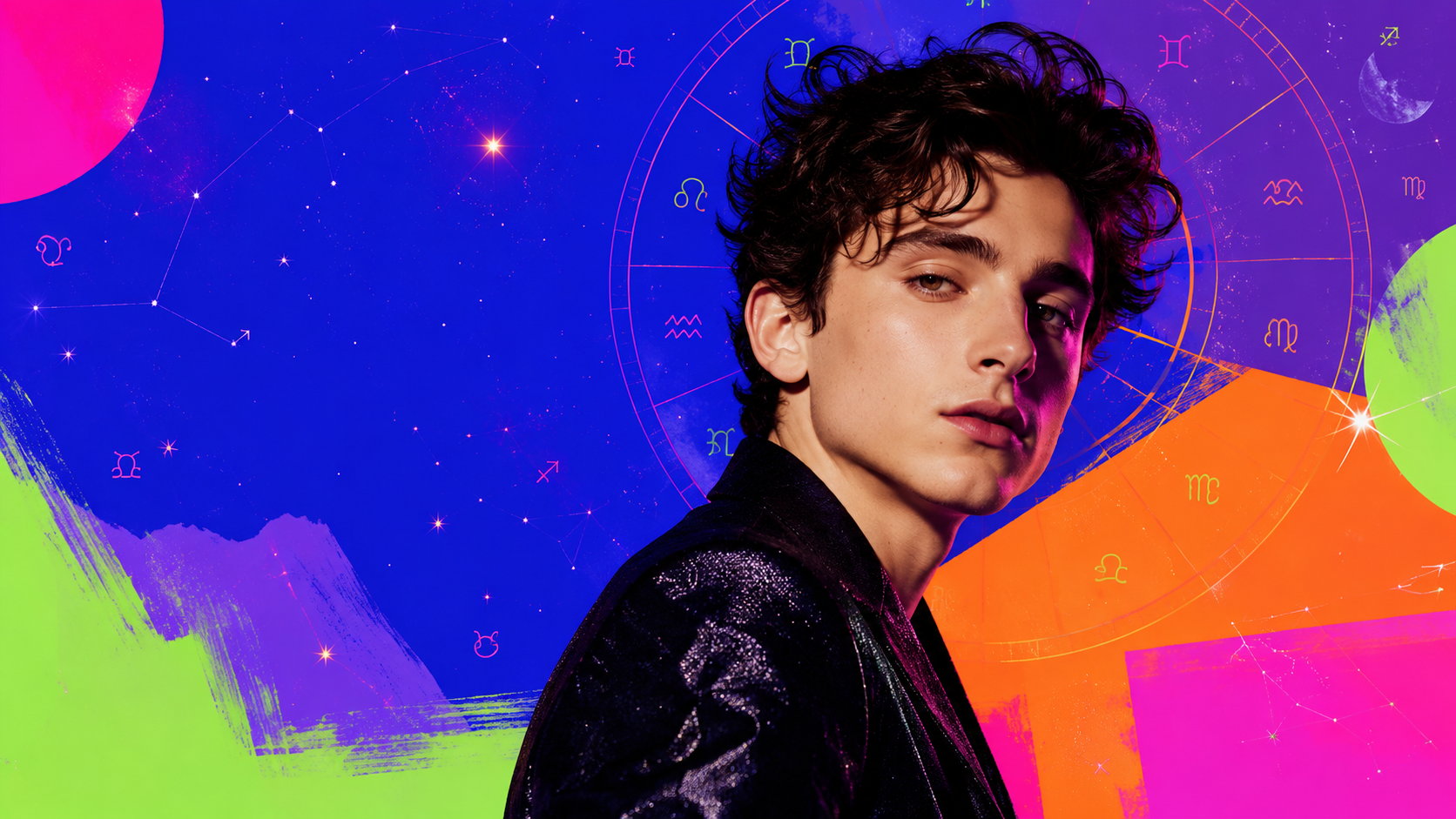
Written in the Stars: The Birth Chart of Timothée Chalamet, Hollywood's Old Soul
Timothée Chalamet has been called an old soul so often the phrase has worn smooth — and his birth chart confirms it with paperwork: five planets in Capricorn, Mars exalted at their center, and not a single retrograde in the sky. Add the poet's mark of Mercury fused to Neptune, a Moon-Saturn conjunction built for exquisite melancholy, and a voice standing at an exact right angle to his destiny, and you get the express-train chart of the youngest Best Actor nominee in nearly eighty years. A deep-dive reading of the craft cluster, the French sovereign Jupiter, and the sky that filed "I want to be one of the greats" decades before he said it out loud.
Timothée Chalamet has been called an old soul so often the phrase has worn smooth — the twenty-something with the nineteenth-century face, the young actor critics kept comparing to legends before he could rent a car. His birth chart's response to the cliché is to confirm it with paperwork: five planets in Capricorn — the Sun, Mercury, Mars, Uranus, and Neptune, half the sky stacked in the zodiac's oldest, most disciplined, most mastery-obsessed sign. Born on December 27, 1995, in New York City, he carries the most Capricorn-loaded chart this series has ever examined — and Capricorn is, precisely, the sign of the young person who reads ancient: born serious, apprenticed early, aimed at the summit from the first chapter. The world kept marveling that he seemed older than his years. The chart's position is that he was simply on schedule.
Strip away the franchises, the couture, the festival ovations, and what remains is the December sky over Manhattan — and that sky was doing several extraordinary things at once. Start with what it wasn't doing: there is not one trine in this chart, not one opposition, and — rarer still — not a single retrograde planet. Every planet, moving full-speed forward; every aspect either a conjunction, a sextile, or a square. Translate the astrology: nothing in this chart is free (no trines), nothing is stuck (no oppositions, no retrogrades) — everything is work, support, or productive pressure, all of it pointed the same direction. It is the aspect profile of the express train, and the biography ran on it: the youngest Best Actor nominee in nearly eighty years didn't wander to that podium. He arrived early, on a chart with no detours built in.
Then the machinery. In the heart of the stellium, Mercury sits conjunct Neptune at 0°55′ — the voice fused to the dream, the poet's mark, the single best aspect an actor can own. And that same Mercury forms the chart's tightest aspect, one this series has never seen so exact: a square to the North Node at 0°05′ of orb — five minutes of arc, essentially perfect. The voice, sitting at a precise right angle to the axis of destiny. We'll unpack it fully, but note the headline now: in this chart, the career does not merely use the voice. It hinges on it. Add a Moon conjunct Saturn in Pisces — the professional-melancholy signature, and a direct callback to the Meghan Markle chart that opened this series — plus Mars exalted at the stellium's center, a Saturn-Neptune mutual reception (the third in this series, after Tyler Henry and Gigi Hadid — apparently the 1990s issued its artists a standard treaty between dream and discipline), and one final elegance: trace the classical rulership chains, and everything — the entire Capricorn machine included — terminates in Jupiter, dignified in its own sign of Sagittarius. The grinder's chart, ultimately governed by a philosopher-king of art, meaning, and foreign lands. Hold that last word; his passport does.
A note on method before we begin: because his recorded birth time is set to noon, we're setting aside the houses and the rising sign, and reading the planets purely by sign, degree, and their conversations with one another. As ever, the chart says plenty without them.
Let's begin where all charts begin — with the Sun.
The Capricorn Stellium: Five Planets and an Old Soul
The Sun in Capricorn — his sits at 5°28′ — is the climber's Sun: disciplined, ambitious, allergic to shortcuts, oriented toward mastery and the long game. This series has met it once before, in Tyler Henry, where a single Capricorn Sun built a business out of the unbuildable. Chalamet's chart quintuples the dose: Sun, Mercury, Mars, Uranus, and Neptune, all in the sea-goat's sign — identity, mind, drive, genius, and imagination, every one of them enrolled in the same austere academy. A stellium this heavy makes the sign a homeland, and Capricorn's homeland has three laws: the craft is everything, the summit is the point, and youth is not an excuse — it is a head start.
The biography reads like the stellium's transcript. Raised in Manhattan's Hell's Kitchen in an artists' subsidized building, trained at LaGuardia — the "Fame" school, the conservatory of teenagers who treat art as a trade — and then the Capricorn timeline in full: the prestige apprenticeship of small roles, and at twenty-two, Call Me by Your Name — and with it, the youngest Best Actor nomination since 1939. Not the youngest winner of buzz; the youngest nominee at the industry's most conservative altar in nearly eight decades. That is not a lightning-strike statistic. It is a Capricorn statistic: early arrival at the institution's summit, by the institution's own rules. What followed obeyed the same law — a filmography curated like a museum wing (Lady Bird, Little Women, Beautiful Boy, The King, Bones and All), the generational-franchise anchor role in Dune, and a second Best Actor nomination for becoming Bob Dylan, singing live.
And if the stellium ever needed a confession, he gave it on stage, trophy in hand, at the SAG Awards: "I'm in pursuit of greatness... I want to be one of the greats." Actors do not say this out loud. It violates the industry's entire liturgy of aw-shucks humility — and the room gasped, then cheered, because everyone knew it was true. That sentence is five planets in Capricorn, holding a microphone. The old soul wasn't an aesthetic. It was a mission statement, filed early.
Mercury Conjunct Neptune: The Poet's Instrument
Now zoom into the stellium's core, because packed between 20° and 29° of Capricorn sits a four-planet cluster — Mars, Mercury, Neptune, Uranus — that functions as a single machine, and the machine it most resembles is an actor.
Begin with the tightest weld: Mercury conjunct Neptune, 0°55′. The planet of voice and mind, fused to the planet of imagination, illusion, and dream — under a degree. This is the poet's mark: language with an undertow, thought that moves in images, a speaking instrument permanently dipped in atmosphere. In a writer it produces lyricism; in an actor it produces the rarer thing — permeability: the capacity to let an imagined person flood the voice until the seams disappear. His most acclaimed work is this conjunction performing itself: cast as Bob Dylan — an actual poet, the era's definitional Mercury-Neptune human — he spent years absorbing the voice, the phrasing, the harmonica, the guitar, and then sang it live on film. Critics called it channeling. Astrologically, that's not a metaphor; it's the aspect's job description.
The cluster hands the instrument its remaining parts. Mercury conjunct Mars (2°46′) puts heat in the delivery — the sudden intensity, the line that arrives like a strike; his characters are famously soft-spoken until, abruptly, they are not, and that hinge is this conjunction. Mercury conjunct Uranus (5°31′) adds the offbeat brilliance — the unexpected reading, the choice no coach would suggest, the modern nerve inside the classical technique (note Uranus at 29°07′, the anaretic degree: the old order's final word, spoken by its strangest student). And Mercury sextile Saturn (4°29′) disciplines the whole apparatus — the poet's voice, drilled like scales, which is what separates the LaGuardia kid from the merely gifted.
Then the aspect that turns craft into fate: Mercury square the North Node, 0°05′ — essentially exact, the tightest nodal contact this series has printed. The node sits in Libra — partnership, the audience, the other — and a planet squaring the nodal axis becomes the hinge the destiny turns on: its skill is the toll gate through which the life's purpose must pass, over and over. His toll gate is Mercury: the voice, the mind, the instrument. Every threshold of the career has been a Mercury exam — the accents, the languages (he auditioned for the world in English and charmed it in French), the singing, the phrasing, the interviews that became their own genre. And he does not take the exam alone: Neptune squares the node at 1°00′, Mars at 2°42′, Uranus at 5°35′ — the entire craft cluster stands at right angles to the destiny. The message is unambiguous: nothing in this life is reached around the craft. Everything is reached through it.
The Moon Conjunct Saturn in Pisces: Professional Melancholy
Here is the placement that explains what the camera actually found. The Moon — the emotional body — sits at 22°09′ of Pisces, the most porous, permeable, feeling-saturated sign in the zodiac: the empath's Moon, the actor's Moon, the instrument that absorbs whatever the scene is carrying. And it sits conjunct Saturn at 3°01′ — the planet of sorrow, restraint, and structure, pressed against the feelings.
Series readers will recognize the signature: Meghan Markle's chart opened this series with a Moon-Saturn conjunction, read there as an emotional life shaped early by conditionality — composure as armor, maturity paid for privately. His carries the same gravity with a different vocation, because in an actor, Moon-Saturn is not just a wound; it is a specialty. The conjunction produces sorrow with structure — feeling of enormous depth, held in exquisite control — and that is, almost clinically, the thing he is most famous for on screen: the long, silent, devastating final shot; the grief performed at whisper volume; the melancholy so precise it reads as memory. Every generation gets one actor whose stillness breaks hearts. Moon conjunct Saturn in Pisces is what that looks like on paper.
And the chart wires the sorrow directly into the workshop: this Moon sextiles Mercury (1°28′), Mars (1°19′), and Neptune (2°23′) — three supply lines running from the feeling-body straight into the craft cluster. Whatever the Pisces Moon absorbs, the Capricorn machine can use: emotion converted to voice, to action, to atmosphere, on demand, with Saturn keeping the tap precise. Most actors spend decades building that pipeline. His came factory-installed — with one honest caveat the square to Jupiter (6°22′) supplies: feelings this deep, run through a machine this demanding, need somewhere off-camera to go. The chart's kindest advice to its owner is the same it gave Meghan: the composure is a gift; don't let it become the whole house.
Mars Exalted in Capricorn: The Engine
At the stellium's center stands the chart's classical powerhouse: Mars at 20°50′ of Capricorn — exalted, the warrior planet at its maximum traditional dignity. Exalted Mars is drive perfected: effort without waste, ambition with a spine of patience, the engine that runs cold and never quits. In a chart already sworn to Capricorn's academy, it is the difference between wanting mastery and manufacturing it.
Watch it work. The transformations his roles demand are Mars-in-Capricorn projects, executed with athlete's rigor: years of guitar, harmonica, and vocal training to sing Dylan live; the combat choreography carried across a desert franchise; a table-tennis opus trained for like a sport, because it was one. Mars conjunct Neptune (3°42′) is the profession itself in a single aspect — action fused to illusion, the body lent to the dream, which is simply the definition of acting — and Mars sextile Saturn (1°43′) is the training montage: discipline and drive on permanent good terms, the exalted engine bolted to the structure. Even the temper is Capricorn-grade: rarely seen, precisely deployed, and pointed — per the Mars-node square — at whatever stands between the craft and the destiny. In a chart with no trines, this Mars is why nothing needed to be free. He could afford to earn all of it.
Venus in Aquarius: The Style Disruptor
One planet stands outside the earth-and-water gravity, and it explains the entire second front of his fame. Venus at 7°20′ of Aquarius — beauty in the sign of the future: detached, experimental, allergic to the expected, cool in the literal and figurative senses. Venus in Aquarius does not follow taste; it forecasts it — and his red-carpet record is the placement's museum: the backless halter at Venice, the sequined hoodies-as-suits, the embroidered everything, an ongoing one-man renovation of what a leading man is permitted to wear. Fashion houses treat him as a forward indicator because his Venus is one. Where the Capricorn five built the actor, this single air placement built the icon — the proof that the old soul's taste runs, disorientingly, ten years ahead.
Its lone aspect seals the effect: Venus sextile Pluto (5°32′) — charm wired to magnetism, the cool that somehow smolders. It is the aspect behind the peculiar intensity of his fandom: affection at Aquarian distance, obsession at Plutonian depth, both at once. The style was never decoration. It is the chart's one rebel, doing all the rebelling for the whole committee.
Jupiter in Sagittarius: The Sovereign
And now the quiet ruler of everything. Trace the classical rulership chains: the five Capricorn planets answer to Saturn; Saturn, in Pisces, answers to Jupiter; the Pisces Moon answers to Jupiter; Venus answers to Saturn answers to Jupiter; Pluto, in Sagittarius, answers to Jupiter — and Jupiter, at 28°30′ of Sagittarius, answers to no one: dignified in its own sign, the final dispositor of the entire chart. The most disciplined sky this series has seen is, at the end of every chain of command, governed by the planet of meaning, art, faith, and foreign lands — luck enthroned, holding the deed to the whole Capricorn factory.
The biography honors the sovereign in the most literal way available: he is half French. The son of a father from Nîmes, a dual citizen raised on summers in a small village in Provence, fluent — the famous interviews conducted in easy French — with a career that treats borders as scenery: European auteurs, international festivals, the global franchise, the worldwide press tours run like diplomatic missions. Jupiter in Sagittarius is the foreign inheritance, and in this chart it isn't a flavor; it is the government. Even the Sun reports to it — Sun conjunct Jupiter, 6°58′, an out-of-sign handshake across the Sagittarius-Capricorn border: the identity, personally blessed by the sovereign. It is the aspect of the fortunate serious person — the one whose relentless Capricorn labor keeps, somehow, landing in golden rooms — and its sextile to the North Node (4°59′) confirms the arrangement: the luck and the destiny, on speaking terms. The machine grinds; the king it serves believes in art. That treaty is the career.
The Dream Disciplined: The Reception, the Generation, the Crossroads
Which brings us to this series' most persistent ghost. Saturn sits in Pisces — Neptune's sign — while Neptune sits in Capricorn — Saturn's sign: mutual reception, sealed with a sextile (5°24′). Third time in this series: Tyler Henry used the treaty to give the veil office hours; Gigi Hadid used it to industrialize glamour; Chalamet's version is the purest yet — art, run as a profession. Saturn in Pisces disciplines the dream (the conservatory training, the melancholy under control); Neptune in Capricorn institutionalizes it (imagination with a call sheet, the dream factory's best employee). The three of them — medium, model, actor, all born within thirty months of each other — suggest the early nineties issued its children a standard clause: the unreal is real work now. This chart signed in the fullest ink.
The generational stamps close the file: Uranus conjunct Neptune (4°35′) — the last breath of the great early-'90s conjunction, the cohort born as the material and the imaginal fused — and Uranus sextile Pluto (2°42′), the innovator's line to the deep. And beneath them, the structural fact worth restating: with the North Node in Libra — the sign of the audience, the partner, the other — squared by Mercury (exactly), Neptune, Mars, and Uranus, the destiny of this chart is collaborative and public by decree, and it is reached exclusively through the craft cluster's toll gate. No side doors. The chart never built any.
The Synthesis: The Young Master
Read together, the chart resolves into the series' cleanest portrait of vocation. Five planets in the sign of mastery, with the drive exalted at their center. A voice fused to the dream at under a degree, standing at an exact right angle to the destiny. A feeling-body of oceanic depth, held in Saturn's precise grip and piped directly into the workshop. One rebel Venus running the style department ten years ahead of schedule. And over all of it, a sovereign Jupiter in its own sign — meaning, art, and the French half — signing the paychecks.
And the aspect ledger tells you how it was always going to go: no trines, so nothing arrived free; no oppositions and no retrogrades, so nothing stalled or circled back. Only conjunctions, sextiles, and squares — fusion, support, and productive pressure — every planet facing forward. If there is a single sentence this chart keeps writing, it is this: the gift was never the point; the mastery was. The world called him an old soul because he seemed to have skipped the apprenticeship. The chart's correction is gentler and more impressive: he didn't skip it. He started it at birth, with five planets already enrolled — and then said the quiet Capricorn part out loud, trophy in hand: I want to be one of the greats.
The sky had it in writing first.
Frequently Asked Questions
What is Timothée Chalamet's zodiac sign?
Timothée Chalamet is a Capricorn Sun, born December 27, 1995 — and not casually: his Sun leads a five-planet Capricorn stellium (Sun, Mercury, Mars, Uranus, Neptune), the heaviest concentration in the sign this series has examined. Capricorn is the sign of early mastery, discipline, and the long climb — the astrological source code of the "old soul" reputation, and of a young man who announced on a trophy stage that he's in pursuit of greatness.
What is Timothée Chalamet's Moon sign?
His Moon is in Pisces — the empath's Moon, the actor's Moon, porous enough to absorb whatever a scene carries — and it sits conjunct Saturn, the signature of sorrow with structure: feeling of enormous depth held in exquisite control. It is, almost clinically, his on-screen specialty — the devastating stillness, the grief at whisper volume — with sextiles piping the feelings directly into the chart's craft cluster.
What is Timothée Chalamet's rising sign?
From this data alone, we can't say. The chart used here is set to noon rather than an exact birth time, so the rising sign and houses can't be reliably calculated — an Ascendant changes roughly every two hours. This reading sticks to signs, degrees, and aspects, which hold true regardless of the hour. (It's also a perfect illustration of why an exact birth time matters for a personal reading.)
What is his "big three"?
With the noon-chart caveat on the rising sign, his confirmed two-thirds are Capricorn Sun and Pisces Moon — the discipline and the dream, the climber and the empath. It is the working artist's pairing in its purest form: Capricorn builds the career; Pisces supplies the material.
What in his birth chart explains his acting?
A four-planet machine in late Capricorn. Mercury conjunct Neptune at 0°55′ — the poet's mark — fuses the voice to the imagination: the permeability that let him channel Bob Dylan, singing live. Mercury conjunct Mars supplies the sudden intensity; Mercury conjunct Uranus the offbeat brilliance; Mars conjunct Neptune is acting itself — action fused to illusion — with Mars exalted, the drive at maximum classical strength, running the transformations like athletic training. The Pisces Moon-Saturn conjunction then adds the specialty: professional melancholy.
Why is he such a style icon?
One planet does it alone. Venus in Aquarius — beauty in the sign of the future: detached, experimental, forecasting taste rather than following it. The backless halter, the sequined suits, the ongoing renovation of leading-man dress codes — all one placement, sextile Pluto for the magnetism underneath. The five Capricorn planets built the actor; this single air rebel built the icon.
What does the exact Mercury-Node square mean?
At 0°05′ of orb — five minutes of arc — it is the tightest nodal aspect this series has printed: the voice at a perfect right angle to the destiny axis. A planet square the nodes becomes the hinge the life turns on — its skill is the toll gate every threshold must pass through. His is Mercury: the accents, the languages, the singing, the phrasing. And the whole craft cluster (Neptune, Mars, Uranus) squares the node behind it: in this chart, nothing is reached around the craft. Everything is reached through it.
What's the rarest thing in his birth chart?
Take your pick. The five-planet Capricorn stellium with Mars exalted at its center. The Mercury-Node square exact to five minutes. The aspect ledger itself: no trines, no oppositions, and not one retrograde planet — nothing free, nothing stuck, everything forward, the express-train chart of the youngest Best Actor nominee in nearly eighty years. And the quiet crown: a final dispositor Jupiter, dignified in Sagittarius — the whole disciplined machine ultimately governed by the planet of art, meaning, and foreign lands. He is, fittingly, half French.
Is this reading based on his exact birth time?
No — and that's worth being transparent about. His circulated data uses a noon placeholder time, so this analysis deliberately excludes houses and the Ascendant and reads only what's certain: planetary signs, degrees, and aspects. Even that partial picture tells a strikingly coherent story. A verified birth time would sharpen everything further — which is exactly why professional readings always begin by asking for yours.
Your Chart Is Waiting
Here's the thing: this entire reading came from a noon chart — no birth time, no houses, no rising sign. A fraction of the picture. Imagine what a full reading of your chart could reveal: your exact angles, your houses, your aspects and degrees, the whole architecture of your sky, walked through line by line. If this reading stirred something, that's usually the invitation.
Book your personal chart reading — and find out what was written in your stars.
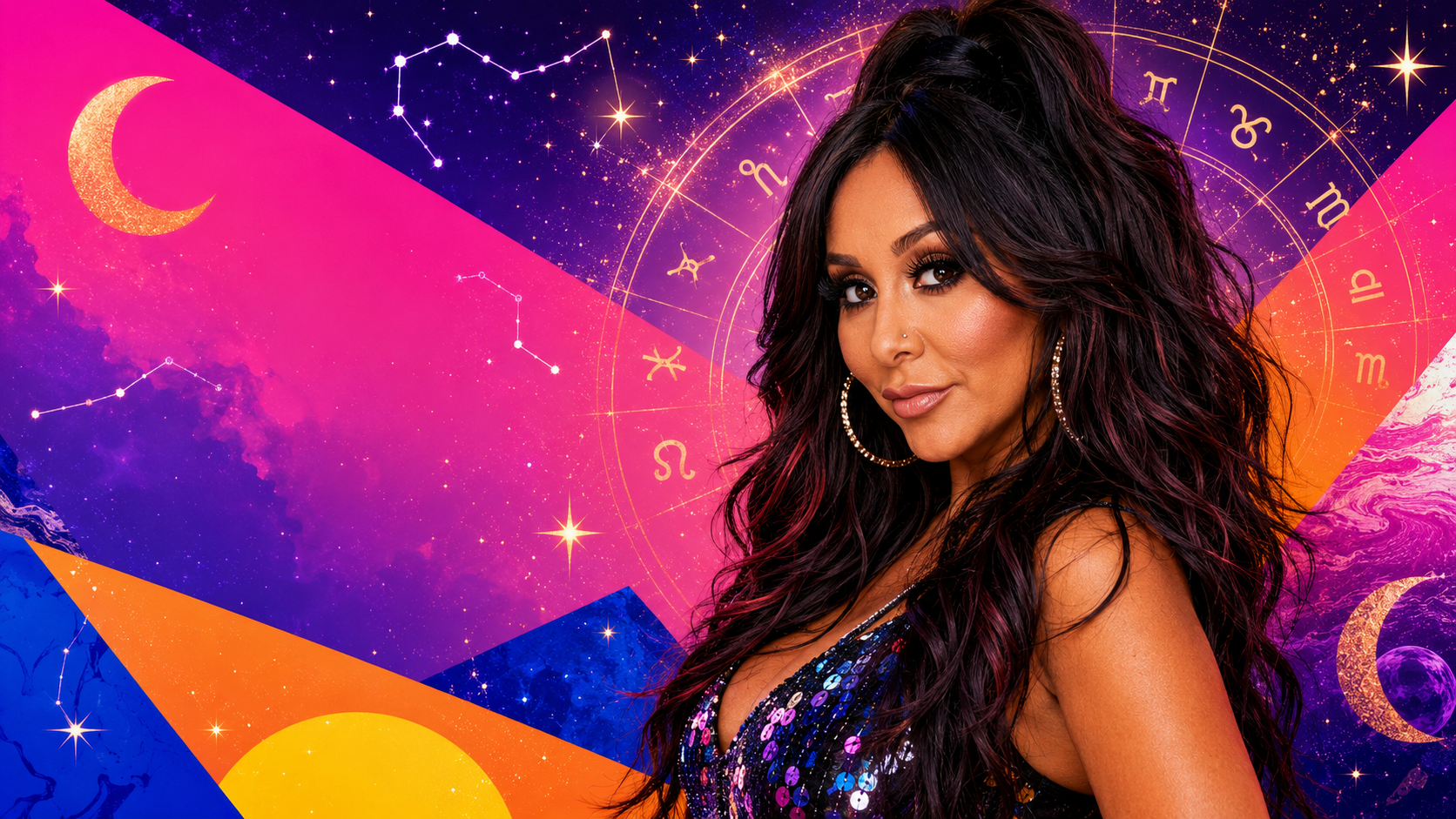
Written in the Stars: The Birth Chart of Nicole "Snooki" Polizzi, Reality TV Icon
There's one job in entertainment with no craft to hide behind: being yourself on camera — and Snooki's birth chart reads like it was drawn up for exactly that. Born under a four-planet Sagittarius stellium, a sky containing a single square and not one opposition, and an exact zero-degree trine between her Sun and her destiny, the reality TV icon carries astrology's rarest fame signature: the flow chart. A deep-dive reading of the secret Capricorn Moon that planned the whole thing, the Venus built for both the wild years and the wedding, and the near-exact empire aspect nobody saw coming.
There is exactly one job in entertainment with no craft to hide behind: being yourself on camera. No script, no character, no twenty-year apprenticeship at the Four Seasons — just a person, a shore house, and a lens. Nicole "Snooki" Polizzi's birth chart reads like it was drawn up for that job and no other. Born on November 23, 1987, in Santiago, Chile — hold that location; the chart certainly does — she carries a sky that explains, with almost embarrassing precision, how a four-foot-nine unknown from a New York suburb became the defining face of an entire television genre by doing nothing except being Nicole, at full volume, in public.
Strip away the poof, the catchphrases, the GIFs that outlived the decade, and what remains is the November sky over Santiago — and that sky was doing something this series has never seen before. Run the aspect list and count the hard angles: there is one square in the entire chart — and it's to a node, not a planet. No planet-to-planet squares. No oppositions. None. Every planetary conversation in this chart is a conjunction, a trine, or a sextile — an unbroken run of green lights. Astrologers call charts like this "soft," and the softness has a very specific career signature: things happen tothese people, easily, without the grinding friction that hard-aspect charts require. Sebastian Maniscalco's chart, two entries ago, was an engine of squares that took twenty years to reach an arena. Hers is a river. MTV put a camera in front of it in 2009, and the river simply kept flowing — which is, more or less, the entire origin story of reality television's biggest star.
And then the chart names the mechanism exactly. Her Sun sits at 0°46′ of Sagittarius — freshly arrived, barely a day into the sign — and it forms the chart's tightest aspect: a trine to the North Node at 0°25′ of Aries, exact to 0°22′, both points standing at the zero degree of fire signs. Read that plainly: the identity and the destiny, aligned at the starting line, twice over. A Sun-Node trine means being who you are advances the life's purpose — no translation required, no persona to build, no gap between the self and the path. It is, almost word for word, the aspect of someone whose career would consist entirely of being herself. The job was Snooki. The chart had pre-approved it.
The rest of the architecture fills in fast: a four-planet Sagittarius stellium — Sun, Venus, Saturn, Uranus — in the zodiac's party sign, its honesty sign, and, pointedly, its foreign lands sign, for a woman born on another continent from the family that raised her. A Capricorn Moon conjunct Neptune — the origins in soft focus, and a secret traditionalist hiding under the party girl (we'll get there; it's the best twist in the chart). A Venus sandwiched between Uranus and Saturn — the wild streak and the wedding ring, fused into one love nature. A near-exact Jupiter-Saturn trine (0°23′) — the empire aspect, quietly waiting behind the shot glasses. And a singleton: her only air placement is Mars, at 29°40′ of Libra — the final degree of the social sign — meaning every ounce of this chart's social energy funnels through one last-degree party warrior. Anyone who watched season one understands immediately.
A note on method before we begin: because her recorded birth time is set to noon, we're setting aside the houses and the rising sign, and reading the planets purely by sign, degree, and their conversations with one another. As ever, the chart says plenty without them.
Let's begin where all charts begin — with the Sun.
The Sun at 0° Sagittarius: Born at the Starting Line
The Sun in Sagittarius is the zodiac's good time: exuberant, blunt, adventure-hungry, allergic to pretense, convinced at a cellular level that life is meant to be enjoyed and that anyone pretending otherwise is lying. Sagittarius doesn't perform fun — it emanates it, loudly, and drags the room along. Hers sits at 0°46′ — she was born barely a day after the Sun crossed in from Scorpio, making her a cusp-adjacent birth that is nonetheless fully Sagittarian, and in some ways more so: the zero degree of any sign is the sign at maximum freshness, undiluted and uncomplicated, the note struck clean. A 0° Sagittarius Sun is pure, concentrated, entry-level-nothing joy — which is a fair three-word review of her entire early televised output.
The receipts write themselves, but notice which receipts: it was never the drinking that made her the star of that house — half the cast drank. It was the Sagittarian package around it: the total absence of filter (Sag is the zodiac's honest sign; it cannot pretend, which is the single most valuable trait a reality camera can find), the self-deprecating hilarity, the adventurousness, the bounce-back — knocked down in every conceivable way across six seasons and never once staying down. Sagittarius is ruled by Jupiter, the planet of buoyancy, and her public life has been a buoyancy demonstration: the pickle obsession, the wrestling match at WrestleMania (which she won), the bestselling novel nobody saw coming, the cheerful shrug at every headline. You cannot embarrass a Sagittarius Sun. They got there first, laughed hardest, and sold the T-shirt.
And the Sun's tightest aspect is the chart's thesis: trine the North Node at 0°22′, fire to fire, zero degree to zero degree. In nodal astrology, a Sun-Node trine is the alignment of identity with purpose — the person whose authentic self is their contribution, who advances the destiny not by becoming something but by refusing to. An Aries North Node destiny is individuation: be the self, boldly, first. Hers arrived pre-completed at the starting gun: the career, the brand, the empire — all of it built on the radical act of being exactly Nicole in front of whoever was watching. Other charts in this series had to earn the alignment. Hers was born in it.
The Sagittarius Stellium: The Party, the Honesty, and the Foreign Sky
Four placements crowd into Sagittarius — Sun, Venus, Saturn, and Uranus — and a stellium this heavy makes the sign less a trait than a homeland: the terrain the whole personality lives on. Sagittarian terrain is expansive, loud, funny, freedom-loving, and truthful to a fault. It is the sign of the friend who says the thing everyone thought, the traveler who's game for anything, the spirit that treats every room as improvable by volume. Reality television, when it arrived as a genre, was essentially a Sagittarius-detection machine — cameras hunting for people incapable of pretense — and it found in her the genre's purest specimen: a woman constitutionally unable to be fake, on a format that pays for exactly that.
But Sagittarius has a second portfolio, and here the chart does something quietly moving. Sagittarius rules foreign lands, distant origins, the far-away — and she was born in Santiago, Chile, half a world from the New York suburb where she was raised, adopted at six months old by the Italian-American family she has always called, simply and firmly, her family. A Sagittarius stellium in the chart of a foreign-born adoptee is the placement operating at its most literal: a life that beginsacross a border, origins written under a distant sky. And the chart's treatment of that beginning is worth reading closely, because it is gentle. The Moon conjunct Neptune (4°18′, in Capricorn) places the planet of mother and origins in soft focus — the biological beginning veiled, unknown, wrapped in mist — which is as close as astrology comes to describing adoption itself. And the Moon square the nodal axis (1°41′), the chart's only square, marks family as the life's one true crossroads: the theme that had to be consciously chosen rather than passively inherited. Her answer to that crossroads has been public and unwavering for her entire career: family is the one that raises you. She has said she never needed to search for her biological parents because she already had her parents. That is the Moon square nodes, resolved — the inherited question, answered by choice — and the Sagittarian stellium blessing the whole arrangement with its oldest teaching: home is not where you started. It's where you aim.
The Moon in Capricorn: The Secret Traditionalist
Now for the best twist in the chart. Beneath the poof, beneath the party, beneath the most gloriously unserious public image of the 2010s, sits a Capricorn Moon — the most old-fashioned, structure-craving, marriage-and-mortgage emotional core in the entire zodiac. A Capricorn Moon needs the real things: commitment, family, security, a household that functions, a future with a foundation under it. It is classically the Moon of people who seem older than their era — and it is hiding in plain sight across six seasons of tape, because go back and listen to what she actually said between the shots: from the first episodes, relentlessly, she wanted a husband, babies, and a house. The famous "gorilla" she was hunting was never a fling — it was, in her own repeated words, a husband. The wildest cast member of the wildest show on television spent the entire run announcing a Capricorn Moon's five-year plan, and nobody noticed because she was announcing it upside down at a bar.
And then — this is the part the chart deserves credit for — she executed the plan. Married the boyfriend she met in the shore house. Three children by her early thirties. The suburbs, the school runs, the businesses, the early nights. The public called it a transformation, the party girl who grew up. The chart disagrees: the Capricorn Moon was there the whole time, patiently waiting for the Sagittarius stellium to finish its lap. The conjunction with Neptune softens this Moon's famous sternness into something warmer — compassion, dreaminess, the escapist streak of the early years maturing into empathy — and its out-of-sign sextile to Mars (2°26′) keeps the feelings actionable: when this woman decides she wants a life, she goes and gets the life. Which, on the record, is exactly what happened.
Venus Between Uranus and Saturn: The Wild Child Built to Settle Down
Here is the love story, told by geometry. Venus sits at 24°28′ of Sagittarius — fun-loving, freedom-first, honest to a fault in affection — and it is sandwiched: conjunct Uranus at 0°55′ on one side and conjunct Saturn at 3°30′ on the other. The planet of love, fused simultaneously to the disruptor and the stabilizer. Astrologically, this is a heart wired for both lightning and concrete — and the biography played the two conjunctions in exactly that order.
Venus-Uranus is the wild conjunction: sudden attractions, unconventional romance, love as adventure and occasionally as chaos — the entire early-seasons romantic record, conducted at high speed in front of eight million viewers. But Venus-Saturn was always sitting one degree over, and Venus-Saturn is the marrying conjunction: loyalty, commitment, love expressed as showing up, the bond that is built rather than sparked. The synthesis is rarer than either alone: a person whose wildness and whose devotion are the same Venus — who could meet a man in the most chaotic environment American television ever constructed and then, Saturn-style, actually marry him, stay married, and build the household around him. The wild child didn't reform into the wife. The chart holds both titles simultaneously, and always did.
The supporting aspects gild it: Venus trine Jupiter (3°53′) — the double-benefic trine, astrology's likability aspect, charm that attracts luck and audiences without strain (the reason America adopted her instantly, scandals included) — and Venus sextile Mars (5°12′), the easy chemistry aspect, warmth and spark on speaking terms. In a chart with no hard aspects to rough it up, this Venus complex is pure flow: loved easily, loving easily, landing — against every tabloid prediction — in something durable.
Mars at 29° Libra: The Last-Degree Party Warrior
Every chart in this series has had a singleton, and hers is a comedy of precision: the only air placement in the entire chart is Mars — at 29°40′ of Libra, the final degree of the social sign, in classical detriment. Read the funnel: all of this chart's air — its social instinct, its need for people, its interpersonal intelligence — must exit through a single placement, and that placement is the planet of action and combat, standing on the last step of the sign of partners, parties, and other people. Social life as physical activity. The dance floor as a sport. Friendship conducted at full contact. Anyone who watched her fist-pump through six seasons has seen a 29° Libra Mars in its natural habitat: the tiny warrior of the social realm, going harder than everyone twice her size.
The anaretic degree — the 29th — carries a signature of urgency and culmination: the sign's lessons compressed, lived at high intensity, sometimes learned in public. Hers were: the Libra curriculum of other people — roommates, boyfriends, frenemies, the infamous bar incident where she took a stranger's punch on national television and the entire country rose in her defense — all of it played out at the degree where Libra's lessons come due. And the chart, true to its all-soft nature, cushions even this: Mars sextiles Uranus (4°17′ — spontaneity, the sudden move), sextiles Venus (the charm-fight blend), and sextiles the Moon (feelings converted to action without stewing). Even her chaos had good aspects.
Jupiter Trine Saturn: The Empire Nobody Saw Coming
Quietly, behind everything, sits the chart's second-tightest aspect — and its most underrated: Jupiter in Aries trine Saturn in Sagittarius, at 0°23′ of orb. Near exact. Jupiter is expansion; Saturn is structure; and in trine — rather than the square Gigi Hadid carries, or the opposition in Travis Kelce's engine — they cooperate frictionlessly: growth that builds durably, opportunity that consolidates, the boom and the discipline on the same team from birth.
This is the aspect the 2010 commentariat never priced in. The consensus on reality stars was that the fame was a sugar rush — and for most of the genre, it was. Hers compounded: the fame became bestselling books (a novelist, to the New York Times list, on the first try — the softest-chart move imaginable), then spin-off shows, then hosting chairs, then the Snooki Shop — actual brick-and-mortar boutiques with her name over the door, plus the online operation — then the podcast, the brands, the fifteen-years-and-running franchise revival. Jupiter-Saturn in trine builds exactly this way: without drama, without the collapse chapter, the empire assembling itself while the headlines watched the poof. And Jupiter retrograde in Aries adds the signature flourish: self-made, self-directed expansion — the luck consults her, not the market. She is, by any honest accounting, one of reality television's great business outcomes, and this quarter-degree trine is the reason the chart never doubted it.
The Deep Planets: The Truth-Teller and the Generation
Mercury sits conjunct Pluto in Scorpio (4°04′) — with Pluto in its own sign — and this is the voice: blunt, penetrating, allergic to euphemism. Mercury-Pluto speaks the underneath — the thing everyone is thinking, said out loud, with a directness that reads as either shocking or refreshing depending on the listener's constitution. On television it made her the quote machine of her era; in the podcast-and-hosting years it matured into the franker gift: the willingness to discuss the real material — body, marriage, motherhood, the hard seasons — without the celebrity gloss. Scorpio Mercury doesn't do small talk. It does true talk, which, in the confessional-chair economy she helped invent, turned out to be the entire product.
Saturn conjunct Uranus (4°24′) in late Sagittarius is her generational stamp — the late-'87 cohort born as structure and disruption fused — and her career personalizes it neatly: she was front-of-frame for the moment an entire television format broke (Uranus) and became an institution (Saturn). Reality TV's establishment was built by its disruptors, and she is on the founding documents. Neptune sextile Pluto (4°20′) hums beneath as the era's image-as-power undercurrent — the generation that understood, before the platforms existed, that a persona is an asset. Hers appreciated.
The Synthesis: The River
Read together, the chart resolves into something this series hasn't produced before: a portrait without an engine — because it never needed one. Every other subject's chart ran on friction: Meghan's Mars square the stellium, Travis's T-square, Sebastian's twenty-year Saturn grind. Hers runs on flow: one square in the whole sky, aimed at the family question she answered by choice, and everything else — the fame, the love, the empire — arriving on trines and sextiles like weather she was born downstream of.
If there is a single sentence this chart keeps writing, it is this: being herself was always the plan. A Sun at the zero degree of the honest sign, trine a destiny at the zero degree of the self's sign, exact to a third of a degree — identity as career, authenticity as asset, the person and the path never once out of alignment. The party was real, and so was the Capricorn Moon underneath it, quietly ordering the husband, the babies, and the boutiques the whole time. The world thought it was watching a wild child. The chart knew it was watching a very buoyant long-term plan.
That is not a small assignment — being fully yourself in public never is. It is, however, exactly the kind of assignment written for someone born under six placements of fire, on a foreign sky, at the starting line of two signs at once — with every light in the chart already green.
Frequently Asked Questions
What is Snooki's zodiac sign?
Nicole "Snooki" Polizzi is a Sagittarius Sun, born November 23, 1987. Her Sun sits at just 0°46′ of the sign — barely a day past the Scorpio border — but a zero-degree Sun isn't diluted; it's the sign at maximum freshness: pure, concentrated Sagittarius exuberance, honesty, and bounce-back. It also forms the chart's tightest aspect: an exact trine to the North Node — being herself, quite literally, as destiny.
What is Snooki's Moon sign?
Her Moon is in Capricorn — the chart's best plot twist. Beneath the party-girl image sits the zodiac's most traditional emotional core: the Moon that wants marriage, babies, a household, and a foundation — which is precisely what she announced from season one and then went and built. The conjunction with Neptune softens it with compassion (and marks the veiled origins of her adoption story); the sextile to Mars makes the wants actionable.
What is Snooki's rising sign?
From this data alone, we can't say. The chart used here is set to noon rather than an exact birth time, so the rising sign and houses can't be reliably calculated — an Ascendant changes roughly every two hours. This reading sticks to signs, degrees, and aspects, which hold true regardless of the hour. (It's also a perfect illustration of why an exact birth time matters for a personal reading.)
What is her "big three"?
With the noon-chart caveat on the rising sign, her confirmed two-thirds are Sagittarius Sun and Capricorn Moon — the party and the plan. It's one of the zodiac's great odd couples: Sagittarius supplies the fun, the honesty, and the bounce; Capricorn supplies the secret five-year plan that, on the record, she executed to the letter.
What in her birth chart explains her reality TV fame?
Two structures, working together. First, the chart is almost entirely soft — one square in the whole sky, no oppositions: the "flow" signature of fame that arrives easily rather than being ground out. Second, the exact Sun-North Node trine at 0°22′ — identity aligned with destiny at the zero degree of two fire signs. Reality TV pays for one thing: the inability to be fake. Her Sagittarius stellium made pretense impossible, and the Sun-Node trine made authenticity the actual career.
Does her chart show the transformation from party girl to businesswoman?
Beautifully — except the chart insists it was never a transformation. The Capricorn Moon wanted the family from day one; Venus conjunct Saturn (alongside its wilder conjunction to Uranus) is the marrying aspect that turned a shore-house romance into a lasting household; and the near-exact Jupiter trine Saturn (0°23′) is the empire aspect — expansion and structure cooperating frictionlessly, which is how the fame compounded into bestselling books, boutiques, and a fifteen-year franchise instead of burning off. The party girl and the businesswoman were the same chart, taking turns.
What does her chart say about being born in Chile and adopted?
The chart handles it with remarkable tenderness. The four-planet Sagittarius stellium — the sign of foreign lands and distant origins — is the placement at its most literal for a life that began on another continent. The Moon conjunct Neptune places the biological origins in soft focus — veiled, unknown — which is as close as astrology comes to describing adoption. And the Moon square the nodes, the chart's only square, marks family as the life's one crossroads: a question answered not by inheritance but by choice. Her lifelong answer — that her real family is the one that raised her — is that square, resolved.
What's the rarest thing in her birth chart?
Three candidates. The absence of hard aspects — one square (to a node) and zero oppositions in the entire chart — is genuinely uncommon and is the structural key to the whole career. The double zero-degree fire trine — Sun at 0° Sagittarius exactly trine the Node at 0° Aries — is the thematic key. And Venus conjunct both Uranus and Saturn simultaneously — the wild streak and the wedding ring fused into one heart — is the biographical key.
Is this reading based on her exact birth time?
No — and that's worth being transparent about. Her circulated data uses a noon placeholder time, so this analysis deliberately excludes houses and the Ascendant and reads only what's certain: planetary signs, degrees, and aspects. Even that partial picture tells a strikingly coherent story. A verified birth time would sharpen everything further — which is exactly why professional readings always begin by asking for yours.
Your Chart Is Waiting
Here's the thing: this entire reading came from a noon chart — no birth time, no houses, no rising sign. A fraction of the picture. Imagine what a full reading of your chart could reveal: your exact angles, your houses, your aspects and degrees, the whole architecture of your sky, walked through line by line. If this reading stirred something, that's usually the invitation.
Book your personal chart reading — and find out what was written in your stars.
Written in the Stars: The Birth Chart of Gigi Hadid, Supermodel
Most celebrity charts explain a rise to fame — Gigi Hadid's explains something rarer: why the most photographed face of her generation keeps turning away from the camera. Born with a closed circle of mutual reception linking the star, the beauty, and the fighter, perfectly balanced elements, and her Sun pressed against the South Node, the supermodel carries a sky of gifts brought in ripe — and a Scorpio destiny that was always going to pull her behind the blur. A deep-dive reading of the era-handoff aspect, the industrialized glamour, and the chart of fashion's great hinge generation.
Most celebrity birth charts have one job: explain how their owner got famous. Gigi Hadid's has a harder one — explaining why the most photographed face of her generation keeps, at every opportunity, turning away from the camera. Born on April 23, 1995, in Los Angeles — the second chart in this series to open under that city's manufactured light — she carries a sky that accounts for both halves of the paradox with unusual elegance: the girl who walked into modeling as if returning to something she already knew how to do, and the woman who, at the height of that career, asked the world's paparazzi to blur her daughter's face.
Strip away the thirty-five Vogue covers, the campaigns, the runways of four fashion capitals, and what remains is the April sky over Los Angeles — and that sky was doing something astrologers rarely get to see. Trace the classical rulership chains and three planets form a closed circle of mutual reception: the Sun sits in Taurus, Venus's sign; Venus sits in Aries, Mars's sign; and Mars sits in Leo, the Sun's sign. The star, the beauty, and the fighter, passing keys around a sealed triangle — each planet a guest in the next one's house, the circuit complete. It is a rare architecture, and it is also, read plainly, the athlete-supermodel in a single structure: identity expressed as beauty, beauty powered by combat, combat performed like a star. Hold that triangle; the whole career lives inside it.
And the chart keeps going. Saturn in Pisces and Neptune in Capricorn sit in mutual reception — structure in the dream's sign, the dream in structure's sign, sealed with a sextile — the exact signature this series found in Tyler Henry's chart, wearing a different costume here: not mediumship, but glamour, industrialized. Neptune, moreover, is stationary — frozen at maximum volume, as Meghan Markle's Uranus was. Pluto sits retrograde at 29°56′ of Scorpio — the final degree of its own sign; she was born two days after Pluto slipped back into Scorpio for its last visit of the twentieth century, making her one of the very last children of the Pluto-in-Scorpio era. And Uranus stands at 0°25′ of Aquarius, dignified, three weeks into its own sign — the same freshly-crossed-the-threshold Uranus that Tyler Henry carries. The two of them — the last degree of the old era, the first degree of the new — form the chart's tightest aspect, a sextile of 0°29′: the outgoing age and the incoming age, shaking hands over her birth. Add a Sun conjunct the South Node and a waning, balsamic Moon, and a theme announces itself before a single placement is read: this is a chart of culminations. Gifts brought in ripe. An old story ending so a deeper one can begin.
One more structural note, because it may be the most professionally relevant of all: run the element count and you'll find three placements in fire, three in earth, three in water, and two in air. No singleton. No funnel. The most balanced chart this series has examined. Every other subject so far had a lopsided sky that forced their talent through one narrow exit; hers distributes. Which is, when you think about what a great model actually does — become editorial, commercial, athletic, romantic, androgynous, whatever the shoot requires — not a footnote. It is the job description. Versatility isn't her trick. It's her architecture.
A note on method before we begin: because her recorded birth time is set to noon, we're setting aside the houses and the rising sign, and reading the planets purely by sign, degree, and their conversations with one another. As ever, the chart says plenty without them.
Let's begin where all charts begin — with the Sun.
The Sun and Mercury in Taurus: The Embodied Star
The Sun in Taurus — hers sits at 3°09′, early in the sign — is the zodiac's placement of presence: grounded, unhurried, sensual, at home in the physical world the way other signs are at home in ideas. Taurus is ruled by Venus, which makes it the sign most literally concerned with beauty as a material fact — the body, the face, the fabric, the light — and Taurean self-possession has a particular quality the camera worships: stillness. Where fire signs perform for a lens and air signs charm it, Taurus simply is in front of it, solid and unbothered, and photographs drink that up. If you were designing a supermodel's Sun from scratch, you would design this one: Venus-ruled, embodied, calm at the center of chaos, capable of holding a pose — and a career — without fidgeting.
The biography obliges from the start, and in an unexpectedly Taurean way: before the runways there were horses and volleyball — she was a serious equestrian and a competitive volleyball player good enough for junior national consideration — which is Taurus embodiment in its native form: strength, physicality, the body as instrument before the body as image. That athletic build would later become a public storyline when parts of the fashion world questioned it; her response — an open letter defending her body, refusing to apologize for its power — was fixed-earth Taurus to the letter: immovable, unbothered, standing exactly where it stands. (Her Sun square Uranus, 2°44′, supplies the rebel edge to that stand: the establishment's mold, politely declined. We'll return to it.)
Mercury sits nearby at 13°33′ of Taurus, giving the voice the same earth: deliberate, warm, unpretentious, and — this is the delightful part — tactile. Mercury in Taurus communicates through the senses: food, texture, craft, the made thing. Consider the off-runway résumé, because it is a Taurus Mercury portfolio with a publicist: the famous home cooking (an entire corner of the internet knows her vodka pasta by name), the hosting turn on a fashion making show, and above all Guest in Residence — the brand she founded not around perfume or glamour but around cashmere: knitwear, texture, the luxury of touch. A fire-sign Mercury would have launched a fragrance. A Taurus Mercury launched a sweater you want to live in. The chart, as usual, chose first.
But the Sun's most important feature in this chart is not its sign. It is its company — because this Sun sits within two and a half degrees of the South Node (Sun opposite the North Node, 2°27′). In nodal astrology, the South Node marks the inheritance: the gifts that arrive pre-installed, the territory a soul walks in already knowing. A Sun conjunct the South Node describes someone whose core identity is that inheritance — born ripe, competent at their own nature from the first chapter, often finding early success in the South Node's terrain almost suspiciously easy. Her terrain is Taurus: beauty, embodiment, the material image. And the early career reads exactly like a South Node story: scouted as a toddler, signed to a major agency before twenty, a debut that behaved less like a launch than a return. The catch — and every South Node Sun has one — is that the inheritance, however golden, is not the destination. The destination sits directly opposite, in Scorpio. We will end the reading there, because her life keeps ending its own chapters there too.
Venus in Aries and the Reception Triangle: The Fighter in the Beauty
Venus — the planet of beauty itself, and this chart's dispositor of both the Sun and Mercury — sits at 1°57′ of Aries, the warrior's sign, in her classical detriment. And here, once again, the series' running lesson holds: the debilities are where the interesting careers live. Venus in Aries cannot do passive beauty. This is the athlete's Venus — direct, competitive, impatient with preciousness, beautiful in motion rather than in repose — the exact aesthetic that separated her from the delicate archetype and made "the athletic supermodel" a category the industry had to widen to fit. Venus in Aries doesn't wait to be chosen. It walks in like it was already booked.
Now watch the triangle work, because this is the chart's signature machine. Venus, in detriment, sits in Mars's sign — and Mars, in Leo, sits in the Sun's sign — and the Sun sits in Venus's sign. Three planets, each hosted by the next, keys passing in a closed circle: the beauty borrows the fighter's nerve, the fighter borrows the star's shine, the star borrows the beauty's grace. Every classical weakness in the loop is rescued by reception, and the result is a persona the public would recognize anywhere: the stunning woman who is also visibly strong; the sweetheart who, when a stranger grabbed her off her feet on a Milan street, responded with an elbow to the face and zero apology afterward — "I had every right to defend myself," said Venus in Aries, holding Mars's keys. The tabloids called it shocking. The chart calls it Tuesday.
Venus's aspects finish the portrait. A sextile to that dignified, brand-new Uranus (1°32′) makes the beauty independent and slightly unconventional — the model who breaks format, co-signs the changing industry, and keeps one foot outside its rules. And a trine to Pluto (2°01′, out of sign) — the beauty planet in flowing contact with the planet of magnetism at the last degree of Scorpio — supplies the thing photographs can't explain and campaigns pay millions for: pull. Venus-Pluto contact is depth of attraction, intensity behind the eyes, the face you look at twice. Between the Uranus sextile and the Pluto trine, her Venus is wired for both novelty and gravity — the new thing you can't look away from.
The Moon in Aquarius: The Cool Girl and the Cause
The emotional core sits at 24°00′ of Aquarius — air, fixed, famously the coolest Moon in the zodiac. An Aquarius Moon feels at a slight, friendly remove: warm to everyone, melted by no one, emotionally regulated by perspective rather than immersion. It is the "guy's girl" Moon, the good-hang Moon, the teammate — and it explains the specific temperature of her public persona, which has always run approachable where other supermodels ran untouchable: the laugh, the ease, the sense that she'd rather be at the family dinner than the afterparty. Aquarius Moons also process feeling through the collective — the group, the cause, the principle — and hers has receipts: the sustained humanitarian giving, the advocacy for Palestinian relief drawn from her own heritage, earnings pledged to displaced families. When this Moon hurts, it organizes.
But two hard aspects complicate the cool, and they are the honest part of the reading. Moon opposite Mars (6°05′)stretches across the Leo-Aquarius axis: the detached feelings versus the fiery presence, composure versus flare. This is the aspect of the even keel that occasionally, suddenly, isn't — the flash of temper or bluntness that surprises people precisely because the baseline is so easygoing. (Its noblest expression is the same Milan moment: the cool girl's switch, flipped in defense.) And Moon square Pluto (5°56′) — squared, notably, by that anaretic, last-degree Pluto in its own sign — puts genuine depth and guardedness beneath the friendly surface: intense private attachments, a fierce need to control what the world gets access to, and an emotional life far less breezy than the persona suggests. The public got the Aquarius. The Scorpio-Pluto square kept the rest — which, as we'll see, is exactly where her destiny points.
Mars in Leo: The Walk
Mars — drive, heat, the body in motion — sits at 17°55′ of Leo, fixed fire, the sign of the show, holding the Sun's keys in the reception triangle. Mars in Leo performs its power: it competes with style, works with pride, and possesses the specific gift her profession is literally built on — entrance energy. The runway walk is Mars in Leo as a job skill: controlled fire, power display as art form, the athlete's engine dressed in the star's confidence. Where her Taurus Sun gives the stillness photographs love, this Mars gives the motion runways love; between them, the two halves of modeling — the pose and the walk — each have a dignified engine.
Its aspects add candor and fortune. Mercury square Mars (4°22′) is the blurt wire — the deliberate Taurus voice at a hard angle to the proud fire — which shows up as her well-documented directness: the unfiltered interview answer, the public clap-back on behalf of her body or her family, words arriving with heat when the pride is poked. In a media-trained industry, the occasional unmanaged sentence became part of the appeal: proof of person. And Mars trine Jupiter (3°18′)— flowing contact with a sovereign Jupiter, as we're about to see — gives the effort scale and luck: energy that lands on ever-larger stages, the campaign that becomes the contract that becomes the empire.
Jupiter Retrograde in Sagittarius: The World in Her Blood
Jupiter sits at 14°37′ of Sagittarius — its own sign, in full domicile — retrograde. A dignified Jupiter is fortune operating at strength, and in Sagittarius its portfolio is explicit: foreign lands, travel, cross-cultural life, the wide world. It would be hard to invent a cleaner placement for her actual inheritance — the daughter of a Palestinian father and a Dutch mother, a bloodline spanning continents, whose career is definitionally global: four fashion weeks a season, campaigns on every landmass, a face that belongs everywhere because its origins refuse a single flag. Jupiter in Sagittarius is the international; hers simply started in the DNA.
The retrograde turns the fortune inward — luck as inner conviction rather than outer showiness, the sense of a compass that consults itself — and the square to Saturn (6°01′) keeps the abundance honest: expansion versus the industry's gatekeeping, the biggest opportunities arriving yoked to the heaviest scrutiny, the boom always negotiating with the discipline. Jupiter-Saturn squares build empires the slow way, which brings us to Saturn — because her Saturn is running a very particular operation.
Saturn in Pisces, Neptune in Capricorn: Glamour as a Discipline
Here is the series callback, and it is a delight. Saturn sits in Pisces — Neptune's sign — while Neptune sits in Capricorn — Saturn's sign: mutual reception, sealed with a sextile (4°54′). Readers of this series will recognize the signature instantly: it is the exact master-key arrangement in Tyler Henry's chart, where it built a doorway between structure and spirit. In hers, the same two planets trade the same keys and build something else with them: the professionalization of the dream. Because what is fashion, structurally, if not Neptune run by Saturn — illusion on a production schedule, fantasy with call times, glamour as an industry? Saturn in Pisces is the discipline of the image: the unglamorous rigor beneath the ethereal photograph — the 4 a.m. calls, the fittings, the body maintained like infrastructure. Neptune in Capricorn is the dream, incorporated: enchantment with a contract attached. In mutual reception, they run the operation jointly — which is why a career made entirely of smoke and light has, in her hands, behaved like a well-managed business: the brand extensions, the equity positions, the cashmere company. The dream keeps office hours here too.
And her Neptune carries one amplifier the Tyler chart didn't: it is stationary — parked, barely moving, the needle pinned — which traditional astrology reads as a planet at maximum volume (Meghan Markle's stationary Uranus played the same trick in this series' first chart). A stationary Neptune in the sign of industry, in reception with Saturn, in the chart of a professional image: the glamour isn't an accent in this life. It is load-bearing, at full signal, permanently.
The Last Degree: Pluto, Uranus, and the Nodes
Now for the strangest and most beautiful machinery in the chart — the part that reads less like personality and more like timing.
Pluto sits retrograde at 29°56′ of Scorpio — the final degree of its own sign. Pluto had already left Scorpio for Sagittarius in January 1995; it turned retrograde and slipped back across the border for one last visit — and she was born two days into that return. She is, astrologically, among the very last children of the Pluto-in-Scorpio generation: the intensity cohort, caught at its closing credit. A 29th-degree planet — the anaretic degree — carries a quality of culmination: the sign's entire lesson, compressed and completing. Meanwhile, Uranus stands at 0°25′ of Aquarius — dignified in its own sign, which it had entered three weeks before her birth: the new era, at its opening credit. And these two — the last degree of the old age, the first degree of the new — form the chart's tightest aspect: a sextile of 0°29′. The outgoing and the incoming, cooperating. A handshake between eras, timed to her arrival. Whatever else this chart describes, it describes someone born precisely on a hinge — which may be why her career has always straddled one: the last supermodel of the magazine era, the first of the Instagram one, fluent in both because she was minted at the border.
Neptune sextile Pluto (4°24′) hums beneath it as the generational undercurrent of image-as-power, and the Sun square Uranus (2°44′) personalizes the new-era planet sharply: the establishment's daughter who keeps renovating the establishment — the body-standard pushback, the format-breaking, the refusal to be curated into someone else's mold.
And then the nodes, which hold the reading's final word. The North Node sits at 5°37′ of Scorpio — with her Sun, remember, pressed against the South Node in Taurus. The nodal instruction could not be plainer: the inheritance is the surface — beauty, image, the visible, the material, all of it mastered early and easily — and the destiny is the depth: Scorpio's territory of privacy, intimacy, transformation, and the real self behind the image. Watch the life honor it. At the absolute peak of visibility, she became a mother — and promptly made the most Scorpio-North-Node move imaginable: a public letter asking paparazzi and press to blur her daughter's face in photographs, drawing a hard boundary between the self that is sold and the life that is sacred. The most photographed woman of her generation, teaching the world which images it may not have. That is not a retreat from the South Node gifts. That is the North Node, using them as leverage.
The Synthesis: Born Ripe
Read together, the chart resolves into a portrait unlike any other in this series — not a funnel but a balance, not a becoming but a completing. The reception triangle — Sun, Venus, Mars, keys in a circle — built the athlete-beauty the cameras found fully formed. The balanced elements made her the versatile instrument a global industry could point at anything. The Saturn-Neptune reception industrialized the dream; the sovereign Jupiter globalized it; the stationary Neptune keeps it lit.
But the deeper signature is the one written in the chart's timing devices: the balsamic Moon (the cycle's closing phase), the anaretic Pluto (the era's closing degree), the Sun on the South Node (the inheritance, fully claimed). This is a chart of things finishing well — a life that arrived with its first act pre-completed, and whose real assignment was always the second one: the Scorpio node's descent from image into substance, from being seen into being known, from the face the world owns to the life it doesn't.
If there is a single sentence this chart keeps writing, it is this: the beauty was the inheritance; the depth is the destination. She was born on the hinge between two eras, with the old one's gifts ripe in her hands and the new one's planet freshly dignified above her — and the chart's quiet prediction is that the most interesting chapters were never the covers. They're what she's building behind the blur.
Frequently Asked Questions
What is Gigi Hadid's zodiac sign?
Gigi Hadid is a Taurus Sun, born April 23, 1995. Her Sun sits at 3°09′ of the sign — Venus-ruled, embodied, and still in the way cameras love — and it sits conjunct the South Node, the point of inherited gifts: beauty and presence arriving pre-installed, which is why her career always read less like a launch than a return.
What is Gigi Hadid's Moon sign?
Her Moon is in Aquarius, at 24° — the zodiac's coolest, friendliest Moon: warm to everyone, melted by no one, and emotionally moved by causes and the collective (the sustained humanitarian giving is this Moon's signature). An opposition to Mars supplies the occasional flare beneath the ease, and a square to her last-degree Pluto keeps genuine depth — and fierce privacy — behind the approachable surface.
What is Gigi Hadid's rising sign?
From this data alone, we can't say. The chart used here is set to noon rather than an exact birth time, so the rising sign and houses can't be reliably calculated — an Ascendant changes roughly every two hours. This reading sticks to signs, degrees, and aspects, which hold true regardless of the hour. (It's also a perfect illustration of why an exact birth time matters for a personal reading.)
What is her "big three"?
With the noon-chart caveat on the rising sign, her confirmed two-thirds are Taurus Sun and Aquarius Moon — earth and air, the embodied and the cool. It's the supermodel's pairing in miniature: Taurus supplies the physical presence and stillness; Aquarius supplies the approachable, unbothered temperature that made her the industry's favorite hang.
What makes her chart a "model's chart"?
Four structures. A Venus-ruled Taurus Sun — beauty as embodiment, stillness the camera drinks. The reception triangle — Sun, Venus, and Mars each in one another's signs — fusing beauty, fight, and star power into one circuit: the athletic supermodel as architecture. Perfectly balanced elements (3 fire, 3 earth, 3 water, 2 air) — no funnel, total versatility, the face that can become whatever the shoot requires. And the Saturn-Neptune mutual reception: glamour, run as a discipline.
Does her chart show fame?
Yes — with a global stamp. A sovereign Jupiter in its own sign of Sagittarius ties the fortune to travel, foreign lands, and cross-cultural life — fitting for a Palestinian-Dutch model whose career is definitionally international — and its trine from Mars in Leo scales the effort to ever-larger stages. Venus trine Pluto supplies the magnetism campaigns pay for; the stationary Neptune keeps the glamour at maximum volume.
What does Sun conjunct the South Node mean in her chart?
It marks the inheritance: a core identity fused to gifts already mastered — in Taurus, beauty, embodiment, and the material image — which is why early success came almost suspiciously easily. But the South Node is the starting line, not the destination: her North Node in Scorpio points the destiny toward depth, privacy, and the real self behind the image. The public letter asking press to blur her daughter's face is that node, in action: the most photographed woman of her generation deciding which images the world may not have.
What's the rarest thing in her birth chart?
An embarrassment of candidates. The closed reception triangle (Sun→Venus→Mars→Sun) is the standout — most charts have no mutual reception; hers has a three-planet circuit plus the Saturn-Neptune reception. Then the timing devices: Pluto retrograde at 29°56′ of Scorpio — born during Pluto's final backward visit to its own sign, among the last of that generation — sextile a dignified Uranus at 0°25′ of Aquarius, the chart's tightest aspect: the old era and the new, shaking hands. And a stationary Neptune, pinned at full volume in the sign of industry.
Is this reading based on her exact birth time?
No — and that's worth being transparent about. Her circulated data uses a noon placeholder time, so this analysis deliberately excludes houses and the Ascendant and reads only what's certain: planetary signs, degrees, and aspects. Even that partial picture tells a strikingly coherent story. A verified birth time would sharpen everything further — which is exactly why professional readings always begin by asking for yours.
Your Chart Is Waiting
Here's the thing: this entire reading came from a noon chart — no birth time, no houses, no rising sign. A fraction of the picture. Imagine what a full reading of your chart could reveal: your exact angles, your houses, your aspects and degrees, the whole architecture of your sky, walked through line by line. If this reading stirred something, that's usually the invitation.
Book your personal chart reading — and find out what was written in your stars.
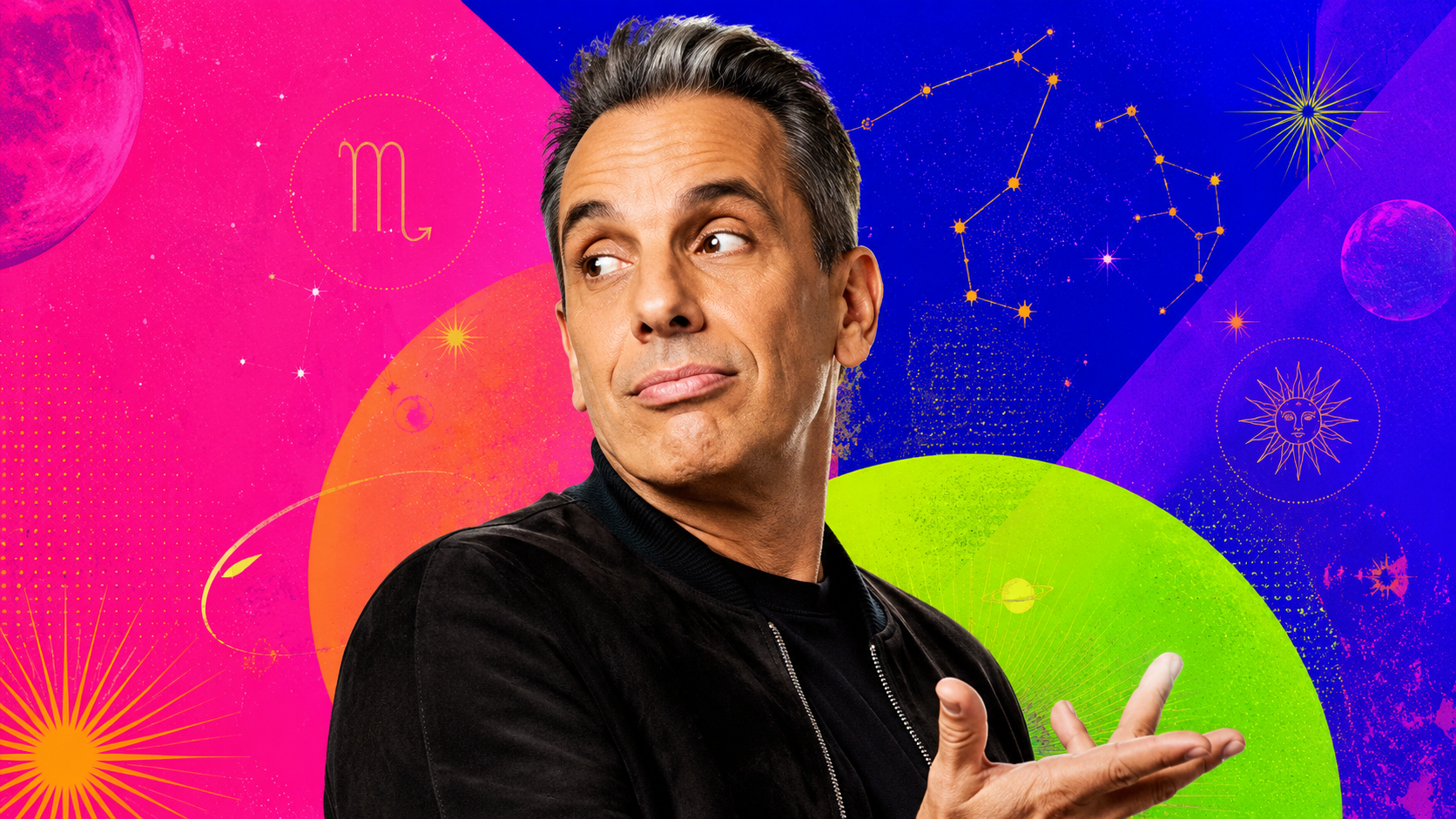
Written in the Stars: The Birth Chart of Sebastian Maniscalco, Comedy's Arena Headliner
Every birth chart has a point of view — Sebastian Maniscalco's has a complaint. Born with a traditionalist Cancer Sun squared by both Mars and the modern world, a retrograde Leo Mercury that stages the inner monologue, and every planet in the chart answering to a dignified Mars in Aries, comedy's arena headliner carries a sky built to turn aggravation into craft. A deep-dive reading of the exasperation engine, the twenty-year Saturn apprenticeship, and the Venus-Jupiter axis that booked the Garden.
Every birth chart has a point of view. Sebastian Maniscalco's has a complaint. Born on July 8, 1973, in Arlington Heights, Illinois — a northwest Chicago suburb full of the exact well-mannered, hard-working people his comedy would spend decades defending — he carries a chart that reads like a grievance filed with the cosmos and granted in full: the sensitive traditionalist wired directly to a hair-trigger; the observer whose inner monologue was always going to become the act; the body built to perform the aggravation that the mouth was still composing. He is, by the numbers, the biggest live comedian of his era — the man who sold out Madison Square Garden four times in a single weekend — and the astrology's explanation for how a hospitality worker from the suburbs pulled that off is unusually complete.
Strip away the arenas, the Netflix specials, the Scorsese scenes, and what remains is the July sky over Cook County — and that sky was organized, with almost suspicious tidiness, around a single planet. Trace the classical rulership chains in this chart — each planet handing authority to the ruler of its sign — and every one of them, by every path, terminates in the same place: Mars, in Aries, its own sign, dignified and at full strength. Mars is this chart's final dispositor. Enter the psyche through any door — the feelings, the voice, the charm, the ambition — and you end up in the same room: the planet of heat, motion, and irritation, sitting on its own throne. Meghan Markle's chart, earlier in this series, funneled everything into a sovereign Leo Sun; Sebastian's funnels everything into a sovereign Aries Mars. Which is the astrological way of saying: everything in this man eventually becomes physical — the reaction, the opinion, the punchline. All of it exits through the body.
And then the chart hands over the rest of the mechanism, piece by piece. A Cancer Sun — the traditionalist, the family man — locked in a square to that Mars and a second square to Uranus, planet of the modern and the disruptive: the offended classicist, permanently aggravated by contemporary behavior, which is not a description of his comedy so much as its entire premise. A Venus in showbiz Leo standing opposite Jupiter, planet of the crowd, at 0°16′ of orb — essentially exact, the performer and the arena staring at each other across the wheel. And one structural detail so on-the-nose it borders on parody: run the element count, and his singleton earth — the chart's only grounded placement — is the North Node itself, in Capricorn: the point of destiny, standing alone, in the sign of the father, the work ethic, and the old ways. The man's career-summit film is titled About My Father. The chart filed that title in 1973.
A note on method before we begin: because his recorded birth time is set to noon, we're setting aside the houses and the rising sign, and reading the planets purely by sign, degree, and their conversations with one another. What's remarkable, as ever, is how much the chart says without them.
Let's begin where all charts begin — with the Sun.
The Sun in Cancer: The Offended Traditionalist
The Sun in Cancer — Sebastian's sits at 16°22′, midsummer, deep in the sign — is the zodiac's keeper of the hearth: family-first, tradition-minded, nostalgic, protective, and sensitive in the precise sense of registering everything. Cancer Suns are tuned to how things are supposed to feel — the household running right, the guest treated properly, the respect paid where respect is owed — and they experience violations of that order not as trivia but as personal affronts. This is the Sun of the man whose comedy is, at bottom, a defense of manners: the doorbell you don't ring unannounced, the party you bring something to, the handshake done correctly. Cancer doesn't invent values; it inherits them, and guards them.
The inheritance, in his case, has a name and an accent. The son of Salvatore — the Sicilian immigrant hairdresser whose old-world exasperation became the beating heart of the act — Sebastian built a career on the Cancer Sun's home territory: the Italian-American family, the mother's kitchen, the father's rules, the Sunday dinner as sacred institution. Cancer runs on memory and loyalty, and his material runs on both: nearly every classic bit is a piece of domestic archaeology, the old way held up next to the new way, to the new way's enormous disadvantage.
But a warm nostalgic Sun does not fill arenas by itself, and here the chart installs the engine — because this gentle, tradition-keeping Sun is squared from both sides. First, Sun square Mars (5°02′): the sensitive core at a permanent right angle to the planet of irritation — and not just any Mars, but the dignified, full-strength, final-dispositor Mars in Aries. Sun-Mars squares run hot: quick to aggravation, allergic to slowness and stupidity, physically expressive of every annoyance. In most lives this square is a temper to manage. In his, it is the product. The entire Maniscalco persona — the personally offended man, vibrating with disbelief at what he's just witnessed — is a Sun-Mars square doing standup. The aggravation was never incidental to the comedy. The aggravation is the comedy.
And then the second square names the target: Sun square Uranus (2°38′) — the traditionalist at a hard angle to the planet of the modern, the disruptive, the new. Sun-Uranus squares describe a life in permanent friction with contemporary norms, and his act has monetized that friction with almost scientific precision: the bewilderment at how people behave now — at the airport, at the gym, at the party, on the phone — delivered by a man visibly stranded in the wrong decade and proud of it. "Why would you do that?", the title of his breakout special, is a Sun-square-Uranus sentence. The chart's central comedy machine is exactly this triangle: Cancer supplies the standards, Uranus supplies the violations, and Mars supplies the reaction — at full, dignified, unfiltered volume.
Mercury Retrograde in Leo: The Inner Monologue, Externalized
The voice sits at 3°11′ of Leo, retrograde — and for a comedian, this Mercury deserves slow appreciation, because it describes not just that he's funny but the specific architecture of how.
Mercury in Leo is the performer's voice: warm, dramatic, story-shaped, constitutionally incapable of telling an anecdote without acting it out. It doesn't relay information; it stages it. But the retrograde is the masterstroke, because a retrograde Mercury turns the commentary inward — the running internal monologue, the mind that watches, replays, and privately editorializes. Now consider what a Maniscalco bit actually is: it is the inner monologue of a man observing other people's behavior — the silent, appalled commentary everyone has and suppresses — dragged out of the skull and performed at full theatrical scale. Mercury retrograde in Leo is that operation in a single placement: the private reaction, staged. He has effectively spent thirty years doing dramatic readings of his own internal dialogue, which is the retrograde-in-Leo job description verbatim.
The supporting aspects fill out the toolkit with almost suspicious completeness. Mercury trine Neptune (1°52′) is the imagery engine — the planet of the voice in flowing contact with the planet of illusion and mime. This is the act-out aspect: the full-body impressions, the wordless faces, the ability to become the guy at the buffet rather than describe him. Mercury sextile Pluto (1°19′) supplies the scalpel — observation that cuts to the exact absurd detail everyone noticed and nobody named; comedy's version of the surgical strike. Mercury opposite Jupiter (6°41′) licenses the exaggeration — hyperbole as rhetoric, the small offense inflated to operatic scale, which is half of how a bit about hors d'oeuvres becomes ten minutes. And a wide conjunction to Venus in Leo (6°57′) dresses the whole voice in style — because notice that the observations, however scathing, always arrive charming: tailored, polished, delivered in a suit.
One more wire matters enormously, and it's a hard one: Moon square Mercury (1°11′) — the second-tightest aspect in the chart. The visceral emotional reaction (a Scorpio Moon; we're getting there) collides with the speaking voice at a right angle, which in ordinary lives produces the blurt, the tone problem, the thing said before it was considered. In a comedian's chart it produces something priceless: the gap — the beat where the feeling has clearly arrived and the words haven't, the face doing the reacting while the mouth loads. Anyone who has watched him take a long, disgusted pause before the line knows this square by sight. The friction between what he feels and what he says isn't a flaw in the instrument. It's the timing.
The Moon in Scorpio: The Disgust Engine
The emotional core sits at 2°00′ of Scorpio — classically the Moon's fall, and, as this series keeps finding, the classical debilities are where the interesting careers live. A Scorpio Moon feels intensely and viscerally: reactions arrive in the body as full-strength states — contempt, suspicion, loyalty, disgust — with no diluted middle settings. It is a Moon that cannot fake neutrality. Show it something it finds ridiculous and the verdict is instant, total, and visible from the cheap seats.
Which is, of course, the other half of the act. If Mercury retrograde supplies the commentary, the Scorpio Moon supplies the reaction — the genuine, unmanufactured revulsion that makes the commentary land. His comedy is frequently described as "disgust-based," and astrologically that is not a metaphor: this Moon's native emotional register — the curled lip, the narrowed eyes, the full-body recoil from the guy eating over the open buffet — is the raw material the whole enterprise refines. Audiences can tell performed outrage from the real thing, and the reason his reads as real is that it is: a Scorpio Moon does not do bits about things it doesn't actually feel.
The chart then does something crucial: it disciplines the intensity. Moon trine Saturn (4°53′) — an out-of-sign trine, reaching from late Gemini — puts the volcanic feelings under professional management: emotional control, deadpan patience, the ability to hold a reaction for exactly as long as the laugh requires. Moon-Saturn harmony is the timing aspect, the containment that turns eruption into craft. And Moon sextile the North Node (5°38′) ties the feelings to the destiny: the visceral reactions aren't a private liability in this chart — they are, quite literally, the path. The thing he couldn't help feeling became the thing arenas pay to watch him feel.
Venus in Leo Opposite Jupiter: The Showman and the Arena
Now for the chart's tightest aspect, and its most prophetic. Venus — charm, taste, the audience's affection — sits at 10°09′ of Leo, the sign of the stage, the spotlight, and the show. Venus in Leo performs its charm: it dresses well, it holds the room, it understands presentation as a form of respect (his famous stage wardrobe — the suits, the loafers, the groomed — is this Venus's signature on every ticket). And this Venus stands in direct opposition to Jupiter in Aquarius, retrograde, at 0°16′ of orb — essentially exact.
Read the polarity: Leo is the individual performer; Aquarius is the mass audience. Venus is the charm; Jupiter is the multiplier. An exact Venus-Jupiter opposition across this axis is, almost literally, the showman facing the arena — personal magnetism and collective scale locked eye-to-eye, each demanding the other grow. Venus-Jupiter contacts are classically the most fortunate in astrology (charm that attracts abundance, audiences, benefactors), and the opposition is the version that plays at maximum size: not the comedy club's fifty seats but the amphitheater, the stadium tour, the four sold-out Gardens in a weekend, the "highest-grossing comedian" line on the Billboard chart. The aspect's caution is excess — more shows, more cities, more everything — but in a touring comic's life, excess is the business model. The chart got the venue right to within a sixteenth of a degree.
Two flowing trines complete the charm machinery. Venus trine Mars (1°11′) blends the affection with the aggression — and this is the aspect that solves the central puzzle of his appeal: the comedy is genuinely combative (mockery, contempt, aggravation) and yet lands as likable, even affectionate. Venus-Mars harmony lets the attack and the charm operate as one gesture; the audience being roasted is somehow also being embraced. And Venus trine Neptune (5°06′) adds the gloss — glamour, cinema, the aesthetic sheen that made him castable the moment Hollywood looked over: Green Book, then Scorsese's The Irishman, then a movie of his own. Venus in Leo never doubted it would end up on a marquee. The trines simply drew the route.
Mars in Aries: The Body as Punchline
And so to the throne room — the planet the whole chart reports to. Mars sits at 11°20′ of Aries, its own sign, fully dignified: the warrior at home, the engine at full compression. And in this chart, remember, Mars is the final dispositor — the terminus of every rulership chain. The feelings (Moon in Scorpio, Mars's classical sign) answer to it directly; the Sun squares it; everything else routes to it eventually. Whatever this psyche produces — opinion, emotion, observation — its final output format is Martial: kinetic, immediate, physical.
Which is the astrological explanation for the single most distinctive thing about him as a performer: the body is the act.Maniscalco is routinely called the most physical comedian of his generation — the strut, the recoil, the full-torso disbelief, the impressions built from posture before a word is spoken — and a dignified Aries Mars as final dispositor is precisely that wiring: a system in which everything eventually moves. Other comics write jokes and add gestures. His chart suggests the reverse assembly order: the physical reaction is the native language, and the words are the subtitles.
Mars's aspects sharpen the picture. Mars sextile Jupiter (1°28′) pipes the physical energy straight into the arena aspect — stamina at scale, the capacity to do the two-hundred-date tour and perform to the back row of a stadium with his shoulders. Mars square the Sun, as covered, converts the heat into the persona. And Mars square the North Node (3°42′) puts the drive at a hard angle to the destiny — the signature of a path advanced through friction: nothing about the climb was smooth, every stage of it was pushed for, and the impatience that made the twenty-year wait excruciating is the same force that made it end.
Saturn in Gemini: The Twenty-Year Apprenticeship
Here is the placement that explains the part of the biography the arenas obscure. Saturn — discipline, delay, mastery through repetition — sits at 27°07′ of Gemini, the sign of speech, wit, and words. Saturn in Gemini is the craft of language treated as a trade: timing drilled like scales, bits rewritten for years, the conviction that funny is not a gift but a discipline. It is the placement of the comic's comic — the one other comedians describe as technically flawless — and it is earned exactly the way Saturn always insists: slowly.
The receipts are famous precisely because they were unglamorous. He moved to Los Angeles in 1998 and spent the better part of a decade waiting tables at the Four Seasons Beverly Hills — serving the industry by day, doing open mics and bowling-alley gigs by night — a Saturn apprenticeship of nearly Dickensian length before Vince Vaughn's Wild West Comedy Show cracked the door in 2006, and years more grinding after that before the rooms became theaters and the theaters became arenas. Saturn square Pluto (4°45′) — the endurance aspect, the capacity to withstand sustained obscurity without quitting — is all over that stretch: the slow, pressurized decade that either breaks a performer or compresses him into something arena-grade. And the Moon's trine to this Saturn is what the audience now sees on stage every night: intensity, under exquisite control. The pause held one beat past comfortable. The reaction, rationed. Timing is just Saturn in Gemini with twenty years of reps, and his has exactly that.
The Outer Planets and the Node: A Generation's Weather, One Man's Father
The slow outer planets describe generational climates, and his cohort's are quickly told: Uranus in Libra and Pluto in Libra mark the generation that renegotiated partnership and social norms — in his chart, mostly background weather, though Uranus's square to his Sun personalizes it sharply, as we've seen, into the act's central grievance with modernity. Neptune in Sagittarius, retrograde, is the widescreen-dreamer signature — belief, travel, broadcasting — and its flowing contacts to his Mercury and Venus quietly underwrite the storytelling instinct and the screen career: the mime, the glamour, the leap from club stages to Netflix's global platform and movie sets. Jupiter sextile Neptune (4°50′) hums underneath as the dream-at-scale aspect: the suburban waiter's fantasy of arenas, which had the poor judgment to come true.
But the personal headline among the slow points is the one flagged at the top. Run the element count: fire holds four placements, air holds four, water holds his two luminaries — and earth holds exactly one point in the entire chart: the North Node, at 7°38′ of Capricorn. The chart's only ground is the destiny itself. A singleton, as this series keeps demonstrating, is a funnel — and here the funnel means that all of this chart's need for the tangible, the earned, the real, discharges through a single location: the node of fate, wearing the sign of the father, the work ethic, discipline, and the old ways.
It would be difficult to overstate how precisely his life has honored that placement. A Capricorn North Node's mandate is to grow toward earned mastery, traditional structure, and the paternal line — away from the South Node's soft comfort in Cancer's kitchen and toward the mountain. His career is that document: the two-decade climb with no shortcuts taken (Capricorn does not acknowledge shortcuts as a category), the brand built on his father's old-world values, the book and special titled Stay Hungry — a Capricorn commandment if one was ever issued — and, at the summit, the most Capricorn-North-Node artifact imaginable: a major studio film, starring Robert De Niro, titled About My Father. The destiny point stood alone in the sign of the father for fifty years, and then he filmed it. The node's hard squares from Mars and Pluto (3°42′, 5°46′) simply confirm what the biography shows: this destiny was reached by pushing, not by drifting.
The Synthesis: The Complaint as Craft
Read together, the chart resolves into a portrait of productive contradiction — the series' recurring theme, here tuned for laughs. The water luminaries — Cancer Sun, Scorpio Moon — supply the standards and the visceral reactions: the traditionalist who feels every violation of the proper way. The fire bench — Mercury, Venus, Mars, with Neptune's blessing — supplies the stage: the voice that performs, the charm that dresses the attack, the body that delivers it. The air planets — Saturn's craft, Jupiter's crowd, the Libra outer planets' social eye — supply the setting: other people, en masse, behaving badly. And the whole system drains, by every rulership channel, into one dignified Aries Mars: the reaction, made physical, made professional, made enormous.
If there is a single sentence this chart keeps writing, it is this: the aggravation is the gift. A Cancer Sun squared by Mars and Uranus was always going to be offended by the modern world; the rest of the chart determined what happened next — the retrograde Leo Mercury staged the inner monologue, the Scorpio Moon guaranteed the reaction was real, Saturn in Gemini drilled it into timing, and the exact Venus-Jupiter axis booked the arena. Most people's irritation costs them. His chart routed it, disciplined it, dressed it in a tailored suit, and sold it out four nights at the Garden.
That is not a small assignment. It is, however, exactly the kind of assignment written for a man whose every planet answers to Mars, whose only earth is his destiny, and whose destiny is spelled, in the old calendar of the sky, the father's way — earned the long way up.
Frequently Asked Questions
What is Sebastian Maniscalco's zodiac sign?
Sebastian Maniscalco is a Cancer Sun, born July 8, 1973. His Sun sits at 16°22′ of the sign — the traditionalist's placement of family, memory, and inherited values — and it is squared by both Mars (the aggravation) and Uranus (the modern world). That double square is, almost literally, the premise of his comedy: the man of the old ways, permanently offended by the new ones.
What is Sebastian Maniscalco's Moon sign?
His Moon is in Scorpio, at 2° — the sign of visceral, full-strength emotional reactions. It is the disgust engine of the act: the genuine, unfakeable revulsion that powers the faces and the recoils. A near-exact square to his retrograde Mercury creates the famous gap between the reaction and the line, and a trine to Saturn puts the whole thing under professional timing control.
What is Sebastian Maniscalco's rising sign?
From this data alone, we can't say. The chart used here is set to noon rather than an exact birth time, so the rising sign and houses can't be reliably calculated — an Ascendant changes roughly every two hours. This reading sticks to signs, degrees, and aspects, which hold true regardless of the hour. (It's also a perfect illustration of why an exact birth time matters for a personal reading.)
What is his "big three"?
With the noon-chart caveat on the rising sign, his confirmed two-thirds are Cancer Sun and Scorpio Moon — both water, the traditionalist and the visceral reactor. It's a deeply feeling pairing hiding inside a combative act: the standards come from Cancer, the intensity comes from Scorpio, and the fire planets do the performing.
What in his birth chart explains his comedy style?
Four signatures, working as one machine. Sun square Mars and Uranus supplies the persona — the offended traditionalist at war with modern behavior. Mercury retrograde in Leo is the mechanism itself: the inner monologue, staged — with a trine to Neptune for the act-outs and mime, and a sextile to Pluto for the surgical observation. The Scorpio Moon guarantees the disgust is real. And Mars in Aries as the chart's final dispositor makes everything physical: every planet in the chart ultimately answers to the body.
Why is his comedy so physical?
Because the chart is built that way structurally, not stylistically. Mars sits in Aries — its own sign, fully dignified — and serves as the final dispositor: trace any planet's rulership chain and it terminates in Mars. The entire psyche's output routes through the planet of motion and heat. The strut, the recoil, the posture-first impressions — astrologically, the body isn't illustrating the jokes. The body is the native language, and the words are subtitles.
Does his chart show fame?
Emphatically — and it names the venue. Venus in Leo opposite Jupiter in Aquarius at 0°16′ — essentially exact — is the showman facing the mass audience: personal charm and collective scale locked across the wheel. It is the arena aspect, supported by Venus trine Mars (attack that lands as charm) and Venus trine Neptune (the screen career). The chart never predicted a club comic. It predicted Madison Square Garden, four times in a weekend.
What's the rarest thing in his birth chart?
Three features compete. Mars in Aries as final dispositor — the entire chart draining into one dignified planet — is the standout. Close behind: the Venus-Jupiter opposition at 0°16′, essentially exact. And the strangest: his singleton earth is the North Node itself in Capricorn — the chart's only grounded point is the destiny, in the sign of the father and the work ethic. The man spent twenty years earning the climb and then made a film called About My Father. The node was there first.
Is this reading based on his exact birth time?
No — and that's worth being transparent about. His circulated data uses a noon placeholder time, so this analysis deliberately excludes houses and the Ascendant and reads only what's certain: planetary signs, degrees, and aspects. Even that partial picture tells a strikingly coherent story. A verified birth time would sharpen everything further — which is exactly why professional readings always begin by asking for yours.
Your Chart Is Waiting
Here's the thing: this entire reading came from a noon chart — no birth time, no houses, no rising sign. A fraction of the picture. Imagine what a full reading of your chart could reveal: your exact angles, your houses, your aspects and degrees, the whole architecture of your sky, walked through line by line. If this reading stirred something, that's usually the invitation.
Book your personal chart reading — and find out what was written in your stars.
Written in the Stars: The Healer — Pisces Sun, Scorpio Moon, Virgo Rising
Every reading in this series so far came with an asterisk — a noon chart, no houses, no rising sign. This time the asterisk comes off. An anonymous reader shared her exact birth time, and the sky repaid her: a Moon fused to Pluto at twelve minutes of arc, a Pluto sextile the Ascendant exact to a single minute, both angles ruled by one intuitive Mercury, and a chart that names its purpose in every house it owns. This is what a full reading looks like.
Every reading in this series so far has come with an asterisk. Meghan Markle, Tyler Henry, Travis Kelce — all of them read from noon charts, with the houses and rising sign politely set aside, and each post ending with the same honest confession: a verified birth time would sharpen everything. Today the asterisk comes off. The chart below belongs not to a celebrity but to a reader — a woman who shared her data for publication, identifying details withheld — and her birth time is exact: 6:15 in the evening, on the twelfth of March, 1993, in a South Jersey town about fifteen minutes from Philadelphia. Since anonymous charts can't be named for their owners, we'll name each one in this new strand of the series for its archetype — the figure the sky itself keeps drawing. By the end of this reading, you'll see why this one could only be called The Healer. For the first time in this series, we have the whole sky: every house, both angles, the entire architecture. This is what the asterisk was hiding.
And the timing of that birth turns out to be the first interpretation. At 6:15 PM on that date, at that latitude, the Sun had slipped below the western horizon minutes earlier — she was born at sundown, with the Sun sitting almost exactly on the Descendant, the setting-point of the chart. In traditional astrology, a birth after sunset makes this a night chart, and in a night chart the Sun hands its lantern to the Moon: the Moon becomes the luminary in charge, the light the whole life reads by. Hold that thought, because this chart's Moon is not a gentle lamp. It is fused to Pluto — the underworld itself, at home in its own sign of Scorpio — at 0°12′ of orb, essentially exact. And the two tightest aspects in the entire chart, tighter than anything we've seen in this series, are that Moon and that Pluto sextiling the Ascendant at 0°11′ and 0°01′ — one single minute of arc. The deepest point in the chart is wired directly into the face it shows the world, to a precision that borders on unsettling.
One more piece of scene-setting, because the sky insists on it: within a day of her first breath, the Storm of the Century— the great March 1993 superstorm — came roaring up the Eastern Seaboard and buried her home state in snow. She was born, quite literally, on the eve of the storm. Given what the chart says about depth, pressure, and weathering things, it is hard not to smile at the timing.
A note on method, inverted this time: because the birth time is exact, we are using everything — signs, degrees, aspects, and the twelve houses (Placidus), which answer the question the noon charts never could: where in life each planet does its work. If signs are the how and planets the what, houses are the where — career or home, love or health, the public stage or the private room. Structurally, three things leap out before we touch a single placement: five of eleven placements sit in water — the chart is more than half feeling; the Moon and Mars sit in traditional mutual reception, each in the other's sign, trading keys the way this series' charts keep doing; and both angles — the Virgo Ascendant andthe Gemini Midheaven — are ruled by the same planet, Mercury, making this a rare double-Mercury chart: the persona and the career both report to one planet. We'll meet that planet shortly, and it is not where you'd expect.
Let's begin — for once — not with the Sun, but where an exact birth time lets us begin: at the Ascendant.
The Virgo Ascendant and the Double-Mercury Chart
The Ascendant — the sign rising on the eastern horizon at the moment of birth — is the chart's front door: the instinctive persona, the first impression, the way life is met. Hers rises at 25°26′ of Virgo: precise, observant, helpful, self-contained. Virgo rising people tend to present as composed and useful — the one who notices what's needed and quietly handles it, the friend with the plan and the well-stocked bag, the colleague whose competence is so consistent it becomes invisible. There is a modesty built into this Ascendant, sometimes to a fault: Virgo rising would rather be correct than be seen, and often deflects attention toward the work.
But the Ascendant is only the door; the chart ruler tells you who answers it. Virgo is ruled by Mercury — and here the chart makes its first structural statement, because the Midheaven, the career-point at the top of the chart, sits at 24°46′ of Gemini, also ruled by Mercury. Both angles of this chart — the self-point and the world-point, the mask and the mission — funnel through a single planet. Whatever Mercury is doing in this chart, the whole outer life is doing.
So find Mercury: it sits at 14°54′ of Pisces, retrograde, in the Sixth House — and every word of that sentence matters. Pisces is the sign of Mercury's classical detriment and fall, which textbooks read as weakness and lived charts read as difference: this is not the linear, list-making mind Virgo rising advertises on the door. It is an intuitive, associative, porous mind — one that absorbs rather than sorts, that knows things before it can show its work, that thinks in images and undercurrents. Retrograde turns that mind inward: the deep processor, the one who replays conversations, who drafts and redrafts, whose best thinking happens after the meeting, in the quiet. And the Sixth House placement — the house of work, service, health, and daily craft — aims all of it at being useful: this is a mind built for care work, for reading what a person or a body or a room actually needs beneath what it says.
Put the architecture together and you get the chart's first portrait: a Virgo mask of order and competence, run from behind the scenes by a Pisces intuition that operates on feel. She likely presents as the organized one and operates as the psychic one — the practical exterior over the intuitive engine. And because both angles answer to this Mercury, the implication runs deep: the life's outer work, whatever form it takes, will always come back to perception, communication, and care — the noticing mind, in service.
One more resident of the First House deserves mention: Jupiter, retrograde in Libra, sits just inside the Ascendant. Jupiter rising is one of astrology's kindest placements — grace, buoyancy, a benefic standing at the front door, inclining others to trust and like her on sight. In Libra it reads as fairness and charm; retrograde, the luck works from the inside: resilience, a self-righting quality, protection that shows up as inner buoyancy rather than outer showiness. It softens everything the heavier parts of this chart are about to say.
The Sun in Pisces in the Sixth, Setting on the Descendant
The Sun — identity, vitality, the life's central project — sits at 22°23′ of Pisces in the Sixth House, freshly set, three degrees from the Descendant. Three statements in one placement.
First, the sign. A Pisces Sun is the empath's Sun: permeable, imaginative, compassionate to the point of self-forgetting, tuned to the feelings in a room the way other signs are tuned to the facts in it. Pisces runs on meaning and mercy; it struggles with rigid systems and thrives wherever care, creativity, or spirit are the actual product.
Second, the house — and here the chart repeats itself on purpose. The Sixth is the house of work, health, service, and daily practice, and her Sun and her chart-ruling Mercury both live there. When a chart doubles down like this, the reading writes itself: the identity is realized through service. This is the signature of the helper, the healer, the caretaker, the one whose sense of self is inseparable from being of use — teacher, nurse, therapist, counselor, caregiver, advocate; the specific costume varies, but the Sixth-House Pisces Sun always ends up in some version of the helping professions, formally or informally. The shadow is just as legible: the Sixth-House Sun can over-serve — burning its own vitality as fuel for other people's needs — and Pisces, which struggles with boundaries on a good day, makes that the chart's most important health warning. The medicine is built in next door: the Virgo Ascendant's routines, lists, and limits exist precisely to give this Sun a container.
Third, the angle. The Sun stands in opposition to the Ascendant — which is to say, conjunct the Descendant, the partnership point, within about three degrees. She was born as the Sun touched the western horizon: the self, positioned at the meeting-place with the other. Sun-on-the-Descendant people find themselves through relationship — they see their own light most clearly reflected in a partner, a client, a person across the table — and their lives tend to be built around significant one-to-one bonds. Combined with the Sixth-House service theme, the picture sharpens further: identity found in devoted attention to another person. It is a beautiful placement, and a demanding one: the lifework includes learning that the self exists even when no one is currently being helped.
The Sun's aspects are almost entirely soft — a flowing trine to the Moon and Pluto in Scorpio, supportive sextiles to Uranus and Neptune — which matters enormously in a chart this deep: the identity is on good terms with its own intensity. Whatever pressure this chart carries, the core self and the core feelings are allies. Which brings us to the feelings.
Moon Conjunct Pluto in Scorpio in the Third: The Lamp in the Deep
Here is the center of the chart — the placement everything else orbits. The Moon sits at 25°15′ of Scorpio, conjunct Pluto at 25°28′ — an orb of 0°12′, as close to exact as natal aspects get — with Pluto standing in its own sign, at full domicile strength. And remember the sect: born after sundown, this is a night chart, and the Moon is its ruling luminary. The lamp of this life is a Moon fused to the lord of the underworld, in the underworld's own sign.
Let's be precise about what that means, because Moon-Pluto is one of astrology's most formidable signatures and it deserves better than ominous hand-waving. The Moon is the emotional body — needs, instincts, safety, memory. Pluto is depth, extremity, death-and-rebirth, the truth beneath the floorboards. Fused, they produce a person who feels at maximum depth or not at all: no casual emotions, no surface attachments, no "fine, thanks." Moon-Pluto natives read undercurrents the way others read faces — they register the tension in a room before the door finishes opening, they know when someone is lying, they form bonds of totalizing loyalty and expect (silently, fiercely) the same in return. The emotional life runs on transformation: this Moon periodically burns down its own structures and rebuilds, and its keeper tends to emerge from each life-chapter genuinely changed — the phoenix pattern, run on a domestic scale. Classically the Moon is in "fall" in Scorpio, and here the chart performs its now-familiar rescue: the Moon sits in the sign of its conjunction partner — fused to its own modern dispositor, at home — and holds traditional mutual reception with Mars (Moon in Mars's sign of Scorpio, Mars in the Moon's sign of Cancer). The feelings and the drive have traded keys. Emotional courage is native here: this is someone who can act on what she feels, and whose actions are always, underneath, about protecting what she loves.
Now the detail an exact birth time makes possible — the houses and the angles — and it changes everything. This conjunction sits in the Third House: the house of communication, language, siblings, early schooling, and the local, everyday world. A Third-House Moon needs to talk to feel safe; a Third-House Pluto gives words surgical power. Together: the voice as the site of depth. This is someone whose speech, writing, or daily conversation carries unusual weight — the friend whose two-sentence text lands like a verdict, the person others confess things to without meaning to. It can also mark the early environment as intense: Third-House Pluto often correlates with a childhood world — siblings, school, the neighborhood — where deep currents ran under ordinary days, and where she learned early to read what wasn't being said. The North Node in Sagittarius sits in this same house: the destiny-point, in the sign of teaching, meaning, and publishing, in the house of the voice. The path of growth in this life runs through communicating what the depths have taught her — turning the underwater perception into language others can use.
And then the aspect that makes this chart genuinely rare. The Moon sextiles the Ascendant at 0°11′; Pluto sextiles it at 0°01′ — one minute of arc, the tightest aspect this series has ever printed. The deepest structure in the chart is soldered directly to the rising degree: the perception, the intensity, the emotional x-ray — all of it flows straight into the persona, harmoniously, whether she intends it or not. People feel it when she enters a room. The Virgo mask says tidy and helpful; the sextile from the deep says and she sees everything. Most Moon-Pluto people learn to hide the depth. Hers is load-bearing in the face itself.
Every centerpiece has its cost, and this one is named Saturn: from 24°37′ of Aquarius, Saturn squares the Moon at 0°39′ and Pluto at 0°51′ — a double square from the planet of restriction to the chart's emotional core, in fixed signs, nearly exact. Moon square Saturn is the signature of feelings met early with conditions — the learned instinct that emotions are safest managed, rationed, earned; that composure is armor. Squaring this Moon, with Pluto attached, it reads as a gatekeeper installed over an ocean: enormous feeling, and an equally strong internal official deciding what may surface, when, and to whom. Saturn-Pluto in square adds the endurance signature — the capacity to withstand sustained pressure that would flatten others, purchased at the price of rarely letting anyone see the strain. In a young life this square usually feels like loneliness; in a maturing one it becomes the very thing that makes the depth usable — the discipline that turns an overwhelming inner sea into a well with a bucket and a rope. The fixed squares are the hard weather of this chart. They are also, unmistakably, its strength training.
Venus Retrograde in Aries in the Eighth: The Heart, Under Renovation
The love storyline in this chart is vivid enough to deserve its own chapter. Venus — love, desire, worth — sits at 19°58′ of Aries, retrograde, at the end of the Seventh House and therefore read in the Eighth: the house of intimacy, merging, shared resources, and transformation through relationship.
Take the layers in order. Venus retrograde is the rarest of the retrogrades — Venus reverses less than any other planet, so only a small fraction of people carry it natally — and it turns the love-function inward: worth and affection are processed privately, felt more than shown, and relationships tend to be re-examined, re-encountered, re-negotiated. Venus-retrograde natives often report a love life with second acts: the returning person, the relationship that must be done twice to be done right, the late-blooming clarity about what the heart actually wants versus what it was taught to want. There is frequently an early chapter of undervaluing herself in love — accepting less, loving unavailable or unfinished people — followed by a genuine revaluation. The retrograde's gift is that the second draft is almost always truer than the first.
The sign adds heat: Venus in Aries loves directly — quick to spark, courageous, allergic to games, wanting the honest flame rather than the slow negotiation (its classical "detriment" simply means love here refuses to be diplomatic). And the Eighth-House placement adds depth and stakes: this is not a Venus for casual dating. The Eighth House merges — emotionally, physically, financially — and its Venus experiences love as transformation: relationships that change her at the root, intimacy as the place where the real self is finally seen. Combined with the Scorpio Moon-Pluto, the romantic signature is coherent and intense: all-in or not at all, with a strong preference for all-in.
The aspects tell the plot. Venus squares the Uranus-Neptune conjunction (1°24′ and 0°43′) — the disruptor and the dissolver, both challenging the heart. Venus-Uranus squares bring the sudden: instant attractions, abrupt endings, love that arrives and departs like weather, and a lifelong tension between closeness and freedom. Venus-Neptune squares bring the veil: idealization, the beloved seen in soft focus, the disappointment when the fantasy develops ordinary human edges — and, at its best, a capacity for genuinely transcendent, compassionate love once the projector is switched off. Early relationships under these squares tend to be educational in the expensive sense. But the chart writes a corrective into the same paragraph: Venus sextile Saturn (4°38′) — the stabilizer. With time, the same Saturn that gates the Moon steadiesthe Venus: love matures, chooses better, builds. This is a heart whose story genuinely improves with age — the retrograde revaluation, the Saturn ballast, the Eighth-House depth finally met by someone who can hold it. The chart practically promises the second act is better than the first.
Mars in Cancer in the Tenth: The Protector at the Top of the Chart
Mars — drive, effort, the fight — sits at 12°16′ of Cancer in the Tenth House, the house of career, reputation, and the public role. Mars in Cancer is the series' returning guest (Meghan Markle carries it too): the tender warrior, the fighter whose battles are always, underneath, about protection — family, the vulnerable, the inner circle. Its anger is tidal rather than explosive; its courage is fiercest on someone else's behalf. Classically in its fall, this Mars is rescued the same way the Moon was: the mutual reception — Mars in the Moon's sign, Moon in Mars's — means the drive and the feelings run each other's households. She fights because she feels; she feels safely because she can fight.
The Tenth-House placement aims all of it at the career: the protector, installed at the very top of the chart, visible to everyone. Mars in the Tenth works — ambitiously, tirelessly, and usually in roles with a defensive or caretaking edge: advocacy, healthcare, teaching, management of people who need managing for their own good, any profession where effort visibly shields someone. Note how the whole vocational architecture now locks together: a Gemini Midheaven ruled by a caring Pisces Mercury in the Sixth; a Sixth-House Sun of service; and a protective Cancer Mars actually standing in the Tenth. Three separate systems, one job description. Whatever her business card says, the work is care, and the chart has been unanimous about it from every angle.
One aspect needs honest handling: Mars square Jupiter, at 0°18′ — the second-tightest planetary aspect in the chart.Mars-Jupiter squares do everything at 120 percent: more effort, more commitments, more causes, the yes said before the calendar is consulted. In a Tenth-House Mars, it reads as professional overextension — the one who takes the extra shift, absorbs the extra case, carries the extra colleague — powered by a genuinely enormous engine and endangered only by its own generosity. Paired with the Sixth-House Sun's over-serving tendency, this is the chart's clearest practical warning, so let it be said plainly: the drive is not the problem; the dosage is. The same square, disciplined, is the signature of prodigious, principled work capacity — the person who simply outlasts every problem in front of her.
The Fourth House: Uranus Conjunct Neptune, and the Roots in Motion
An exact birth time turns generational weather into personal architecture, and nowhere more than here. Uranus and Neptune sit conjunct at 0°41′ of orb in Capricorn — the great, once-in-171-years conjunction that peaked in 1993, the very year of her birth; she carries it at nearly its exact degree — and in her chart it lands in the Fourth House: home, family, roots, the private foundation of the life.
Read plainly and gently: the house of foundations, occupied by the planet of disruption fused to the planet of dissolution, suggests roots that moved — a childhood home life touched by change, instability, unconventionality, or a certain unreality: the family that relocated or restructured, the parent who was present-but-elusive, the sense (common to Fourth-House Neptune especially) that something in the family story was idealized, unspoken, or slightly out of focus. Fourth-House Uranus adds the electric version: sudden changes of household, an early life where the ground could rearrange itself without notice. The IC — the root-point itself — sits in Sagittarius, sign of distance and belief: a family narrative involving big beliefs, big moves, or meaning-making as the household weather.
Here is what the rest of the chart does with it, and it is genuinely redemptive: this conjunction is supported everywhere — sextile the Sun (1°01′, 1°42′), sextile the Moon (3°53′, 4°34′), trine the Ascendant (4°04′, 4°45′). The unstable foundation did not destabilize the person; it trained her. The shifting ground became the source of her adaptability, her radar for undercurrents, her refusal to take safety for granted — the very sensitivities the Sixth-House Sun and Third-House Moon turned into skill. In the mature chapter of this chart, the Fourth-House conjunction usually inverts: the person who grew up on moving ground becomes the one who builds an unconventional, deeply intentional home of her own — chosen family, redefined roots, a foundation designed rather than inherited. The storm she was born before, weathered into architecture.
Saturn in Aquarius in the Fifth: The Late Permission to Play
One placement remains, and it answers a question the fixed squares raised. Saturn — dignified in its own traditional sign of Aquarius — sits in the Fifth House: joy, creativity, romance, play, children, self-expression. Saturn here takes the fun seriously, which usually means an early life where fun felt earned rather than free: the child who was responsible before she was carefree, for whom self-expression carried performance pressure and play had a curfew. Fifth-House Saturn people often report feeling older than their peers young — and younger than their age later, because this is the placement of joy as a discipline: creativity, romance, and delight arriving properly in the second act, built rather than stumbled into, and therefore durable. (Saturn's quincunx to the Ascendant, 0°50′, repeats the theme sideways: the composed persona and the inner official are in permanent, slightly awkward negotiation about how much lightness is allowed to show.) The instruction hidden in this placement is one of the kindest in the chart: schedule the joy. Treat play as seriously as work, and Saturn — who respects nothing but commitment — will build it to last.
The Synthesis: The Well and the Rope
Read together, the chart resolves into a single coherent portrait, and for once the houses let us say where it lives. The water — five placements deep — is the sea itself: a Pisces Sun of compassion, a Scorpio Moon-Pluto of x-ray feeling, a Cancer Mars of protection, all in mutual conversation by trine, reception, and sect. The Virgo Ascendant and its double-Mercury architecture are the wellhead: the practical, precise, service-shaped structure through which the sea is drawn up in usable buckets. The fixed Saturn squares are the rope's tension — the gatekeeping that made the depth survivable and will, matured, make it deliverable. And the Third-House North Node is the destination: the deep water, spoken. Taught. Written. Shared.
If there is a single sentence this chart keeps writing, it is this: the depth is the gift, and the discipline is the delivery system. A person built to feel everything, born at the moment the Sun handed the sky to a Moon fused with the underworld — and equipped, angle by angle and house by house, with exactly the structures needed to turn that inheritance into care for other people. The noon charts in this series could tell us who someone is. An exact birth time tells us what the life is for. This one, by every measure the houses allow, is for the helping.
She was born at sundown, on the eve of the storm of the century. The chart suggests she has been quietly good in storms ever since.
Frequently Asked Questions
What are the "big three" in this chart?
Pisces Sun, Scorpio Moon, Virgo Rising — and for the first time in this series, all three are confirmed, because the birth time is exact. It is a classic healer's triad: Pisces supplies the compassion, Scorpio the depth and perception, Virgo the practical craft that makes the other two usable. Two water lights behind an earth mask: the empath, presenting as the organized one.
What does Moon conjunct Pluto mean in a birth chart?
Moon-Pluto fuses the emotional body to the planet of depth and transformation: feelings run at maximum intensity, bonds are total, and the native reads undercurrents others miss entirely. At 0°12′ of orb, in Pluto's own sign of Scorpio, this chart carries one of the strongest possible versions. In the Third House, the depth flows into the voice — words that land with unusual weight. The challenge is the near-exact Saturn square: learning to let the depth be seen, not just managed.
Is Venus retrograde in a natal chart bad for love?
No — but it is slow, in the best sense. Venus retrograde (which fewer than one in ten people have) turns love inward: worth and desire get re-examined rather than accepted as taught, and the love life tends toward second acts — revaluations, returns, late-blooming clarity. In this chart, Venus retrograde in Aries in the Eighth House squares Uranus and Neptune (early lessons in sudden and idealized love) but sextiles Saturn: the heart's story genuinely improves with age, and what it builds late, it keeps.
What does Mercury retrograde mean in a birth chart?
Natally, Mercury retrograde is nothing to fear — it describes an inward mind: reflective, thorough, at its best in the second draft. Here it carries extra weight because Mercury rules both the Ascendant and the Midheaven — the persona and the career alike answer to it — and it sits in intuitive Pisces in the Sixth House of service. The whole outer life runs through a mind that perceives by feel and thinks in depth. Slower to speak, and worth the wait.
What careers fit this chart?
The chart is unusually unanimous. A Sixth-House Pisces Sun (identity through service and health), the chart ruler in the Sixth, a protective Cancer Mars in the Tenth (career house), and a Gemini Midheaven of communication together point at the helping and healing professions: healthcare, therapy and counseling, teaching, advocacy, care coordination — any role where perceptive attention to people is the actual job. The Third-House North Node adds a writing, teaching, or speaking dimension that grows over the lifetime.
What's the rarest thing in this chart?
Three candidates. Pluto sextile the Ascendant at 0°01′ — one minute of arc, the tightest aspect this series has published. The Moon-Pluto conjunction at 0°12′ with Pluto at home in Scorpio. And the double-Mercury architecture — both angles ruled by one planet — combined with a natal Venus retrograde, which fewer than ten percent of people carry. It is a chart of exact wiring: the important things in it are not approximate.
What does it mean that the Sun is on the Descendant?
She was born minutes after sunset, placing the Sun on the western angle — the partnership point. Sun-on-the-Descendant natives find and refine their identity through significant others: the self is most visible in devoted one-to-one connection. It also makes this a night chart, which hands rulership of the sky to the Moon — so the Scorpio Moon-Pluto conjunction is not merely an aspect here. It is the chart's governing light.
Why does an exact birth time change a reading this much?
Compare this post to the three before it. Without a birth time, we could read who someone is — signs, degrees, aspects. With one, we can read where the life happens: the houses placed this Sun in service, this Moon in the voice, this Mars in the career, this Uranus-Neptune in the childhood home — and gave us the Ascendant, the Midheaven, and aspects exact to the minute of arc. The noon charts were portraits. This is a map.
Whose chart is this?
A reader's — a woman born in March 1993 who generously allowed her data to be published anonymously, with identifying details withheld. Which means one more thing worth saying: the next chart in this series could be yours.
Your Chart Is Waiting
For three posts, this series has ended the same way: imagine what a full reading could reveal. Now you've seen one. Exact angles, real houses, aspects to the minute — the whole architecture of a sky, walked through line by line. Your chart holds the same precision, waiting for a birth time and an hour of attention.
Book your personal chart reading — and find out what was written in your stars.
Written in the Stars: The Birth Chart of Travis Kelce, Super Bowl Champion
Some birth charts read like diaries — Travis Kelce's reads like a stadium. Born with the athlete's mark of Sun conjunct Mars, a rare double mutual reception trading keys between the lover and the fighter and between family and fortune, and his only fire installed directly in the Moon, the Super Bowl champion carries a chart that never had to choose between gladiator and entertainer. A deep-dive reading of the cardinal engine, the dignified craft planets, and the Venus that squared destiny itself.
Some birth charts read like diaries — private, interior, written for an audience of one. Travis Kelce's reads like a stadium: built for capacity, wired for sound, and loudest in the fourth quarter. Born on October 5, 1989, in Cleveland Heights, Ohio — a streetcar suburb on the east side of a football-mad city — he carries a chart that has spent three decades refusing to choose between its two obvious careers: the gladiator and the entertainer, the record-book tight end and the man singing "Viva Las Vegas" off-key on a championship podium, the most physical position in American sport and the biggest personality in it.
Strip away the highlight reels, the podcast downloads, the most-watched romance on earth, and what remains is the sky over Cleveland Heights on an October afternoon in 1989. And that sky was up to something genuinely strange. Run this chart through the classical scorecard and the result is almost comic: the craft planets are royalty — Mercury in its own sign of Virgo, Jupiter exalted in Cancer, Saturn enthroned in Capricorn, Pluto at home in Scorpio — while the self planets are all, technically, in trouble. The Sun in its fall in Libra. Mars in its detriment in Libra. Venus in her detriment in Scorpio. A chart where the work is dignified and the ego is humbled — which is, when you think about it, the exact job description of a superstar who plays a team sport.
And then the chart performs its rescue, twice. Venus and Mars — the lover and the fighter — sit in mutual reception, each occupying the other's sign, trading keys: the warrior wearing the diplomat's uniform, the heart wearing armor. And the Moon and Jupiter do the same thing — Moon in Sagittarius, Jupiter's sign; Jupiter exalted in Cancer, the Moon's — a second key-exchange, this one between the feelings and the fortune. Two mutual receptions in a single natal chart is rare. Two mutual receptions plus a full cardinal T-square — the Sun and Mars squaring an almost perfectly exact Jupiter–Neptune opposition (0°20′ of orb, the tightest aspect in the chart) with Saturn welded in — is an engine room. This is not a subtle chart. It is a chart with a depth chart.
A note on method before we begin: because his recorded birth time is set to noon, we're setting aside the houses and the rising sign, and reading the planets purely by sign, degree, and their conversations with one another. What's remarkable is how much the chart says even without them. One structural detail worth naming up front: run the element count and you'll find four placements in earth, three in air, three in water — and exactly one in fire. His singleton fire is the Moon itself. Every ounce of this chart's flame — its showmanship, its exuberance, its need to celebrate — funnels through the emotional body. Hold that thought; it explains roughly half of what you've ever seen him do on camera.
Let's begin where all charts begin — with the Sun.
The Sun Conjunct Mars in Libra: The Graceful Gladiator
The Sun in Libra — Travis's sits at 12°23′, mid-sign — is traditionally described as the Sun "in fall," and astrology textbooks tend to say this apologetically, as though something went wrong. Nothing went wrong. What the classical language is describing is a Sun that does not blaze alone: in Libra, the sign of the other, identity is built relationally. A Libra Sun finds out who it is through partnership — the teammate, the co-host, the brother, the beloved. The ego is not the center of the chart's solar system; the pairing is.
Now look at his actual life, because it is Libra Sun methodology from end to end. The defining professional relationship of his career is a duo: Mahomes-to-Kelce, the most prolific quarterback–tight end connection in NFL history — a two-man conversation conducted at full speed in front of seventy thousand people. The defining media project of his life is a duo: New Heights, the podcast he hosts with his brother Jason, two voices, one bloodline, a show whose entire product is the chemistry between them. And the defining chapter of his public life is — well. A duo. The Libra Sun does not accumulate solo trophies and retreat to a tower. It builds partnerships, and then the partnerships build the legend.
But here is what keeps this Libra Sun from being merely charming: Mars sits conjunct the Sun at 1°57′ of orb. Sun-Mars conjunctions are the classic signature of the born competitor — will and drive fused, identity and aggression running on the same fuel line. This is the athlete's mark: the person for whom effort is not a chore but an expression of self. People with this conjunction don't merely want to win; winning is how they exist out loud. Fused in Libra, though, the aggression is civilized — choreographed, sportsmanlike, aestheticized. Mars in Libra is a fighter who needs the fight to be fair and, ideally, beautiful: rules, referees, a scoreboard, an opponent to shake hands with afterward. It is combat as dance. Anyone who has watched him run an option route — reading a defender's hips like a conversation partner, then breaking the other way — has watched Mars in Libra work: violence, negotiated.
And the mutual reception deepens everything. His Mars occupies Venus's sign; his Venus occupies Mars's. The fighter and the lover have swapped uniforms — which is why the hits come with a grin and the grin comes with an edge. It's why the trash talk lands as charm, why the celebration dances read as flirtation with an entire stadium, why a man who plays one of football's most brutal positions has somehow never stopped being likable while doing it. The chart's aggression is on loan to grace, and its affection is on loan to fire. They pay each other back constantly.
The receipts, for the record: a three-sport star at Cleveland Heights High who played quarterback; a third-round pick in 2013 (we'll get to why the road was slow — Saturn is waiting); then seven consecutive 1,000-yard seasons, a record for the position; the most postseason receptions in NFL history; five Super Bowl appearances and three rings. That is Sun-conjunct-Mars endurance wearing Libra's tuxedo: relentless, and somehow never not smiling.
The Moon in Sagittarius: The Only Fire in the Building
Now for the placement that explains the other career. The Moon — the emotional core, the instinctive self, the inner weather — sits at 15°19′ of Sagittarius. And it is his only placement in fire.
Sit with the mechanics of that for a moment, because a singleton is a funnel: everything the chart wants to do in that element must pass through the one placement holding it. All of this chart's flame — its enthusiasm, its theatricality, its need to celebrate, evangelize, and perform — has exactly one exit, and that exit is the Moon: the most instinctive, least filtered, most emotional point in any chart. Which means the fire doesn't come out as strategy or ideology. It comes out as feeling, at full volume, in public.
You have seen this placement. It is the touchdown celebrations. It is the podium at the Super Bowl parade, shirtless in February, leading a hundred thousand people in a Beastie Boys chorus. It is grabbing the microphone to sing, badly and gloriously. It is the laugh on New Heights that arrives before the joke is finished. A Sagittarius Moon is the zodiac's most buoyant emotional signature — jovial, blunt, allergic to moping, convinced at a cellular level that things will work out and that the appropriate response to good news is volume. As a singleton, it isn't one trait among eleven. It is the pressure valve for the entire system. The earth grinds, the air negotiates, the water feels — and then all of it exits through a Moon that celebrates like a man on fire, because astrologically speaking, he is the fire.
Honesty requires the other side: an unfiltered Moon is unfiltered in every direction. Sagittarius Moons say the thing. The famous sideline moments — the heat-of-battle eruption at his own head coach in a Super Bowl, later repaired with visible affection — are the same valve under pressure (with a Mars-Saturn square supplying the friction against authority; we're coming to it). This Moon does not simmer. It flashes, it vents, it apologizes, it moves on. Grudges require a slower element.
And here is the chart's second key-exchange: this Moon sits in mutual reception with Jupiter — the Moon in Jupiter's sign of Sagittarius, Jupiter in the Moon's sign of Cancer, where Jupiter is exalted, at its highest classical dignity. The feelings and the fortune are holding each other's doors open. Jupiter exalted in Cancer is, almost word for word, luck through family — abundance that arrives via kin, home, food, the mother, the hearth. Now run the biography: the career rescued at Cincinnati in part because his brother was on the roster and vouched for him. The media empire co-founded with that same brother. A mother so beloved by the public she became a phenomenon of her own, splitting Super Bowls between her sons. A steakhouse. A foundation. Even the franchise that drafted him functioning, famously, as a family business. The Moon-Jupiter reception means the emotional life and the abundance are the same circuit — this is a man whose fortune has always traveled through the people he loves, and whose feelings have always been his luckiest asset.
Mercury in Virgo: The Quarterback Brain
Here is the placement casual fans would never guess and film-room people would guess instantly. Mercury — mind, perception, communication — sits at 25°59′ of Virgo, its own sign, where it holds both domicile and exaltation. This is Mercury at maximum dignity: the analyst, the technician, the craftsman of detail. It is the strongest classical placement in the entire chart.
Remember that he arrived at football as a quarterback — the position that reads the whole field — and never gave the quarterback's brain back when he changed positions. The scouting consensus on Kelce has always contained a paradox: the goofball with the impeccable route craft, the party personality who sees coverages like a coordinator, improvising option routes off leverage in real time — which requires processing a defense the way a QB does, in the two seconds after the snap. That paradox is not a paradox. It is Mercury in Virgo operating underneath a Sagittarius Moon: the flame on the surface, the spreadsheet underneath. The precision is the placement — the footwork at the top of the route, the body positioned a shoulder's width from the defender, the detail work that turned a mid-round pick into the most productive tight end of his era.
And Mercury carries the chart's most charming tight aspect: a sextile to Venus in Scorpio at 0°38′ — the voice and the heart, wired nearly exact. Mercury-Venus contact makes speech pleasurable: banter, comedy, the well-timed line, affection expressed verbally. It is a podcast host's aspect. It is also — and the chart deserves credit for its sense of humor here — the aspect that performed itself in front of the entire world: when the moment of his life arrived, he didn't send flowers. He told a story on his podcast — the friendship bracelet, the missed meeting, the number on the bead — and let the message find her. Mercury sextile Venus: he talked his way into the love story. At half a degree of orb, he was always going to.
Venus in Scorpio: The All-In Heart
Venus — love, desire, attachment, taste — sits at 26°37′ of Scorpio, deep in the sign of intensity, and classically in her detriment. As with the Sun, the old language sounds like a diagnosis and functions as a description: Venus in Scorpio cannot do casual. This is the all-or-nothing heart — private, loyal, magnetic, possessive of what it loves, and entirely uninterested in affection at surface depth. Where Venus in Libra flirts with the room, Venus in Scorpio chooses one person in it and means it.
The mutual reception with Mars is this Venus's salvation and its signature. Sitting in Mars's sign while Mars sits in hers, the heart borrows the warrior's tools: courage, directness, the willingness to risk. Venus in Scorpio alone can circle a desire for years, guarding itself. Venus in Scorpio holding Mars's keys makes the move — publicly, on the record, with a bracelet as the opening play. And the reception runs the other way too: his Mars competes the way Venus would, with charm and choreography, while his Venus loves the way Mars would, with totality and nerve. The lover and fighter aren't at war in this chart. They're teammates running a two-man game.
But the aspect that turns this Venus from a personality trait into a storyline is this: Venus squares the nodal axis at 2°06′— the planet of love sitting at a hard right angle to the chart's line of destiny. When a planet squares the nodes, astrologers read it as a crossroads the life must pass through: the planet's business becomes a hinge on which the biography turns, usually publicly, usually unmissably. Venus square the nodes is love as a fate event — a relationship that doesn't just happen inside the life but redirects it, reroutes the destiny, and merges the private heart with the public road. It would be difficult to describe more precisely what happened when the most famous musician on earth walked into Arrowhead Stadium in the autumn of 2023, and the tight end's story stopped belonging to sports. The chart got there first — by thirty-four years. And it saw the ending too, or at least the milestone: the engagement, announced in the late summer of 2025, in a single post that briefly outdrew the news cycle of several governments. Venus, squaring destiny, on schedule.
Saturn, Neptune, and Uranus in Capricorn: The Grind Behind the Grin
If the Libra and Sagittarius placements explain why the cameras love him, the Capricorn wall explains why there was anything for the cameras to find. Three planets stand in Capricorn: Saturn at 7°47′ — in its own sign, dignified, enthroned — with Neptune conjunct at 1°53′ of orb, and Uranus wider behind them. Saturn in Capricorn is the zodiac's foreman: discipline as identity, the long game as the only game, mastery through repetition, the conviction that nothing counts unless it was earned. Every ounce of the chart's earth answers to it.
And Saturn's fingerprints are all over the résumé's hard parts — because this career, remember, nearly ended before it began. Suspended for his entire redshirt sophomore season at Cincinnati after a failed drug test; scholarship gone; the future a coin flip. What followed was the most Saturn-in-Capricorn sequence imaginable: the unglamorous comeback, the brother's intercession, the position switch, the third-round draft slot behind flashier names, a rookie year erased by knee surgery — and then a decade of compounding, unbroken production. Saturn does not give early. Saturn gives permanently, to those who stay. Seven straight thousand-yard seasons is not a highlight; it is an attendance record. That is the dignified Saturn: the showman's career built on a foreman's foundation.
The Saturn-Neptune conjunction is the poetry hiding in the discipline — the same 1989 signature stamped on an entire generation (his fiancée, born nine weeks later, carries it too), but personal here because of what it aspects. Saturn conjunct Neptune fuses the planet of structure to the planet of dreams: the dream, given a job; the fantasy, put on a training schedule. In a chart this kinetic, it reads as the ability to institutionalize magic — to take the improbable (the two-star recruit, the converted quarterback, the fairy-tale romance) and make it durable, contractual, load-bearing. It is also, frankly, the celebrity-industrial placement: myth, professionally managed.
Now assemble the chart's engine, because all of these planets are in cardinal signs, and they are all talking to each other at hard angles. Jupiter in Cancer sits opposite Saturn and Neptune in Capricorn — the exalted planet of appetite, play, and more staring down the dignified planet of restraint, work, and enough — with the Jupiter-Neptune opposition exact to an astonishing 0°20′, the tightest aspect in the chart. And the Sun and Mars in Libra square both ends of that opposition. This is a cardinal T-square: three of the chart's heaviest actors locked in a right-angled triangle, with the Sun-Mars conjunction at the apex, taking pressure from both sides.
A T-square is not a flaw. It is a motor. The opposition supplies permanent tension — indulgence versus discipline, the party versus the program, the exalted appetite versus the enthroned coach — and the apex planet is where the pressure discharges. His discharges through Sun-Mars in Libra: identity, drive, and competition. Which is to say: the entire internal argument between Jupiter's more and Saturn's earn it gets resolved, over and over, on a football field, in public, in front of a scoreboard. People with strong T-squares are famously incapable of idling; the geometry doesn't permit rest. It also doesn't permit burnout to win — the same square that made him combustible (the sideline flashes, the fines, the coach collision) is the square that made him inexhaustible. Squares are engines. This one has five Super Bowl appearances of torque on it.
The Outer Planets: A Generation's Weather, Personally Felt
The slow outer planets describe generational climates more than personal traits — but as with the others in this series, his chart keeps cashing the generational checks personally.
Pluto at 13°50′ of Scorpio — at home, in its own sign, the fourth dignified planet in this chart — belongs to the intensity generation, and in his chart it forms a flowing trine to exalted Jupiter at 3°51′: power and fortune in easy conversation. Jupiter-Pluto trines are the signature of compounding success — wealth and influence that regenerate, ventures that transform rather than merely accumulate. Watch the second-career portfolio assemble itself: the podcast that became a nine-figure media property, the festival, the restaurant, the production deals, the game-show hosting, the acting turns — each one converting fame into a durable asset. Jupiter trine Pluto doesn't just get lucky. It gets equity.
Uranus and Neptune in Capricorn mark the late-'80s cohort born as old institutions began renovating themselves from the inside — and his Saturn-Uranus conjunction (wide, but in Saturn's own sign) personalizes it: the system-disruptor who works within the system. He did not tear up football; he renovated a position. The tight end was a blocker who occasionally caught passes; by the time he'd finished rewriting the record book, it was a headline position with its own economy. That is Uranus conjunct a dignified Saturn: revolution, filed as paperwork.
And the North Node at 24°32′ of Aquarius points the destiny at the collective — the network, the audience, the many — with the South Node behind it in Leo, the solo spotlight being outgrown. Read plainly: this is a life pulled, chapter by chapter, from individual stardom toward mass connection — the team over the star, the podcast community over the celebrity profile, the shared jersey number stitched into a foundation and a steakhouse. It is the final quiet joke of the chart that his Venus squares this axis: the most private planet he has, colliding with the most public destiny imaginable. The love life was never going to stay off the broadcast. The nodes had it scheduled.
The Synthesis: The Charmer and the Grinder
Read together, the chart resolves into a portrait of productive contradiction — the series' recurring theme, tuned here to maximum volume. The dignified earth — Mercury, Saturn, and their Capricorn court — demands craft, repetition, and the long climb. The Libra air — Sun and Mars — demands partnership, fairness, and the beautiful win. The Scorpio-Cancer water — Venus, Pluto, Jupiter — demands depth, loyalty, and family. And the whole system exhausts itself through a single Sagittarius Moon that turns every outcome, good or bad, into a feeling the size of a stadium.
The two mutual receptions are the treaties that make it work. Venus and Mars trading keys means the fighter charms and the charmer fights — aggression with manners, affection with nerve. The Moon and Jupiter trading keys means the feelings and the fortune share a bank account — family as luck, luck as family. And the cardinal T-square is the engine bolted underneath all of it, converting the permanent argument between appetite and discipline into two decades of forward motion, discharged through the athlete's mark at the apex.
If there is a single sentence this chart keeps writing, it is this: nothing here works alone. The ego is in fall so the duo can shine; the fire is a singleton so the joy stays concentrated; the love planet is in detriment until it borrows the warrior's keys; the destiny runs through the crowd. It is a chart that was always going to need a teammate, a brother, a co-host, a partner — and that turned each one, in order, into history.
That is not a small assignment. It is, however, exactly the kind of assignment written for someone born under two mutual receptions and a cardinal engine, with the only fire in the chart installed directly in the heart — in a city that lives for Sundays, sixty miles from the Hall of Fame.
Frequently Asked Questions
What is Travis Kelce's zodiac sign?
Travis Kelce is a Libra Sun, born October 5, 1989. His Sun sits at 12°23′ of the sign — and, crucially, it sits conjunct Mars within 1°57′, the classic mark of the born competitor. Libra builds identity through partnership; Mars supplies the engine. The result is the signature of his whole career: combat, conducted charmingly, in duos.
What is Travis Kelce's Moon sign?
His Moon is in Sagittarius, at roughly 15° — and it is his only placement in fire, a singleton. Every ounce of the chart's flame funnels through the emotional body, which is why his feelings arrive at stadium volume: the touchdown celebrations, the parade-podium singing, the unfiltered podcast laugh. It is the entertainer's half of the chart in a single placement.
What is Travis Kelce's rising sign?
From this data alone, we can't say. The chart used here is set to noon rather than an exact birth time, so the rising sign and houses can't be reliably calculated — an Ascendant changes roughly every two hours. This reading sticks to signs, degrees, and aspects, which hold true regardless of the hour. (It's also a perfect illustration of why an exact birth time matters for a personal reading.)
What is his "big three"?
With the noon-chart caveat on the rising sign, his confirmed two-thirds are Libra Sun and Sagittarius Moon — air and fire, the diplomat and the celebrant. It's one of the zodiac's most naturally likable pairings: Libra supplies the charm and the partnership instinct, Sagittarius supplies the joy and the volume.
What in Travis Kelce's birth chart explains his football career?
Four signatures, working as one system. Sun conjunct Mars is the athlete's mark — will and drive fused. The cardinal T-square (Sun-Mars squaring the exact Jupiter–Saturn/Neptune opposition) is the engine: permanent internal pressure discharged through competition. Saturn dignified in Capricorn supplies the grind — the comeback from the college suspension, the seven straight 1,000-yard seasons. And Mercury in Virgo, at maximum dignity, is the quarterback brain that survived the position switch: the route technician underneath the showman.
What explains the entertainer side?
The singleton Sagittarius Moon — all the chart's fire exiting through the feelings, in public — plus the near-exact Mercury-Venus sextile (0°38′), the podcast host's aspect: banter, comedy, affection delivered verbally. The North Node in Aquarius points the destiny at the mass audience, and Jupiter trine Pluto converts the fame into an empire. The chart never chose between athlete and entertainer because it was never asked to.
Are Travis Kelce and Taylor Swift astrologically compatible?
That's a full synastry reading of its own — but note the headline: she was born nine weeks after him, a Sagittarius Sun sitting in the same sign as his Moon — his only fire. In synastry, Sun-Moon contact in a shared sign is one of the classical marriage markers: her core identity lights up his emotional home. They also share the entire 1989 Saturn-Neptune-in-Capricorn signature — the same generational stamp of dreams made durable — and his exalted Jupiter sits in her Moon's sign of Cancer. The rest of the story deserves a proper reading.
What's the rarest thing in his birth chart?
Three features compete. The double mutual reception — Venus↔Mars and Moon↔Jupiter, two simultaneous key-exchanges — is the standout; most charts have none. Close behind: the cardinal T-square anchored by a 0°20′ Jupiter-Neptune opposition, essentially exact, and the fact that four planets sit in classical dignity (Mercury, Jupiter, Saturn, Pluto) while the Sun, Mars, and Venus are all technically debilitated — the ego humbled, the craft enthroned. A team player's chart, by design.
Does his chart show fame?
Yes — through the collective. The North Node in Aquarius aims the destiny at the many rather than the few; Jupiter trine Pluto compounds fortune into empire; the Moon-Jupiter mutual reception routes the luck through family, which is why the brand is a household. And Venus square the nodes guaranteed the most private part of his life would become the most public: love as a destiny event, witnessed by everyone.
Is this reading based on his exact birth time?
No — and that's worth being transparent about. His circulated data uses a noon placeholder time, so this analysis deliberately excludes houses and the Ascendant and reads only what's certain: planetary signs, degrees, and aspects. Even that partial picture tells a strikingly coherent story. A verified birth time would sharpen everything further — which is exactly why professional readings always begin by asking for yours.
Your Chart Is Waiting
Here's the thing: this entire reading came from a noon chart — no birth time, no houses, no rising sign. A fraction of the picture. Imagine what a full reading of your chart could reveal: your exact angles, your houses, your aspects and degrees, the whole architecture of your sky, walked through line by line. If this reading stirred something, that's usually the invitation.
Book your personal chart reading — and find out what was written in your stars.
Written in the Stars: The Birth Chart of Tyler Henry, the Hollywood Medium
Some birth charts describe a personality — Tyler Henry's describes an instrument. Born in a Central Valley farm town with his Sun fused to Neptune, his Moon welded to the point of destiny, and Saturn and Neptune trading keys in a rare mutual reception, the Hollywood Medium carries a chart wired for reception: an electrified Aquarius antenna, a clairsentient Moon, and a gatekeeper that gives the veil office hours. A deep-dive reading of the degrees and aspects behind the most famous medium of his generation.
There are birth charts that whisper, and there are birth charts that arrive. Tyler Henry's does something stranger: it receives. Born on January 13, 1996, in Hanford, California — a small farming town in the Central Valley, about as far from Hollywood as a California zip code gets — he carries a chart that reads like a piece of precision equipment: the boy who woke up knowing, the teenager who read his classmates, the twenty-year-old who became the most famous medium of his generation on national television. The question that has followed him his whole career is how. Skeptics have their answer, believers have theirs — and the astrology, it turns out, has a third one that is weirdly, beautifully specific.
Strip away the cameras, the celebrity living rooms, the waitlist with hundreds of thousands of names on it, and what remains is the sky over Hanford at the moment he drew his first breath. And that sky was busy. A Sun fused to Neptune, planet of the veil, in no-nonsense Capricorn. A Moon welded to the North Node — the point of destiny — within a single degree. An electrified cluster of Mercury, Mars, and Uranus stacked in Aquarius, the sign of frequency and sudden knowing. And quietly running underneath it all, the rarest signature in the chart: Saturn and Neptune in mutual reception — the planet of structure sitting in the sign of spirit, the planet of spirit sitting in the sign of structure, each holding the other's door open. It is a chart of matter and mystery in equal measure, of someone built to cross between worlds and, being a Capricorn, to keep regular hours doing it.
A note on method before we begin: because his recorded birth time is set to noon, we're setting aside the houses and the rising sign, and reading the planets purely by sign, degree, and their conversations with one another. What's remarkable is how much the chart says even without them. One structural detail worth naming up front: run the element count and you'll find six placements in air, three in earth — and exactly one planet each in fire and in water. His singleton water is Saturn. His singleton fire is Pluto. Hold both of those thoughts; they turn out to be the whole mechanism.
Let's begin where all charts begin — with the Sun.
The Sun in Capricorn, Conjunct Neptune: The Pragmatic Mystic
The Sun in Capricorn — and Tyler's sits at 22°55', deep in the sign — is the placement of the climber: disciplined, ambitious, allergic to shortcuts, oriented toward mastery and the long game. Capricorn Suns do not drift. They build. They treat their lives like a mountain with a summit on it, and they start walking early. On its own, this is the signature of a CEO, a craftsman, a serious person. It is not, on its own, the signature of a medium.
Which is why the next detail changes everything: his Sun sits conjunct Neptune — the planet of the veil, of dreams, of dissolving boundaries — at just 2°15' of orb. Sun-Neptune conjunctions belong to mystics, artists, and psychics: the membrane between self and other runs thin, the imagination functions as a sense organ, and the identity is permanently tuned to frequencies most people never notice. In a water sign, this pairing often produces the dreamy and the lost-at-sea. In Capricorn, it produces something far rarer: the professional. Because Capricorn does not do vague. Capricorn wants receipts. A Sun-Neptune conjunction in the sign of evidence describes, almost to the letter, the style of mediumship Tyler became known for — what the field calls evidential mediumship: names, dates, the specific object in the drawer, the verifiable detail that lands like a thunderclap. Not "your grandmother loves you," but the particular, checkable fact. Neptune supplies the signal; Capricorn demands it arrive with documentation.
And Capricorn is, bluntly, a career sign — so note the shape of the career, because it is pure sea-goat. The kid from Hanford was giving readings to classmates in high school. He was discovered before he could legally drink. Hollywood Medium with Tyler Henry premiered on E! in January 2016, when he was twenty years old — a Capricorn timeline if there ever was one: the prodigy who reaches the summit young because he treated the mountain like a job from day one. Four seasons on E!. Two books. A Netflix series. National theater tours. A reading waitlist that famously ran into the hundreds of thousands of names — which is not a mystical statistic; it is an operations statistic. Whatever one believes about where the information comes from, the structure around it — the professionalism, the consistency, the sheer scale — is Sun-in-Capricorn to the letter.
The Sun also forms a supportive sextile to Saturn (2°33') — its own ruling planet, reaching back from Pisces — which closes a remarkable loop we'll trace fully in a moment: identity, structure, and spirit all passing the same current around a closed circuit. For now, hold the headline: this is not a person who has mystical experiences. This is a person whose selfhood is built out of them — and who then, being a Capricorn, built a business.
Mercury, Mars, and Uranus in Aquarius: The Antenna
If the Sun-Neptune conjunction explains that he receives, the Aquarius cluster explains how — and this is where the chart stops describing a personality and starts describing wiring. Stacked in early Aquarius, the sign of electricity, frequency, and sudden knowing, sit three planets in tight formation: Mercury at 3°40', retrograde. Mars at 4°13'. Uranus at 0°05' — newly arrived in its own sign. Mercury conjunct Mars at a razor 0°33'. Mercury conjunct Uranus at 3°35'. Mars conjunct Uranus at 4°08'. One stacked, electrified antenna.
Take it apart piece by piece. Mercury retrograde turns the planet of mind inward: this is not the outward-broadcasting intellect but the receiving one — the mind that listens before it speaks, that processes on an interior channel. Then Uranus — and pause on that degree, because it's extraordinary: 0°05' means Uranus had crossed into Aquarius, the sign it rules, mere hours before his birth. A dignified Uranus at full strength, fresh through its own front door. Uranus is the planet of the download — the flash, the bolt, information arriving whole and unbidden — and Mercury fused to it is the classic signature of the clairvoyant mind: images and knowings that appear laterally, instantly, from outside the normal chain of reasoning. He has described his experience in almost exactly those terms: impressions that arrive as sudden pictures and sensations rather than voices.
And then Mars — where the chart produces its most delightful, on-the-nose detail. Mars is the body in motion, the hand, the physical act. Anyone who has watched a Tyler Henry reading knows the signature gesture: he scribbles. Loops and lines on a notepad, continuously, while he reads — a kinetic focusing technique he has used from the very beginning. That is Mercury-conjunct-Mars rendered literally: the mind channeled through the moving hand. Automatism as method. The antenna doesn't just receive; it grounds the signal through motion, which is precisely what a Mercury-Mars conjunction at half a degree would be expected to do.
One more wire completes the circuit, and it may be the most telling aspect in the chart: Mercury sextile Pluto, exact to 1°20' — the planet of communication in easy, flowing conversation with the planet of death, the underworld, and buried things. If Mercury-Uranus describes how the information arrives, Mercury-Pluto describes where it comes from and what it is about: the hidden, the deceased, the secret, the unresolved. A mind built to retrieve what lies underneath — and, crucially, to say it out loud. Mars joins the same circuit (Mars sextile Pluto, 1°52'), lending the retrieval work stamina and nerve. It takes a specific kind of courage to sit across from a grieving stranger and speak about their dead. This cluster is that courage, wired in at birth.
And notice the sign holding all of it. Aquarius is the collective, the broadcast, the many. This antenna was never going to serve one village mystic's candlelit parlor. It was built for transmission at scale — television, streaming, the mass audience — which is exactly where it ended up.
The Moon Conjunct the North Node in Libra: The Empath's Destiny
Now for the emotional core — and another nearly exact signature, because this chart apparently doesn't do loose orbs where it matters. The Moon sits at 22°32' of Libra, conjunct the True North Node at 21°35' — an orb of just 0°57'.The North Node is not a planet but a point of destiny: the unfamiliar territory a soul is meant to grow toward in this lifetime. His sits fused to the Moon itself. Read plainly: the destiny runs directly through feeling — and specifically, through feeling other people.
A Libra Moon is instinctively relational. It is calibrated to the person across the table, soothed by harmony, allergic to imbalance; it reads a room — or a sitter — in seconds and adjusts. Fuse that Moon to the North Node and you get a life path that isn't merely suited to one-on-one emotional attunement but karmically assigned to it. Look at the actual format of his work: not sermons, not stages full of strangers shouting initials, but sittings — two chairs, two people, one bridge. The Libra signature is right there in the format. So is the famous bedside manner: the gentleness, the tact, the instinct to deliver devastating information kindly. That is Libra Moon methodology — truth, upholstered.
But this Moon carries a second wire, and it's the psychic one: Moon square Neptune, at 2°37'. A Moon-Neptune square makes the emotional body porous. Feelings bleed in from outside; moods arrive that belong to other people; the boundary between "what I feel" and "what you feel" runs thin. In an undisciplined chart, this is the signature of the overwhelmed empath — the sponge. In this chart, with Saturn regulating the water (we're getting there), it functions as equipment: clairsentience. He has described receiving impressions physically — sensations in the body corresponding to how someone passed, a tightness, a pressure, a feeling. That is Moon-square-Neptune, on the clock, doing its job.
And now step back and look at the architecture forming, because it's the chart's centerpiece. The Sun-Neptune conjunction in Capricorn squares the Moon-North Node conjunction in Libra: Neptune squares the nodal axis at 3°35', the Sun squares the Node at 1°20', and the Sun squares the Moon at an astonishing 0°23' — essentially exact. The veil in this chart doesn't sit politely off to one side. It sits at the crossroads of the identity, the emotions, and the destiny simultaneously. A hard-aspect junction like this guarantees friction — and guarantees the friction is the entire point. Squares are engines. This one runs the practice.
Consider what that near-exact Sun-Moon square means for a moment, because he later named it himself without knowing. The conscious Capricorn self and the porous Libra feeling-body are locked at a permanent right angle — earth versus air, the businessman versus the empath, the climber versus the sponge — two modes of being that never fully merge and never stop talking. He was also born at the last-quarter Moon, the waning phase astrologers associate with distilling inherited knowledge and transmitting it forward. And what did he title his memoir? Between Two Worlds. The chart drew it first, at 0°23' of orb.
The biography's origin story fits the wiring with eerie precision. At ten years old, by his own account, he woke with a sudden, certain knowing that his grandmother was about to die — and moments later, the phone rang confirming it. Look at the circuitry lighting up in that single anecdote: the knowing (Sun-Neptune), the embodied feeling (Moon-Neptune), the subject matter — a family death (Mercury-Pluto), received by a child a full decade before television found him. First activation, all systems, at once.
Saturn in Pisces: The Gatekeeper of the Veil
Here is the placement that makes the whole system work rather than short-circuit — and it's the one a casual reading would skip entirely. Saturn sits at 20°22' of Pisces, and it is his only planet in water. Every drop of this chart's oceanic, emotional, psychic capacity is funneled through the planet of boundaries, discipline, and form.
Think about what that means mechanically. Most psychically wired charts leak: water everywhere, no walls, the gift indistinguishable from the flood. This chart has the opposite design — one water placement, and it's the gatekeeper. Saturn in Pisces is the signature of structured access to the formless: the mystic with office hours, the channel with a door that opens and — crucially — closes. It gives the unseen a container: a notepad, a session length, a format, a television runtime. It is also, classically, the placement of grief as vocation — Saturn (duty, work, the heavy) in Pisces (loss, compassion, the beyond). Strip away the celebrity gloss and his entire career is, at its core, grief work: sitting with the bereaved, professionally, on a schedule. That is Saturn in Pisces as a literal job description.
And now the chart's master signature, the one we flagged at the top. This Saturn sits in mutual reception with Neptune: Saturn occupies Pisces, Neptune's sign, while Neptune occupies Capricorn, Saturn's sign. In classical astrology, planets in each other's homes trade keys — they cooperate, guest and host at once. Here, the planet of structure and the planet of spirit are running a joint operation, and they seal the partnership with a supportive sextile at 4°47'. Neptune lends Saturn the keys to the ocean; Saturn lends Neptune a skeleton. The result is the rarest thing in metaphysical work: a sustainable practice. Sensitivity that doesn't burn out. A veil that parts on request and seals itself afterward. In most people, Saturn and Neptune are adversaries — the realist versus the dreamer, forever arguing. In this chart they are business partners. If you wanted to design a psyche that could access the unseen without drowning in it — and then, frankly, charge admission — this is the blueprint.
Trace the rulership chains and the loop closes elegantly: the Capricorn Sun answers to Saturn; Saturn answers to Neptune; Neptune sits pressed against the Sun. Identity, structure, and spirit passing the same current around a closed circuit — a chart that doesn't just contain a doorway, but powers one.
Venus in Aquarius: Fame at a Friendly Distance
Venus — charm, affection, audience, the planet of being liked — sits at 28°21' of Aquarius, late in the sign of the collective. Venus in Aquarius loves at a slight, friendly remove: warm to everyone, owned by no one, most at ease when adored by a crowd rather than consumed by one person. It is a natural celebrity Venus — the affection of the many — and it comes paired with a flowing Moon-Venus trine (5°49') across the air signs, producing the easy, unforced likability that made a twenty-year-old reading Hollywood living rooms feel instantly familiar rather than strange. The charm doesn't push. It floats. Even his public persona — boyish, unthreatening, oddly wholesome for a man who talks to the dead — is this Venus doing its work: the strange, made friendly.
But this Venus carries an edge worth naming honestly: a square to Pluto at 4°00'. Venus-Pluto in hard aspect entangles love, beauty, and popularity with intensity, death, and power. In his case the entanglement is almost literal: his fame is made of other people's grief. The audiences love him because he traffics in loss; the celebrity access, the six-figure waitlist, the tears on camera — all of it runs on Plutonian material, and the square keeps that bargain honest and occasionally heavy. Balancing the ledger is a supportive Venus sextile Jupiter (4°00') — benefactors, opportunity, and social grace arriving right on time, doors held open by well-placed admirers. Which is, as career origin stories go, more or less exactly how a Central Valley teenager ends up with a show on E!.
The Outer Planets: A Generation's Weather, Personally Felt
The slow-moving outer planets describe generational climates more than personal traits — but in some charts the generational becomes biographical, and his, like Meghan's before him in this series, is one of them.
Pluto at 2°21' of Sagittarius is his singleton fire — the only flame in the entire chart — and a singleton, remember, becomes a funnel: all of the chart's fire, its evangelizing drive, its reach-for-the-horizon energy, must pass through this one placement. And this one placement happens to be the planet of death sitting in the sign of publishing, broadcasting, and belief. The job description writes itself: broadcast the underworld. Take death — the taboo, the buried, the whispered-about — and put it on syndicated television, on Netflix, into memoirs, on national tour. Run the catalogue: Hollywood Medium. Life After Death. Between Two Worlds. Here & Hereafter. An entire media empire that is, title by title, Pluto-in-Sagittarius subject matter. A tight Uranus-Pluto sextile (2°15') wires this broadcast mandate directly back into the Aquarius antenna — the downloads and the death-material running on the same easy circuit. Even the Netflix era fits the brief: Life After Death famously turned the investigation inward, excavating a buried secret in his own family line — Pluto's oldest specialty, the hidden history surfacing at home.
He also belongs to the Uranus-Neptune conjunction generation — the two ideation giants sit within 4°56' in his chart, straddling Capricorn and Aquarius — the early-'90s cohort born as the boundary between the material world and the invisible network began dissolving for good. This is the generation for whom unseen signals carrying real information is simply how reality works. It is probably not a coincidence that this generation's most famous medium describes his gift less like a haunted Victorian parlor and more like a frequency: something received, tuned, and relayed.
The Synthesis: Matter and Mystery
Read together, the chart resolves into a portrait of productive contradiction — the same kind that runs through every great chart, but here tuned to a very particular purpose. The Capricorn placements — Sun, Jupiter, Neptune — demand evidence, structure, and the long climb. The air placements — Moon, Mercury, Venus, Mars, Uranus, the Node — demand connection, transmission, and the crowd. Earth wants proof; air wants signal. The Capricorn side asks can it be verified?; the Aquarius side answers it just arrived.
The Saturn-Neptune mutual reception is the bridge — the treaty between the realist and the mystic that most charts never sign. When this chart functions at its highest expression, the structure serves the signal: the scribbled notepad, the disciplined session, the evidential detail delivered with Libra-Moon gentleness to the one person across the table, then broadcast by the singleton Pluto to millions. When the chart is under strain, the same wiring runs hot — the porous Moon absorbing what isn't his, the Venus-Pluto bargain collecting its fee, the near-exact Sun-Moon square grinding between the professional and the empath.
And through it all runs the signature that needed no interpretation, because he supplied it himself. A Sun and Moon locked at 0°23' — a man structurally suspended between the world of matter and the world of feeling, who grew up, wrote a book, and titled it Between Two Worlds. If there is a single sentence this chart keeps writing, it is this: the veil is not somewhere you visit. It is where you live — so build a door, and keep office hours.
That is not a small assignment. It is, however, exactly the kind of assignment written for someone born under a Saturn-Neptune key exchange, at the last-quarter Moon, in a farm town about to send its strangest export to Hollywood.
Frequently Asked Questions
What is Tyler Henry's zodiac sign?
Tyler Henry is a Capricorn Sun, born January 13, 1996. His Sun sits at 22°55' of the sign — and, crucially, it sits conjunct Neptune within 2°15', fusing the pragmatic, evidence-minded Capricorn identity with the planet of the veil. That single conjunction is the shortest possible answer to "why is the famous medium a Capricorn, of all things."
What is Tyler Henry's Moon sign?
His Moon is in Libra, at roughly 22° — conjunct the True North Node within a single degree. A Libra Moon is relational and attuned to the person across the table; fused to the point of destiny, it describes a life path built around one-on-one emotional connection. It also squares Neptune, the porous-empath signature behind his clairsentience.
What is Tyler Henry's rising sign?
From this data alone, we can't say. The chart used here is set to noon rather than an exact birth time, so the rising sign and houses can't be reliably calculated — an Ascendant changes roughly every two hours. This reading sticks to signs, degrees, and aspects, which hold true regardless of the hour. (It's also a perfect illustration of why an exact birth time matters for a personal reading.)
What is his "big three"?
With the noon-chart caveat on the rising sign, his confirmed two-thirds are Capricorn Sun and Libra Moon — earth and air, the professional and the empath — locked in a nearly exact square of 0°23'. It's the tension his whole practice is built on: the businessman and the sponge, permanently in conversation.
What in Tyler Henry's birth chart explains his mediumship?
Four signatures, working as one system. Sun conjunct Neptune fuses his identity to the veil. Mercury retrograde conjunct a dignified Uranus is the classic clairvoyant antenna — sudden images and downloads — while Mercury sextile Pluto points the retrieval line directly at the dead. Moon square Neptune makes the emotional body porous (clairsentience). And the Saturn-Neptune mutual reception — his only water planet, Saturn in Pisces, trading signs with Neptune in Capricorn — gives the whole system boundaries, so the gift functions as a practice instead of a flood.
What kind of medium is he, astrologically?
The chart describes a clairvoyant (Mercury-Uranus: images and flashes), a clairsentient (Moon-Neptune: the body as receiver), an evidential medium (Capricorn and Saturn: names, dates, verifiable detail), and a broadcast medium (the Aquarius stellium and singleton Pluto in Sagittarius: built for television and the mass audience, not the parlor). Which is, detail for detail, exactly the medium the public got.
What's the rarest thing in his birth chart?
Three features compete. The Saturn-Neptune mutual reception — structure and spirit occupying each other's signs, sealed with a sextile — is the standout: it's the mechanism that makes the sensitivity sustainable. Close behind are the Sun-Moon square at 0°23' (essentially exact, and the source of his own phrase "between two worlds") and Uranus at 0°05' of Aquarius — the planet of the download having entered its own sign just hours before his birth, dignified and at full volume.
Does his chart show fame?
Yes — through an unusual route. His singleton fire, Pluto in Sagittarius, funnels all the chart's broadcast energy through the planet of death in the sign of publishing and media: fame via the underworld. Venus in Aquarius is a collective-affection placement — beloved by crowds — supported by a Venus-Jupiter sextile (benefactors and open doors) and complicated by a Venus-Pluto square: a public image permanently entangled with grief.
Is this reading based on his exact birth time?
No — and that's worth being transparent about. His circulated data uses a noon placeholder time, so this analysis deliberately excludes houses and the Ascendant and reads only what's certain: planetary signs, degrees, and aspects. Even that partial picture tells a strikingly coherent story. A verified birth time would sharpen everything further — which is exactly why professional readings always begin by asking for yours.
Your Chart Is Waiting
Here's the thing: this entire reading came from a noon chart — no birth time, no houses, no rising sign. A fraction of the picture. Imagine what a full reading of your chart could reveal: your exact angles, your houses, your aspects and degrees, the whole architecture of your sky, walked through line by line. If this reading stirred something, that's usually the invitation.
Book your personal chart reading — and find out what was written in your stars.
Written in the Stars: The Birth Chart of Meghan Markle, Duchess of Sussex
Some birth charts whisper — Meghan Markle's arrives. Born under the rare 1981 Jupiter-Saturn Great Conjunction with her Moon welded inside it, the Duchess of Sussex carries a chart written for the spotlight: a Leo Sun that every planet answers to, a Libra stellium that made partnership her fate, and a Mars square that guaranteed none of it would be quiet. A deep-dive reading of the degrees, aspects, and signatures behind the performer who became a duchess — and the duchess who rewrote the script.
There are birth charts that whisper, and there are birth charts that arrive. Meghan Markle's belongs unmistakably to the second category. Born on August 4, 1981, in Los Angeles — a city that manufactures light for a living — she carries a chart that reads like a story arc: the performer who became a duchess, the duchess who became a dissenter, the woman who has spent her entire public life negotiating the space between being seen and being known.
Strip away the tabloid noise, the palace intrigue, the endless commentary, and what remains is the astrology — a snapshot of the sky at the moment she drew her first breath. And that sky, it turns out, was busy. A Sun blazing in Leo. A rare, history-making Jupiter-Saturn Great Conjunction in Libra, exact to within a single degree, with the Moon nestled right beside it. Venus holding court in fastidious Virgo. Mars swimming in the protective waters of Cancer — and squaring nearly everything that matters. It is a chart of glamour and gravity in equal measure, of someone built for the spotlight and burdened by it, someone whose life lessons would always, always arrive through relationships.
A note on method before we begin: because her recorded birth time is set to noon, we're setting aside the houses and the rising sign, and reading the planets purely by sign, degree, and their conversations with one another. What's remarkable is how much the chart says even without them. One structural detail worth naming up front: trace the rulership chains in this chart and every single planet ultimately answers to the Sun in Leo — what astrologers call the final dispositor. Enter this psyche through any door — the emotions, the love life, the ambition — and you end up in the same throne room. There was a monarch in this chart long before Windsor entered the picture.
Let's begin where all charts begin — with the Sun.
The Sun in Leo: Born for the Light
If astrology had a house style, Leo would be its couture. The Sun in Leo — and Meghan's sits at 12 degrees, in the very heart of Leo season — is the Sun at home: dignified, undiluted, allergic to invisibility. This is the placement of the born protagonist: warm, magnetic, expressive. Leo Suns do not drift through life hoping to be noticed. They organize their lives, consciously or not, around the question of radiance — how to shine, where to shine, and for whom.
It is almost too on the nose that a Leo Sun native spent her early career literally in front of cameras. And note the shape of that career, because it is pure fixed fire: the daughter of a television lighting director who grew up on studio lots, the briefcase model on Deal or No Deal auditioning between gigs, the working actress stacking one-episode roles for a decade before landing Rachel Zane on Suits — a part she then held for seven straight seasons. Leo endurance is exactly this: the refusal to leave the stage before the stage notices you. And when the role of a lifetime finally arrived — one of the most photographed positions on earth — it was, fittingly for a Leo, literally crown-adjacent.
But the deeper truth of Leo is not fame — it's authorship. Leo rules the heart, and the Leo journey is about living from the heart's center rather than performing for approval at the periphery. The immature expression of the sign chases applause; the mature expression generates warmth whether or not anyone is clapping. Watch the arc of Meghan's public life and you can trace this exact evolution: from actress executing other people's scripts, to royal executing an institution's script, to a woman who — at enormous cost — insisted on writing her own.
Her Sun also forms a flowing sextile to the Moon (within about 4 degrees) — identity and emotion, will and instinct, in easy agreement. Sun-Moon sextile natives tend to be internally coherent: what they want and what they feel rarely contradict, and it reads on camera as that unteachable thing casting directors call presence. It is also why her composure so seldom cracks in public. The self and the feelings are not at war. The war, as we'll see, comes from Mars.
Leo is a fixed fire sign, and the fixity matters. Fixed signs commit. They endure. They do not pivot easily, and they do not forgive easily, either. Once a Leo Sun has decided who they are and what they stand for, that decision hardens into identity. Critics have called her stubborn; astrologers would call her fixed. The same quality that makes a Leo Sun capable of withstanding years of global scrutiny is the quality that makes retreat, apology, or reinvention-on-demand nearly impossible. The lion does not shapeshift. The lion stands there, mane out, and waits for the weather to change.
There is also Leo's relationship to dignity — a word that follows this sign everywhere. Leo Suns experience disrespect not as inconvenience but as injury. Much of the public drama of Meghan's life can be read as a Leo Sun's non-negotiable demand to be treated with dignity colliding with institutions and industries that traffic in humiliation. Astrologically speaking, this was never going to end quietly.
Mercury in Leo, Conjunct the North Node: The Destiny of the Voice
Sitting close to the Sun is Mercury at 6 degrees of Leo — the planet of voice, mind, and message dressed in the same golden fabric as her core identity. Mercury in Leo speaks warmly, dramatically, and with conviction. This is not the detached, data-driven communicator; this is the storyteller. Words, for Mercury in Leo, are performances of the heart.
The receipts here are almost comically abundant. At eleven years old, she watched a dish-soap commercial declare that "women" were fighting greasy pans, decided the wording was wrong, and wrote letters — to the soap company, to the First Lady, to a news anchor — until the ad copy was actually changed. That is Mercury in Leo in miniature: the child who believes her voice can rewrite the script, and then proves it. Fast-forward, and the signature never wavers. She taught calligraphy and freelanced celebrity wedding invitations between auditions — literally making language beautiful, letter by letter. She founded The Tig, a lifestyle blog where the real product was her editorial voice. She delivered a UN Women speech on gender equality that traveled around the world. Later came Archetypes, a podcast built entirely around dissecting the words used to label women — "diva," "difficult," "bimbo" — which is about as on-the-nose as a Mercury placement gets; a children's book, The Bench, that began as a poem; open letters and first-person essays in major publications. The medium keeps changing. The Mercury doesn't.
But here is where the chart gets genuinely interesting: Mercury sits conjunct the North Node of the Moon, which falls at the very first degrees of Leo. In astrology, the North Node is not a planet but a point of destiny — the direction of growth, the unfamiliar territory a soul is meant to walk toward in this lifetime. The South Node, its opposite point in Aquarius, represents the comfort zone being left behind: the group, the collective, the safety of belonging to something larger and blending in.
A Leo North Node lifepath is, in essence, a mandate to individuate — to step out of the chorus and into the lead role, even when the chorus objects. And with Mercury fused to that node, the destiny is specifically vocal. She is, karmically speaking, meant to speak. Meant to be heard. Meant to risk the exposure of a singular voice rather than the anonymity of consensus. When astrologers see a Sun, Mercury, and North Node all gathered in Leo, the reading writes itself: this is a person whose life will not permit hiding, however much hiding might occasionally appeal. The universe, in this chart, keeps handing her a microphone. The lesson is learning what the heart actually wants to say into it.
And one exquisite technical detail: Mercury's tightest aspect in the entire chart is a sextile to Saturn that is exact to within a third of a degree, with matching sextiles to Jupiter and the Moon in Libra. Her fiery Leo voice is hard-wired into the Libra stellium — disciplined by Saturn, amplified by Jupiter, softened by the Moon. This is the signature of someone whose words land as composed even when they detonate: the measured cadence of the Oprah answers, the open letters that read like closing arguments. Fire, filed and notarized.
The Libra Stellium: Moon, Jupiter, Saturn — and the Great Conjunction
Now for the chart's true center of gravity. In early Libra, packed within three degrees of one another, sit the Moon, Jupiter, and Saturn — with Pluto further along in the same sign. Four planets in Libra. If the Leo placements describe her fire, the Libra stellium describes her fate: relationships, partnership, image, justice, and the exhausting, lifelong art of balance.
Start with the historical footnote that isn't a footnote at all. In 1981, Jupiter and Saturn — the two great "societal" planets — met in one of their rare Great Conjunctions, an event that occurs only once every twenty years and that classical astrologers used to time the rise and fall of dynasties. Meghan was born with this signature sitting at less than one degree of orb — essentially exact — in the sign of marriage and diplomacy. People born under a Jupiter-Saturn conjunction often carry a curious dual charge: Jupiter's expansion and Saturn's restriction fused together, opportunity and limitation arriving as a package deal. In Libra, that package is delivered through partnership. The marriage that elevates and confines. The union that opens doors and closes them. The relationship as both blessing and structure, privilege and contract. It would be difficult to invent a cleaner astrological metaphor for marrying into a monarchy. The chart got there first — by thirty-seven years.
Then place the Moon there — and the Moon, in any chart, is the emotional core, the instinctive self, the inner weather. Millions of people were born with Jupiter conjunct Saturn in 1981; almost none of them had their Moon welded inside the conjunction, two to three degrees from both planets. That is the detail that turns a generational aspect into a biographical one. For her, the twenty-year "kings' aspect" isn't background weather. It's her inner life.
A Libra Moon needs harmony the way other Moons need food. It is soothed by beauty, by symmetry, by please-and-thank-you, by rooms where no one is fighting. Libra Moon natives are natural diplomats and instinctive aestheticians; they read a room's emotional temperature in seconds and adjust themselves accordingly. Sound familiar? The Tig was, in retrospect, a Libra Moon diary: travel, food, style, and "inspiring women" — beauty and fairness sharing the same masthead. Years later, With Love, Meghan translated the same instinct to Netflix — the flowers, the tablescapes, the soft-focus hospitality, an entire show premised on the idea that arranging a beautiful room for other people is a form of love. Beauty, for this Moon, is not vanity. It is regulation. It is how the nervous system finds peace — and, monetized, it is a business model.
And do not overlook the other face of Libra, because her résumé certainly doesn't: the scales are the zodiac's symbol of justice. A stellium here produces not just aesthetes but advocates. She double-majored in theater and international studies at Northwestern — a perfect Leo-Libra split ticket, the stage and the statecraft — and interned at the U.S. Embassy in Buenos Aires before Hollywood won the coin toss. The advocacy never left: UN Women, World Vision, gender-equality campaigning, and later the Smart Works capsule collection, a workwear line designed so that every purchase clothed an unemployed woman for a job interview. One-for-one fairness, stitched into fashion. It would be hard to design a more Libran business.
But her Libra Moon does not sit in the sign alone, and here the chart stops flattering and starts confessing. The Moon is fused to Saturn, and a Moon-Saturn conjunction is one of astrology's more sobering signatures. It describes an emotional life shaped early by conditionality — the felt sense, often rooted in childhood, that love must be earned, that feelings are best managed rather than expressed, that composure is safer than spontaneity. Moon-Saturn people are frequently praised for their maturity and self-control, and they pay for that praise privately, in loneliness. There is often a complicated family storyline, an early acquaintance with emotional fracture. Her parents divorced when she was young; her adult estrangement from her father played out in headlines. Whatever the biography, the astrology describes the internal architecture: a heart that learned discipline before it learned ease.
And yet — Jupiter is there too, pressed against both Moon and Saturn. Jupiter conjunct the Moon is protective, buoyant, generous; it is the signature of someone whose emotional life, however constrained, keeps expanding anyway — benefactors appear, second acts materialize, and sorrows tend to arrive with strange silver linings of scale. Moon-Jupiter-Saturn together in Libra reads like this: an emotional destiny lived out publicly and relationally, oscillating between enormous fortune and enormous restriction, forever seeking the point of balance between the two. The scales of Libra are not decorative in this chart. They are load-bearing.
Venus in Virgo: The Editor's Eye
If the Libra stellium is the chart's heart, Venus in Virgo is its hands. Venus — planet of love, taste, beauty, and value — sits at 13 degrees of Virgo, and the pairing is more interesting than it first appears. Venus is traditionally considered "in fall" in Virgo, which sounds ominous and isn't. What it means, practically, is that love here refuses to stay abstract.Virgo is the sign of craft, refinement, and devoted service, and Venus in Virgo loves through doing: the perfectly considered detail, the handwritten note, the meal cooked from scratch, the small daily acts of care that romantics overlook and Virgo Venuses consider the entire point.
Here is a structural detail that explains half her business empire: run the element count on this chart and Venus is her only planet in earth. Fire is loaded, air is loaded, water holds Mars and Uranus — and the entire earthy, practical, material dimension of the chart funnels through this single placement. All of the chart's tangible output — money, product, physical beauty — must pass through the planet of taste, wearing the sign of craft. If you ever wondered why every venture she touches becomes a lifestyle venture, this is why. Astrologically, there was no other exit.
Her ventures read like a Venus-in-Virgo portfolio. The Tig ran on recipes and wellness — Virgo's home turf of health, habit, and the well-run life. Her first royal project was not a gala but a cookbook: Together, made with the women of the Hubb Community Kitchen after the Grenfell fire — Venus in Virgo's exact thesis that food, service, and healing are the same gesture. And the As Ever brand is the placement fully realized: raspberry spread in keepsake jars, flower sprinkles, herbal teas — small, perfectible, useful luxuries. Beauty you can put on toast. Where a Leo brand would sell glamour and a Libra brand would sell romance, a Venus-in-Virgo brand sells craft: love expressed as usefulness, care expressed as quality control. Even the name — as ever — is a Virgo promise of consistency.
The shadow side deserves honesty, because Virgo always prefers honesty. Venus in Virgo can turn its exacting gaze inward and find itself perpetually insufficient; the same eye that perfects the tablescape audits the self without mercy.And in love, this Venus can struggle to simply receive — to be adored without immediately reciprocating, improving, or organizing something. Its growth lies in learning that worth is not a performance review.
Beautifully, Venus forms a close sextile to Mars in Cancer — under two degrees of orb — the two relationship planets in easy, flowing conversation. Venus-Mars in harmonious aspect is a classic signature of charm, of magnetism that doesn't strain, of a person in whom the give and take of affection feels natural. Whatever else the chart says about relational hardship, this aspect says the capacity for warm, functional, mutual love is native to her. In a chart full of dramatic geometry, it is the quietly happy aspect — and probably the most underrated one she has.
Mars in Cancer: The Tender Warrior
And then there is Mars — the planet of drive, anger, and self-defense — at 11 degrees of Cancer. Like Venus in Virgo, Mars in Cancer carries a classical asterisk: it is the sign of Mars's "fall," where the planet of direct action finds itself submerged in a water sign that moves sideways, like the crab, and feels everything. Textbooks call this placement indirect, moody, passive-aggressive. Lived experience calls it something else: the fierce protector.
Mars in Cancer does not fight for sport. It fights for home — for family, for the emotionally vulnerable, for the inner circle. Its anger is tidal rather than explosive: slow to gather, immense when it arrives, and always, always personal. Consider the shape of her most combative public moments: they have almost uniformly been framed around protection — of her children, her marriage, her mental health, her mother. Her defining legal battle was the lawsuit against the Mail on Sunday for publishing a private, handwritten letter to her father — Mars in Cancer suing over family correspondence, the most Cancerian casus belli imaginable. And winning. The step back from royal life was announced in the language of the nest: safety, family, mental health. Even the foundation she and Harry built afterward is Mars in Cancer as mission statement — Archewell, named for their son Archie, an entire organization erected on top of a child's name. This Mars goes to war over the hearth, and then builds its empire around the hearth, too.
Now for the critical tension of the whole chart — because Mars at 11 degrees of Cancer sits in a tight square to the entire Libra stellium: square the Moon within three degrees, square Jupiter within five, square Saturn within six. One planet, three collisions, all in working orb. If you want to know where the storyline of her life comes from, it comes from here. A Mars-Moon square is friction between anger and feeling: emotions arrive with heat, and the native must learn the difference between reacting and responding. A Mars-Saturn square is the classic authority-struggle aspect — the sense of being perpetually blocked, restrained, told no by fathers, institutions, gatekeepers — and the compensating drive to push back twice as hard. A Mars-Jupiter square inflates the stakes, making every battle feel epic, every cause a crusade — and the world, obligingly, responds at crusade scale.
Put plainly: this chart describes a woman whose deepest need is peace (the Libra Moon) and whose instinctive defense system keeps pulling her into conflict on behalf of that peace (the Cancer Mars). It is the paradox of the tender warrior — someone who wages battles in order to secure calm, and who may spend a lifetime learning that some forms of calm cannot be won by fighting, only chosen. The square is difficult, but squares are engines. This aspect, more than any other, supplies the chart's stamina: the refusal to be worn down, the capacity to keep going long after the audience assumed she'd retreat.
The Outer Planets: A Generation's Weather, Personally Felt
The slow-moving outer planets describe generational climates more than personal traits — but in some charts, the generational becomes biographical, and hers is one of them.
Uranus, the planet of disruption and liberation, sits at 26 degrees of Scorpio and was stationary at her birth — barely moving, and therefore, in traditional interpretation, dramatically amplified. A stationary planet is a needle stuck at maximum volume. Hers happens to be the planet of rebellion, parked in the sign of taboo, secrets, and institutional power, frozen mid-turn on the day she was born. The theme turns intensely personal: she has repeatedly played the disruptor within closed systems, the person who says aloud what institutions prefer buried. The Oprah interview — two hours of taboo-breaking about the interior of the world's most secretive family, watched by tens of millions — was Uranus in Scorpio performed live. So, arguably, was the simple fact of her arrival: a biracial, divorced American actress marrying into the House of Windsor was itself a quiet electrical storm through a very old fuse box. Whether one cheers or winces, the astrology is unambiguous: this chart does not do omertà.
Neptune, retrograde at 22 degrees of Sagittarius, belongs to the generation of global dreamers — border-crossers, seekers, idealists of meaning. Sagittarius rules foreign lands, publishing, broadcasting, and belief itself; Neptune there dissolves borders and dreams in widescreen. Her life obligingly runs on all of it: the international-studies degree and the Buenos Aires embassy internship; Toronto, Windsor, Montecito; humanitarian travel to Rwanda and India for clean water and girls' education; then a second act built precisely on the industries Sagittarius governs — Netflix productions, a global podcast, a media company with worldwide reach. Even the docuseries was Sagittarian at its core: the retelling of her own story as epic. The caution with Neptune is always the same — the dream can blur into the mirage — and this placement must periodically check its narratives against the ground. But its ambition is undeniable: meaning, distributed globally.
Pluto at 21 degrees of Libra completes the picture, and it completes it pointedly. Pluto — planet of power, destruction, and regeneration — in the sign of marriage describes a generation fated to transform the institution of partnership itself: to expose its power dynamics, renegotiate its contracts, and rebuild it on different terms. For most of her cohort, this operates quietly, in divorce statistics and shifting norms. For her, with four placements in Libra, it operated on the world stage: a marriage that became a referendum, a partnership that functioned as both sanctuary and crucible, a union that genuinely altered — however history judges it — one of the oldest marital institutions on earth. Pluto in Libra people learn that love is not separate from power. Few have learned it more publicly.
The Synthesis: Fire and Scales
Read together, the chart resolves into a portrait of productive contradiction. The Leo placements — Sun, Mercury, North Node — demand self-expression, visibility, and the courage of the individual voice. The Libra stellium — Moon, Jupiter, Saturn, Pluto — demands relationship, diplomacy, and the endless calibration of self against other. Fire wants to declare; air wants to negotiate. The Leo side says this is who I am; the Libra side asks but how does it land with you?
Mercury's razor-tight sextiles from Leo to the Libra cluster are the bridge: the voice in service of relationship, the storyteller whose subject is, again and again, connection — love, family, belonging, fairness. When this chart functions at its highest expression, the Leo warmth animates the Libra grace, and the result is that particular brand of luminous composure the cameras have always loved. When the chart is under siege, the Mars-in-Cancer square activates instead, and the diplomat becomes the defender, the smile becomes the statement, the scales become a shield.
And through it all runs the Jupiter-Saturn signature — the twenty-year kings' conjunction stamped directly onto her Moon. Expansion and contraction, elevation and constraint, the crown and its weight. If there is a single sentence this chart keeps writing, it is this: your fortune and your limitation will arrive through the same door, and that door is a relationship. The lifework is not choosing between the fire and the scales, but letting the fire warm the scales without melting them — being fully, unapologetically herself (Leo) inside partnership rather than instead of it (Libra).
That is not a small assignment. It is, however, exactly the kind of assignment written for someone born under a Great Conjunction, at the height of Leo season, in the city of light. And so far, the chart has kept every one of its appointments.
Frequently Asked Questions
What is Meghan Markle's zodiac sign?
Meghan Markle is a Leo Sun, born August 4, 1981 — right in the heart of Leo season. Her Sun sits at 12 degrees of the sign, and because it also acts as the final dispositor of her entire chart, the Leo signature isn't just one trait among many. It's the destination every other placement points back to.
What is Meghan Markle's Moon sign?
Her Moon is in Libra, at roughly 8 degrees — conjunct both Jupiter and Saturn. That means her emotional nature craves harmony, beauty, and fairness (classic Libra Moon), but it's fused to the rare 1981 Jupiter-Saturn Great Conjunction, tying her inner life to themes of fortune and restriction arriving through partnership.
What is Meghan Markle's rising sign?
Honestly? From this data alone, we can't say. The chart used here is set to noon rather than an exact birth time, which means the rising sign and houses can't be reliably calculated — a rising sign changes roughly every two hours. That's why this reading sticks to signs, degrees, and aspects, which hold true regardless of the hour. (It's also a perfect illustration of why an exact birth time matters so much for a personal reading.)
What is her "big three"?
With the noon-chart caveat on the rising sign, her confirmed two-thirds are Leo Sun and Libra Moon — fire and air, the performer and the diplomat. It's a naturally charismatic pairing: Leo supplies the radiance, Libra supplies the polish.
What's the rarest thing in Meghan Markle's birth chart?
Two things compete for the title. First, she was born under the exact Jupiter-Saturn Great Conjunction in Libra — a once-every-twenty-years event classical astrologers linked to the rise and fall of dynasties — with her Moon inside the conjunction, which is what makes it personal rather than merely generational. Second, Uranus was stationary on her birthday, amplifying the planet of disruption to maximum volume in secretive Scorpio. Between the two, her chart contains both the royalty and the rebellion.
What aspects in her chart explain her career?
Three stand out. The Mercury-Saturn sextile, exact to within a third of a degree, gives her the disciplined, composed voice behind the speeches, essays, and interviews. The Leo Sun-Mercury-North Node cluster points a lifetime of destiny at visibility and self-expression — acting, blogging, podcasting, publishing. And Venus in Virgo as her only earth placement funnels all of the chart's material output through taste and craft, which is why every venture, from The Tig to As Ever, becomes a lifestyle venture.
Which placements explain her leaving royal life?
Look at Mars in Cancer squaring her Libra stellium — the protective instinct in perpetual friction with structure, authority, and public image — alongside stationary Uranus in Scorpio, the amplified disruptor of closed institutions. Together they describe someone who tolerates enormous pressure until family and safety are at stake, and then breaks with the institution rather than the loved ones. Which is, of course, precisely what happened.
Are Meghan and Prince Harry astrologically compatible?
That's a full synastry reading of its own — comparing two complete charts, aspect by aspect — and it deserves more than a paragraph. But note the headline: Harry is a Virgo Sun, sitting right on her Venus in Virgo, his Sun illuminating her love planet. In synastry, Sun-Venus contact is one of the classic markers of genuine attraction and affection. The rest of the story is worth a proper reading.
Is this reading based on her exact birth time?
No — and that's worth being transparent about. Her widely circulated data uses a noon placeholder time, so this analysis deliberately excludes houses and the Ascendant and reads only what's certain: planetary signs, degrees, and aspects. Remarkably, even that partial picture tells a coherent story. A verified birth time would sharpen everything further — which is exactly why professional readings always start by asking for yours.
Here's the thing: this entire reading came from a noon chart — no birth time, no houses, no rising sign. A fraction of the picture. Imagine what a full reading of your chart could reveal: your exact angles, your houses, your aspects and degrees, the whole architecture of your sky, walked through line by line. If this reading stirred something, that's usually the invitation.
Book your personal chart reading at lotusastrology.com/contact — and find out what was written in your stars.