Written in the Stars: The Birth Chart of Theresa Caputo, the Long Island Medium
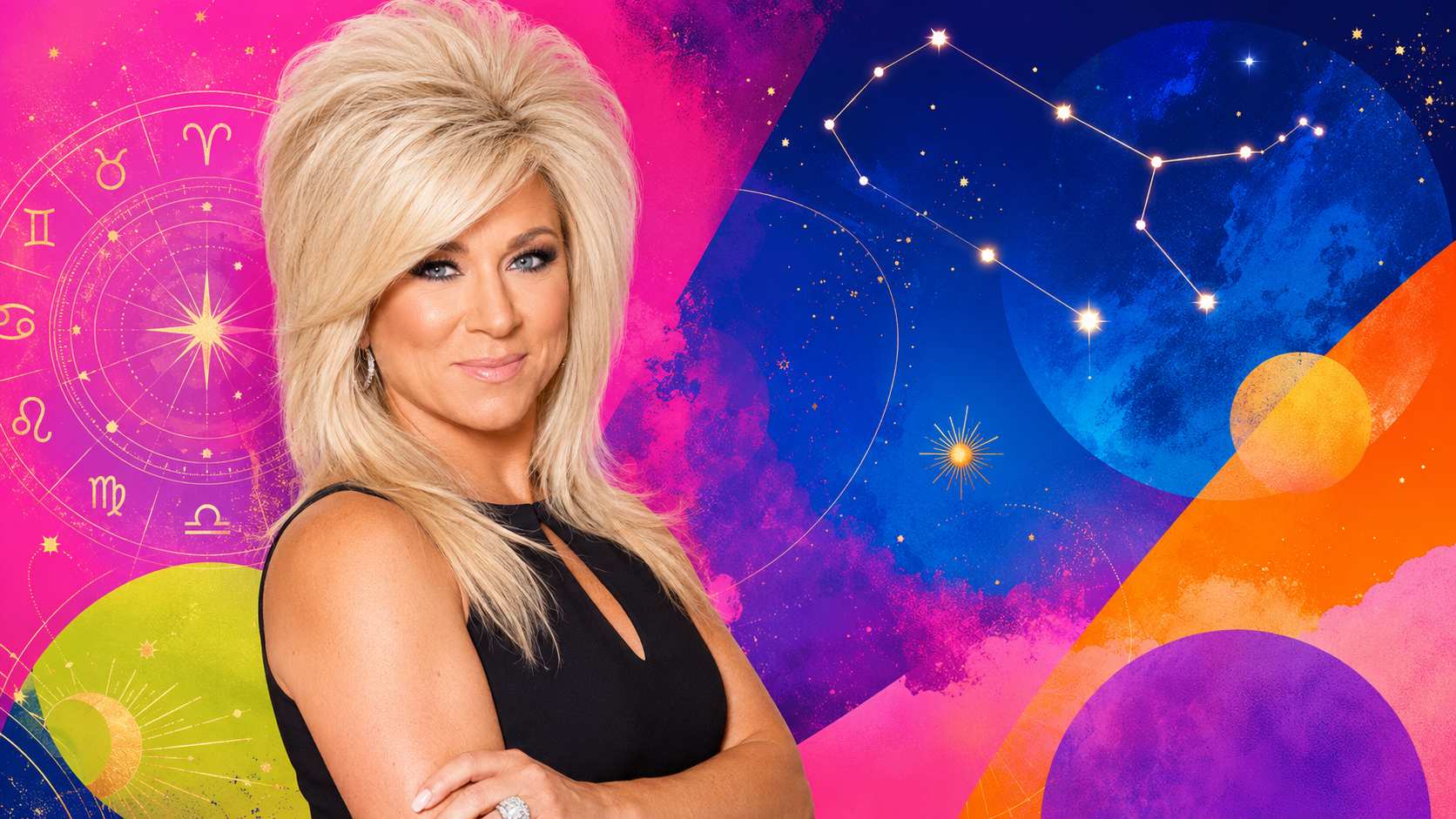
For the first few decades of her life, Theresa Caputo thought something was wrong with her. The anxiety arrived in childhood — a constant, humming dread she couldn't explain and couldn't turn off — and it stayed for years, through school, through young motherhood, through a perfectly ordinary Long Island life, until a spiritual teacher offered her a different diagnosis entirely: nothing was wrong with the wiring. The wiring was an antenna, and it had been receiving the whole time. Born on June 10, 1967, in Hicksville, New York, the woman who became television's most recognizable medium carries a birth chart that takes an unambiguous side in that story — because the wiring is right there, drawn in degrees and minutes, and so is the antenna. They are, as she eventually learned, the same circuit.
But start with the structure, because this chart has the most elegant government this series has ever mapped. Her Moon sits at 18°14′ of Cancer — its own sign, in full domicile — the receptive luminary, enthroned. Now trace the chains of command: the Gemini Sun answers to Mercury; Mercury, in Cancer, answers to the Moon; Venus and Jupiter in Leo answer to the Sun, which answers up the same chain; Mars answers to Venus, Saturn to Mars, Uranus and Pluto to Mercury, Neptune through its rulers to the same place — every planet in this sky, by every path, drains to the Moon. Sole final dispositor. Dignified. This series has seen shared governments before — Elon Musk's mind-mood loop, Timothée Chalamet's sovereign Jupiter — but never a monarchy: one planet, in its own sign, ruling everything. And consider who the monarch is, and whose chart this is. The entire sky of the woman whose profession is feeling the dead on behalf of families reports to a Moon at home in the sign of family, memory, mothers, and grief. The chart isn't subtle. The chart is a job posting.
Then look at what the Moon is wired to, because here is the mechanism itself. Moon sextile Pluto at 0°14′ of orb — fourteen minutes of arc, essentially exact: the planet of feeling, connected by the smoothest possible line to the planet of death and the underworld. Moon trine Neptune (4°03′) — Cancer to Scorpio, the classic water-trine of clairsentience, feeling that crosses the veil without friction. And Neptune sextile Pluto (4°17′) closes the figure: a sealed triangle of soft aspects joining the Moon, the veil, and the beyond — a private, always-open circuit between her feeling body and the other side. Astrologers would call it a minor grand trine. Given the résumé, we'll call it what it is: the séance circuit. And riding alongside, Uranus conjunct Pluto (2°21′) with the Moon sextile Uranus at 2°07′ — the lightning planet, spliced directly into the same line, supplying the thing her readings are famous for: the sudden download, mid-sentence, mid-manicure, whether anyone asked or not.
Add the rest of the headlines — a Gemini Sun (the talkiest medium in the business), Venus conjunct Jupiter in Leo at 0°55′ (the hair, and everything the hair stands for), both malefics debilitated and locked in opposition with each other, and a South Node in Scorpio that says she arrived already fluent in this — and you have the series' second medium chart, built on completely different architecture than its first. We'll get to that comparison; it's the best part.
A note on method before we begin: because her recorded birth time is set to noon, we're setting aside the houses and the rising sign, and reading the planets purely by sign, degree, and their conversations with one another. As ever, the chart says plenty without them.
Let's begin — for once, not with the Sun. In a monarchy, you start with the queen.
The Moon in Cancer: The Monarchy of Feeling
A dignified Moon is the strongest possible version of the most receptive thing in astrology. The Moon governs feeling, memory, instinct, the body's tidal responses, the bonds of family — and in Cancer it operates at full power and full comfort: nothing needs translating, nothing arrives distorted, the feeling function simply works, at maximum sensitivity, all the time. People with dignified Cancer Moons feel the room before they enter it, carry other people's emotions home by accident, and treat family — given or chosen — as the organizing principle of existence.
Hers, as established, also rules the entire chart — and the career built on it is almost comically faithful to the placement. Consider what the show actually was, for fourteen seasons: not an occult spectacle but a family program — a Long Island mom in ordinary kitchens and living rooms and delis, delivering messages between family members, about family grief, usually from a mother or a father or a child, while her own family life ran warmly in the background. The Moon's entire portfolio — mothers, kitchens, memory, grief, the tie that outlasts death — is the format. Other mediums position themselves as mystics. Her positioning, from episode one, was the neighbor who happens to hear your grandmother. That is a dignified Cancer Moon's version of the gift: domestic, familial, warm as a kitchen — and, because the Moon is conjunct Mercury (5°02′), endlessly verbal. Moon-Mercury conjunctions speak their feelings in real time; hers narrates the messages as they arrive, in the middle of sentences, in that unmistakable accent, because in this chart even the impressions come through chatting.
The Séance Circuit: Moon, Neptune, Pluto — and the Lightning
Now the mechanism, aspect by aspect, because this is the finest medium-wiring this series has documented.
Moon sextile Pluto, 0°14′. Fourteen minutes from exact — the chart's tightest aspect by a wide margin. Pluto governs death, the underworld, and everything buried; the Moon governs feeling; and a sextile is an open, cooperative channel that works without strain. At this precision, the aspect describes a feeling body with a direct line to the depths — grief, the dead, the unsaid — running not as an occasional intrusion but as standing infrastructure. In an ordinary chart, Moon-Pluto contact makes a person emotionally penetrating, drawn to what others avoid. In this chart — sitting inside the rest of the circuit, in the sky of the Moon-monarch — it reads as the profession's foundation cable.
Moon trine Neptune, 4°03′. Cancer to Scorpio, water to water — the textbook clairsentient trine, the aspect astrologers reach for first when a chart belongs to a psychic, an empath, or an artist of the invisible. Neptune is the veil, the dissolving of boundaries between self and other, here and elsewhere; trine the Moon, the veil is permeable by default — feeling flows across it the way water finds level, no effort, no ritual, no door to open because there was never a door. Her lifelong description of the experience matches the aspect exactly: not séances, not trances — just knowing things, sensing presences, the information arriving as feeling first and words second.
Neptune sextile Pluto, 4°17′ seals the triangle — veil to underworld — completing a closed circuit of exclusively soft aspects joining the three most otherworldly points a chart can join: the receptive luminary, the dissolver of boundaries, and the lord of the dead. Nothing in the figure is hard; nothing resists; the current just runs. And then the amplifier: Uranus conjunct Pluto (2°21′) — her generation's great mid-sixties conjunction — sits fused to the circuit's Pluto terminal, with its own sextile to the Moon (2°07′). Uranus is voltage, suddenness, the bolt from nowhere — and spliced into the séance circuit it produces the signature phenomenon of every episode: the interruption. The reading that ambushes a stranger in a supermarket aisle. The message that arrives mid-manicure, mid-dinner, mid-her own sentence, with a suddenness she has always described as not hers to schedule. The circuit is always on, and Uranus decides when it speaks.
The Anxiety and the Antenna
Which brings us to the origin story — the best-known fact of her biography, and the place where this chart performs its most compassionate trick. From early childhood she lived with severe, unexplained anxiety: the racing heart, the dread, the sense of too much coming in with no name for what it was. For decades she assumed it was a defect. Then a spiritual teacher told her the anxiety was undelivered energy — spirit, arriving with nowhere to go — and that delivering the messages would quiet the static. She started delivering. The anxiety, by her account, transformed.
Read the hard aspects now, because they are the same story in geometry. Moon square Mars (1°50′) — agitation wired directly into the feeling body: the emotional system running hot, restless, over-revved. Sun square Uranus (1°16′) and Sun square Pluto (1°04′) — the identity itself at hard angles to the lightning and the underworld: a nervous system carrying voltage and depth it never asked for, experienced from inside as electricity with no outlet. Mercury square Saturn (2°22′) — the childhood fear around the voice: the worry, the self-doubt, the decades of not saying what was coming through. Assemble them and you have, precisely, a clinical portrait of the anxious years — a person built as a high-voltage receiver, with the transmitter switched off.
And here is the trick: the hard aspects and the séance circuit share the same planets. The Pluto that squares her Sun is the Pluto her Moon sextiles at 0°14′. The Uranus that electrifies her identity is the Uranus feeding her downloads. The chart never contained an illness and a gift; it contained one apparatus, experienced two ways — as affliction while the messages went undelivered, as vocation once they flowed. Her teacher's reframe, in other words, was astrologically correct: the wiring was never wrong. It was an antenna, grounded at last. Few charts in this series have illustrated so cleanly that the hard aspects and the gifts are so often the same equipment — which is, incidentally, the single most useful thing a reading can teach anyone about their own squares.
The Sun in Gemini: The Talker
The Sun sits at 19°05′ of Gemini — and thank goodness, because a séance circuit without a Gemini Sun is just a very overwhelmed empath. Gemini is the messenger: verbal, quick, curious, incapable of not-saying. It is the sign of the courier — and a medium is, job-descriptionally, a courier: information in, words out, all day. Her version of the profession is the most conversational on television — readings that sound like coffee talk, delivered at Long Island velocity, with the bluntness and comic timing of a sign that has never in its life let a thought ripen unspoken. Where the Cancer Moon receives, the Gemini Sun narrates — and the dispositor chain makes the arrangement official: the Sun answers to Mercury, Mercury answers to the Moon. Even the talking, structurally, works for the feeling.
Sun trine Mars (2°40′), air to air, keeps the delivery energized and socially graceful — the stamina for arena-sized live shows, hours of readings, a touring schedule that would flatten most performers — and Mercury sextile Pluto (4°48′)gives the light, chatty voice its unexpected depth-reach: the words come out breezy and land in the wound, gently. The whole verbal apparatus, wired to the same underworld as the Moon.
Venus Conjunct Jupiter in Leo: The Hair, the Heart
At 0°55′ of orb — the chart's second-tightest aspect — the two benefics sit fused in Leo: Venus, planet of beauty and affection, welded to Jupiter, planet of abundance and joy, in the sign of maximum presentation. This is the double-benefic conjunction — astrology's warmest single signature — and in Leo it does not whisper. It arrives: big love, big generosity, big laughter, and yes, big hair. The platinum bouffant, the nails, the bedazzled everything, the leopard print — the entire iconic look is this conjunction operating as intended: joy as spectacle, warmth you can see from the back row. It would be a mistake to read the glamour as separate from the gift. Venus-Jupiter in Leo makes delight itself part of the ministry — the reason a show about grief has always been, improbably, fun; the reason the medium hugging a sobbing stranger is wearing rhinestones. The sparkle is load-bearing. It tells the grieving that joy survived.
Venus trine Saturn (6°45′) grounds the warmth in loyalty and endurance — the decades-long bonds, the repeat families, the constancy under the glitter — while the benefic pair's square to the nodal axis (Venus 2°03′, Jupiter 2°57′) places giving itself at the life's crossroads: the generosity is not incidental to the path. It is the toll the path collects, and she has paid it in public, hug by hug, for fourteen seasons and counting.
Mars and Saturn: The Hobbled Malefics
Now a structural joke the chart plays entirely in her favor. Astrology's two malefics — Mars and Saturn, the planets of conflict and constraint — are, in this chart, both debilitated: Mars sits in Libra, its detriment, and Saturn sits in Aries, its fall. And they are locked in opposition with each other (5°34′) across the Aries-Libra axis. Picture it: the chart's two troublemakers, each stripped of its dignity, stationed at opposite ends of the relationship axis, permanently absorbed in their own argument — while the dignified Moon runs the country in peace. It is as close as astrology comes to a benevolent government by design.
The personal cost of the arrangement is real and recognizable: Mars in detriment in Libra spends its energy on and through other people — the classic wiring of someone who works tirelessly for everyone else and struggles to fight for herself — and Saturn in fall in Aries makes self-assertion the lifelong homework: the boundaries drawn late, the "no" that took decades, the years of swallowing her own strangeness rather than defending it (there is the Mercury-Saturn square again — the doubted voice). But the same arrangement is why the gift stayed gentle. A medium with a dignified Mars might have built an empire of ego around the ability; a dominant Saturn might have gate-kept it into a priesthood. Hers, with the hard planets hobbled and busy with each other, built the softest possible container: no mystique, no hierarchy, no throne except the Moon's — just a neighbor with a message and very good nails.
The Nodes: The Inheritance and the Assignment
The South Node sits in Scorpio — and by now this series' readers can translate on sight: the South Node is the inheritance, the fluency brought in from before, and Scorpio is death, the unseen, the underworld. She arrived, in other words, already conversant with the territory — which matches both the séance circuit (all soft aspects: native, unlearned, frictionless) and the biography (the sensing began in early childhood, unbidden). The dead were never the assignment. They were the starting equipment.
The assignment is the North Node in Taurus: the sign of the body, the ordinary, the tangible, the kitchen table. The destiny of this chart is not to dwell in Scorpio's depths — it owns them already — but to carry them into Taurus: to normalize the afterlife, to make the profoundest subject in human life feel as ordinary as coffee. And that is, precisely, the brand. No incense, no dim chambers: messages delivered in laundromats and nail salons and diner booths, the beyond discussed in the same breath as the marinara. The most radical thing about her entire career is how unspooky it is — and the nodes say that was the point all along. Fittingly, the North Node's ruler is Venus — sitting fused to Jupiter in Leo: the destiny, governed by the double benefic. The assignment was always going to be delivered with warmth, and probably with rhinestones.
Two Mediums, Two Doors
And now the comparison this series has been waiting to make. Tyler Henry — the Hollywood Medium, this series' second chart — and Theresa Caputo share a profession and almost nothing else astrologically, and the contrast is a lesson in how the sky works. His medium-machinery was structural: a Capricorn Sun, and the Saturn-Neptune mutual reception — the planet of form and the planet of the veil trading keys, the doorway between worlds given office hours and a business plan. Discipline, hosting spirit. Hers is tidal: a dignified Moon-monarch governing everything, a closed water-and-earth circuit of soft aspects running feeling straight to the other side, the door not built but born open. His chart says the veil can be professionally managed. Hers says the veil was never really there.
Two mediums, two completely different architectures, one job — which is perhaps the most honest thing astrology can demonstrate about any calling: the sky doesn't issue one signature per profession. It builds many doors into the same room. What the two charts do share is telling: in both, the otherworldly planets are bound into the chart's central power structure rather than left floating at the edges — the gift, in both skies, is load-bearing. Neither of these people could have been anything else.
The Synthesis: The Open Line
Read together, the chart resolves into the series' purest portrait of receptivity. A dignified Moon, crowned sole ruler of the sky, holding a near-exact open line to the world of the dead. A sealed circuit of soft aspects — feeling, veil, underworld — that was never installed because it was never absent. A lightning rod spliced in, deciding the timing. A Gemini courier to say it all out loud, a double benefic in Leo to say it with warmth and volume and hair, two hobbled malefics too busy arguing with each other to harden any of it — and a nodal axis instructing her to take the deepest thing there is and set it down gently on the kitchen table.
If there is a single sentence this chart keeps writing, it is this: the sensitivity was never the problem; it was the appointment. For decades the wiring read as anxiety because the messages had nowhere to go. The chart's position — filed in 1967, at fourteen minutes of arc — is that the receiver was built to specification from the start, and simply waiting for someone to explain what it was for. Eventually, someone did. The rest is fourteen seasons, several bestsellers, a few thousand hugs, and one very famous head of hair — the Moon's monarchy, broadcasting in full daylight.
Frequently Asked Questions
What is Theresa Caputo's zodiac sign?
Theresa Caputo is a Gemini Sun, born June 10, 1967 — the messenger's sign, and the source of the most conversational reading style in the business: the coffee-talk delivery, the Long Island velocity, the constitutional inability to leave a message undelivered. Fittingly, her Gemini Sun answers up the rulership chain to her Cancer Moon — even the talking, structurally, works for the feeling.
What is Theresa Caputo's Moon sign?
Her Moon is in Cancer — its own sign, in full dignity — and it is the single most important placement in her chart: trace every rulership chain and every planet in the sky drains to it. The receptive luminary, enthroned, ruling everything — in the chart of a woman whose profession is feeling the dead on behalf of families. Its aspects are the mechanism itself: a near-exact sextile to Pluto, a water trine to Neptune, and a conjunction to Mercury that narrates the impressions in real time.
What is Theresa Caputo's rising sign?
From this data alone, we can't say. The chart used here is set to noon rather than an exact birth time, so the rising sign and houses can't be reliably calculated — an Ascendant changes roughly every two hours. This reading sticks to signs, degrees, and aspects, which hold true regardless of the hour. (It's also a perfect illustration of why an exact birth time matters for a personal reading.)
What is her "big three"?
With the noon-chart caveat on the rising sign, her confirmed two-thirds are Gemini Sun and Cancer Moon — the courier and the queen: a voice that never stops and a feeling body at maximum, dignified sensitivity. It is the medium's pairing in its most domestic form — the neighbor who hears your grandmother, and tells you immediately.
What makes her chart a "medium's chart"?
A closed circuit astrologers rarely see this clean: Moon sextile Pluto at 0°14′ (feeling, wired near-exactly to the world of the dead), Moon trine Neptune (the classic clairsentient water trine — the permeable veil), and Neptune sextile Plutosealing the triangle — a soft-aspect circuit joining the receptive luminary, the veil, and the underworld, with Uranus conjunct Pluto spliced in for the sudden, unscheduled downloads. All of it governed by a dignified Cancer Moon that rules her entire chart.
How does her chart explain her anxiety story?
Beautifully — and compassionately. The hard aspects (Moon square Mars, Sun square Uranus and Pluto, Mercury square Saturn) draw a precise portrait of the anxious decades: a high-voltage receiver with the transmitter switched off. But those squares use the same planets as the séance circuit — the chart never contained an illness and a gift, just one apparatus experienced two ways. The famous reframe she received — that the anxiety was spirit energy needing delivery — is, astrologically, simply accurate.
How is her chart different from Tyler Henry's?
Completely — and that's the lesson. His medium-machinery is structural: a Capricorn Sun and the Saturn-Neptune mutual reception, the veil given office hours. Hers is tidal: a dignified Moon ruling the whole sky and a born-open circuit of soft water aspects. His chart professionally manages the doorway; hers suggests the door was never there. Two architectures, one profession — the sky builds many doors into the same room.
What's the rarest thing in her birth chart?
Four candidates. The Moon as sole, dignified final dispositor — a true one-planet monarchy, unique in this series. The 0°14′ Moon-Pluto sextile — fourteen minutes from exact. The sealed Moon-Neptune-Pluto soft-aspect circuit — the séance triangle. And the structural joke in her favor: both malefics debilitated and opposing each other — Mars in detriment, Saturn in fall, locked in their own argument across the sky while the Moon reigns in peace.
Is this reading based on her exact birth time?
No — and that's worth being transparent about. Her circulated data uses a noon placeholder time, so this analysis deliberately excludes houses and the Ascendant and reads only what's certain: planetary signs, degrees, and aspects. Even that partial picture tells a strikingly coherent story. A verified birth time would sharpen everything further — which is exactly why professional readings always begin by asking for yours.
Your Chart Is Waiting
Here's the thing: this entire reading came from a noon chart — no birth time, no houses, no rising sign. A fraction of the picture. Imagine what a full reading of your chart could reveal: your exact angles, your houses, your aspects and degrees, the whole architecture of your sky, walked through line by line. If this reading stirred something, that's usually the invitation.
Book your personal chart reading — and find out what was written in your stars.