Written in the Stars: The Birth Chart of Zohran Mamdani, Mayor of New York City
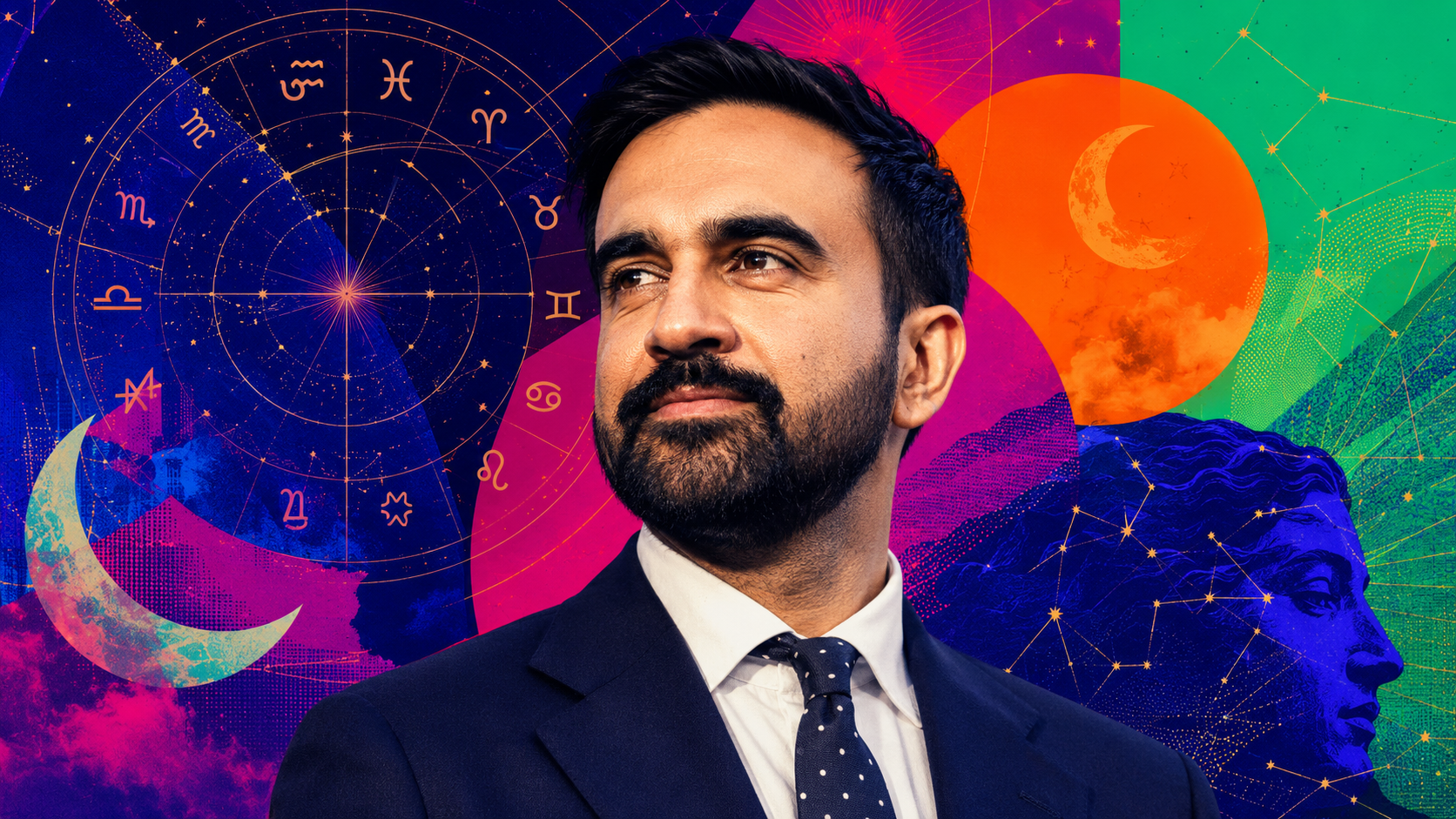
New York's mayor is routinely described, by admirers and critics alike, as a firebrand. His birth chart contains — and this is the first time this series has ever been able to write this sentence — no fire at all. Not a singleton, like the lone far-off flame in Elon Musk's sky. None. Run the count on Zohran Mamdani's chart and you find five placements in earth, three in air, three in water, and an empty column where the fire should be: no planet in Aries, Leo, or Sagittarius, anywhere. Born on October 18, 1991, in Kampala, Uganda, the youngest mayor of America's largest city in generations campaigned with an energy that commentators reached for combustion metaphors to describe — and his sky's quiet correction is that what everyone was watching was never fire. It was focus, and the distinction, as we'll see, explains almost everything about how he actually operates.
Because the chart that lacks fire is loaded nearly everywhere else, starting with the most on-the-nose destiny signature this series has printed. The North Node — the destiny point — sits at 13°34′ of Capricorn, the sign of government, institutions, and civic structure. And it does not sit alone: Neptune, the planet of the dream and the collective imagination, sits conjunct it at 0°33′ — the chart's tightest aspect — and Uranus, the planet of reinvention, sits conjunct it at 3°23′. Read that plainly: the destiny, parked in the sign of the institution, flanked on both sides by the planet that dreams and the planet that rewires. A fate assignment that says, in so many words: bring imagination and reinvention into the machinery of government. The man was born in 1991; New York City handed him the machinery in January 2026. The chart had the job posting drafted first.
Then the engine. Mars square Saturn at 0°44′ — and series readers who remember Sebastian Maniscalco's twenty-year grind under the same square should look closer, because this version has a twist that changes everything: both planets are dignified. Mars sits in Scorpio, its own traditional sign — the relentless strategist's Mars, at full strength. Saturn sits at 0°20′ of Aquarius, its own traditional sign — the architect of collective structures, freshly enthroned, at the very first degree. Two legitimate powers, both crowned, locked at a near-exact right angle: the insurgent and the institution, each arguing from a throne. It is the cleanest astrological diagram imaginable of a career that began as an outsider's challenge to an establishment and ended — or rather, began again — with the outsider holding the establishment's highest office. The square never resolved. It got elected.
And running through it all, a structural signature this series has never seen in this exact configuration: the dignity table, inverted. In the previous entry, Theresa Caputo's chart hobbled both malefics and crowned the Moon — the softest possible architecture. His chart does the precise opposite: Mars, Saturn, and Pluto all sit enthroned in their own signs, while the Sun (in fall in Libra), Venus (in fall in Virgo), and Jupiter (in detriment in Virgo) are all humbled. The hard planets hold every throne; the ego and the luxuries hold none. Whatever one makes of the politics — and this reading, like every entry in this series, is about temperament and mechanism, not platforms — the architecture is unambiguous: this is a chart where power lives in discipline, strategy, and transformation, and where the self, the pleasures, and the excesses were built subordinate from birth. The "we, not me" campaign wasn't a slogan looking for a candidate. It was a dignity table, looking for a microphone.
One more headline before we begin: not a single planet in this chart is retrograde. Every planet, moving full-speed forward — the second all-forward chart in this series, after Timothée Chalamet's, and it carries the same express-train biography: a State Assembly seat at 29, the mayoralty of New York at 34, no detours, no circling back.
A note on method: because his recorded birth time is set to noon, we're setting aside the houses and the rising sign, and reading the planets purely by sign, degree, and their conversations with one another. As ever, the chart says plenty without them.
Let's begin with the absence — because in this chart, the absence is the thesis.
The Missing Fire: The Firebrand Without Fire
In astrology, a missing element is not a missing capacity — it is a different delivery system. Fire is spontaneity, temper, theatrical heat, the flare that burns hot and moves on. A chart with no fire runs its intensity through the other three elements instead, and the result, in high-functioning cases, is something observers routinely mistake for fire because it produces fire-like output — energy, urgency, momentum — through entirely different machinery. Watch how his actually works, element by element.
The drive is water: Mars in Scorpio, dignified — not the sprinter's Mars but the strategist's, the drive that fixes on an objective and simply does not release it, for months, quietly, while everyone else assumes the race is over. The campaign that launched polling in the low single digits and ground forward for a year — the eighty-thousand-door canvassing operation, the walk down the full length of Manhattan, the record volunteer army — is Scorpio Mars in its natural mode: relentless rather than explosive, tidal rather than flammable. The ideas are air: a Libra Sun and Aquarius Moon running the messaging — we'll get there. And the follow-through is earth: five placements, the largest column in the chart, including the entire Capricorn destiny cluster — the door-knocked spreadsheet, the policy detail, the organizer's ground game. Assemble it and you get the corrected metaphor: this was never a wildfire. It is a pressure system — water-driven, air-directed, earth-executed — and pressure systems, unlike fires, don't burn out. They just keep arriving. Anyone who watched the campaign's famously undimmed final months watched a chart with no fire demonstrating why it never needed any.
The Sun in Libra, the Moon in Aquarius: The "We" Machine
The Sun sits at 24°29′ of Libra — in its classical fall — and here, once again, this series' favorite lesson: the debilities are where the interesting careers live. A Sun in fall is an ego that does not run the show — identity subordinated to something beyond the self, which in Libra means the relationship, the coalition, the other side of the table. In most charts this reads as accommodation. In a politician's chart it reads as the specific rhetorical signature every observer of his speeches noticed: the near-total absence of "I." The campaign spoke in "we" with a consistency that media analysts remarked on — and the chart's position is that this was never technique. A Libra Sun in fall constitutionally experiences itself as the representative of a relationship rather than the point of one. The candidate as convener; the mayor as the coalition's instrument.
And the Sun does not merely sit in the coalition sign — it is aligned, nearly exactly, with the people themselves: Sun trine Moon at 1°04′, Libra to Aquarius, air to air. A tight luminaries' trine is inner unanimity — what the identity wants and what the emotional body needs, flowing in the same direction without friction — and the signs make it political: the coalition-self, trine the Aquarius Moon, the Moon of the collective, the crowd, the many. His emotional home is, by placement, the public itself: the rally, the subway car, the comment section. Aquarius Moons feel with groups more comfortably than one-on-one, process emotion through principle, and read as strikingly even-tempered — the famous unbotherable debate demeanor, the smile that never cracked under attack, is an air-trine chart doing what air-trine charts do.
The one hard aspect to the Moon supplies the depth charge: Moon square Pluto (4°09′) — the collective feelings at a hard angle to the planet of entrenched power, dignified in Scorpio. This is the confrontational undertow beneath the even temper: an emotional life organized, at the structural level, around the encounter with concentrated power — challenging it, unseating it, and now, in the chart's great plot twist, wielding it. The square's lifelong homework, for anyone who carries it, is the same in office as in opposition: intensity this deep needs honest outlets, because it does not evaporate.
Mercury Conjunct Mars in Scorpio: The Knife in the Message
Here is the aspect the internet already knows, whether it knows it or not. Mercury at 4°27′ of Scorpio, conjunct the dignified Mars at 1°04′ (3°23′) — the voice, fused to the strategist's blade, in the sign of precision strikes. Mercury-Mars conjunctions speak with edge: the sentence as instrument, the debate line that lands and stays landed, the reply that ends the exchange. In Scorpio, the edge is aimed — no scatter, no bluster, the single sharpest version of the point, delivered calmly, which is more unsettling to opponents than any amount of shouting. The campaign's viral-video machine — the format that turned a longshot into a phenomenon — ran on exactly this signature: short, surgical, direct-to-camera, one idea per blade.
The supporting aspects finish the communications shop. Mercury sextile Jupiter (2°43′) scales the message — the storyteller's reach, the ability to make a city-sized argument feel personal — and Mercury sextile Venus (4°27′) warms the steel: the charm in the delivery, the grin that arrives with the thrust, the reason the sharpest messenger in the race consistently polled as its most likable. And Mercury square Saturn (4°07′) supplies the discipline and the resistance in one aspect: message rigor — the campaign's famous refusal to be knocked off its three or four themes — earned against the constant pushback of institutional gatekeepers, editorial boards, and establishment skepticism. Mercury-Saturn squares are the voice that authority doubts until it can no longer afford to; the arc from dismissed longshot to City Hall is that square, played out on the largest stage in American municipal politics.
Mars Square Saturn at 0°44′: Two Thrones at War
Now the engine room, properly. The series has met the Mars-Saturn square before — in Sebastian Maniscalco it was the twenty-year apprenticeship, drive grinding against limitation until the grind itself became the talent. His version is rarer and stranger: both planets are in their own signs. Mars is not a frustrated upstart; it is dignified — the full-strength strategist. Saturn is not a faceless wall; it is dignified — the legitimate architect of collective structures, in Aquarius, the sign of systems built for the many, at 0°20′: the very first degree, the new order barely across its own threshold. When two enthroned planets square each other, the chart stages not a rebellion but a constitutional crisis: two valid claims to authority, at right angles, permanently — the movement and the institution, each with a crown.
The biography is the square, run in fast-forward. Act one: dignified Mars as the insurgent — the housing counselor turned assemblyman turned longshot, driving against every institutional Saturn the city could field: the party establishment, the donor class, the editorial boards, a former governor with universal name recognition. Act two, the twist no one writes better than a chart: the insurgent won the institution. As of January 2026 he sits on Saturn's side of his own square — the youngest person to run the machinery in over a century, the outsider now responsible for the inside — and the square's permanent tension has become, quite literally, the job description: movement urgency versus institutional process, the promise versus the procurement timeline, every single day. It is worth saying neutrally what the aspect guarantees regardless of anyone's politics: this administration will always be a negotiation between its Mars and its Saturn, and observers on all sides will always be able to point at whichever end they prefer. The believers are reading his Mars. The skeptics are reading his Saturn. The chart, as with another polarizing subject earlier in this series, holds both at full strength — the difference here being that both ends wear crowns.
Venus Conjunct Jupiter in Virgo: The Grocery-Aisle Benefics
For the second consecutive entry — a first for this series — the chart carries the double-benefic conjunction: Venus and Jupiter, fused (1°44′). But where Theresa Caputo's benefic pair blazed in Leo — spectacle, rhinestones, joy visible from the back row — his sits in Virgo, and both planets are debilitated: Venus in fall, Jupiter in detriment. And here the series' recurring lesson about debilities pays its richest dividend yet, because a humbled benefic pair in the sign of service, detail, and daily bread produces a very specific kind of public figure: one whose entire vocabulary of abundance is groceries. Rent. Bus fare. Childcare. The cost of eggs at the corner store. The campaign that made him famous was, at the level of message, one long Virgo-benefic sentence — pleasure and plenty measured not in grandeur but in the line items of an ordinary week — and the pre-political résumé matches: years as a foreclosure-prevention housing counselor in Queens, the benefics doing casework. Even the aesthetic obeys: the suit off the rack, the halal-cart lunch on camera, the studied ordinariness. Leo benefics sparkle so the room believes in joy. Virgo benefics itemize the receipt so the room believes it can afford joy. Both are ministries. The signs just run different departments.
The conjunction's aspects supply the range. Venus trine Uranus (1°17′) is the left-field charm — and the biography's best receipt: before politics, there was the rap career, the "Mr. Cardamom" years, the creative unconventionality that later made the campaign's content feel like nothing else in American politics. Venus trine Neptune (5°13′) is the cinematic inheritance — his mother is the filmmaker Mira Nair, and the trine between the beauty planet and the dream planet is the family business in a single aspect: the visual instinct, the framing, the campaign videos that played like short films because their maker grew up on sets. And Venus trine the North Node (4°40′) puts the charm formally in service of the destiny: the art, the warmth, and the aesthetic were never decoration on the path. Per the geometry, they were vehicles on it.
The Capricorn Convergence: Destiny in the Sign of Government
And so to the chart's crown jewel. The North Node in Capricorn — the destiny in the sign of institutions, structures, and public responsibility — with Neptune conjunct at 0°33′ and Uranus conjunct at 3°23′, the two great planets of change stationed on either side of the fate point like an honor guard. This series has seen loaded nodes before — Timothée's besieged by squares, Elon's fused to Mars — but never one escorted: the dream and the revolution, both riding the destiny, in the sign of government.
Read the three-part instruction. Capricorn says: the path runs through the institution — not around it, not against it from outside, but through its offices, budgets, and org charts. Neptune at 0°33′ says: carry the dream in with you — the destiny is inseparable from collective imagination, from the vision of what the structure could be, and (Neptune's eternal caveat) from the gap between vision and delivery that every idealist in power must manage. Uranus at 3°23′ says: and rewire it — the mandate is not stewardship of the machine as found but its reinvention. Behind it all sits the South Node in Cancer: the inheritance and the departure point — home, origins, the tribe — which reads, in this biography, with unusual poignancy: born in Kampala to an Indian-Ugandan family, moved across the world at seven, naturalized at twenty-seven; the Cancer inheritance of homeland carried and re-carried, released into a Capricorn destiny of building within the civic structure of the adopted city. The immigrant child whose fate point sat in the sign of government, in the town that would eventually hand him its keys.
The generational layer seals it. Uranus conjunct Neptune (3°56′) is the great early-nineties conjunction — the third time this series has met it, after Gigi Hadid and Timothée Chalamet — the cohort born as structures and dreams fused. In the artists' charts it made the imaginal professional. In his, conjunct the node, in Capricorn, it does something the astrology of that generation always promised: it walks the fusion into City Hall. Pluto sextile the Node (5°43′) — dignified power, cooperating with the path — and Jupiter trine Uranus (3°02′) and trine Neptune (6°58′) wire the benefics' service ethos into the same earth-sign grid. The whole chart, in the end, drains toward the same address: the institution, dreamed at and rewired.
The Synthesis: The Organized Flame
Read together, the chart resolves into the series' most paradoxical portrait — and its most internally consistent. No fire, and a reputation for burning: the heat was always focus, water-driven, air-directed, earth-executed, the pressure system that doesn't gutter because it was never a flame. An ego in fall that turned the first person singular into the first person plural. A message-knife in Scorpio, a benefic pair doing casework in the grocery aisle, a luminaries' trine humming "we" at one degree of orb. Two crowned planets locked in the permanent argument between movement and institution — an argument the biography then made literal by electing one end to run the other. And over everything, the destiny in the sign of government, escorted by the dream and the revolution, with every planet in the sky moving forward and not one in retreat.
If there is a single sentence this chart keeps writing, it is this: the assignment was always the institution. Not the burning of it — there is no fire in this sky to burn anything — but the entering of it, carrying a dream on one shoulder and a rewiring kit on the other, at the express-train pace of a chart with no reverse gear. Whether the assignment succeeds is a question for voters, budgets, and time — matters no natal chart decides. What the chart does file, and filed in October 1991 over Kampala, is the shape of the attempt: a firebrand with no fire, a "we" where the "I" should be, and a destiny that was always, from the first degree, headed downtown.
Frequently Asked Questions
What is Zohran Mamdani's zodiac sign?
Zohran Mamdani is a Libra Sun, born October 18, 1991 — and notably, his Sun sits in its classical fall: an ego constitutionally subordinated to the coalition, the relationship, the "we." It is the astrological source of the rhetorical signature every observer of his speeches noticed — the near-total absence of "I" — and it sits in a near-exact trine to his Moon: the identity and the public, aligned at one degree of orb.
What is Zohran Mamdani's Moon sign?
His Moon is in Aquarius — the Moon of the collective: emotionally at home in crowds, causes, and the many rather than the intimate few, processing feeling through principle, and famously even-tempered under fire. Its one hard aspect, a square to dignified Pluto in Scorpio, supplies the undertow: an emotional life structurally organized around the confrontation with concentrated power.
What is Zohran Mamdani's rising sign?
From this data alone, we can't say. The chart used here is set to noon rather than an exact birth time, so the rising sign and houses can't be reliably calculated — an Ascendant changes roughly every two hours. This reading sticks to signs, degrees, and aspects, which hold true regardless of the hour. (It's also a perfect illustration of why an exact birth time matters for a personal reading.)
What is his "big three"?
With the noon-chart caveat on the rising sign, his confirmed two-thirds are Libra Sun and Aquarius Moon — an all-air pairing, trine at 1°04′: the coalition-builder and the collective's Moon, in near-exact harmony. It is the "we" machine in miniature — and it means the famous energy is not fire (his chart has none) but air: ideas, moving at speed.
What does it mean that his chart has no fire?
It is the chart's thesis. A missing element isn't a missing capacity but a different delivery system: his intensity runs through water (the dignified, relentless Scorpio Mars — strategy, not sprinting), air (the Libra-Aquarius messaging engine), and earth (five placements — the ground game, the detail, the door-knocked spreadsheet). What commentators call fire is, astrologically, a pressure system — and pressure systems, unlike fires, don't burn out.
What in his chart explains the viral communication style?
Mercury conjunct a dignified Mars in Scorpio — the voice fused to the strategist's blade: short, surgical, one idea per strike, delivered calmly. Mercury's sextiles to Jupiter (scale) and Venus (the charm in the delivery) built the rest of the communications shop, and the square to Saturn supplied both the message discipline and the institutional resistance it was forged against.
Does his chart show political destiny?
As directly as astrology can. The North Node sits in Capricorn — the sign of government and institutions — conjunct Neptune at 0°33′ and Uranus at 3°23′: the destiny point, escorted by the planet of the dream and the planet of reinvention, in the sign of civic structure. The instruction reads: enter the institution, carry the vision in, and rewire it. What any administration does with such an assignment is a matter for voters and time — the chart describes the shape of the attempt, not its verdict.
What's the rarest thing in his birth chart?
Four candidates. The complete absence of fire — the first elementally void chart in this series. The double node conjunction — Neptune and Uranus both riding the Capricorn destiny point. The inverted dignity table — Mars, Saturn, and Pluto all enthroned while the Sun, Venus, and Jupiter are all debilitated: power in the hard planets, humility in the ego and the luxuries. And the 0°44′ square between two dignified planets — the insurgent and the institution, both crowned, permanently at right angles.
Is this reading based on his exact birth time?
No — and that's worth being transparent about. His circulated data uses a noon placeholder time, so this analysis deliberately excludes houses and the Ascendant and reads only what's certain: planetary signs, degrees, and aspects. Even that partial picture tells a strikingly coherent story. A verified birth time would sharpen everything further — which is exactly why professional readings always begin by asking for yours.
Your Chart Is Waiting
Here's the thing: this entire reading came from a noon chart — no birth time, no houses, no rising sign. A fraction of the picture. Imagine what a full reading of your chart could reveal: your exact angles, your houses, your aspects and degrees, the whole architecture of your sky, walked through line by line. If this reading stirred something, that's usually the invitation.
Book your personal chart reading — and find out what was written in your stars.