Written in the Stars: The Alchemist — Scorpio Sun, Virgo Moon
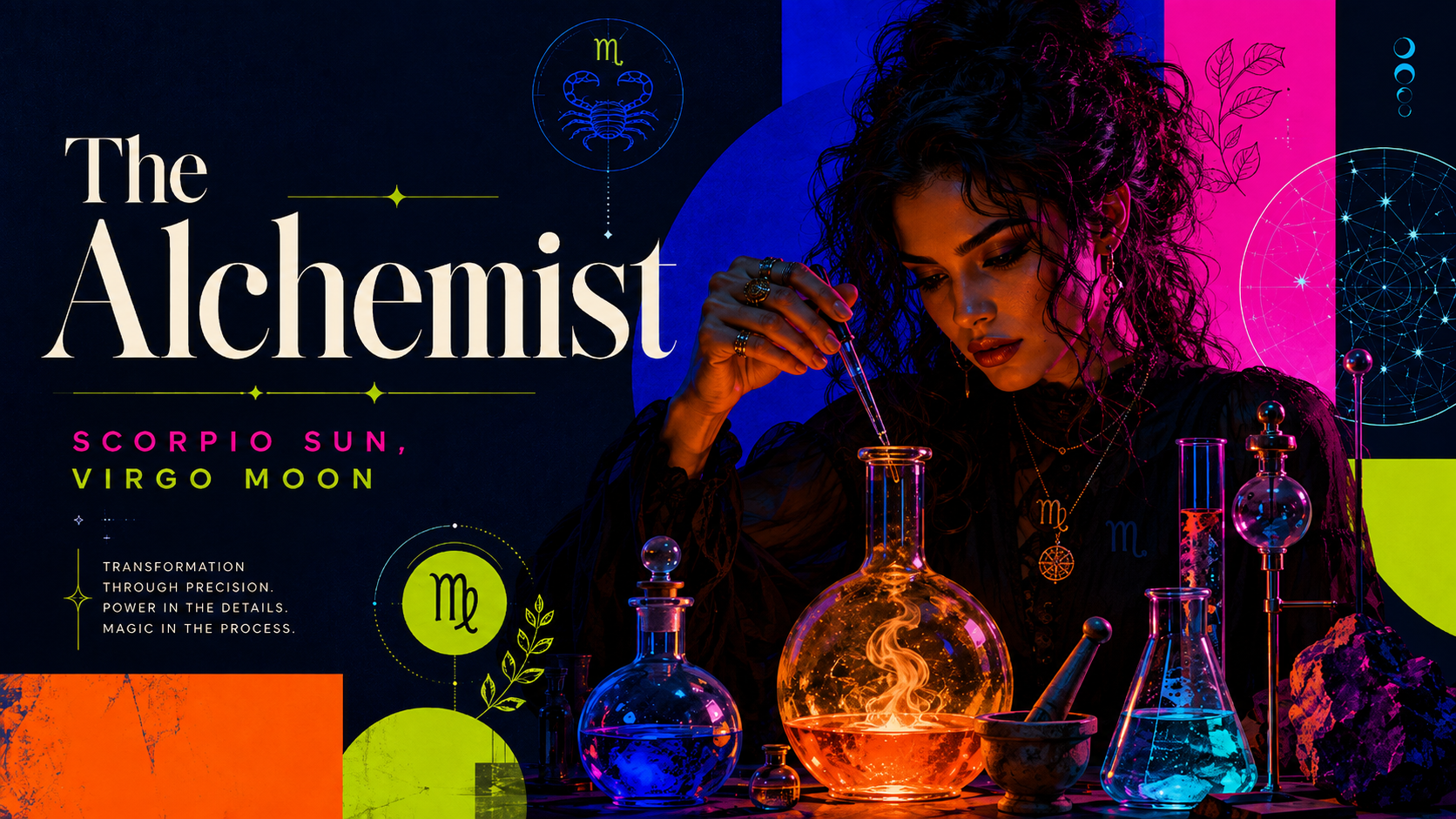
Some birth charts arrive like declarations. Others work quietly, separating, distilling, testing — taking the raw material of life apart until they understand what it is made of.
This one belongs to the second kind.
Born on October 25, 1932, under a Scorpio Sun and Virgo Moon, this anonymous chart carries the signature of someone who does not accept anything at face value. Scorpio wants the truth beneath the truth. Virgo wants to examine it, improve it, and put it to use. Together, they produce a person built for refinement: the observer who notices what others overlook, the investigator who keeps going after everyone else has accepted the easy answer, the steady pair of hands brought in when something complicated needs to be repaired.
But the chart is not made entirely of restraint.
Underneath its earth and water sits an almost perfectly exact trine between Mars in Leo and Uranus in Aries — the only two fire planets in the chart, wired directly to each other. Behind the careful analysis is voltage. Behind the composure is a streak of independence that will not be managed indefinitely. Behind the person who thinks through every detail is someone capable of making one sudden, decisive move that changes the entire situation.
And running through the center of the chart is its real assignment: an exact conjunction between Jupiter and the South Node in Virgo, opposite the North Node in Pisces.
Competence is the inheritance. Surrender is the lesson.
That tension — between improving life and trusting it, between knowing what to do and allowing what cannot be controlled — is why this chart could only be called The Alchemist.
A Note on the Birth Time
The recorded time for this chart is noon, used as a placeholder because the exact birth time is unknown. That means the Ascendant, Midheaven, houses, and planetary angles have been intentionally excluded. Without a reliable time, assigning them would create a precision the data cannot support.
The Moon requires additional care. At noon it sits at 8°32′ of Virgo, but it moved several degrees during the date, so its exact degree and the orbs of its aspects are approximate.
The Moon did, however, remain in Virgo throughout the local calendar day. The Virgo Moon is therefore secure, even though we cannot treat 8°32′ as the confirmed birth degree. Its conjunction with Neptune also remains part of the chart’s emotional landscape, although the exact 1°01′ noon-chart orb should not be read as fixed.
Everything involving the slower planets — including the remarkably tight Venus-Uranus quincunx, Jupiter’s opposition to the North Node, and the Mars-Uranus trine — remains reliable regardless of the missing hour.
And even without houses, this chart is structurally loud.
Among the ten planets, five occupy earth signs, three occupy water, two occupy fire, and none occupy air. Four planets gather in Virgo alone: the Moon, Venus, Jupiter, and Neptune. Mutable energy dominates, producing adaptability, responsiveness, and the instinct to keep revising until something works.
But every Virgo planet answers to Mercury, and Mercury is not in an airy or detached sign. It is in Scorpio.
The workshop reports to the underworld.
The Sun in Scorpio Square Saturn: The Sealed Furnace
The Sun — identity, vitality, and the central project of the life — sits at 2°04′ of Scorpio.
Scorpio Suns are rarely satisfied with the visible layer of anything. They want motive, origin, leverage, consequence. They are psychologically observant and naturally protective of their own interior world. Trust is not given because someone asks for it; it is built through consistency, discretion, and proof.
This is not necessarily a person who says everything they see. It is more often someone who sees considerably more than they say.
The early degree of the Sun gives the placement a concentrated quality. This is Scorpio close to the beginning of its work: newly inside the sign, but already aware that appearances are incomplete and that transformation requires honesty.
The strongest pressure on this Sun comes from Saturn in Capricorn, forming a square at 3°31′.
Sun-Saturn squares often describe an identity shaped under weight. The person may develop an early awareness of expectations, consequences, authority, limitation, or the feeling that respect must be earned rather than assumed. Confidence is constructed slowly. Self-expression passes through an internal supervisor that asks whether it is responsible, defensible, and good enough.
With Saturn in Capricorn, the supervisor is exceptionally strong. Saturn is at home in this sign: disciplined, strategic, patient, and capable of carrying responsibility for a very long time. The square can make the Scorpio Sun even more self-contained, but it also gives the chart extraordinary durability.
This is not confidence built from applause. It is confidence built from surviving its own tests.
The shadow is an identity that becomes too armored — the person who expects difficulty before allowing possibility, who mistakes self-denial for maturity, or who continues proving their strength long after the proof is complete.
The gift is authority earned from the inside.
There is another structural detail that strengthens the Sun considerably: the Sun sits in Scorpio, traditionally ruled by Mars, while Mars sits in Leo, ruled by the Sun. The two planets occupy each other’s signs, forming a mutual reception.
The identity and the will have traded keys.
Scorpio supplies Mars with strategy, emotional courage, and endurance. Leo supplies the Sun with pride, creativity, and the need to act from the heart. Even without a close geometric aspect between them, the planets cooperate through rulership. The Sun knows how to mobilize Mars, and Mars knows how to defend the Sun.
This is one reason the chart’s reserve should never be mistaken for passivity.
The furnace is sealed. It is not extinguished.
The Virgo Moon Conjunct Neptune: The Sensitive Instrument
The Moon describes instinct, emotional regulation, memory, safety, and the private self that reacts before the conscious mind has time to prepare an answer.
Here, the Moon is securely in Virgo.
A Virgo Moon seeks emotional safety through comprehension. It observes, categorizes, anticipates, and improves. When life becomes uncertain, this Moon looks for the detail that can be handled: the appointment that can be scheduled, the drawer that can be organized, the problem that can be broken into steps.
Its care is practical. It often shows love by remembering what someone needs, noticing what has changed, or quietly preventing a problem before anyone else realizes one was developing.
Virgo Moons are frequently described as critical, but criticism is only the surface behavior. Underneath it is sensitivity to disorder. This Moon registers what is misaligned, inefficient, unhealthy, unfinished, or slightly off. It notices because it cares — although the person carrying it may need time to learn that not everything noticed requires correction.
Neptune occupies the same sign, and the Moon remains within conjunction range of it throughout the day.
Moon-Neptune contacts make the emotional membrane unusually thin. The person may absorb atmospheres, moods, symbols, dreams, and unspoken feelings before they understand where the information came from. The body often functions as a barometer. A room can feel wrong before anything visibly happens. Another person’s distress can enter the nervous system as though it originated there.
In a water sign, this conjunction can become openly mystical or emotionally fluid. In Virgo, it attempts to make the sensitivity useful.
The impression needs a method. The intuition needs a task. The invisible needs to be translated into something practical: care, craft, diagnosis, service, ritual, editing, healing, repair.
This is the sensitive instrument kept in a clean case.
The combination can produce remarkable discernment, but it can also blur the line between perception and worry. Virgo searches for what is wrong; Neptune dissolves boundaries. Together, they can create hypervigilance, diffuse anxiety, impossible standards, or the belief that safety depends on detecting every potential problem in advance.
The person may also struggle to distinguish between helping because help is genuinely needed and helping because being needed temporarily quiets their own nervous system.
The medicine is not less sensitivity. It is better filtration.
Rest, solitude, creative work, spiritual practice, time in nature, and clear emotional boundaries help this Moon separate meaningful perception from ambient noise. Virgo gives Neptune a container; Neptune reminds Virgo that not everything sacred can be measured.
At the noon reference time, the Moon also falls within conjunction range of Jupiter, suggesting emotional generosity and an enlarged instinct to protect, advise, or improve. Because the Moon’s degree changes significantly across the day, that particular conjunction should be treated as possible rather than exact.
The Neptune contact is the more dependable signature.
This is an emotional nature that notices almost everything — and must learn that noticing does not create an obligation to carry it.
The Virgo Concentration and the South Node: The Mastered Craft
The Moon is not alone in Virgo.
Venus, Jupiter, and Neptune also occupy the sign, creating a concentrated field of earth and mutable energy. Love, feeling, faith, growth, imagination, and sensitivity are all filtered through Virgo’s central question:
What can be made better?
Virgo is the craftsperson of the zodiac. It refines through repetition. It studies the process, identifies the flaw, and returns to the work. It is associated with service not because it lacks ambition, but because it finds meaning in usefulness — in becoming skilled enough to improve a real condition.
With four placements here, competence is not a peripheral trait. It is one of the chart’s primary languages.
Then comes the detail that turns a personality pattern into a life-path story.
The North Node sits at 16°12′ of Pisces. Directly opposite it, Jupiter sits at 15°39′ of Virgo — conjunct the South Node within just 0°32′.
This is one of the tightest and most important configurations in the chart.
The South Node represents familiar territory: qualities that arrive easily, patterns reinforced through repetition, inherited strengths that can become automatic. Jupiter expands whatever it touches. Conjunct the South Node in Virgo, it suggests an enormous reserve of practiced knowledge, judgment, discernment, and problem-solving ability.
This person may enter situations already knowing how to help. They may possess a natural authority in practical matters or an instinct for teaching, advising, organizing, repairing, or making a system more functional.
Jupiter on the South Node can feel like old wisdom.
But the South Node is not simply a gift. It is also the place where ability can become overreliance.
The chart may default to expertise even when expertise is not what the moment requires. It may try to solve emotional uncertainty with information, earn belonging through usefulness, or treat every mystery as a problem awaiting the correct method.
Jupiter can make the Virgo pattern generous and capable, but it can also make it excessive: too much responsibility, too many improvements, too much faith in the idea that the right analysis can prevent pain.
Venus sits within five degrees of the South Node as well. This ties affection, worth, and relationship patterns to the same familiar Virgo territory.
Love may be expressed through labor. Care may arrive as attention to detail, loyalty, practical support, and the willingness to handle what others avoid. But Venus near the South Node can also carry the old equation that says:
I am valuable because I am useful.
The North Node in Pisces asks for something radically different.
Pisces does not reject Virgo’s intelligence. It asks that intelligence to bow occasionally before what cannot be fixed. It calls for compassion without calculation, faith without complete evidence, rest without having earned it, and love that does not require constant improvement.
The growth path is not from competence to incompetence. It is from control to trust.
Virgo knows how to separate. Pisces knows how to reunite.
Virgo identifies the ingredient. Pisces remembers the ocean it came from.
The chart’s evolutionary work is to keep the discernment while loosening the grip — to understand that precision is a gift, but perfection cannot become the price of peace.
Mercury in Scorpio: The Mind Beneath the Floorboards
Mercury is one of the most important planets in this chart.
It rules Virgo, which means the Moon, Venus, Jupiter, and Neptune all report to it. Whatever Mercury is doing tells us how the chart’s dominant concentration processes experience and delivers its gifts.
Mercury sits at 18°25′ of Scorpio.
This is the investigative mind: private, strategic, psychologically perceptive, and rarely interested in superficial information. Mercury in Scorpio listens for omission. It notices the hesitation before the answer, the detail that does not fit, the emotional current underneath a perfectly ordinary sentence.
It does not gather information merely to know more. It gathers information to understand what is really happening.
With no planets in air signs, the chart does not naturally process life from a cool or detached distance. That does not indicate a lack of intelligence; Mercury is far too active and well-connected for that. It means thinking is immersive. Ideas are felt, tested against instinct, and examined for emotional or practical consequence.
The mind enters the material rather than hovering above it.
Mercury forms matching sextiles to Venus and Jupiter, both at 2°46′. This is a beautiful structural symmetry.
Venus gives Mercury grace, tact, aesthetic sensitivity, and an awareness of how language will land. Jupiter gives it scope, meaning, judgment, and the ability to connect a detail to a larger principle. Mercury becomes the interpreter between them: the voice capable of making complex material understandable, persuasive, or unexpectedly elegant.
This can be the researcher who also knows how to tell the story. The critic whose judgment is accompanied by taste. The person who can deliver difficult information in a form another person is able to receive.
Mercury also trines the North Node at 2°13′, suggesting that communication itself can become a bridge toward the chart’s Pisces growth path. Words may help turn private knowledge into shared meaning. Writing, teaching, counseling, investigation, or honest conversation may all become ways of loosening the Virgo compulsion to manage everything alone.
A wider trine to stationary Pluto deepens the psychological range further. Mercury-Pluto contacts are associated with concentration, research, secrecy, persuasion, and the ability to remain mentally present around subjects other people avoid.
This mind is not frightened by the basement.
But it does carry friction.
Mercury squares Mars in Leo at 1°41′. The mind and the drive meet at a hard angle, creating speed, force, debate, and the potential for words to become weapons before diplomacy has been consulted.
Mercury-Mars squares think urgently. They notice the weak argument quickly and may respond before deciding whether the argument needed to be defeated. In Scorpio and Leo, both fixed signs, disagreements can become contests of will. Once a position has been taken, backing down may feel like surrendering something more personal than the point being discussed.
At its best, this is intellectual courage: the capacity to say what others will not, confront evasions, defend a conviction, and pursue the truth past the point of comfort.
At its most reactive, it is the devastating sentence delivered too accurately.
Mercury’s quincunx to Uranus adds another layer of nervous electricity. Insight may arrive suddenly, interrupting the established line of thought. The mind can oscillate between intense concentration and abrupt mental departure — between following one thread obsessively and needing to break free from the entire structure.
The adjustment is timing.
Not every truth needs to be softened, but every truth benefits from being delivered at the moment it can do more than wound.
Venus in Virgo: Devotion With an Escape Hatch
Venus describes affection, attraction, pleasure, values, receptivity, and the internal measure of worth.
Here, Venus sits at 21°11′ of Virgo.
Traditional astrology calls Venus in Virgo a placement of fall, but this does not mean an absence of love. It means Venus cannot operate through ease alone. Love becomes attentive, selective, skilled, and particular. It wants to understand the beloved well enough to care for them accurately.
This Venus remembers the preference, notices the strain, corrects the small inconvenience, and proves devotion through consistency. It may be modest in display but exact in effort.
The difficulty is that affection can become entangled with evaluation. Venus in Virgo sees what could be improved, including in itself. Receiving love without first becoming more useful, more polished, or less complicated can feel strangely vulnerable.
The conjunction with Jupiter expands the heart. Beneath Virgo’s reserve is generosity, decency, and a genuine desire to contribute something beneficial. This pairing can give warmth, artistic sensitivity, social grace, or pleasure in teaching and cultivating the abilities of others.
Venus also sextiles Pluto at 2°16′, adding emotional depth and regenerative power. Relationships are rarely meaningless under Venus-Pluto contacts. Affection reaches beneath the social surface, and bonds can become catalysts for profound change.
There is loyalty here, but not light attachment.
Then we reach the tightest aspect in the entire chart: Venus quincunx Uranus at just 0°14′.
A quincunx joins signs that do not naturally understand each other. It demands continuous adjustment. Venus in Virgo seeks reliability, discernment, and evidence of care. Uranus in Aries demands independence, immediacy, and the freedom to move according to its own internal signal.
One part of the relationship nature wants to know where it stands. Another refuses to be permanently positioned.
This can create unusual attractions, sudden changes of preference, relationships that do not follow conventional expectations, or an ongoing need to balance intimacy with autonomy. The person may be deeply devoted and unexpectedly difficult to contain.
Because the aspect is so exact, the adjustment is not incidental. It is built into the heart’s design.
Routine without freedom becomes suffocating. Freedom without reliability becomes destabilizing. The task is not to choose one and reject the other, but to create forms of commitment spacious enough to hold both.
Venus opposite the North Node places relationships directly on the Virgo-Pisces developmental axis. Love becomes one of the places where the old equation of usefulness must be released.
The heart does not need to earn its place by becoming indispensable.
It needs room to be chosen while doing nothing at all.
Mars in Leo Trine Uranus: The Hidden Voltage
Mars sits at 20°06′ of Leo.
Mars in Leo acts from pride, creativity, loyalty, and the need to express will visibly. It is courageous when the heart is involved and particularly fierce when dignity — its own or someone else’s — is at stake.
This Mars does not enjoy being treated as interchangeable. It wants authorship. Even when operating behind the scenes, it needs to know that the action carries a personal signature.
On its own, Mars in Leo can be dramatic, stubborn, protective, and highly motivated by recognition. But its closest major aspect changes the tone considerably.
Mars trines Uranus in Aries at 0°51′.
Mars and Uranus are the chart’s only two fire planets, and they are connected by an almost exact flowing aspect. Every available spark in the chart runs through this circuit.
Mars supplies action. Uranus supplies liberation, invention, shock, and the refusal to repeat a dead pattern simply because it is familiar. In fire signs, the combination is fast, brave, self-directed, and willing to take a risk before consensus has formed.
This is the emergency switch hidden behind the Virgo control panel.
The earth-heavy chart may appear measured, cautious, and deliberate. The Scorpio placements may reveal little until trust has been established. But when the moment for action arrives, Mars-Uranus can move with startling speed.
It is the person who has evaluated the situation silently and then, without warning, does the one thing no one else was prepared to do.
The trine can indicate mechanical or inventive instincts, entrepreneurial courage, creative originality, and a strong resistance to coercion. It needs agency. Attempts to control it too tightly may produce compliance for a period — followed by a decisive break.
Combined with the Sun-Mars mutual reception, this aspect gives the chart a powerful internal engine. The will is more resilient and more independent than the Virgo reserve initially suggests.
The challenge is impulsive certainty. Mars-Uranus can act so quickly that consequences arrive after the decision. Mercury square Mars adds verbal speed to the same system: the thought, the statement, and the action can occur almost simultaneously.
The gift is courageous innovation.
The lesson is to distinguish liberation from reaction.
Saturn, Pluto, and Uranus: The Pressure Architecture
Saturn sits at 28°33′ of Capricorn, strong in its own sign and close to the end of it.
This is Saturn with decades in its voice: disciplined, realistic, strategic, and aware that structures survive only when someone maintains them. It understands hierarchy, consequence, and the long-term cost of neglect.
Its square to the Sun makes discipline personal. Its opposition to Pluto makes it historical.
Pluto sits at 23°27′ of Cancer, nearly stationary and preparing to turn retrograde. A stationary planet is emphasized; symbolically, its themes become concentrated. Pluto in Cancer connects transformation, power, survival, and buried material with family, protection, belonging, and emotional inheritance.
Saturn opposing Pluto creates a confrontation between structure and survival. It can describe an internal world in which control feels necessary because the consequences of disorder are imagined — or remembered — as severe.
This is endurance astrology.
It can produce someone able to function under conditions that would overwhelm others: someone who remains composed during crisis, carries heavy responsibility, and understands how to rebuild after loss.
But the same signature can make letting go extremely difficult. When strength has been developed through pressure, softness may initially register as danger. The person may continue holding a structure together because releasing it feels more frightening than admitting it has already ended.
Uranus in Aries squares Pluto at 2°30′, adding rupture to the architecture.
This is a generational aspect, describing people born into a period of deep collective instability and reinvention. But in this chart it becomes personally relevant because both planets connect tightly to the inner system: Uranus trines Mars and forms the exact quincunx to Venus, while Pluto trines Mercury and sextiles Venus.
The generational weather enters the personality through action, thought, and relationship.
Uranus demands a break with inherited conditions. Pluto exposes how deeply those conditions are rooted. Saturn attempts to preserve what remains functional. Together, the three planets describe a person who may feel responsible for maintaining order while simultaneously carrying the knowledge that some structures cannot — and should not — be saved.
At its highest expression, this becomes the power to renovate rather than merely destroy.
Saturn supplies the framework. Uranus opens the wall. Pluto removes what has been rotting inside it.
The danger is becoming so identified with survival that peace feels suspicious.
The gift is knowing how to rebuild without pretending nothing happened.
The Synthesis: The Alchemist
Read together, the chart resolves into a portrait of concentrated intelligence, sensitivity, and controlled power.
The Virgo concentration is the laboratory: observant, methodical, responsive, committed to refinement. It notices the contaminant, measures the imbalance, and returns to the experiment.
The Scorpio Sun and Mercury are the sealed vessel: willing to descend, examine difficult material, and remain with a question long after easier minds have turned away.
The Mars-Uranus trine is the flame underneath it: the sudden courage, the inventive act, the moment the controlled process becomes transformation.
And the Pisces North Node is the solvent — the element that cannot be fully contained, the reminder that the final stage of the work is not greater control but dissolution of what is no longer necessary.
This is why The Alchemist fits.
Alchemy is not the creation of something from nothing. It is the transformation of material already present. It requires patience, heat, separation, recombination, and faith that a substance can become more than its current form suggests.
That is the chart’s method.
Under strain, the same pattern can become compulsive: endless correction, chronic vigilance, emotional secrecy, overfunctioning, and the belief that every outcome depends on staying useful and prepared. The exact Venus-Uranus adjustment can pull between devotion and escape. Mercury-Mars can make perception sharp enough to cut. Sun-Saturn can withhold permission until the moment has passed.
But at its highest expression, this is a chart that can enter complexity without becoming confused by it.
It can diagnose without condemning.
It can improve without controlling.
It can remain loyal without becoming trapped.
It can tell the truth without needing the truth to become a weapon.
And eventually, through the North Node in Pisces, it can learn the most difficult skill in the entire chart: allowing something to remain unfinished without experiencing that unfinishedness as failure.
If there is one sentence this chart keeps writing, it is this:
The gift is refinement, and the lesson is surrender.
This person was not born to abandon precision. The precision is real, practiced, and powerful.
They were born to discover what precision is for.
Not to perfect every living thing, but to recognize the moment when the work is complete — the medicine has been made, the vessel can be opened, and what has been transformed must be released.
Frequently Asked Questions
What are the “big three” in this chart?
The confirmed placements are a Scorpio Sun and Virgo Moon. The Rising sign cannot be determined because the exact birth time is unknown.
The Moon remained in Virgo throughout the local birth date, so the Moon sign is secure even though its precise degree is not. This creates a water-and-earth combination: Scorpio supplies depth, privacy, and psychological perception, while Virgo supplies discernment, practicality, and the desire to improve what it encounters.
What does a Virgo Moon conjunct Neptune mean?
A Virgo Moon regulates emotion through observation, usefulness, routine, and problem-solving. Neptune makes the emotional boundary more porous, increasing sensitivity to atmospheres, dreams, symbols, and other people’s feelings.
Together, they describe intuitive perception that wants to become practical. The person may translate sensitivity into care, craft, healing, analysis, or service. The challenge is separating genuine intuition from worry and recognizing that noticing a problem does not create an obligation to solve it.
Because the birth time is unknown, the exact orb of the conjunction varies, but the Moon remained within conjunction range of Neptune throughout the day.
What does Jupiter conjunct the South Node mean?
Jupiter sits conjunct the South Node in Virgo within 0°32′, making this one of the chart’s defining configurations.
It suggests familiar or inherited strengths involving knowledge, judgment, teaching, service, organization, and practical problem-solving. The person may naturally occupy the role of adviser, expert, helper, or improver.
The challenge is overidentifying with competence. The North Node in Pisces asks for trust, emotional openness, imagination, and acceptance of what cannot be fully controlled or explained.
What does Venus quincunx Uranus mean?
Venus quincunx Uranus creates an ongoing adjustment between attachment and independence.
Venus in Virgo wants reliability, thoughtful care, and evidence that a relationship is functioning. Uranus in Aries wants freedom, spontaneity, and the right to act independently. At an orb of only 0°14′, this is the tightest aspect in the chart.
Relationships may need unconventional structures or more personal space than appearances initially suggest. The person is learning how to remain devoted without feeling contained.
Does having no planets in air signs mean a lack of intelligence?
No.
The chart’s Mercury is highly active, ruling four Virgo placements and forming strong aspects to Venus, Jupiter, Mars, Uranus, Pluto, and the North Node. The mind is one of the chart’s central forces.
The absence of air suggests that information may be processed less impersonally. Thinking is more likely to be intuitive, emotional, practical, investigative, or embodied than purely abstract and detached.
What kinds of work fit this chart?
Without an exact birth time, the Midheaven, career houses, and planetary house placements are unavailable, so a specific profession cannot be responsibly predicted.
The planetary signatures nevertheless support work involving investigation, research, analysis, editing, health, psychology, crisis response, technical repair, systems improvement, teaching, skilled craft, or any role that turns complicated material into something more functional.
Mercury in Scorpio wants depth. Virgo wants usefulness. Mars trine Uranus wants enough independence to solve problems differently.
What is the strongest aspect in the chart?
Several aspects stand out:
Venus quincunx Uranus at 0°14′
Jupiter opposite the North Node — conjunct the South Node — at 0°32′
Mars trine Uranus at 0°51′
Mercury square Mars at 1°41′
Mercury trine the North Node at 2°13′
The Moon-Neptune conjunction is also important, but its exact 1°01′ noon-chart orb changes with the unknown birth time.
Why does the exact birth time matter?
An exact time would reveal the Rising sign, Midheaven, houses, chart angles, sect, and the precise degree of the Moon. It would show where the chart’s major patterns are most likely to manifest: relationships, career, family, creativity, health, finances, or another specific area of life.
This noon chart tells us how the planets operate and how they relate to one another. A verified time would tell us where the alchemy takes place.
Whose chart is this?
The chart belongs to an anonymous subject born on October 25, 1932, in New Jersey. Identifying details have been intentionally withheld.
The chart is being read as a symbolic portrait rather than a biography: no life events have been assumed, and no houses or Rising sign have been added without reliable data.
Your Chart Is Waiting
This entire interpretation came from a noon chart — no houses, no Rising sign, no exact angles.
And still, the pattern emerged: the Scorpio depth, the Virgo laboratory, the exact South Node conjunction, the hidden fire running between Mars and Uranus, and a life path moving from mastery toward trust.
Imagine what the complete architecture of your own chart could reveal with an exact birth time: the areas of life carrying your strongest gifts, the angles that shape your direction, and the precise places where your own transformation is waiting.
Book your personal chart reading — and discover what was written in your stars.
Frequently Asked Questions
What does a Scorpio Sun and Virgo Moon mean?
A Scorpio Sun with a Virgo Moon combines emotional depth with careful observation. Scorpio seeks truth, transformation, and psychological understanding, while Virgo processes emotions by analyzing details, solving problems, and creating order.
This combination can describe someone who is private, perceptive, discerning, and highly aware of what is happening beneath the surface. They may appear composed and practical while experiencing life with considerable emotional intensity.
How accurate is a noon astrology chart?
A noon chart can provide reliable planetary sign placements and most aspects between the planets. However, it cannot accurately determine the Rising sign, Midheaven, houses, or exact planetary angles without a confirmed birth time.
The Moon moves more quickly than the other planets, so its exact degree and the strength of Moon-related aspects may also change depending on the true birth time.
For this reason, the chart is interpreted through planetary signs and aspects rather than houses or angles.
Can the Rising sign be calculated without a birth time?
No. The Rising sign changes approximately every two hours and depends on the exact time and location of birth.
Without a reliable birth time, assigning an Ascendant could create a misleading interpretation. The Rising sign, Midheaven, houses, and aspects to the chart angles have therefore been intentionally omitted from this reading.
Is the Virgo Moon placement certain?
The noon chart places the Moon at 8°32′ Virgo. Because the exact birth time is unknown, the Moon’s precise degree should be treated as an estimate.
If the Moon changed signs during the birth date, the emotional interpretation could vary depending on the actual time of birth. Moon-related aspects should also be interpreted with wider flexibility than aspects between slower-moving planets.
What does the Moon conjunct Neptune mean?
The Moon represents emotional instincts, memory, comfort, and the private inner world. Neptune represents sensitivity, imagination, intuition, spirituality, and blurred boundaries.
A Moon-Neptune conjunction can describe someone who is highly receptive to moods, environments, and unspoken emotional information. They may absorb the feelings of others before realizing where those feelings came from.
In Virgo, this sensitivity often seeks a practical purpose. It may be expressed through caregiving, healing, creative work, service, analysis, or the desire to improve difficult circumstances.
Because the birth time is unknown, the exact orb of this conjunction is approximate.
What does Jupiter opposite the North Node mean?
Jupiter in Virgo sits opposite the North Node in Pisces, placing it near the South Node of the chart.
The South Node represents familiar abilities, habits, and patterns that may feel natural or deeply practiced. Jupiter expands these qualities, emphasizing knowledge, service, discernment, organization, and practical problem-solving.
The North Node in Pisces points toward growth through trust, intuition, compassion, imagination, and acceptance. The lesson is not to abandon Virgo’s competence, but to recognize that not every situation can be perfected or controlled.
What does Venus quincunx Uranus mean?
Venus quincunx Uranus creates an ongoing adjustment between closeness and independence.
Venus in Virgo values reliability, thoughtful care, loyalty, and practical expressions of affection. Uranus in Aries values freedom, individuality, spontaneity, and the right to move independently.
With an orb of only 0°14′, this is one of the tightest aspects in the chart. Relationships may require flexibility, personal space, or an unconventional structure that allows commitment and freedom to coexist.
What does Mars trine Uranus mean?
Mars trine Uranus suggests independent action, courage, innovation, and the ability to respond quickly when circumstances change.
Mars in Leo acts through confidence, pride, creativity, and personal conviction. Uranus in Aries intensifies the desire for freedom and encourages original or unexpected choices.
This aspect can create someone who appears careful and controlled but is capable of making sudden, decisive moves when they feel restricted or inspired.
What does it mean to have no planets in air signs?
Having no major planets in air signs does not indicate a lack of intelligence or communication ability.
Instead, the person may process information through emotion, instinct, experience, practicality, or deep observation rather than through detached analysis alone.
Mercury in Scorpio is especially investigative and perceptive. It wants to understand motives, hidden patterns, and the deeper meaning behind what is being said.
What are the dominant element and modality in this chart?
Earth is the dominant element, reflecting practicality, realism, patience, and an awareness of details. The strong Virgo concentration reinforces the desire to organize, improve, and make ideas useful.
Mutable is the dominant modality, suggesting adaptability, responsiveness, and the ability to revise plans when circumstances change.
The combination of earth and mutable energy can produce a skilled problem-solver, although it may also create overthinking, perfectionism, or the feeling that something always needs to be adjusted.
What are the strongest aspects in this chart?
Several aspects stand out because of their tight orbs:
Venus quincunx Uranus at 0°14′
Jupiter opposite the North Node at 0°32′
Mars trine Uranus at 0°51′
Moon conjunct Neptune at approximately 1°01′
Mercury square Mars at 1°41′
Mercury trine the North Node at 2°13′
Venus sextile Pluto at 2°16′
The Moon’s exact degree depends on the unknown birth time, so the Moon-Neptune orb should be treated as approximate.
What is the main lesson of this birth chart?
The chart’s central lesson is the movement from control toward trust.
The strong Virgo influence brings discernment, competence, responsibility, and the ability to identify what needs improvement. The Scorpio placements add emotional depth, resilience, and the desire to understand what lies beneath the surface.
However, the North Node in Pisces asks the individual to make room for intuition, surrender, compassion, and uncertainty.
The goal is not to stop being capable. It is to understand that personal worth does not depend on fixing every problem, anticipating every outcome, or always being the useful one.