Written in the Stars: The Synastry of Princess Diana and Kate Middleton, the Woman and the Inheritance
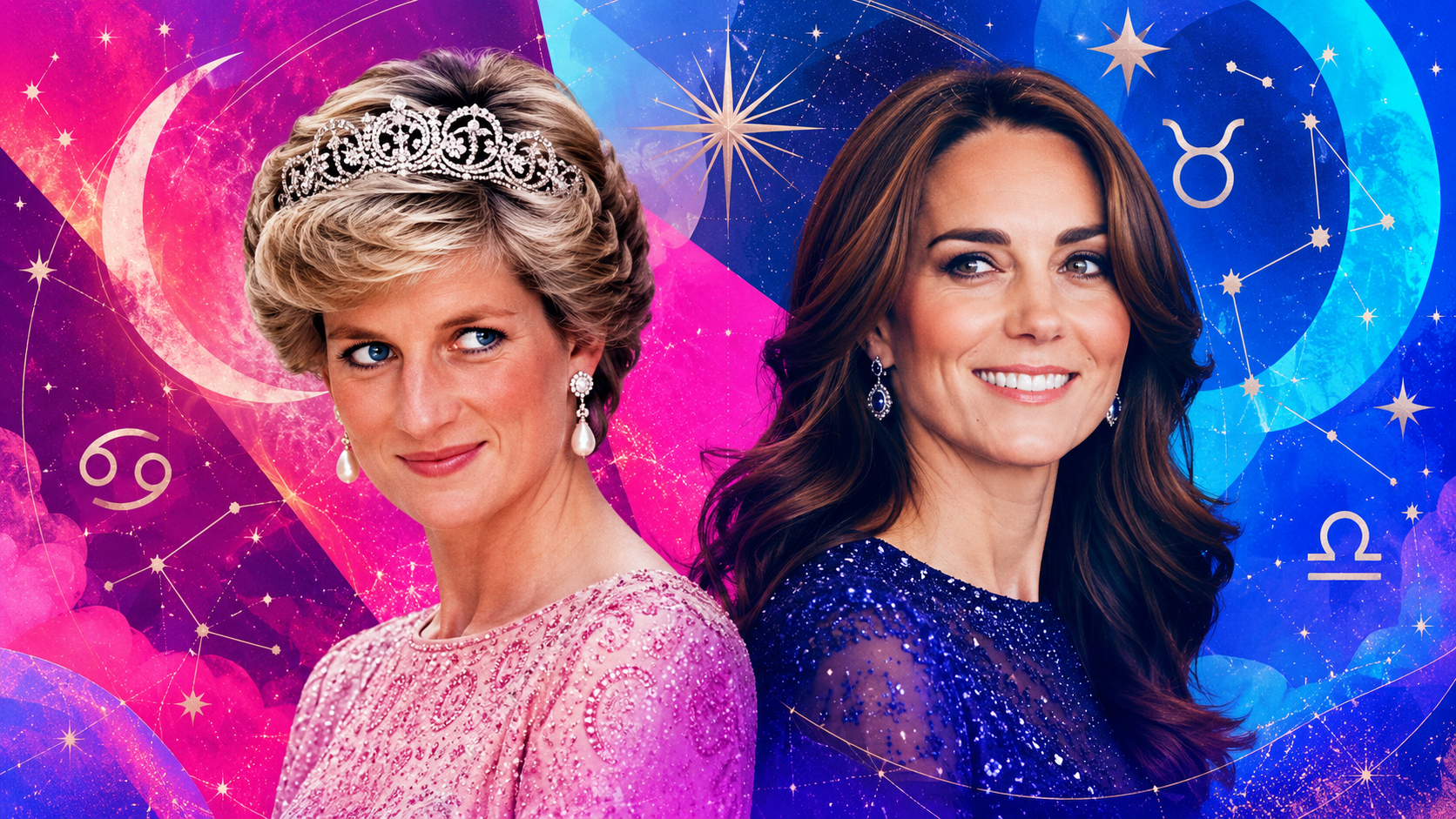
Princess Diana and Catherine, Princess of Wales, never met.
Diana died in Paris on August 31, 1997.
Catherine met Prince William at the University of St Andrews several years later, in 2001.
There is no shared conversation to analyze, no photograph of the two women together, no private relationship whose emotional history can be reconstructed through astrology.
And yet Diana has been present in Catherine’s public life from the beginning.
When Prince William announced his engagement to Catherine in November 2010, the ring on her hand was Diana’s sapphire-and-diamond engagement ring. William explained that using it was a way of keeping his mother close to the occasion she could not share.
In 2011, Catherine married Diana’s eldest son.
In 2022, she became Princess of Wales—the title most of the modern public still associates instinctively with Diana.
She entered a role Diana had transformed, inherited an image Diana had permanently altered, raised the grandchildren Diana never met, and became the next woman required to negotiate the public meaning of family inside the British monarchy.
This is not ordinary synastry.
It is legacy synastry.
The charts do not describe a lived interpersonal bond. They describe the symbolic field connecting a deceased woman, her son’s wife, an inherited title, a family, an institution, and a global public that never stopped comparing the present Princess of Wales with the one whose image had already become myth.
The astrology is remarkably exact.
The central interlocking structure joins Diana’s natal Jupiter–Neptune square to Catherine’s natal Mercury–Venus–Jupiter configuration:
Diana’s Jupiter conjuncts Catherine’s Mercury within approximately 0°40′.
Diana’s Neptune squares Catherine’s Venus within approximately 1°18′.
Diana’s Neptune conjuncts Catherine’s Jupiter within approximately 1°24′.
Diana’s Jupiter conjuncts Catherine’s Venus within approximately 2°12′.
Diana’s Neptune squares Catherine’s Mercury within approximately 2°50′.
Diana’s Jupiter in Aquarius enlarges Catherine’s Aquarius voice and public style.
Diana’s Neptune in Scorpio merges with Catherine’s Jupiter and places myth, compassion, projection, grief, glamour, and collective longing directly into Catherine’s natal benefic structure.
This is the chart of a public inheritance that cannot remain small.
The ring is not only jewelry.
The title is not only a title.
The comparison is not only a comparison.
Each becomes an amplifier.
The second defining structure is heavier:
Diana’s Saturn squares Catherine’s Pluto within approximately 1°01′.
Diana’s Saturn in Capricorn describes the institution, the burden, the hierarchy, and the demands she internalized.
Catherine’s Pluto in Libra describes power inside partnership, image, contract, and the constitutional relationship through which her public role exists.
The contact places Diana’s experience of institutional weight at a hard angle to Catherine’s relationship with power inside the same royal structure.
Then Uranus creates a different possibility:
Diana’s Uranus sextiles Catherine’s Saturn within approximately 1°29′.
Diana’s disruption of royal femininity can cooperate with Catherine’s exalted Saturn of disciplined partnership and formal duty.
The woman who broke the picture and the woman who stabilized the picture are not astrologically opposed in every way.
The synastry suggests that reform can become structure.
Diana’s emotional and humanitarian legacy can be institutionalized rather than merely imitated.
That distinction is central to Catherine’s public work.
Diana made compassion visible through touch, proximity, and the immediate power of the image.
Catherine has increasingly concentrated her work on early childhood, family systems, emotional development, and the structures shaping children before they are old enough to speak for themselves.
Diana humanized the institution through direct emotional contact.
Catherine attempts to build institutions around the conditions that produce emotional security.
One made the monarchy feel. The other asks what must be built so that feeling has somewhere to live.
Their synastry is not a verdict on resemblance.
It is a map of transmission.
What Legacy Synastry Can and Cannot Say
Synastry usually compares two people who have met and whose charts operate through direct relationship.
That is not the situation here.
Diana and Catherine had no personal relationship.
Astrology cannot tell us:
Whether Diana would have approved of Catherine
What private bond they might have formed
Whether Catherine consciously models herself on Diana
Whether one woman is the spiritual successor, reincarnation, or destined replacement of the other
What Diana would think of Catherine’s marriage, parenting, public work, or use of the Princess of Wales title
Whether public similarities are intentional
The chart should not be used to create a fictional conversation between them.
What it can describe is the symbolic relationship produced by documented circumstances:
Catherine married Diana’s eldest son.
She wears Diana’s engagement ring.
She became Princess of Wales.
She works inside the institution Diana permanently changed.
Her public image is interpreted through a cultural memory shaped by Diana.
She raises Diana’s grandchildren.
Her royal work includes families, mental health, children, and early development.
The synastry therefore operates through inheritance, memory, expectation, family, image, and institution.
This is a real relationship field even though it was never a direct personal bond.
A Note About Both Birth Times
Both charts use 12:00 noon placeholders, not verified birth times.
Princess Diana
July 1, 1961
12:00 noon
Sandringham, England
UT: 11:00
Catherine, Princess of Wales
January 9, 1982
12:00 noon
Reading, England
UT: 12:00
Because the birth times are unverified, this analysis excludes:
Ascendants and Descendants
Midheavens and Imum Coeli
Houses
House overlays
Angular contacts
Composite houses
Claims based on house rulership or angularity
Both Moon signs are secure for their full local birth dates.
Diana’s Moon remained in Aquarius throughout July 1, 1961.
Catherine’s Moon remained in Cancer throughout January 9, 1982.
Their Moon signs can be interpreted confidently.
Their exact lunar degrees and all Moon-based interaspect orbs remain provisional.
All non-lunar contacts presented as core synastry are stable for the dates.
The Two Natal Charts Entering the Field
Diana’s chart is governed by two sovereign planets.
Under traditional rulership, nearly every placement ultimately reports to Saturn in Capricorn. Venus stands apart in Taurus, its own sign, and trines Saturn.
Duty and beauty govern together.
The chart can carry the institution and make the institution physically, emotionally, and visually accessible.
Diana’s Cancer Sun trines Neptune within 0°43′, joining identity with compassion, image, sacrifice, glamour, and collective projection.
Venus squares Uranus within 0°45′, placing disruption inside the feminine and royal image.
Mercury in Cancer sextiles Mars and Pluto in Virgo.
Feeling becomes language.
Language becomes focused action.
Catherine’s chart is built around a different architecture.
Her Capricorn Sun opposes a dignified Cancer Moon.
The institution and the family face each other across the chart.
Her Sun is the chart’s only earth placement, making identity and duty the sole material anchor.
Her Venus in Aquarius and exalted Saturn in Libra form a mutual reception.
Grace and duty exchange signs.
Her Mercury conjoins Venus, and both square Jupiter in Scorpio with extraordinary precision.
Catherine’s public communication, style, social effect, and symbolic scale are tightly coupled.
Where Diana’s chart turns image into emotional immediacy, Catherine’s chart turns grace into a structured public function.
Where Diana’s chart disrupts the image, Catherine’s chart administers the image.
Where Diana’s Cancer Sun makes care personal, Catherine’s Cancer Moon and North Node make family and care the emotional and developmental center beneath a Capricorn role.
The synastry does not connect two random charts.
It links two different solutions to the same royal problem:
How can an institution built on continuity remain emotionally recognizable to the people watching it?
The Inherited Myth Circuit
The most important structure in the synastry is not a single aspect.
It is a cross-chart circuit.
Diana was born with Jupiter at 5°08′ Aquarius square Neptune at 8°38′ Scorpio.
Catherine was born with Mercury at 5°48′ Aquarius conjunct Venus at 7°20′ Aquarius, both square Jupiter at 7°14′ Scorpio.
The two natal configurations occupy almost the same degrees.
When the charts are placed together:
Diana’s Jupiter conjoins Catherine’s Mercury.
Diana’s Jupiter conjoins Catherine’s Venus.
Diana’s Neptune conjoins Catherine’s Jupiter.
Diana’s Neptune squares Catherine’s Mercury.
Diana’s Neptune squares Catherine’s Venus.
Catherine’s Jupiter squares Diana’s Jupiter.
Diana’s natal Jupiter–Neptune square overlays Catherine’s natal Mercury–Venus–Jupiter square.
This is the synastry’s governing mechanism.
Jupiter expands.
Neptune mythologizes.
Mercury names.
Venus presents.
The circuit describes an inheritance moving through language, style, image, compassion, projection, and public scale.
Catherine did not simply inherit a piece of jewelry and a title.
She entered a symbolic system already saturated with Diana’s meaning.
Diana Jupiter Conjunct Catherine Mercury at 0°40′: The Legacy Enters the Voice
Diana’s Jupiter is at 5°08′ Aquarius.
Catherine’s Mercury is at 5°48′ Aquarius.
The conjunction is approximately 0°40′.
Jupiter expands whatever it touches.
It grants range, confidence, social meaning, and a connection to a wider audience.
Mercury speaks, explains, names, interprets, organizes information, and decides how a message will be framed.
Diana’s Jupiter in Aquarius enlarges Catherine’s Aquarius Mercury.
Aquarius communicates through systems, collective purpose, social context, reform, and the future.
This is not necessarily a loud conjunction.
It is a broad one.
Catherine’s words and public initiatives are received within a field larger than the immediate statement because Diana’s legacy has already taught the public to interpret the Princess of Wales as a figure with emotional and humanitarian significance.
A speech about children is not heard only as policy.
A photograph with a family is not seen only as an engagement.
A statement about illness, privacy, motherhood, or emotional development is absorbed into a longer royal narrative about women, family, vulnerability, and public duty.
Jupiter can support the Mercury person.
The inherited legacy can give Catherine’s communication reach and symbolic weight.
It can also make every sentence larger than she intended.
The exact conjunction describes the opportunity and the tax.
Catherine’s Mercury is already square her own Jupiter.
Her voice is nataly amplified.
Diana’s Jupiter lands directly on that Mercury and intensifies the existing pattern.
The public does not let Catherine’s communication remain small.
Diana Jupiter Conjunct Catherine Venus at 2°12′: The Image Inherits Reach
Diana’s Jupiter also conjoins Catherine’s Venus in Aquarius.
Venus governs style, social grace, beauty, value, relationship, and the image through which a person becomes appealing or recognizable.
Diana’s Jupiter expands Catherine’s Venus.
The symbolism is almost literal.
Diana’s ring becomes Catherine’s engagement ring.
Diana’s former title becomes Catherine’s title.
The visual memory attached to one Princess of Wales enlarges the visual meaning of the next.
Catherine’s natal Venus already participates in the “Kate effect,” the amplification of clothing, presentation, and public taste.
Diana’s Jupiter adds another layer of historical reach.
The conjunction can indicate admiration at the symbolic level.
The Venus person may carry forward something the Jupiter person valued or represented.
But this is not permission to claim Diana personally chose Catherine.
The aspect describes a public inheritance, not a posthumous endorsement.
In Aquarius, the value being transmitted is modernizing.
Diana’s image altered expectations around royal emotional accessibility.
Catherine’s image operates in a later media environment and under a different strategy, but it cannot return completely to the distance that existed before Diana.
The public now expects a Princess of Wales to be both formal and human.
Jupiter enlarges that expectation.
Diana Neptune Conjunct Catherine Jupiter at 1°24′: The Myth Enters the Mission
Diana’s Neptune at 8°38′ Scorpio conjoins Catherine’s Jupiter at 7°14′ Scorpio within approximately 1°24′.
This is one of the most important contacts in the chart.
Neptune describes myth, image, compassion, grief, idealization, sacrifice, glamour, projection, and the collective longing that attaches itself to a person.
Jupiter describes meaning, moral scale, public reach, generosity, and the desire to make an influence socially useful.
Diana’s Neptune enters Catherine’s Jupiter.
The myth enters the mission.
Catherine’s charitable and public work exists in a field already shaped by Diana’s humanitarian image.
This does not make Catherine’s work derivative.
It means the work will be interpreted through an inherited emotional atmosphere.
Diana became globally associated with direct compassion: touching patients, embracing children, walking through a minefield, using the image of the princess to redirect attention toward stigmatized or injured people.
Catherine’s Jupiter in Scorpio seeks depth and long-term consequence beneath the visible event.
Her early-childhood work attempts to identify the hidden roots of later social and emotional outcomes.
Neptune can inspire Jupiter.
Diana’s legacy can give Catherine’s public mission an emotionally legible larger purpose.
But Neptune also creates impossible ideals.
Catherine can be compared not with a complete human being but with the perfected memory of a woman frozen in global grief.
No living person can compete with a myth.
Neptune conjunct Jupiter can enlarge inspiration until it becomes a burden.
The mature expression is not imitation.
It is translation.
What does compassion become in a different life, a different marriage, a different generation, and a different institutional moment?
Diana Neptune Square Catherine Venus at 1°18′: Style Under the Ghost of Comparison
Diana’s Neptune squares Catherine’s Venus within approximately 1°18′.
This is the aspect of aesthetic projection.
Neptune idealizes Venus.
It can make the Venus person appear graceful, romantic, symbolic, elusive, or permanently associated with an image larger than the actual individual.
It can also blur the boundary between appreciation and comparison.
Catherine’s Venus governs her public style and social presentation.
Diana’s Neptune places that style under the atmosphere of myth.
Every gown can invite comparison.
Every tiara can become historical reference.
Every choice to wear or not wear a jewel can be interpreted as a statement about Diana.
Every photograph can be read as continuity, contrast, tribute, distance, or replacement.
The aspect explains why the public can become emotionally invested in visual details Catherine may experience as practical or ceremonial.
Neptune gives the image poetry.
The square gives the poetry pressure.
Catherine’s Venus is retrograde in Aquarius.
It is private, deliberate, disciplined, and resistant to being completely consumed by public expectation.
The growth task is maintaining a personal value system inside a myth-saturated role.
Diana Neptune Square Catherine Mercury at 2°50′: The Difficulty of Speaking Beside a Myth
Neptune also squares Catherine’s Mercury.
The myth affects the message.
Catherine speaks into a public field where Diana’s memory is emotionally charged, unfinished, and interpreted through decades of biography, grief, journalism, documentary, drama, and family conflict.
Mercury wants clarity.
Neptune supplies atmosphere.
A statement can be interpreted symbolically even when it is concrete.
Silence can be interpreted as reverence, avoidance, institutional control, or private boundary.
Speech can be interpreted as tribute, appropriation, comparison, or coded family commentary.
The square does not mean deception.
It means communication occurs inside fog created by collective projection.
Catherine’s Aquarius Mercury manages this through distance, context, and controlled framing.
The public may want emotional disclosure because Diana’s image taught it to expect emotional access from the Princess of Wales.
Catherine’s chart responds differently.
Her Mercury belongs to a Venus–Saturn system of measured communication.
The synastry asks whether privacy can be accepted as a legitimate form of emotional integrity rather than treated as evidence of emotional absence.
Jupiter Square Jupiter at 2°06′: Two Different Forms of Public Good
Diana’s Jupiter in Aquarius squares Catherine’s Jupiter in Scorpio.
Both women connect public role with social purpose.
They differ in method.
Aquarius Jupiter expands through collective inclusion, networks, social reform, humanitarian visibility, and attention to people outside the established center.
Scorpio Jupiter expands through depth, research, crisis, psychological reality, hidden causes, and long-term transformation.
Diana’s humanitarian influence was often immediate and image-based.
She could change the emotional meaning of a subject through a gesture.
Catherine’s early-childhood work is more institutional, research-oriented, and designed around long-term social outcomes.
Aquarius says: Bring the excluded person into the public circle.
Scorpio says: Find the hidden condition producing the suffering and intervene at the root.
The square can create public comparison because both approaches claim moral scale.
But the chart does not require one to invalidate the other.
They are different historical expressions of royal service.
Diana redistributed attention.
Catherine builds a framework intended to redistribute understanding and resources over time.
Diana Sun Trine Catherine Jupiter at 2°07′: The Humanitarian Identity Supports the Mission
Diana’s Cancer Sun trines Catherine’s Scorpio Jupiter within approximately 2°07′.
This is one of the synastry’s warmest stable contacts.
The Sun represents identity.
Jupiter represents meaning, growth, public purpose, and the larger philosophy guiding a life.
Diana’s Cancer identity—care, family, vulnerability, protection, emotional recognition—supports Catherine’s Jupiterian mission in Scorpio.
Catherine’s work around early childhood, family breakdown, mental health, addiction, and emotional development can be understood as a structured extension of themes Diana made publicly human.
Again, extension is not imitation.
The trine allows the principle to flow while the method changes.
Diana’s Sun says the person must be felt.
Catherine’s Jupiter asks what deeper system shapes the person before the visible crisis arrives.
The contact can symbolize a legacy that becomes more useful when it is translated rather than reenacted.
Diana Mercury Trine Catherine Jupiter at 3°52′: Testimony Becomes Framework
Diana’s Mercury in Cancer trines Catherine’s Jupiter in Scorpio.
Diana’s voice developed through personal memory, emotional testimony, and the insistence that the private experience mattered.
Catherine’s Jupiter seeks depth, expertise, and long-range social effect.
The trine connects story with framework.
A human account can become the reason an institution studies, funds, or restructures a problem.
Diana’s public legacy helped normalize the idea that emotional pain, family difficulty, stigma, and private suffering belong in public conversation.
Catherine’s work operates in a later stage of that cultural development.
The conversation is not only whether pain should be acknowledged.
It is how society can shape healthier emotional development from the beginning.
Mercury–Jupiter harmony supports education.
The inherited story can become a curriculum rather than remaining only a memory.
Diana Saturn Square Catherine Pluto at 1°01′: The Weight Inside the Inheritance
Diana’s Saturn is at 27°50′ Capricorn.
Catherine’s Pluto is at 26°49′ Libra.
The square is approximately 1°01′.
This is the synastry’s institutional pressure point.
Diana’s Saturn represents the structure she entered, the hierarchy she carried, the expectations she internalized, and the limits she eventually found unsustainable.
Catherine’s Pluto in Libra represents power inside partnership, formal relationship, public image, and the constitutional bond through which her role exists.
Diana’s Saturn presses on Catherine’s Pluto.
The past institutional burden activates the present relationship with power.
This does not mean Catherine repeats Diana’s experience.
Their marriages, temperaments, support systems, media strategies, and historical circumstances are not the same.
The aspect describes the impossibility of entering the role without encountering the history embedded inside it.
Catherine’s marriage to William is not only a private relationship.
It is the partnership through which she became a working royal and later Princess of Wales.
Diana’s Saturn reminds the chart that the partnership carries institutional consequence.
Pluto asks how power is negotiated inside the bond.
The contact can create endurance.
Saturn gives Pluto form.
Pluto gives Saturn the capacity to transform what has become rigid.
The shadow is inherited fear.
A structure may become so determined not to repeat an earlier crisis that it creates new forms of control.
The mature expression is institutional memory used consciously.
What did the earlier structure fail to protect?
What boundaries are necessary?
What forms of support must exist for the role to remain human?
Diana Uranus Sextile Catherine Saturn at 1°29′: Reform Can Become Duty
Diana’s Uranus in Leo sextiles Catherine’s Saturn in Libra.
Uranus disrupts the expected image.
Saturn formalizes, stabilizes, and sustains.
The sextile allows the two functions to cooperate.
Diana changed the visual and emotional expectations attached to royal femininity.
Catherine’s Saturn can absorb some of that change and make it part of a durable operating structure.
This is one of the synastry’s clearest intergenerational strengths.
Catherine does not have to reproduce Diana’s style of disruption in order to continue its effect.
A reform is most successful when it no longer requires constant rebellion to exist.
Diana’s physical affection with her children, emotional accessibility, fashion autonomy, and cause-focused visibility altered the public template.
Catherine’s chart can institutionalize a more family-centered royal role through consistency, partnership, and formal programs.
Uranus supplies the opening.
Saturn builds the continuation.
Diana Mars Square Catherine Uranus at 1°40′: Action and Disruption Do Not Share a Tempo
Diana’s Mars in Virgo squares Catherine’s Uranus in Sagittarius.
Diana’s Mars acts through immediate practical service, precision, bodily presence, and attention to the person or task directly in front of her.
Catherine’s Uranus in Sagittarius modernizes through broader ideas, international perspective, media, education, and changes in how a message travels.
The square creates different tempos of reform.
Virgo Mars asks: What can be done now, here, for this person?
Sagittarius Uranus asks: What larger framework, story, or future must change?
The tension can become productive.
Immediate service and system-wide change need one another.
But the public may prefer the emotional visibility of the immediate act and undervalue slower institutional work.
Diana walking through the minefield is unforgettable.
A multi-year program studying early development is less easily condensed into one iconic photograph.
The square reminds us that different forms of action produce different media effects.
Visibility is not the same as impact.
Diana Pluto Sextile Catherine Jupiter at 1°12′: The Legacy Deepens the Mission
Diana’s Pluto in Virgo sextiles Catherine’s Jupiter in Scorpio within approximately 1°12′.
This is a practical transformation contact.
Pluto in Virgo changes systems through service, detail, health, bodily reality, and focused intervention.
Jupiter in Scorpio seeks depth, root causes, emotional truth, and lasting change.
The sextile supports work addressing conditions that are hidden until they become crises.
Catherine’s early-childhood emphasis is consistent with this geometry.
The work asks society to intervene before later problems become publicly visible.
Diana’s legacy supplies the moral urgency of seeing suffering.
Catherine’s Jupiter seeks the developmental depth beneath it.
Pluto ensures the work is not merely comforting.
It asks what must change.
Diana Node Sextile Catherine Pluto at 1°22′: Legacy Meets Transformative Power
Diana’s Leo North Node sextiles Catherine’s Pluto in Libra.
Diana’s developmental path required visible personal authorship and the transformation of royal femininity from within the image.
Catherine’s Pluto operates through partnership, formal role, and the public relationship structure.
The sextile suggests that the legacy created by Diana’s individual visibility can support Catherine’s ability to transform the meaning of partnership-based public power.
The contact is nodal, so it should be interpreted symbolically rather than as proof of fate.
It does not mean Catherine was destined to replace Diana.
It means the public path opened by Diana remains active in the relational and institutional terrain Catherine now occupies.
Diana Venus Sextile Catherine North Node at 1°38′: The Material Legacy Supports the Path
Diana’s Venus in Taurus sextiles Catherine’s Cancer North Node.
This is one of the most tangible contacts in the chart.
Venus governs jewelry, clothing, beauty, value, affection, and the material objects through which relationship is symbolized.
Catherine’s North Node in Cancer develops through family, motherhood, belonging, protection, and emotional continuity.
Diana’s Venus supports that path.
The sapphire ring is an unusually literal expression.
A Venusian object belonging to Diana becomes part of Catherine’s path into marriage and family.
The astrology should not reduce the aspect to one piece of jewelry, but the symbolism is exact enough to notice.
Diana’s style legacy also supports Catherine’s public path, though not by requiring imitation.
Taurus Venus values continuity through material culture.
Objects carry memory.
Jewels, clothing, photographs, and names become vessels through which family history remains physically present.
The sextile is gentle.
The legacy can support without controlling—provided the object remains a connection rather than a demand to become the person who once wore it.
Diana Venus Trine Catherine Sun at 5°10′: Beauty Supports the Institutional Self
Diana’s Venus trines Catherine’s Capricorn Sun by approximately 5°10′.
This is a wider luminary contact, but thematically important.
Diana’s dignified Taurus Venus supports Catherine’s earth-sign identity.
Style, value, material continuity, and grace can strengthen Catherine’s capacity to inhabit a formal role.
The contact helps explain why the visible inheritance often appears harmonious.
Catherine can wear historic jewelry and royal symbolism without the objects completely overwhelming her own composure.
Taurus and Capricorn understand continuity.
Both signs know that an object becomes more valuable when it survives time.
The trine’s shadow is excessive reverence for form.
The growth task is using continuity as a foundation rather than a limitation.
Diana Sun Square Catherine Mars at 1°00′: Care Challenges the Method of Action
Diana’s Cancer Sun squares Catherine’s Mars in Libra within approximately 1°00′.
This is a dynamic, potentially uncomfortable contact.
Diana’s identity is Cancerian: personal, emotional, protective, family-centered, and responsive to immediate human need.
Catherine’s Mars in Libra acts through diplomacy, relationship, timing, coordination, and the effort to preserve balance.
The square asks how action should occur when care and protocol do not move at the same speed.
Cancer can experience deliberation as insufficient protection.
Libra can experience emotionally driven action as creating relational or institutional consequences that have not been fully weighed.
Again, this is not a record of a disagreement between two women who never met.
It is the tension between Diana’s legacy and Catherine’s operating style.
The public may expect Catherine to act with Diana’s emotional immediacy.
Catherine’s Mars is more calibrated.
The square can make restraint look like indifference to audiences trained by Diana’s image to recognize care through visible spontaneity.
The chart’s mature expression understands that diplomacy can also be protective.
The method differs.
Diana Jupiter Sextile Catherine Uranus at 2°01′: The Legacy Encourages Modernization
Diana’s Jupiter sextiles Catherine’s Uranus.
The humanitarian, socially inclusive Jupiter in Aquarius supports Catherine’s modernizing Uranus in Sagittarius.
This contact gives the inheritance a future orientation.
Diana’s legacy does not only ask to be preserved.
It can encourage new forms of communication, family life, charitable work, and public relevance.
The sextile favors experimentation without requiring total rupture.
It suggests that Catherine’s most authentic relationship with Diana’s legacy may emerge through innovation rather than imitation.
Diana Node Trine Catherine Neptune at 2°44′: The Legacy Enters the Collective Imagination
Diana’s Leo North Node trines Catherine’s Neptune in Sagittarius.
Diana’s path of visible authorship connects with Catherine’s generational planet of global image, belief, media, and symbolic meaning.
The contact helps explain why the connection between them lives so powerfully in the public imagination.
The trine can make the inherited narrative feel natural, even inevitable.
That is precisely why caution is required.
A smooth symbolic story can become stronger than the documented reality.
The public may create a relationship between the women because the image is emotionally satisfying.
Astrology should describe the symbolic resonance without pretending the imagined relationship was lived.
The Noon-Moon Layer: The Mother and the Family Path
The Moon layer is emotionally compelling and technically provisional.
Both Moon signs are secure.
Diana has an Aquarius Moon.
Catherine has a Cancer Moon.
The signs themselves do not form a major Ptolemaic aspect.
They represent different emotional functions.
Aquarius distributes care toward the collective and the outsider.
Cancer concentrates care around family, home, attachment, and emotional continuity.
Diana’s public emotional legacy moved outward.
Catherine’s emotional and developmental work moves inward toward the early family environment and then builds outward from it.
The noon degrees create several notable contacts.
Diana Moon Trine Catherine Saturn — 1°33′ at Noon
At noon, Diana’s Aquarius Moon trines Catherine’s exalted Saturn in Libra.
This would be a powerful contact of emotional legacy meeting formal responsibility.
The Moon person’s social and humanitarian sensitivity supports the Saturn person’s duty.
Catherine’s disciplined role can give structure to values associated with Diana’s emotional public image.
The exact orb is provisional because Diana’s Moon degree is unverified.
Diana Sun Conjunct Catherine Moon — 5°00′ at Noon
At noon, Diana’s Cancer Sun conjoins Catherine’s Cancer Moon.
The sign conjunction is secure because Catherine’s Moon remained in Cancer throughout the date.
The exact 5°00′ orb is not verified.
Symbolically, this is the heart of the “mother and inheritance” story.
Diana’s identity as mother, caregiver, and emotionally recognizable princess meets Catherine’s emotional nature and family-centered public work.
The contact does not create a personal maternal bond they never had.
It describes why the public so easily experiences Catherine’s family role as a continuation of themes associated with Diana.
Diana Moon Sextile Catherine Neptune — 5°10′ at Noon
At noon, Diana’s Aquarius Moon sextiles Catherine’s Neptune in Sagittarius.
The contact links humanitarian feeling with global image and collective symbolism.
It may contribute to the public’s emotional imagination around the two women.
The exact orb remains provisional.
Diana Neptune Trine Catherine Moon — 5°43′ at Noon
At noon, Diana’s Neptune trines Catherine’s Cancer Moon.
This is the most mythically charged lunar contact.
Diana’s image, grief, compassion, and symbolic presence flow toward Catherine’s emotional and maternal Moon.
The aspect can describe inspiration and projection in equal measure.
Because Catherine’s exact Moon degree is unknown, the orb must remain provisional.
What the Synastry Does Well
It can turn legacy into structured service
Diana’s Jupiter and Pluto support Catherine’s Mercury, Venus, and Jupiter. Humanitarian meaning can become communication, public style, research, and institution-building.
It connects emotional recognition with developmental depth
Diana’s Cancer Sun trines Catherine’s Scorpio Jupiter. The person who made suffering visible connects with the person asking what hidden early conditions shape later life.
It supports modernization that can last
Diana Uranus sextile Catherine Saturn is an excellent signature for reform becoming part of formal duty rather than remaining dependent on permanent disruption.
It gives material continuity a developmental purpose
Diana Venus sextile Catherine’s Cancer North Node connects jewelry, style, family memory, marriage, motherhood, and emotional continuity.
It allows difference in method
The charts do not require Catherine to become Diana. The strongest contacts show transmission through translation: image becomes framework, feeling becomes structure, reform becomes continuity.
What People May Misunderstand
The public may interpret every overlap as proof that Catherine is “the new Diana.”
The synastry does not support replacement.
Diana’s chart is fixed, disruptive, emotionally immediate, and mythically porous.
Catherine’s chart is cardinal, administratively balanced, partnership-oriented, and highly controlled.
Diana’s Venus squares Uranus.
Catherine’s Venus belongs to a mutual reception with Saturn.
One changes the form by breaking its expected image.
The other changes the form by inhabiting it consistently enough to alter what it can sustain.
They are not the same archetype.
The public may also mistake Diana’s symbolic presence for Catherine’s personal experience.
Catherine may value the ring, title, and family connection deeply.
The sources do not support pretending we know her full private relationship with Diana’s memory.
The synastry describes the field around her, not the contents of every feeling inside her.
The Shadow Pattern
The shadow begins when inheritance becomes comparison.
Diana’s image is idealized by Neptune.
Catherine’s Venus and Mercury enter the Neptunian field.
Every style choice and statement is compared with a perfected memory.
Catherine’s differences are interpreted as deficiencies.
Institutional caution increases.
Increased caution produces less emotional access.
Less access causes the public to project even more.
The myth becomes stronger because the living person remains partially unknown.
The Jupiter contacts enlarge the cycle.
A small gesture becomes a referendum on legacy.
A jewel becomes a declaration.
A photograph becomes a theory of family history.
A period of privacy becomes a cultural narrative.
Saturn square Pluto adds pressure.
The institution may attempt to manage the comparison so carefully that the management itself becomes part of the story.
The shadow is not Diana’s memory.
The shadow is using memory to deny the present woman the right to be distinct.
The Growth Path
The chart’s growth path is differentiated continuity.
Catherine does not need to reject Diana’s legacy in order to possess her own identity.
She does not need to imitate Diana in order to honor the emotional transformation Diana created.
The Jupiter–Neptune circuit needs boundaries.
Inspiration must be separated from projection.
Compassion must be separated from the demand for personal disclosure.
Tribute must be separated from replacement.
The Saturn–Pluto square needs conscious institutional memory.
The earlier experience should inform protection, support, media boundaries, and family structure without becoming a template through which every present event is interpreted.
Uranus sextile Saturn shows how this can work.
Reform becomes routine.
A more emotionally aware monarchy does not have to depend on one charismatic woman continually exposing herself to public feeling.
It can be built into how the institution supports family, children, mental health, and the human limits of public duty.
Diana’s Cancer Sun and Catherine’s Cancer Moon point toward care.
Catherine’s Capricorn Sun asks for structure.
The most mature continuation of Diana’s legacy may therefore be something Diana’s own life showed was necessary:
an institution capable of protecting the person carrying the role.
The Final Portrait
Princess Diana and Kate Middleton’s synastry is not the chart of two women who knew one another.
It is the chart of a woman and the inheritance she left inside a family, a title, a visual language, and an institution.
Diana’s Jupiter conjoins Catherine’s Mercury within approximately 0°40′.
The legacy expands the voice.
Diana’s Jupiter conjoins Catherine’s Venus.
The legacy expands the image.
Diana’s Neptune conjoins Catherine’s Jupiter and squares Catherine’s Mercury and Venus.
The myth enters the mission, the message, and the public presentation.
Diana’s Saturn squares Catherine’s Pluto within approximately 1°01′.
The institutional burden remains embedded in the partnership through which the role is inherited.
Diana’s Uranus sextiles Catherine’s Saturn.
The disruption can become structure.
Diana’s Venus sextiles Catherine’s Cancer North Node.
The material legacy—the ring, the jewels, the visual memory, the family symbols—supports a path organized around marriage, children, and emotional continuity.
At noon, Diana’s Cancer Sun conjoins Catherine’s Cancer Moon.
The woman whose identity became inseparable from motherhood meets the emotional center of the woman raising her grandchildren and building a public program around early childhood.
The exact orb is provisional.
The symbolism is unmistakable.
But the synastry’s deepest lesson is not that Catherine is destined to continue Diana’s life.
It is that a legacy survives most honestly when it changes form.
Diana made compassion immediate.
Catherine makes it structural.
Diana redirected the camera toward the person who had been excluded.
Catherine directs institutional attention toward the early conditions shaping the person before exclusion or crisis becomes visible.
Diana altered royal femininity through emotional presence and visible disruption.
Catherine alters it through consistency, partnership, boundaries, and the patient construction of a family-centered public role.
The sapphire ring keeps Diana close.
The chart shows what else remains close:
the expectation that the Princess of Wales will be more than ornamental,
the belief that royal visibility should serve human need,
the public insistence that family and institution cannot be treated as separate worlds,
and the unresolved question of whether a person can carry a symbol without disappearing inside it.
Diana is the woman in the inheritance. Catherine is the woman required to make the inheritance livable.
Principal Synastry Signatures
Time-stable interaspects
Diana Jupiter conjunct Catherine Mercury — 0°40′
Diana Sun square Catherine Mars — 1°00′
Diana Saturn square Catherine Pluto — 1°01′
Diana Pluto sextile Catherine Jupiter — 1°12′
Diana Neptune square Catherine Venus — 1°18′
Diana North Node sextile Catherine Pluto — 1°22′
Diana Neptune conjunct Catherine Jupiter — 1°24′
Diana Uranus sextile Catherine Saturn — 1°29′
Diana Venus sextile Catherine North Node — 1°38′
Diana Mars square Catherine Uranus — 1°40′
Diana Jupiter sextile Catherine Uranus — 2°01′
Diana Jupiter square Catherine Jupiter — 2°06′
Diana Sun trine Catherine Jupiter — 2°07′
Diana Uranus trine Catherine Neptune — 2°08′
Diana Jupiter conjunct Catherine Venus — 2°12′
Diana North Node trine Catherine Neptune — 2°44′
Diana Neptune square Catherine Mercury — 2°50′
Diana Pluto square Catherine Uranus — 2°55′
Diana Uranus sextile Catherine Pluto — 3°30′
Diana Mercury trine Catherine Jupiter — 3°52′
Diana Mars sextile Catherine Pluto — 4°38′
Diana North Node square Catherine Uranus — 4°56′
Diana Venus trine Catherine Sun — 5°10′
Noon-based lunar contacts
Diana Moon trine Catherine Saturn — 1°33′
Diana Sun conjunct Catherine Moon — 5°00′
Diana Moon sextile Catherine Neptune — 5°10′
Diana Neptune trine Catherine Moon — 5°43′
The Moon signs are secure, but exact Moon degrees and lunar aspect orbs are provisional.
Core inherited-myth circuit
Diana Jupiter conjunct Catherine Mercury — 0°40′
Diana Neptune square Catherine Venus — 1°18′
Diana Neptune conjunct Catherine Jupiter — 1°24′
Diana Jupiter conjunct Catherine Venus — 2°12′
Diana Neptune square Catherine Mercury — 2°50′
Diana Jupiter square Catherine Jupiter — 2°06′
Frequently Asked Questions
Did Princess Diana and Kate Middleton ever meet?
No. Diana died in August 1997, while Catherine and Prince William met at the University of St Andrews in 2001. This is therefore interpreted as legacy synastry rather than a lived interpersonal relationship.
What is the closest aspect in their synastry?
Diana’s Jupiter conjuncts Catherine’s Mercury within approximately 0°40′. This links Diana’s public reach and humanitarian meaning with Catherine’s communication, framing, and social message.
What is the main theme of the synastry?
The main theme is inherited public mythology. Diana’s Jupiter–Neptune square overlays Catherine’s Mercury–Venus–Jupiter structure, connecting Diana’s legacy with Catherine’s voice, style, mission, and the public projections attached to the Princess of Wales role.
What does Diana’s Neptune conjunct Catherine’s Jupiter mean?
Diana’s image, compassion, grief, and mythic public presence enter Catherine’s planet of purpose, public meaning, and social scale. The aspect can inspire a larger mission while creating impossible comparisons with an idealized memory.
What does Diana’s Jupiter conjunct Catherine’s Venus mean?
Diana’s symbolic reach expands Catherine’s public style, grace, and social visibility. The sapphire engagement ring is a literal Venusian object through which Diana’s material and family legacy entered Catherine’s public path.
What aspect describes institutional pressure?
Diana’s Saturn squares Catherine’s Pluto within approximately 1°01′. Diana’s experience of institutional duty and limitation meets Catherine’s relationship with power inside partnership, public image, and constitutional role.
Is there an aspect showing that Catherine can modernize the monarchy?
Diana’s Uranus sextiles Catherine’s exalted Saturn within approximately 1°29′. Uranian reform can cooperate with Saturnian structure, suggesting that changes opened by Diana can become durable through Catherine’s more formal and consistent method.
Do their charts show a mother-daughter bond?
Astrology should not invent a personal bond they never had. At noon, Diana’s Cancer Sun conjoins Catherine’s Cancer Moon by approximately 5°00′, which is symbolically resonant around motherhood, family, and emotional continuity. The exact lunar orb is provisional, and it should be interpreted as legacy symbolism rather than a lived maternal relationship.
Are their Moon signs known?
Yes. Diana’s Moon remained in Aquarius throughout her birth date, and Catherine’s Moon remained in Cancer throughout hers. The signs are secure, while the exact degrees and lunar interaspects are not.
Can their houses or angles be compared?
No. Both charts use noon placeholders. Ascendants, Midheavens, houses, house overlays, angular contacts, and composite houses are excluded.
Does this synastry mean Catherine is “the new Diana”?
No. Their natal charts describe different temperaments and methods. Diana’s legacy may amplify Catherine’s role, but the synastry supports translation rather than replacement. Catherine’s path is strongest when it remains distinct.
Book a Relationship or Family Astrology Reading
Synastry is not limited to romantic compatibility.
It can explore:
Partners and spouses
Parents and children
Siblings
Family legacies
Mentors and successors
Creative collaborators
Public partnerships
Relationships with people who shaped a life even when direct contact was limited
A private Lotus Astrology reading can examine:
Stable interaspects between two charts
Emotional and lunar patterns
Communication and conflict styles
Venus, Mars, Jupiter, and Saturn contacts
Nodal and intergenerational themes
Family inheritance and repeating chart patterns
Composite-chart dynamics when accurate birth times are available
Book a private astrology reading by Google Meet or in person.
Contact: https://www.lotusastrology.com/contact
Editorial Source Notes
Natal data and chart framing were based on the existing Lotus Astrology Written in the Stars profiles for Princess Diana and Catherine, Princess of Wales.
Public chronology and institutional context were checked against:
The official Royal Family biography of Diana, Princess of Wales.
The official Royal Family biography of Catherine, Princess of Wales.
The official Royal Family biography of Prince William, which records his relationship to Diana and his later marriage and family with Catherine.
The November 2010 engagement interview in which Prince William described Diana’s engagement ring as a way of keeping his mother close to the occasion.
The Royal Foundation’s official materials on Catherine’s Centre for Early Childhood and its long-term work on the first years of life.
The official announcement that Catherine became Princess of Wales following the accession of King Charles III.
Astrological interpretation is symbolic and editorial. It is not evidence of Diana’s posthumous views, Catherine’s private feelings, spiritual communication, reincarnation, destiny, approval, or disapproval. The two women did not meet, and the synastry is interpreted as a chart of legacy, family, public symbolism, and institutional inheritance.