Written in the Stars: The Birth Chart of Kate Middleton, Princess of Wales
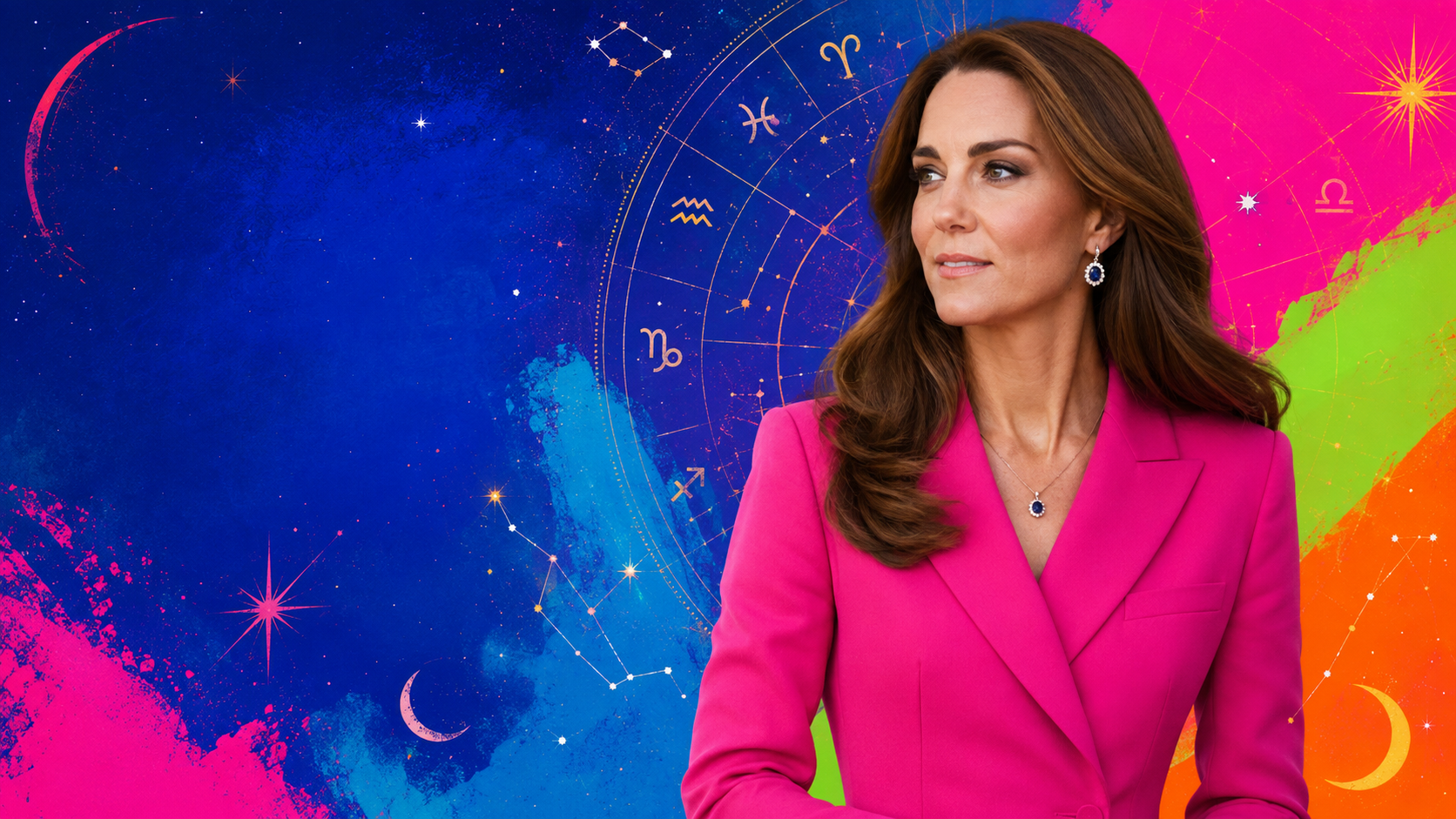
Some charts whisper their thesis. Catherine Elizabeth Middleton's announces it with the two brightest objects in the sky. Born on January 9, 1982, in Reading — a commoner, as the phrase goes, destined to become the first future queen consort born outside the aristocracy in over three centuries — the Princess of Wales arrived under a near-full moon: the Sun in Capricorn, the sign of institutions, duty, and the long climb, directly opposite the Moon in Cancer, the sign of home, mother, and the private hearth. After three consecutive charts in this series without a single opposition, hers opens with the largest one astrology can draw — the luminaries themselves, facing each other across the whole sky — and the axis they mark out is, almost verbatim, the axis of her entire public life: the crown on one side, the kitchen table on the other, and a woman who has spent a quarter of a century holding both ends at once.
And the Moon end of that axis is not merely placed — it is enthroned. The Moon sits at 14°21′ of Cancer, its own sign, fully dignified: the second Moon monarchy this series has encountered, after Theresa Caputo's, and the two could not wear the crown more differently. Hers is the mother's Moon at full constitutional strength — nurture as a native language, family as an organizing principle — in the chart of the woman whose defining royal project is literally called early childhood: the Royal Foundation Centre, the "Shaping Us" campaign, the patronages "centred," in the Palace's own words, "around providing children with the best possible start in life." When the future queen's public office turns out to be motherhood, institutionalized, and her chart turns out to be ruled in half by a dignified Cancer Moon, the astrologer's job reduces to pointing.
The other half of the government is rarer still — a configuration this series has never printed. Venus sits in Aquarius, Saturn's traditional sign. Saturn sits in Libra, Venus's sign — where Saturn is not merely comfortable but exalted, at its highest dignity in the whole zodiac. The two planets hold each other's houses: a mutual reception between the planet of grace and the planet of duty — grace and duty, exchanging keys, each ruling the other's kingdom, each unable to function without its counterpart. Duty, exalted in the sign of partnership: obligation perfected through relationship, protocol made beautiful, the institutional life conducted as a form of courtesy. If you wanted to design, from scratch, the astrological signature of a person who would make royal duty look like natural grace — and make grace function like constitutional duty — you would build exactly this, and you would place it exactly here.
Then the aspect that will headline this entry's records page: Venus square Jupiter at 0°06′. Six minutes of arc — the tightest aspect this series has ever printed, closer to exact than Theresa Caputo's 0°14′ Moon-Pluto. The two benefics — charm and abundance, the planets of everything pleasant — locked at a near-perfect right angle: grace, amplified under pressure to national scale. We'll come to what a benefic square does that a benefic conjunction doesn't; for now, note that the most-watched wardrobe on earth, the one that crashes retail websites within hours of an appearance, belongs to a woman whose Venus and Jupiter are welded together to within a tenth of a degree.
Three more headlines before we begin. Her singleton earth is the Sun itself — of eleven placements, exactly one sits in an earth sign, and it is her Capricorn identity: duty not as one trait among many but as the chart's only ground, the single anchor holding five air placements and a full water Moon to the floor. Her Venus is retrograde — the first retrograde Venus this series has met: the heart that reviews, takes its time, keeps love private and gets it right, in the chart of a woman who met her future husband at university in 2001 and married him a full, famously patient decade later. And her North Node sits in Cancer — the destiny point in the sign of home and family, seconding the Moon's motion: for this chart, the family is the fate.
A note on method: her circulated birth data is set to noon, so although house positions appear in the standard printouts, the Ascendant and houses can't be trusted at an unverified hour — we're setting them aside, as this series always does, and reading the planets purely by sign, degree, and aspect. As ever, the chart says plenty without them.
Let's begin on the axis.
The Full-Moon Axis: The Crown and the Kitchen Table
An opposition between the Sun and Moon means being born at or near the full moon — the two lights at maximum separation, each fully illuminated, neither able to hide from the other. People born under it carry a lifelong negotiation between two complete, legitimate selves; the signs name the parties, and hers could not be more starkly drawn. The Capricorn Sun is the institutional self: ambitious in the patient way, respectful of structures, willing to climb for decades, at home in hierarchy — the self that stood on the Westminster Abbey altar in 2011 and stepped, knowingly, into a thousand years of protocol. The Cancer Moon is the private self: the home-builder, the mother, the guardian of the family table — the self that bakes the birthday cakes herself (a detail the press never tires of), photographs her own children rather than commissioning it, and has fought, visibly and repeatedly, to give three royal children something approximating an ordinary childhood.
A full-moon chart never resolves this tension; it administers it, endlessly, and the administration is the life. What makes hers remarkable is how publicly the negotiation has been conducted and how skillfully: the school runs folded around state occasions, the family holidays defended against the diary, the entire modern reinvention of royal parenting that observers credit her with. The opposition also explains the chart's signature strength under its hardest test. When she announced her cancer diagnosis in early 2024, she did it in her own words, on her own timing, with her family's privacy held firmly at the center — then completed treatment and returned to duties with the same composure. That is the full-moon axis operating under maximum load: the Capricorn end enduring in public, the Cancer end protected in private, neither abandoned. The chart built for holding both ends held.
And note what the Sun is made of, structurally: it is the chart's singleton earth — the only placement in an earth sign among all eleven. A singleton absorbs enormous weight; it becomes the sole delivery route for its element's entire function. All of this chart's practicality, groundedness, and material follow-through must pass through one channel: the Capricorn identity itself. There is no auxiliary earth to delegate to. Duty is not something she does; per the chart's architecture, it is the only ground she stands on — which reads, in the biography, as exactly the steadiness three decades of public life have documented.
The Sun's hard aspects supply the pressure ratings. Sun square Saturn (2°56′) — and remember, this Saturn is exalted: the identity permanently examined by the highest-functioning version of institutional authority the zodiac can produce. Sun-Saturn squares mature early, feel watched always, and convert scrutiny into standards; hers has been conducted under the most sustained public gaze on earth, from the tabloid years of the courtship through every hemline analysis since. Sun square Pluto (7°54′) — wide, but astrology's oldest lesson about public women applies: the identity at hard angle to the planet of power and transformation, lived out as a life in which private matters (a pregnancy, an illness, a photograph) become matters of global speculation. And Saturn conjunct Pluto (4°59′), the two heavies fused in Libra, squaring her Sun together: the sheer weight of the institution she married into, pressing on the self — and the corresponding endurance, which the chart grants and the record confirms. This is the signature of a person built for load-bearing. It has been load-tested.
The Moon Monarchy: Motherhood as Public Office
Return now to the enthroned end of the axis, because half this chart's government sits there. A dignified Cancer Moon runs on care the way other Moons run on excitement or analysis: it nurtures reflexively, reads a room's emotional weather instantly, and organizes life around the protection of its people. In a private chart it makes a matriarch. In this chart it made a public office — because the great originality of her royal career has been the conversion of Cancer Moon values into national infrastructure: the Royal Foundation Centre for Early Childhood, the "Shaping Us" campaign on the first five years of life, the steady insistence — backed by convened scientists and published frameworks — that what happens at the family table in early childhood shapes the society decades later. Previous royal generations cut ribbons. Hers built an institution about mothering. That is what it looks like when a dignified Moon and a Capricorn Sun share one chart: the hearth, given a secretariat.
The Moon's aspects sketch the private cost and the private wealth. Moon square Mars (3°59′) — the tender heart at hard angle to a Mars in Libra, in its detriment: a drive that hates open conflict, in a square that guarantees the feelings will sometimes have to fight anyway. This is the aspect of the composure that costs something — the serene public face maintained over a genuinely sensitive interior, the steel that observers only occasionally glimpse and always remark upon. Moon square Saturn (7°29′) doubles the theme: the private heart, answerable to duty's schedule, feelings filed until the diary allows. And Moon trine Jupiter (7°07′) — the dignified Moon in flowing contact with the benefic, water to water — is the replenishment: emotional generosity that doesn't exhaust, the warmth the public reads as authentic because, per the trine, it is. Add the North Node in Cancer, seconding the Moon's whole program — the destiny point in the sign of home and family, with the South Node in Capricorn releasing the purely institutional path — and the chart's instruction becomes almost redundant: the fate runs through the family. She is the only person in Britain for whom that sentence is simultaneously an astrological reading and a constitutional fact.
Venus and Saturn: The Mutual Reception — Grace and Duty, Exchanging Crowns
Now the configuration that makes her chart structurally unique in this series. Mutual reception — two planets each occupying the other's sign — creates a standing alliance: the planets function as if conjunct, trading resources across the chart, each holding the other's seal. Hers joins Venus in Aquarius (grace, in Saturn's sign: charm conducted with reserve, style as discipline, warmth held at a composed distance) with Saturn in Libra (duty, in Venus's sign — and exalted there: obligation at its most refined, protocol as an art form, the institutional life conducted with courtesy as its operating system). Grace that behaves like duty; duty that presents as grace. Anyone who has watched a royal walkabout — the timed warmth, the perfect degree of engagement, the discipline underneath the ease — has watched this reception at work.
Saturn's exaltation in Libra deserves its own sentence, because the zodiac is specific about what it means: Saturn functions best in the sign of partnership — duty is perfected not alone but through relationship, commitment, the formal bond. In the chart of a woman whose constitutional role exists through marriage, whose duties are defined by partnership with the heir apparent, an exalted Libra Saturn is not a detail. It is the job, dignified.
And then there is the Venus itself: retrograde — the first retrograde Venus this series has encountered, and it could not belong to a more fitting biography. Venus retrograde loves privately, reviews before committing, distrusts the whirlwind, and takes the long road to the right answer. She met her future husband at St Andrews in 2001 — two art history students in the same first-year halls — and married him ten years later, in 2011, after a courtship whose patience became a national talking point. Venus retrograde does not experience that decade as delay. It experiences it as due diligence — and the outcome, a marriage now in its fifteenth year at the center of the monarchy's future, reads like the retrograde's closing argument. Mercury conjunct Venus (1°31′) in Aquarius gives the reception its voice — the gracious, measured public communication, warm but never unguarded — with Mercury and Venus both sextile Uranus (2°41′, 4°13′) supplying the modernizing instinct that has quietly updated everything from royal parenting to royal media, and Venus trine Mars (3°02′) smoothing charm and action into the effortless public choreography the cameras have documented for twenty years.
Venus Square Jupiter at 0°06′: The Six-Minute Square
The record-setter. Six minutes of arc — one-tenth of one degree — separates her Venus from exactitude with Jupiter: the closest aspect this series has ever printed, in any chart. And it joins the two benefics: the planet of charm and the planet of amplification, at a near-perfect right angle.
This series has now seen the benefic pair three ways, and the sequence is instructive. Theresa Caputo carried them conjunct in Leo — fused spectacle. Zohran Mamdani carried them conjunct in Virgo — fused thrift. She carries them square: not fused but dynamically coupled — grace and abundance in permanent creative tension, each escalating the other. A benefic conjunction is a gift that sits; a benefic square is a gift that works — it cannot leave itself alone, it amplifies compulsively, it turns every appearance into an event whether the owner intends it or not. There is a documented economic phenomenon named after her — the "Kate effect," the pattern by which a garment she wears sells out globally within hours, an influence analysts have valued in the billions — and it is this aspect, functioning exactly as a six-minute benefic square should: charm (Venus), involuntarily amplified (Jupiter) to market-moving scale, with the friction of the square supplying the compulsiveness of the effect. She has never once asked the dresses to sell out. The square doesn't require asking. Mercury square Jupiter (1°26′), nearly as tight, extends the amplification to the voice — every remark enlarged, every sentence a headline — which is the blessing and the tax of benefic squares in a public chart: nothing stays small. In this sky, even the pleasant things are load-bearing.
The Quiet Wiring: Sextiles of Endurance
Beneath the headline geometry runs a support grid worth naming. Saturn sextile Neptune (3°38′) — the duty planet in flowing contact with the planet of compassion and imagery: idealism made practical, service given form, the aspect of institutions built around care (an early-childhood foundation is nearly a textbook illustration). Neptune sextile Pluto (1°21′) — the long generational aspect, tightly configured here, linking imagination to depth. And Mercury trine Mars (4°33′) — the courteous voice with follow-through, air to air: the diplomat who actually ships. None of these makes headlines; together they explain the texture everyone describes — the sense of a public figure whose gentleness is organized, whose compassion arrives with logistics attached.
The Synthesis: The Steady Light
Read together, the chart resolves into the series' most architecturally balanced portrait. A full-moon sky, the crown and the kitchen table facing each other across it, administered for decades without either end dropping. A dignified Cancer Moon that turned mothering into a public institution, and a singleton-earth Capricorn Sun that made duty the only ground and then stood on it through everything — the scrutiny, the weight of an exalted Saturn fused to Pluto, and the hardest year of all, met with the privacy of the Moon and the endurance of the Sun in equal measure. A mutual reception this series had never seen, grace and duty holding each other's crowns. A retrograde Venus that took ten patient years to say yes and has not wavered in fifteen since. And a six-minute square between the two benefics, quietly moving markets every time she gets dressed.
If there is a single sentence this chart keeps writing, it is this: the institution and the family were never rivals — they were the two lights of one sky. Most public lives orbit one or the other. Hers was built, from the birthday onward, on the axis between them: the commoner's daughter who climbed Capricorn's whole mountain and then, from the top of it, spent her influence on the view from Cancer — the family table, the first five years, the photograph a mother takes herself. The future queen's chart, in the end, is not about the throne. It is about what the throne is for — and on that question, her sky has never once been ambiguous.
Frequently Asked Questions
What is Kate Middleton's zodiac sign?
Catherine, Princess of Wales, is a Capricorn Sun, born January 9, 1982 — the sign of duty, institutions, and the patient climb. Strikingly, her Sun is also her chart's singleton earth: the only earth placement in the entire sky, making the Capricorn identity the chart's sole practical anchor — duty not as a trait but as the ground itself.
What is Kate Middleton's Moon sign?
Her Moon is in Cancer — its own sign, fully dignified — the mother's Moon at full constitutional strength, and one of the two governing powers of her chart. It sits directly opposite her Sun (she was born near a full moon) and alongside her North Node, also in Cancer: home, family, and nurture written into both the emotional core and the destiny point.
What is Kate Middleton's rising sign?
From this data alone, we can't say. Her circulated chart is set to noon rather than a verified birth time, so the rising sign and houses can't be reliably calculated — an Ascendant changes roughly every two hours, and the house positions that appear in standard printouts of her data are artifacts of the noon placeholder. This reading sticks to signs, degrees, and aspects, which hold true regardless of the hour.
What is her "big three"?
With the noon-chart caveat on the rising sign, her confirmed two-thirds are Capricorn Sun and Cancer Moon — and they oppose each other at 4°33′: the full-moon axis, the institution and the home facing each other across the sky. It is the defining structure of the chart and, arguably, of the public life.
What does the Sun-Moon opposition mean in her chart?
Being born near a full moon creates a lifelong negotiation between two complete selves — and her signs name them precisely: the Capricorn institutional self that stepped into a thousand years of protocol, and the Cancer private self that bakes the children's birthday cakes and guards the family table. A full-moon chart never resolves the tension; it administers it — and three decades of balancing school runs against state occasions is that administration, conducted in public.
What in her chart explains the "Kate effect" on fashion?
Venus square Jupiter at 0°06′ — six minutes of arc, the tightest aspect this series has ever printed: the two benefics, charm and amplification, locked at a near-exact angle. A benefic square amplifies compulsively — it cannot leave anything small — which is why a garment she wears once can sell out globally within hours, an influence she has never once solicited. The square doesn't require asking.
What is the mutual reception in her chart?
Her Venus sits in Aquarius (Saturn's sign) while Saturn sits in Libra (Venus's sign) — each planet occupying the other's kingdom, functioning as permanent allies: grace that behaves like duty, duty that presents as grace. And her Saturn is exalted in Libra — obligation at its most refined, perfected through partnership — a fitting signature for a constitutional role that exists through marriage itself.
What's the rarest thing in her birth chart?
Four candidates. The Venus-Saturn mutual reception with Saturn exalted — grace and duty holding each other's crowns, a first for this series. The 0°06′ Venus-Jupiter square — the closest aspect the series has printed. The singleton-earth Sun — the identity as the chart's only ground. And the dignified Cancer Moon sharing rulership of the chart — the second Moon monarchy this series has met, worn here as motherhood made public office.
Is this reading based on her exact birth time?
No — and that's worth being transparent about. Her circulated data uses a noon placeholder time, so this analysis deliberately excludes houses and the Ascendant and reads only what's certain: planetary signs, degrees, and aspects. Even that partial picture tells a strikingly coherent story. A verified birth time would sharpen everything further — which is exactly why professional readings always begin by asking for yours.
Your Chart Is Waiting
Here's the thing: this entire reading came from a noon chart — no birth time, no houses, no rising sign. A fraction of the picture. Imagine what a full reading of your chart could reveal: your exact angles, your houses, your aspects and degrees, the whole architecture of your sky, walked through line by line. If this reading stirred something, that's usually the invitation.
Book your personal chart reading — and find out what was written in your stars.