Written in the Stars: The Synastry of Zohran Mamdani and Rama Duwaji, Love Inside the Public Frame
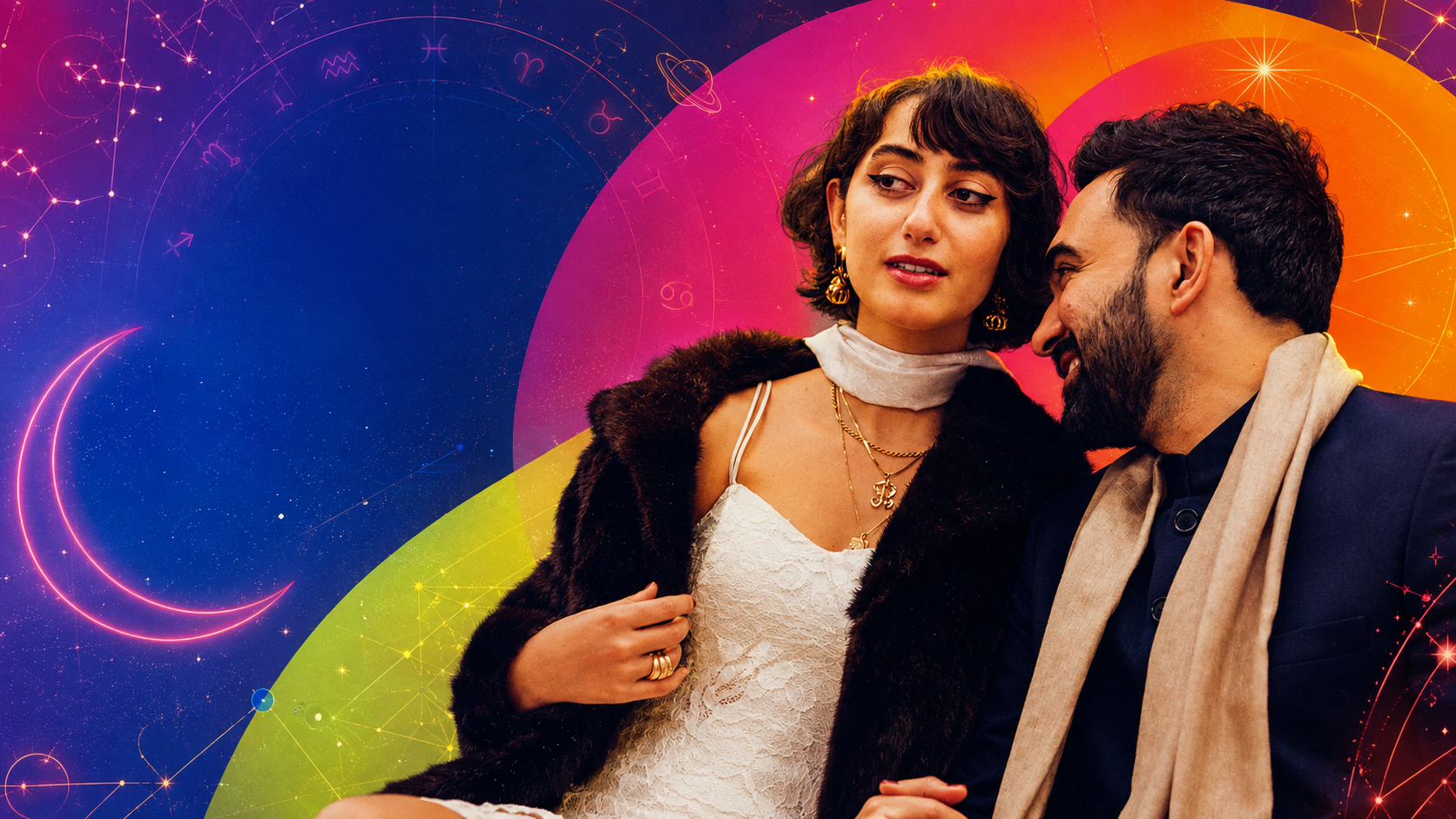
Zohran Mamdani and Rama Duwaji met on Hinge in 2021.
The detail became irresistible to the public once their relationship entered political history. A future mayor of New York City and a future first lady had found each other through the same ordinary digital ritual used by millions of people: a profile, a prompt, a decision to reply.
But the relationship existed before the title.
Duwaji was building a life as an illustrator, animator, and ceramicist. Mamdani was serving in the New York State Assembly and developing the organizing language that would eventually carry him into City Hall. They became engaged in 2024 and married in a civil ceremony at the New York City Clerk’s office in early 2025. Later that year, they celebrated with family in Uganda.
By January 2026, Mamdani had become mayor and Duwaji had entered the public category of “first lady”—a role capable of turning a marriage into civic imagery.
That transition changed the scale of the attention.
It did not create the relationship.
Their synastry reflects that distinction with unusual clarity.
The chart contains an aspect so exact that it functions almost like a signature:
Zohran’s Venus at 8°54′ Virgo sextiles Rama’s Sun at 8°56′ Cancer — an orb of approximately 0°02′.
Venus recognizes value.
The Sun describes identity.
At its simplest, this aspect says: I like who you are. I see something in your way of being that feels worth supporting, protecting, and appreciating.
That easy recognition is only the beginning.
Rama’s Venus in Leo falls directly into Zohran’s natal Mars–Saturn square. It squares his dignified Mars in Scorpio, opposes his dignified Saturn in Aquarius, and also squares his Mercury in Scorpio.
The relationship does not sit outside his ambition, discipline, public responsibility, or strategic drive.
Her Venus enters the engine room.
At the same time, Rama’s Cancer Sun and Mercury face Zohran’s Capricorn Uranus–Neptune–North Node concentration. Her identity and voice meet his institutional destiny cluster across the zodiac’s private–public axis.
The artist meets the organizer.
The personal frame meets the civic structure.
The private relationship becomes visible inside a public office capable of assigning meaning to every image.
Three structures carry the synastry:
An exact Venus–Sun sextile, giving the relationship a foundation of appreciation, recognition, and practical affection.
A cross-chart fixed T-square centered on Rama’s Venus, binding attraction to effort, limits, ambition, communication, and public responsibility.
A Cancer–Capricorn synastry axis, connecting Rama’s identity and voice to Zohran’s Uranus–Neptune–North Node cluster of reform, collective imagination, and institutional purpose.
This is not a synastry chart that promises effortless privacy.
It is a chart asking whether two people can remain recognizable to each other while the world turns their relationship into a symbol.
The central task is not escaping the public frame. It is preserving the human relationship inside it.
A Note About the Birth Times
Both charts in this reading use 12:00 noon placeholders, not verified birth times.
Zohran Mamdani’s chart is calculated for October 18, 1991, in Kampala, Uganda.
Rama Duwaji’s chart is calculated for June 30, 1997, in Houston, Texas.
Because neither birth time has been verified, this reading excludes:
Ascendants and Descendants
Midheavens and Imum Coeli
Houses and house overlays
Angle contacts
Composite houses
Claims based on house rulership or angularity
The Moon signs are more reliable than the exact lunar degrees.
Zohran’s Moon remained in Aquarius throughout his entire local birth date. The noon chart places it at approximately 23°26′ Aquarius.
Rama’s Moon remained in Taurus throughout her entire local birth date. The noon chart places it at approximately 19°37′ Taurus.
Their Moon signs are therefore secure.
The exact Moon degrees and every lunar interaspect remain provisional.
All non-lunar planetary contacts discussed below are sufficiently stable for a noon-chart synastry analysis.
The Synastry Architecture
Before interpreting individual contacts, it helps to see the relationship as a system.
Zohran’s natal chart is built around disciplined pressure.
His Mars in Scorpio squares Saturn in Aquarius within less than one degree. Both planets are traditionally dignified. Mars has strategic power; Saturn has structural authority. The natal square describes a lifelong negotiation between movement and limitation, insurgency and institution, private determination and collective responsibility.
Rama’s natal chart is organized differently.
Her chart feeds through a closed Sun–Moon–Venus dispositor circuit. Identity leads to feeling; feeling leads to art and value; art leads back to identity. Her Venus in Leo is not merely a relationship placement. It is one of the central planets through which the whole chart maintains authorship.
In synastry, Rama’s Venus enters Zohran’s Mars–Saturn square:
Zohran Mars square Rama Venus — 1°17′
Zohran Saturn opposite Rama Venus — 2°00′
Zohran Mercury square Rama Venus — 2°06′
This creates a fixed configuration across Scorpio, Aquarius, and Leo.
Fixed signs preserve, commit, intensify, and resist casual change.
The relationship can carry loyalty and durability.
It can also carry pressure.
Affection does not remain separate from schedules, campaigns, work, public obligations, creative authorship, or the terms under which each person retains independence.
Yet the synastry also contains unusually supportive contacts:
Zohran Venus sextile Rama Sun — 0°02′
Zohran Jupiter sextile Rama Sun — 1°46′
Zohran Sun trine Rama Jupiter — 3°13′
Zohran Mercury trine Rama Sun — 4°28′
Zohran Saturn trine Rama Mars — 4°53′
The chart is not held together by tension alone.
It contains recognition, encouragement, intellectual respect, and the capacity to turn pressure into coordinated action.
The relationship’s architecture is therefore not simply “easy” or “difficult.”
It is warm at the center and consequential at the edges.
Venus Sextile Sun at 0°02′: The Recognition Aspect
Zohran’s Venus is at 8°54′ Virgo.
Rama’s Sun is at 8°56′ Cancer.
The sextile is separated by approximately two minutes of arc.
This is the tightest stable personal interaspect in the synastry.
Venus describes affection, attraction, appreciation, pleasure, style, social ease, and the instinct to support what one values.
The Sun describes identity, vitality, authorship, and the right to occupy one’s own center.
When one person’s Venus supports the other person’s Sun, the Venus person tends to appreciate the Sun person’s natural way of being. The Sun person can feel received rather than constantly revised.
In Cancer and Virgo, the affection is not necessarily theatrical.
It is demonstrated through attention.
Virgo Venus notices details, remembers preferences, improves conditions, and often shows love through practical usefulness. Cancer Sun receives through care, continuity, emotional consideration, and the feeling that the private self has not been ignored.
The aspect is especially meaningful in this relationship because Duwaji’s public role could easily eclipse her individual identity.
She entered City Hall as an artist with an existing body of work, not as a blank civic symbol waiting to be styled by an administration.
The Venus–Sun sextile symbolically supports the preservation of that distinction.
Zohran’s Venus does not need Rama’s Sun to become an accessory. It is capable of valuing the person already occupying the frame.
The aspect can also support collaboration around aesthetics.
Virgo Venus appreciates craft and execution. Cancer Sun creates from memory, belonging, and emotional context. Together, they can recognize that visual communication is not decoration but a form of care.
The shadow of any easy aspect is assumption.
Appreciation can become so natural that it is left unspoken. Practical support can be offered when emotional recognition is what the moment requires. The relationship benefits when admiration remains explicit rather than merely implied through logistics.
Still, this contact is an unusually clear foundation.
Before politics, titles, ceremonies, and public projection, the synastry contains a simple statement:
He values her identity.
The Double Sun–Jupiter Pattern: Each Person Enlarges the Other
The synastry contains supportive Sun–Jupiter contacts in both directions:
Zohran Jupiter sextile Rama Sun — 1°46′
Zohran Sun trine Rama Jupiter — 3°13′
This creates a mutual encouragement pattern.
Jupiter expands, affirms, teaches, celebrates, and connects a life to a wider field of possibility.
The Sun needs room to become itself.
When Jupiter supports the Sun, the Jupiter person often sees potential in the Sun person and helps the identity imagine a larger future. The Sun person can make Jupiter’s beliefs feel embodied and personally meaningful.
Zohran’s Jupiter in Virgo supports Rama’s Cancer Sun.
This is encouragement through work, refinement, skill, and tangible development. His Jupiter may symbolically amplify her confidence in the usefulness and reach of her art—not by demanding that it become generic, but by helping it circulate, scale, or enter new structures.
Rama’s Jupiter in Aquarius trines Zohran’s Libra Sun.
Her Jupiter supports his coalition-oriented identity through social vision, unconventional networks, and the belief that collective structures can be redesigned.
This is not blind praise.
Virgo, Cancer, Libra, and Aquarius are all attentive to context. The support is strongest when it remains connected to actual work and shared values.
The double contact can help explain why the relationship appears capable of holding two distinct public trajectories.
One partner’s expansion does not automatically require the other’s contraction.
The synastry repeatedly says that growth can be mutual.
The risk is overextension.
Jupiter can enlarge commitments beyond available time, energy, or privacy. A couple already living inside a demanding public structure may encourage each other toward more work, more responsibility, and a wider field of concern than either nervous system can sustainably carry.
The relationship grows best when hope is paired with limits.
Rama’s Venus Completes Zohran’s Mars–Saturn Square
The most structurally important relationship pattern centers on Rama’s Venus at 2°21′ Leo.
Zohran’s Mars is at 1°04′ Scorpio.
Zohran’s Saturn is at 0°20′ Aquarius.
His Mars and Saturn form a natal square of approximately 0°44′.
Rama’s Venus:
Squares his Mars by 1°17′
Opposes his Saturn by 2°00′
Squares his Mercury by 2°06′
This turns his natal pressure pattern into a synastry T-square.
Mars Square Venus: Attraction With Friction
Mars–Venus contacts are among the most recognizable attraction signatures in synastry.
Mars initiates, pursues, asserts, and desires.
Venus attracts, receives, values, harmonizes, and decides what is worth moving toward.
The square produces energy through difference.
Zohran’s Mars in Scorpio is focused, strategic, private, and intense. Rama’s Venus in Leo is expressive, authored, warm, visible, and unwilling to let beauty become anonymous.
The attraction can be strong because each planet carries something the other lacks.
Mars supplies depth and determination.
Venus supplies radiance and creative confidence.
But the square requires negotiation.
Scorpio Mars may prefer privacy, control, and strategic timing. Leo Venus wants the personal style and affection to remain visible and wholehearted. One person may experience discretion as protection while the other experiences it as unnecessary containment.
In public life, the difference becomes especially consequential.
How visible should the partnership be?
Which events require joint appearance?
Which images belong to the office?
Which parts of the relationship remain personal?
The square does not provide one permanent answer.
It creates an active conversation.
Saturn Opposite Venus: Affection Meets Responsibility
Zohran’s Saturn opposes Rama’s Venus by approximately 2°00′.
Venus–Saturn contacts make relationships serious.
Saturn introduces time, responsibility, boundaries, duty, consequence, and the question of what can endure beyond the first phase of attraction.
The Saturn person may feel protective of the Venus person and responsible for the conditions surrounding the bond. The Venus person may experience Saturn as reliability, commitment, gravity, or—in difficult moments—evaluation and restriction.
In Leo and Aquarius, the polarity is between personal creative radiance and collective obligation.
Rama’s Venus wants authorship.
Zohran’s Saturn carries systems, institutions, and responsibility to the larger group.
The synastry asks whether the relationship can honor both.
A first lady role can place a person’s appearance, clothing, schedule, and public presence inside an institutional framework. Saturn in Aquarius represents the structure built for the collective; Venus in Leo insists that the individual style cannot be reduced to a function of the structure.
The opposition can become constricting when duty silently defines the terms of affection.
It becomes durable when boundaries are discussed and chosen.
Saturn must protect Venus without managing it. Venus must remain warm without treating every limit as a rejection.
Mercury Square Venus: The Message and the Aesthetic Do Not Always Agree
Zohran’s Mercury in Scorpio squares Rama’s Venus in Leo by approximately 2°06′.
Mercury speaks, interprets, edits, and names.
Venus decides what feels graceful, valuable, relationally appropriate, and aesthetically coherent.
The square can produce lively conversation, teasing, creative disagreement, and strong reactions to tone.
Zohran’s Scorpio Mercury is direct beneath the surface. It looks for the decisive point and may prefer language that cuts through ambiguity.
Rama’s Leo Venus is sensitive to authorship, dignity, presentation, and the emotional effect of how something is delivered.
A statement can be strategically correct and aesthetically wrong.
An image can be compelling and politically incomplete.
A joke can be clever and still land as disrespectful.
The relationship benefits from recognizing that content and presentation are not separate concerns.
For this couple, that lesson may extend beyond private communication into public messaging, campaign imagery, ceremonial presentation, and the way the marriage itself is narrated by others.
The Fixed T-Square: Love Inside the Engine Room
Together, Mars square Venus, Saturn opposite Venus, and Mercury square Venus create a fixed pressure system.
The configuration links:
Zohran’s strategic action
Zohran’s institutional responsibility
Zohran’s communication
Rama’s affection, aesthetics, values, and creative authorship
This is why the relationship cannot be interpreted as a decorative addition to a political biography.
Rama’s Venus becomes one of the places where Zohran’s natal conflict between movement and structure is personally experienced.
The relationship may repeatedly encounter questions such as:
How much should work determine the schedule?
When does public responsibility become private absence?
How can an artist retain authorship inside a civic image?
How should disagreement be expressed when both people understand the public consequences of a sentence?
Which sacrifices are temporary, and which would quietly become the permanent structure?
Fixed signs can survive pressure.
They can also preserve patterns after the original reason for them has passed.
The growth path is deliberate flexibility.
Not every logistical problem is a referendum on commitment.
Not every artistic boundary is opposition to the shared future.
Not every disagreement requires one person to surrender the position entirely.
The T-square becomes constructive when the relationship creates a third structure rather than forcing Venus to choose between Mars and Saturn.
That third structure may be explicit time for the marriage, protected creative independence, clear rules about public appearances, or a shared language for when the institution has begun taking more than either person agreed to give.
Mercury Opposite Neptune at 0°43′: The Message Meets the Dream
Zohran’s Neptune is at 14°07′ Capricorn.
Rama’s Mercury is at 14°51′ Cancer.
The opposition has an orb of approximately 0°43′.
This is one of the synastry’s most exact and symbolically important contacts.
Mercury governs thought, language, interpretation, information, and the way a person makes meaning.
Neptune governs imagination, idealization, image, sacrifice, collective longing, and the boundary between reality and projection.
Rama’s Mercury in Cancer communicates through memory, emotional context, cultural continuity, and the human detail that prevents a story from becoming abstract.
Zohran’s Neptune in Capricorn dreams through institutions.
It imagines what government, authority, and civic structure might become. It can perceive the symbolic power of office and the longing people project onto public leadership.
The opposition can be profoundly creative.
Rama may give language, image, or emotional specificity to a collective vision that might otherwise remain too abstract.
Zohran’s larger institutional imagination may open new contexts for her storytelling and expand the scale at which an image can operate.
But Mercury–Neptune also requires verification.
The partners may occasionally assume they understand each other because the emotional or ideological atmosphere feels shared.
A vision can be mistaken for an agreement.
A symbolic gesture can be interpreted as a literal promise.
A public narrative can become so compelling that it obscures the more complicated private conversation beneath it.
The antidote is not less imagination. It is clearer language around the imagination.
What exactly was agreed?
What belongs to the public role?
What was inferred rather than stated?
Which image represents a shared position, and which belongs to one person’s independent work?
The contact is especially sensitive because Rama’s Mercury also opposes Zohran’s North Node.
The message is not merely romantic.
It becomes developmental.
Mercury Opposite the North Node at 1°17′: Her Voice Meets His Direction
Zohran’s true North Node is at 13°34′ Capricorn.
Rama’s Mercury is at 14°51′ Cancer.
The opposition has an orb of approximately 1°17′.
Nodal contacts are often described too dramatically.
They do not prove fate, permanence, or a predetermined outcome.
They show where one person’s planetary function becomes entangled with the other person’s developmental direction.
Rama’s Mercury—her voice, visual storytelling, memory, and interpretive intelligence—faces Zohran’s Capricorn path toward institutions, authority, responsibility, and public structure.
Her way of seeing can challenge the direction of his public life.
It can humanize it, question it, document it, or insist that the institutional story remain accountable to lived experience.
His path can give her voice a larger civic context.
But it can also place pressure on that voice to represent more than it wishes to represent.
The relationship’s task is to preserve the distinction between influence and conscription.
A spouse can shape how a public figure sees.
That does not make every work of art an extension of the administration.
A mayor’s office can provide a new context.
That does not give the office ownership of the artist’s language.
The nodal opposition is strongest when her voice remains consequential precisely because it remains her own.
Uranus Opposite Sun at 1°16′: The Relationship Changes the Frame
Zohran’s Uranus at 10°12′ Capricorn opposes Rama’s Sun at 8°56′ Cancer by approximately 1°16′.
Uranus awakens, disrupts, liberates, accelerates, and breaks categories that have become too narrow.
The Sun describes identity and authorship.
Uranus–Sun contacts often accompany relationships that alter the expected life path.
The Uranus person introduces a future the Sun person had not organized in advance. The Sun person brings the Uranian impulse into a personal, embodied form.
For Rama, the relationship eventually connected her private artistic identity to a historic public role.
That is an objective change in frame.
The synastry does not say that the change erased the earlier identity.
It says the identity had to remain flexible enough to survive a rapid expansion of context.
In Cancer and Capricorn, the opposition emphasizes private belonging versus public institution.
Home versus office.
Emotional continuity versus historical disruption.
The relationship may create repeated changes in residence, schedule, security, visibility, or the practical boundary between domestic and civic life.
Uranus requires freedom.
The more the public role attempts to standardize Rama’s identity, the more important creative independence becomes.
The aspect stays alive when the relationship allows surprise without treating surprise as instability.
The Cancer–Capricorn Axis: Person, Office, Memory, Institution
Rama’s Cancer Sun and Mercury face Zohran’s Capricorn Uranus, Neptune, and North Node.
The exact contacts include:
Zohran Uranus opposite Rama Sun — 1°16′
Zohran Neptune opposite Rama Mercury — 0°43′
Zohran North Node opposite Rama Mercury — 1°17′
Zohran Uranus opposite Rama Mercury — 4°39′
Zohran North Node opposite Rama Sun — 4°38′
Zohran Neptune opposite Rama Sun — 5°12′
The Cancer–Capricorn axis is one of astrology’s clearest public–private polarities.
Cancer protects memory, belonging, family, home, culture, food, emotional continuity, and the private life that allows a person to remain human.
Capricorn builds institutions, offices, reputations, hierarchies, obligations, and structures meant to outlast the individual moment.
Neither side is superior.
A public institution without Cancer becomes inhuman.
A private world without Capricorn may struggle to protect itself through durable structure.
Their synastry makes this polarity relational.
Rama’s chart repeatedly asks what form can hold lived experience without flattening it.
Zohran’s chart repeatedly asks how collective vision can enter the machinery of government.
Together, the axis asks:
Can the institution become more human without turning the human relationship into institutional property?
This is one of the deepest themes of the pairing.
Mercury Trine Sun: His Mind Supports Her Identity
Zohran’s Mercury at 4°27′ Scorpio trines Rama’s Sun at 8°56′ Cancer by approximately 4°28′.
The contact is wider than the synastry’s tightest aspects, but it remains useful.
Mercury–Sun harmony supports recognition between one person’s thinking and the other person’s identity.
Zohran’s Scorpio Mercury looks beneath the surface and focuses on the point with the greatest strategic consequence.
Rama’s Cancer Sun understands emotional context, memory, and belonging.
Water signs communicate through depth rather than detachment.
The trine can support private understanding that is not always visible in public.
He may grasp why a personal or cultural detail matters even when it appears small to the larger audience.
She may understand the emotional motive beneath a strategic argument.
The risk is assuming that intuitive understanding eliminates the need for explanation.
Water-sign communication can become silent, indirect, or overly reliant on atmosphere.
The relationship becomes stronger when instinctive understanding is followed by explicit language.
Pluto Trine Mercury: Conversation Goes Beneath the Official Story
Zohran’s Pluto at 19°17′ Scorpio trines Rama’s Mercury at 14°51′ Cancer by approximately 4°26′.
Pluto intensifies whatever it touches.
With Mercury, conversation can become investigative, transformative, private, and psychologically consequential.
The partners may be capable of discussing subjects that other people avoid: power, grief, cultural rupture, public hostility, inherited history, political violence, ambition, and the emotional cost of being watched.
The trine allows depth to flow more easily than a hard Pluto contact would.
But it still requires care.
Insight is not ownership.
Understanding someone’s vulnerability does not create the right to use it strategically during conflict.
The healthiest expression is confidential honesty: a private space where the official narrative can be put down and the more complicated truth can be spoken.
The Double Jupiter–Pluto Square: Scale, Conviction, and Power
The synastry contains Jupiter–Pluto squares in both directions:
Zohran Pluto square Rama Jupiter — 1°59′
Zohran Jupiter square Rama Pluto — 3°51′
This is a mutual amplification pattern.
Jupiter expands belief, meaning, optimism, education, and social reach.
Pluto intensifies power, transformation, conviction, and the encounter with forces larger than individual preference.
Together, the planets can produce enormous ambition and a desire to make work matter at scale.
This is coherent with a relationship joining electoral politics and politically attentive art.
Both fields ask how ideas move through institutions, media, culture, and collective emotion.
The squares can support courage.
They can also create ideological escalation.
A disagreement may quickly become a debate about the meaning of the entire project, movement, or moral position. Each person may push the other toward a larger commitment before asking whether the larger commitment is sustainable.
Power and principle can become difficult to separate.
The relationship benefits from periodically reducing the scale.
Not every private decision has to represent the future of the city, the role of art, the meaning of marriage, or the ethics of public life.
Sometimes the correct scale is two people deciding how to spend an evening.
Saturn Sextile Pluto: The Capacity to Carry Weight
Zohran’s Saturn sextiles Rama’s Pluto by approximately 2°59′.
Saturn builds.
Pluto transforms.
The sextile supports sustained effort under conditions that would overwhelm a less structured connection.
This does not mean the relationship is invulnerable.
It suggests that both people may understand that significant work requires endurance, privacy, and a willingness to remain present through periods when the external circumstances are larger than personal preference.
The contact can support long projects, crisis management, and the ability to reconstruct routines after a major transition.
Its shadow is over-identification with difficulty.
A relationship can become proud of how much it can carry and forget that survival is not the only measure of health.
Strength should create room for rest.
Saturn Trine Mars: Coordinated Action
Zohran’s Saturn trines Rama’s Mars by approximately 4°53′.
Saturn gives form to Mars.
Mars gives movement to Saturn.
In Aquarius and Libra, the contact can support coordinated social action, planning, design, and work undertaken with awareness of the larger group.
Rama’s Mars in Libra understands composition and the relational consequences of action.
Zohran’s Saturn in Aquarius understands systems and collective structure.
The trine can help them organize an event, communicate a visual concept, maintain a schedule, or coordinate around public obligations without requiring both people to operate in the same way.
The danger is turning the relationship into a production team.
Efficiency cannot replace intimacy.
The same coordination that makes public life possible should also be used to protect time in which nothing has to be produced.
Sun Opposite Saturn: Identity and Duty Need Separate Seats
Zohran’s Sun at 24°29′ Libra opposes Rama’s Saturn at 19°30′ Aries by approximately 4°59′.
This is a wider but meaningful personal contact.
Sun–Saturn synastry can create respect, commitment, accountability, and a sense that the relationship carries real consequence.
It can also create inhibition.
The Saturn person may challenge the Sun person to become more defined, responsible, or independent. The Sun person may experience that as grounding or as criticism.
Rama’s Saturn in Aries asks for personal authority.
Zohran’s Libra Sun organizes identity through relationship, coalition, and the other side of the table.
The opposition asks that partnership not become an excuse for either person to avoid direct self-definition.
Rama cannot be reduced to “the mayor’s wife.”
Zohran cannot use the collective “we” to disappear from personal responsibility.
The mature expression gives both identity and duty a seat at the table.
The Noon-Moon Layer
Because both birth times are unverified, the lunar contacts must be interpreted separately from the stable synastry.
The Moon signs are secure.
Zohran is an Aquarius Moon.
Rama is a Taurus Moon.
Both are fixed signs.
The emotional systems therefore share loyalty, endurance, and resistance to being rushed into a response.
But they seek safety differently.
Aquarius Moon regulates through perspective, principle, social context, and enough distance to understand the larger pattern.
Taurus Moon regulates through consistency, physical comfort, sensory grounding, routine, and the assurance that the immediate environment is stable.
The signs form a square.
That sign-level tension is reliable even though the exact orb is not.
One partner may need space to think.
The other may need tangible reassurance that nothing essential is being removed.
One may move toward the group or the idea.
The other may move toward the body, home, food, object, or familiar ritual.
Neither method is inherently less emotional.
They process emotion through different stabilizing systems.
Noon Moon Square Moon — 3°48′
At noon, Zohran’s Aquarius Moon squares Rama’s Taurus Moon by approximately 3°48′.
The exact orb could change substantially with verified birth times.
As a provisional aspect, it suggests that emotional compatibility requires translation rather than assumption.
Aquarius may interpret steadiness as resistance.
Taurus may interpret distance as withdrawal.
The relationship benefits when each person names what regulation looks like before conflict begins.
Zohran Moon Conjunct Rama Jupiter — 2°10′
At noon, Zohran’s Moon conjuncts Rama’s retrograde Jupiter in Aquarius.
This can create emotional encouragement, humor, social optimism, and a sense that the relationship belongs inside a wider vision of community.
Rama’s Jupiter may help Zohran’s emotional system feel that the public future remains possible even during periods of pressure.
The aspect can also enlarge emotional commitments and social obligations.
Again, the exact orb remains provisional.
Zohran Pluto Opposite Rama Moon — 0°20′
At noon, Zohran’s Pluto opposes Rama’s Taurus Moon almost exactly.
This is the tightest calculated interaspect in the noon chart, but it cannot be treated as verified.
If present within a close orb, Moon–Pluto contacts intensify attachment, privacy needs, emotional transformation, and the sensitivity surrounding control or exposure.
For a couple living under public scrutiny, the symbolism is relevant.
The private emotional world may feel especially important because the external world repeatedly attempts to enter it.
The aspect’s mature expression is emotional honesty without coercion.
Its shadow is treating intensity as proof of truth.
Zohran Moon Sextile Rama Saturn — 3°56′
At noon, Zohran’s Moon sextiles Rama’s Saturn.
This can support emotional steadiness, reliability, and the capacity to remain present during stressful transitions.
Rama’s Saturn may help contain the scale of Zohran’s collective emotional field.
Zohran’s Moon may give social meaning to the responsibility Rama is carrying.
The exact degree remains birth-time dependent.
What the Relationship Does Well
The strongest supportive features are unusually coherent.
It recognizes identity
The exact Venus–Sun sextile supports appreciation of the person rather than only the role.
It expands both people
The double Sun–Jupiter pattern allows each person’s growth to stimulate the other.
It can translate vision into form
The Cancer–Capricorn contacts connect emotional narrative and artistic memory with institutional imagination.
It can work under pressure
Saturn–Pluto and Saturn–Mars contacts support endurance, coordination, and practical construction.
It takes the relationship seriously
Venus–Saturn and Sun–Saturn contacts resist casual treatment. The bond carries weight.
It can maintain two distinct vocations
The synastry does not require the artist to become the organizer or the organizer to become the artist. It asks them to understand the value of each other’s language.
What People May Misunderstand
The public may assume that Duwaji’s artistic role is secondary because Mamdani holds elected office.
The synastry does not support that simplification.
Her Venus is central to the relationship structure.
Her Sun receives the chart’s most exact affectionate contact.
Her Mercury sits directly across his Neptune–Node destiny cluster.
Her identity, aesthetics, and voice are not peripheral to the synastry. They are among its main organizing forces.
The public may also assume that a visually compelling couple image means the relationship itself is effortless.
The fixed T-square suggests otherwise.
This is a bond that may require substantial negotiation around time, privacy, work, responsibility, and independent authorship.
The pressure does not invalidate the affection.
The affection does not remove the pressure.
Both belong to the chart.
The Shadow Pattern
The relationship’s shadow emerges when the public structure becomes the silent third partner in every decision.
Zohran’s Saturn may define the terms before Rama’s Venus has been fully consulted.
Rama’s Venus may experience logistical limits as a judgment on her value or visibility.
Zohran’s Mars may treat a relationship question as a problem to solve strategically.
Rama’s Mercury may assume the emotional meaning is obvious when the practical agreement has not been stated.
The Mercury–Neptune opposition can allow symbolism to replace clarity.
The double Jupiter–Pluto square can inflate private disagreements into ideological contests.
The fixed Moon signs can preserve hurt after both people believe the subject has been resolved.
The shadow is not simply conflict.
It is role confusion.
Spouse, adviser, artist, mayor, first lady, collaborator, private citizen, public symbol, and representative can begin occupying the same conversation without anyone naming which role is speaking.
Growth requires separation.
Which question belongs to the marriage?
Which belongs to the office?
Which belongs to the artwork?
Which belongs to the public?
Which does not require an audience at all?
The Growth Path
The synastry grows through explicit authorship.
For Zohran, the work is allowing Saturn to create protection rather than control.
Public responsibility cannot become a permanent justification for emotional absence or unchosen sacrifice.
For Rama, the work is allowing Venus in Leo to remain visible without requiring every form of recognition to arrive through the relationship.
Her authorship is strongest when it remains connected to her own center.
For both, the work is using Mercury–Neptune consciously.
Shared vision must be translated into clear agreements.
Admiration should be spoken.
Boundaries should be named before the institution names them by default.
The fixed T-square needs flexible practices:
Protected private time
Clear expectations around public appearances
Independent professional space
Direct repair after conflict
Permission to revise an arrangement that no longer works
A shared understanding that privacy is not secrecy
A shared understanding that independence is not rejection
The exact Venus–Sun sextile is the chart’s guide.
Return to recognition.
Before the office, there was the person.
Before the civic image, there was the artist.
Before the public story, there were two people who chose each other.
The Final Portrait
Zohran Mamdani and Rama Duwaji’s synastry begins with one of the clearest affectionate contacts astrology can offer:
His Venus sextiles her Sun almost exactly.
He values the person.
She gives his values a living center.
Around that recognition, the chart builds a far more demanding structure.
Rama’s Venus enters Zohran’s Mars–Saturn engine, making affection inseparable from ambition, discipline, communication, and public responsibility.
Her Cancer Sun and Mercury face his Capricorn Uranus–Neptune–North Node cluster, placing the private person and the public institution across from one another.
Their Suns receive Jupiter in both directions, allowing growth to become mutual.
Their fixed signs give loyalty and staying power.
Their Mercury–Neptune opposition insists that shared ideals must be supported by clear language.
The relationship is not outside the public frame.
It has become part of the frame.
But the synastry does not ask them to perform the marriage until the performance replaces the people.
It asks for something more difficult:
to let the public role become meaningful without letting it become total.
The artist must remain the author of her image.
The organizer must remain personally accountable inside the collective “we.”
The marriage must be allowed to exist at a scale smaller than history.
Their chart does not promise that this balance will happen automatically.
It shows why the balance matters.
Love inside a public frame survives not because the frame disappears, but because the people inside it continue recognizing each other when the audience is no longer the most important presence in the room.
Principal Synastry Signatures
Time-stable contacts
Zohran Venus sextile Rama Sun — 0°02′
Zohran Neptune opposite Rama Mercury — 0°43′
Zohran Saturn conjunct Rama Neptune — 1°14′
Zohran Uranus opposite Rama Sun — 1°16′
Zohran North Node opposite Rama Mercury — 1°17′
Zohran Mars square Rama Venus — 1°17′
Zohran Jupiter sextile Rama Sun — 1°46′
Zohran Mars square Rama Neptune — 1°57′
Zohran Pluto square Rama Jupiter — 1°59′
Zohran Saturn opposite Rama Venus — 2°00′
Zohran Mercury square Rama Venus — 2°06′
Zohran Saturn sextile Rama Pluto — 2°59′
Zohran Sun trine Rama Jupiter — 3°13′
Zohran Mercury square Rama Uranus — 3°20′
Zohran Pluto sextile Rama North Node — 3°40′
Zohran Jupiter square Rama Pluto — 3°51′
Zohran Pluto trine Rama Mercury — 4°26′
Zohran Mercury trine Rama Sun — 4°28′
Zohran Sun square Rama Neptune — 4°37′
Zohran North Node opposite Rama Sun — 4°38′
Zohran Uranus opposite Rama Mercury — 4°39′
Zohran Saturn trine Rama Mars — 4°53′
Zohran Uranus square Rama Mars — 4°58′
Zohran Sun opposite Rama Saturn — 4°59′
Noon-based lunar contacts
Noon Zohran Pluto opposite Rama Moon — 0°20′
Noon Zohran Moon conjunct Rama Jupiter — 2°10′
Noon Moon square Moon — 3°48′
Noon Zohran Moon sextile Rama Saturn — 3°56′
The Moon signs are secure, but these exact lunar degrees and aspect orbs are provisional.
Frequently Asked Questions
Are Zohran Mamdani and Rama Duwaji astrologically compatible?
Their synastry contains a very exact Venus–Sun sextile, mutual Sun–Jupiter support, and several productive Saturn contacts. It also contains a fixed T-square centered on Rama’s Venus, showing that affection, ambition, work, boundaries, and public responsibility require active negotiation. The chart is supportive but not effortless.
What is the closest stable synastry aspect?
Zohran’s Venus sextiles Rama’s Sun within approximately 0°02′. This is an unusually exact contact associated with appreciation, attraction, and support for the Sun person’s identity.
What is the main challenge in their synastry?
Rama’s Venus squares Zohran’s Mars and opposes his Saturn, completing a fixed T-square. This can create strong attraction and commitment while also producing pressure around time, control, public duty, independence, and how affection is expressed.
Do their Sun signs work together?
Zohran is a Libra Sun and Rama is a Cancer Sun. These signs form a square by sign, so their identities approach life differently: Libra prioritizes relationship, balance, and coalition; Cancer prioritizes belonging, memory, and emotional continuity. Their exact charts add supportive contacts that help bridge the difference, especially Zohran’s Venus and Jupiter sextiling Rama’s Sun.
What are their Moon signs?
Zohran’s Moon remained in Aquarius throughout October 18, 1991. Rama’s Moon remained in Taurus throughout June 30, 1997. Both Moon signs are secure, but the exact degrees are based on noon placeholders.
Are their Moon signs compatible?
Aquarius and Taurus form a fixed square. Both signs are loyal and resistant to sudden emotional pressure, but Aquarius regulates through perspective and principle while Taurus regulates through consistency and sensory security. The pairing requires translation and respect for different emotional rhythms.
Is the Moon–Pluto opposition exact?
At the noon positions, Zohran’s Pluto opposes Rama’s Moon within approximately 0°20′. Because Rama’s birth time is unverified, the exact Moon degree is provisional. The aspect should not be presented as verified.
Are there important nodal contacts?
Yes. Zohran’s North Node opposes Rama’s Mercury by approximately 1°17′ and her Sun more widely. Her voice and identity interact with his developmental path toward public structure and institutional responsibility. Zohran’s Pluto also sextiles Rama’s North Node.
Can their rising signs or house overlays be interpreted?
No. Both charts use noon placeholders. Ascendants, houses, angles, house overlays, and composite houses are excluded.
What is the central theme of the relationship?
The central theme is preserving personal recognition inside a powerful public structure. The exact Venus–Sun sextile supports genuine appreciation, while the fixed T-square and Cancer–Capricorn axis require clear boundaries between marriage, vocation, art, office, and public symbolism.
Book a Relationship Astrology Reading
Synastry does not reduce a relationship to a compatibility score.
It shows how two complete charts interact: where recognition comes naturally, where attraction generates pressure, where emotional languages differ, and where the relationship asks both people to develop.
A complete relationship reading can explore:
Synastry between both natal charts
Communication and conflict patterns
Attraction and affection signatures
Saturn and long-term commitment contacts
Nodal developmental themes
Composite-chart dynamics when accurate birth times are available
Current transits affecting the relationship
Book a private relationship astrology reading with Lotus Astrology by Google Meet or in person.
Contact: https://www.lotusastrology.com/contact
Editorial Source Notes
Public biographical facts were checked against the existing Lotus Astrology birth-chart profiles for Zohran Mamdani and Rama Duwaji, along with reporting from Time, People, ABC News, Vogue, and Vanity Fair.
Key public reference points include:
The couple meeting through Hinge in 2021.
Their engagement in 2024.
Their civil marriage at the New York City Clerk’s office in early 2025.
Their later wedding celebration with family in Uganda.
Mamdani’s inauguration as mayor of New York City in January 2026.
Duwaji’s established career as an illustrator, animator, and ceramicist before entering the public role associated with her husband’s office.
The continued emphasis on Duwaji’s independent artistic identity.
Astrological interpretation is symbolic and editorial. It is not a factual claim about either person’s private feelings, motives, conflicts, or marital experience.